eBook - ePub
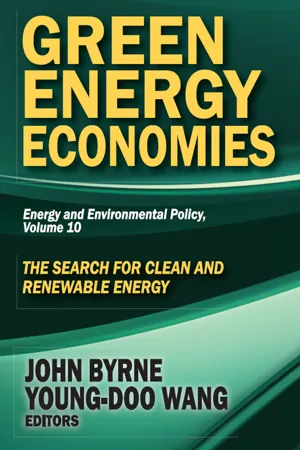
Green Energy Economies
The Search for Clean and Renewable Energy
- 381 pages
- English
- ePUB (mobile friendly)
- Available on iOS & Android
eBook - ePub
About this book
Green Energy Economies offers insight into the major drivers that are shaping a new future powered by clean energy sources. Assembling cutting-edge researchers as contributors, the book provides a comprehensive account of the shift underway, examining in detail the complexities and intricacies involved with such a transition. The book first details the promises and problems of a green energy transition. Next, it explores the economic benefits that a comprehensive strategy toward a green energy economy might create. Then it investigates how communities will be affected and explores the social, cultural, and other changes that are likely to result. Finally, it explores the shift toward new technologies in-depth. Green Energy Economies concludes with policy options that support a transition to a better energy, environmental, and economic future. The contributors argue that a green energy economy offers great promise, but its realization will require making hard choices, and soon. They argue for investments in renewable energy and economic systems that can deliver a sustainable and equitable future. This book makes a forceful case for a green future.
1
The Promise of a Green Energy Economy
Why a Green Energy Economy?
The role of the green energy economy in discussions of potential energy futures has steadily grown. The increasing awareness of—and importance given to—this option is exemplified by the United Nations Conference on Sustainable Development (UNSCD), which convened in Rio de Janeiro, Brazil, from June 20 to 22, 2012, where realizing a new economy fueled by green energy was identified as an essential prong in any strategy to alleviate worldwide poverty and promote sustainable development.1
The opportunity—and need—to transition to a new economy is highlighted in current economic- and climate-change challenges.2,3 The worldwide economic problems since 2008 underscore the need for a shift to alternative development pathways. A major case can be made for the green energy economy as a means to move away from current hardships, while providing methods of reducing dependence on finite energy resources as well as mitigating risks and harms associated with conventional energy sources such as climate change. The consequences of fossil-fuel use in terms of environmental and human-health effects are substantial. For instance, Epstein et al.4 estimate that the life-cycle social costs associated with coal use are between 10 and 28 cents/kWh. The low estimate of 10 cents/kWh corresponds to a cost of $700 billion annually. In short, transitioning away from the use of fossil fuel sources can further increase national income and prosperity by lowering the burden on healthcare services and environmental costs. While the scale and complexity of such a transition are daunting, many benefits can be accrued from a successful shift.
One of the major benefits can be rapid and broad-based job creation. The Energy Information Administration (EIA) forecasts that world energy consumption will increase by 53 percent between 2008 and 2035.5 In order to provide the necessary services on the basis of such forecasts, the modern energy paradigm focuses on increasing the use of conventional energy sources. Expanding and updating coal generation capacity has typically been the means of meeting the rising energy demand. Within this paradigm, there is an incentive for utilities to sell more, rather than less, electricity. While this approach might satisfy prevailing demands in the short run, it does little for long-term structural economic change or employment prospects. In fact, for every million USD invested in supplying fossil-fuel-based services, only four permanent jobs are created.6 Given the same level of investment, the number of permanent job increases is estimated to be three times higher when priority is given to photovoltaics (PV) and other renewable energy installations, and grows by a factor of four when resources are dedicated to the use of information and communication technology (ICT) for a smarter electricity grid and more intelligent transport.7,8,9 Additionally, every million USD invested in energy efficiency and conservation projects creates between twelve and fifteen permanent jobs.10 Green energy technologies—PV, wind, ICT, energy efficiency, etc.—offer a development pathway that is less fuel-intensive while requiring deployment of more human resources to build the transition. Such a pathway can substantially improve employment opportunities in the near term while enabling the change in energy infrastructure necessary to solve enduring threats of climate change and energy poverty (i.e., the large unmet needs of a large proportion of humanity living in the light shadow of industrialized economies).
Investment in a green energy economy can potentially establish the infrastructure of a new paradigm. While the modern energy paradigm relies on the “more is better” principle of development at the core of decision making, the new paradigm will focus on providing energy service needs while using far less energy. This means a new paradigm in which a narrative of “just sustainability”11 is at the core of decision making. Using fewer resources is hardly a recipe for social decline. In fact, research has shown that the “negawatt”12 (i.e., not consuming energy) in most cases costs one-half or less of the US price of retail electricity.13 Moreover, the high conversion and distribution losses associated with conventional energy production and consumption underscore the costliness and long-term risk of the energy status quo: every unit of end-use electricity saved through efficiency measures avoids production/consumption of three units of primary energy.14 The infrastructure of a green energy economy not only improves employment opportunities but also provides the same energy services to consumers with fewer resources so that social opportunity expands into the future. This is in marked contrast to the prevailing order whose use of more energy, drawing from non-renewable sources, can only promise higher costs and widening energy poverty. In brief, investing in green energy negawatts and renewable energy as a global strategy not only mitigates climate change (due to the use of fewer energy resources and, as a result, the release of fewer emissions) but also strengthens the resilience of economies throughout the world.
Of course, a transition to a green energy economy necessitates a substantial increase in production and consumption of certain things, for example, solar cell modules, wind turbine nacelles, and fuel cells. Some wonder whether this is realistic in terms of the scale, complexity, and needed level of commitment. A rapid shift from fossil-fuel resources toward a green energy economy can be accomplished on a timescale that is constrained only by the political will to realize the good. As Lester Brown notes, the shifts in engineering, manufacturing, and ways of daily life associated with the communications revolution of the last thirty years redefined the economic, cultural, and political ties of billions of people.15 The internet and mobile-phone infrastructures are examples of real-time rapid transformation that should warn skeptics who doubt the pace and scope of paradigm shifts.
Several countries recognize the promise of a green energy economy and are creating incentives to ensure that they are manufacturing tomorrow’s energy devices. China’s development strategy is an example: between 2006 and 2008, world solar cell production increased by 2,400 MW. In the same period, China expanded its share in the production of solar cells from 11 to 60 percent.16 Considering that the “green shift” will mean the production of thousands of gigawatts of solar and wind energy, China has positioned itself as a key designer and producer of the new era.17 Notably, countries committed to the production of new technologies will benefit not only their manufacturing industry—and thus, support their domestic job market—but also their national income and export prospects, and their ability to shape further innovation.
Driven by a technological paradigm of “more is better,” the modern energy system requires vast amounts of fuel to function. A parallel economic paradigm of “cornucopian”18 development completes the modern model of growth without limits. But the model has inescapable contradictions, which are especially evident in the contemporary period. One is political: when a society needs fossil-fuel imports to power its success—and the cornucopian impulse destines all moderns to eventually need imports—a political paradox is revealed. Smaller countries must sacrifice a measure of endogenous political control, while larger ones, not withstanding declarations of preference for democratic politics, quickly seek energy hegemony. Additionally, modern society—small or large—must embrace an environmental contradiction: the idea of “normal pollution.”19 Treating its natural surroundings as incidental to economic and energy needs is part and parcel of modernization. Spending the profits of economic growth on cleaning up (the premise of the “environmental Kuznets Curve”)20 will not erase the contradiction: as the ability to clean-up improves, the ability to risk more environmental calamity expands.21 The destiny of such a way of life is ever-expanding political and environmental insecurity.22
In contrast, green energy strategies use domestic energy resources, such as solar irradiation, reduce the length of the supply chain and can lower the risk of political dependence, security conflicts, and environmental harm. For this reason, a green energy economy can empower a politics controlled by domestic goals rather than international conflicts.
The “green shift” can also help in mitigating many of the environmental risks that we currently treat as inevitable. For example, energy and carbon obesity are interlocking features of the contemporary pursuit of happiness.23 Moderns are busily working on “green titan” strategies that can lower greenhouse gas emissions while fueling relentless economic growth,24 as though the cure for obesity is a greening of the unhealthy condition. If greenwash is to be averted, the new economy needs to enable a genuinely new direction, which we propose is a recovery of the commons foundation of economics. The “green” in the new economy is to be found in the energy commons of all economic activity. We will discuss this challenge below. But first, we would like to examine how and why what could be a solution to our problems has been resisted so strenuously for so many decades.
The Political Economy of Energy Transitions
A green energy economy could offer a considerable contribution to our problems. Its promise has been noted for at least thirty five years, since Amory Lovins mapped the “soft energy path.”25 Considering its known, significant potential compared to the contemporary “hard path”26 regime, proponents of change understandably regard the choice as obvious and the case for transition as plain. In essence, this position argues that the intrinsic qualities—from job creation, emission reductions, and energy security—are sufficient to engender the needed social change. The premise is that the green energy economy is virtually self-implementing. After waiting so long for a self-implemented soft path, we might finally reconsider the premise.
One factor in, if you will, the “blindness” of new economy advocacy is that it sees change via the lens of “technological niche”27 in which new technological capabilities and their potential benefits impel change. This perspective neglects the wider context of meso- and macro-level forces of order and change. The larger context, which includes macroeconomic considerations, macro-level political developments, cultural preferences, and the overall exogenous environment, offers a relationship dynamic that needs to be incorporated in any argument for social change.28,29 The overall structure of relationships between energy producers and consumers, the alignment of political and economic power, and the institutional, legal, and policy frameworks are considerations that can accelerate or inhibit social change, despite potential benefits or disadvantages of such change. In the evaluation of alternative energy futures and the promotion of change toward such futures, the structure of social valuation—the social dynamic that directs actions and establishes goals based upon its evaluation of their merit—is an essential element for analysis. In this vein, the key question that needs to be asked is the following: how does the structure of social valuation direct energy development and evaluate alternative energy futures?
At its core, the valuation of action and the setting of goals or targets are produced by the existing po...
Table of contents
- Cover
- Half Title
- Title Page
- Copyright Page
- Table of Contents
- Acknowledgments
- Part I: Promises and Threats
- Part II: The Economic Opportunity
- Part III: The Need for New Communities
- Part IV: Changing the Technology Base
- Part V: Policy Agenda
- Index
Trusted by 375,005 students
Access to over 1.5 million titles for a fair monthly price.
Study more efficiently using our study tools.
Frequently asked questions
Yes, you can cancel anytime from the Subscription tab in your account settings on the Perlego website. Your subscription will stay active until the end of your current billing period. Learn how to cancel your subscription
No, books cannot be downloaded as external files, such as PDFs, for use outside of Perlego. However, you can download books within the Perlego app for offline reading on mobile or tablet. Learn how to download books offline
Perlego offers two plans: Essential and Complete
- Essential is ideal for learners and professionals who enjoy exploring a wide range of subjects. Access the Essential Library with 800,000+ trusted titles and best-sellers across business, personal growth, and the humanities. Includes unlimited reading time and Standard Read Aloud voice.
- Complete: Perfect for advanced learners and researchers needing full, unrestricted access. Unlock 1.5M+ books across hundreds of subjects, including academic and specialized titles. The Complete Plan also includes advanced features like Premium Read Aloud and Research Assistant.
We are an online textbook subscription service, where you can get access to an entire online library for less than the price of a single book per month. With over 1.5 million books across 990+ topics, we’ve got you covered! Learn about our mission
Look out for the read-aloud symbol on your next book to see if you can listen to it. The read-aloud tool reads text aloud for you, highlighting the text as it is being read. You can pause it, speed it up and slow it down. Learn more about Read Aloud
Yes! You can use the Perlego app on both iOS and Android devices to read anytime, anywhere — even offline. Perfect for commutes or when you’re on the go.
Please note we cannot support devices running on iOS 13 and Android 7 or earlier. Learn more about using the app
Please note we cannot support devices running on iOS 13 and Android 7 or earlier. Learn more about using the app
Yes, you can access Green Energy Economies by John Byrne,Young-Doo Wang in PDF and/or ePUB format, as well as other popular books in Economics & Environmental Economics. We have over 1.5 million books available in our catalogue for you to explore.