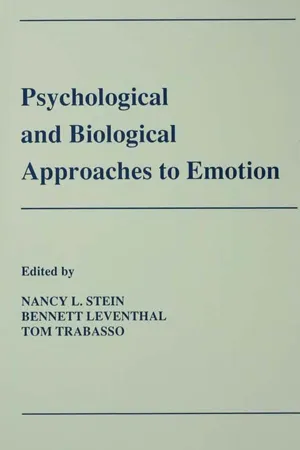
The outgrowth of a University of Chicago conference on the psychological and biological bases of behavior, this unique collection of papers integrates the biological consideration of emotion with current psychological approaches. As such, it includes studies of the coping process associated with emotion as well as those that focus on the appraisal process giving rise to emotion. The book approaches emotion from cognitive, developmental, and biological systems and psychopathological perspectives. Theories on the cognitive, biological, and developmental bases for interpreting, representing, and reacting to emotional situations are proposed. In addition, new studies on issues and questions regarding the roles of cognition, language, brain lateralization, socialization, psychopathology, and coping with affect are presented.
eBook - ePub
Psychological and Biological Approaches To Emotion
- 456 pages
- English
- ePUB (mobile friendly)
- Available on iOS & Android
eBook - ePub
Psychological and Biological Approaches To Emotion
About this book
Information
I
RELATIONSHIPS BETWEEN COGNITION AND EMOTION
1 | Constructs of the Mind in Adaptation |
Richard S. Lazarus
University of California, Berkeley
University of California, Berkeley
Some years ago, when I was thinking about cognitive appraisal as a central process in emotion, I realized that the cognitive revolution in psychology did not create new constructs with which to understand the human mind but only changed the definition and arrangement of old constructs. The basic theoretical entities of psychology have always consisted of motivation, emotion, and cognition, each of which describes different functions of mind. In an interesting discussion of the origins of faculty psychology, Hilgard (1980) has referred to these as the “trilogy of the mind.” To these constructs we must add two other sets of variables, namely, actions and the environmental stimulus array, making a total of five concepts to juggle in our theories of emotion and behavior.
This presentation is an attempt to discuss the relationships among these constructs within a cognitive and relational approach to emotion and human functioning, and to elaborate somewhat on what I have said previously about the cognition-emotion relationship (Lazarus, 1966, 1980, 1982, 1984; Lazarus & Folkman, 1984; Lazarus, Kanner, & Folkman, 1980; Lazarus & Launier, 1978.
In the 1940s and 1950s Freudians and reinforcement learning theorists emphasized drives and placed them early in the stimulus-organism-response (S-O-R) sequence. These theories also gave relatively little attention to cognitive mediation. Drives that were in conflict or blocked from discharge produced tension or anxiety that was reduced by adaptive or ego-defensive behavior learned through the principle of reinforcement. Ego psychologists came along later to once again give prominence to cognition.
WHAT IS A COGNITIVE-RELATIONAL THEORY OF EMOTION?
Renewed interest in cognition returned us to a position that had been well articulated as long ago as Aristotle (1831), who suggested that people are made angry by the thought that they have been insulted or demeaned. Mainstream psychology has once again resurrected cognition—like the Biblical Lazarus—in the form of judgments, expectations, attributions, or appraisals of the significance of what is happening for well-being. German Action Theory, which Frese and Sabini (1985) define as a conception of human behavior directed toward the accomplishment of goals, governed by plans that are hierarchically arranged, and responsive to feedback from the environment, is a good example.
Psychology has also turned from structural S-R and complex S-O-R formulations toward a systems approach that focuses on temporal relations and the flow of behavior involving many interdependent variables and processes (see also McGuire, 1983). A systems arrangement of variables and processes in emotion is portrayed in Fig. 1.1 (cf. Lazarus, DeLongis, Folkman, & Gruen, 1985; Lazarus & Folkman, 1984). Here the stimulus is buried in a person-environment transaction, still important but only in relationship with person characteristics. Cognitive appraisal and coping are the key mediators of emotion. Motivation, which comprises means, ends, and cognitive concerns, as well as drives, is identified as goals in this system. They are antecedent variables that interact with personal beliefs and environmental events in shaping appraisal and coping. The system is in constant flux, and because it is recursive (see also Bandura, 1977) any variable is capable of being either an antecedent, a mediating process, or an outcome, depending on the point in time at which one enters the flow.

FIG. 1.1. Cognitive and Relational Theory.
Very briefly stated, this approach to emotion contains two basic themes: First, emotion is a response to evaluative judgments or meaning; second, these judgments are about ongoing relationships with the environment, namely, how one is doing in the agenda of living and whether an encounter with the environment is one of harm or benefit. One's goal hierarchy, or what is most and least important to the person, and the specific external conditions of an encounter determine the potential for harm or benefit.
Acute emotions such as anger, fear, joy, and pride are reactions to specific encounters of the moment. The term acute means they are short-lived and can be distinguished from longer term emotions called moods. Moods too are based on judgments about the significance of the person-environment relationship, but their concerns are broader, longer term, and more existential than acute emotions. Each emotion, whether acute or a mood, expresses the particular harm or benefit that is cognized to be at stake in an ongoing relationship with the environment, and the action impulse such as attack or flight that addresses the harm or benefit.
The transactional themes of meaning and relationship are expressed theoretically in the concepts of cognitive appraisal (cf. Lazarus, 1966, 1981; Lazarus & Folkman, 1984; Lazarus & Launier, 1978) and coping (Folkman & Lazarus, 1980, 1985; Folkman, Lazarus, Dunkel-Schetter, DeLongis, & Gruen, 1986a; Folkman, Lazarus, Gruen, & DeLongis, 1986b; Lazarus & Folkman, 1984). Primary appraisal concerns whether what is happening in a relationship is relevant for one's well-being. This is assessed as the stakes one has in an encounter. Secondary appraisal concerns the options and resources for coping with problematic relationships.
Coping is important in the emotion process because it can change the significance for well-being of what is happening in the encounter in one of two ways: (1) by actions that alter the actual terms of the person-environment relationship, or (2) by cognitive activity that influences either the deployment of attention (e.g., by avoidance) or the meaning of the encounter (e.g., denial or distancing). The second process (2) has also been referred to as emotion-focused coping, whereas the first (1) is problem-focused coping (e.g., Folkman & Lazarus, 1980; Lazarus & Folkman, 1984). Throughout the remainder of this presentation I use the term cognitive coping for the latter because emotion-focused coping is essentially a cognitive process.
Many theorists and researchers accept the premise that adult human emotion can best be understood in cognitive terms. There is now what could be said to be a family of theories that have a cognitive-relational emphasis. Explicitly cognitive formulations of emotion theory have been offered by Arnold (1960), Averill (1982), Bandura (1977, 1982), Epstein (1983), Leventhal (1984), Mandler (1984), Roseman (1984), Scherer (1984), Solomon (1980), Weiner (1985), and in the clinical context, Ellis (Bernard & DiGiuseppe, in press) and Beck (1976). Most of these provide limited and incomplete statements of the details of the emotion process. Although they vary in emphasis and detail, all accept the idea of cognitive mediation in emotion. This is not the place to examine the overlaps and variations among them or to explore the historical origins of the cognitive theme in emotion theory.
The term appraisal has been adopted by a large number of writers, though it is often used imprecisely. My colleagues and I distinguish between information and appraisal, which refers to an evaluation of the significance of information for personal well-being and action (cf. Kreitler & Kreitler, 1976).
The task of cognitive appraisal is to assimilate two sometimes contradictory sets of forces operating in a person's transactions with the environment: the goals and beliefs brought to the scene by the person and the environmental realities that affect the outcome of the transaction. This process of assimilating these two sets of forces must not go overboard in either direction: To overemphasize personal agenda is autism and to overemphasize the environment is to abandon one's personal identity. Survival would be impossible if appraisals were constantly in a bad fit with the environmental realities. It would be equally in jeopardy if we failed to take personal stakes into account in our appraisals. As Ellis (Ellis & Bernard, 1985; see also Lazarus, in press-a) and other cognitivists (e.g., Beck, 1976) have long maintained, consistently faulty ways of thinking (or appraising) lead to persistent emotional distress and social dysfunction.
CURRENT CONTROVERSIES
Although few seem to challenge that appraisal can affect emotional quality and intensity, current controversies tend to focus on two closely intertwined questions: (1) Is appraisal necessary for emotion, which means that if appraisal of a harm or benefit does not occur, emotion does not occur? Connected with this we must consider whether there are exceptions to the principle that appraisal is always necessary, for example, in the case of infants or animals; (2) regardless of how the issue of whether appraisal is a necessary or sufficient condition of emotion is resolved, should cognition and emotion be regarded as separate processes, or as indissolubly bound together and only separated with difficulty or in psychopathology? This is quite a different matter than the status of appraisal, though those who tend to separate emotion from cognition seem also to favor a “no” answer to the claim that there is no emotion without appraisal.
Are Emotion and Cognition Separate Systems?
Beginning with the second issue, the separatist position has recently been debated by Zajonc (1980, 1984) and by me (Lazarus, 1982, 1984). Zajonc's position appealed to many because of the argument, which I regard as erroneous, that cognitive theories leave emotion bloodless and cold by subsuming it under thought. As Tomkins (1981) put it using the images of Shakespeare: “a remedy [is needed] for affect ‘sicklied o'er with the pale cast of thought’” (p. 306). The notion that cognitive theories take the heat out of emotion is encouraged by the imprecise equation of emotion and cognition as illustrated by Solomon's (1980) comment that “emotions are akin to judgments” (p. 271), or Sartre's (1948) statement, taken out of context, that “Emotion is a certain way of apprehending the world” (p. 52).
Perhaps the best reply to Zajonc on this, and to those who share his view, is that emotion is both based on and contains cognitive activity, but it also includes other hot components such as action impulses and physiological changes that these action impulses generate when there is temporary or sustained mobilization to deal with harms, threats, challenges, or benefits. To emphasize cognitive activity in the generation of an emotion is not to equate emotion with cold cognition.
Zajonc argued that there are separate anatomical brain structures for emotion and cognition and, therefore, that emotion could precede cognition as well as the other way around. This position is especially appealing to those who think of emotion as a hard-wired, innate process. Separatists also tend to reduce mental activity to neurophysiological processes. Reduction leaves an unresolved mind-body problem in which key mental concepts such as appraisal and coping are not adequately mapped by concepts at the body level. This lack of parallelism makes the two levels of analysis, neurophysiological and psychological, difficult to connect in a meaningful way. It is also risky to make a decision about psychological concepts on the basis of what we currently know about the anatomy and physiology of the brain (see also Burghardt, 1985).
Although thought and emotion are normally conjoined, they can, of course, be kept apart, as in what is clinically referred to as defenses such as distancing, isolation, depersonalization, repression, denial, or dissociation. I like the term disconnection. We think of defensive processes as pathological or pathogenic, the result of intentional effort at regulating distressing emotions. When people use them, they are said to be out of touch with their emotions and with the environmental conditions influencing them. However, it is one thing to say that separation is possible under certain conditions and another thing to say that it is normative.
Dissociation theories of hypnosis, for example, imply the splitting of sensory and other mental processes, suggesting that a single, central, cognitive control process is not always firmly in the saddle (cf. Ahsen, 1985). However, when splitting occurs there is still some degree of mutual awareness of interaction among split thoughts and images in the normal waking state. Thus, all such dissociations are relative rather than absolute if care is taken to detect interactions (Hilgard, 1975, 1977).
To give the separation between motivation, cognition, and emotion the status of a biological principle is to turn the mind, which is usually coordinated and directed, into an uncoordinated arrangement in which each function operates on its own. This can also be a dysfunctional arrangement. Instead we should be seeking the organizing principle or principles that make the components of the mind a unit, operating in harmony with the adaptational requirements of the environment and the personal agenda that create the story lines of our lives.
The case for the normal integration of the constructs of the mind requires qualification. For example, mental development involves gaining gradual freedom from the concrete environmental stimulus and from the tyranny of drives or impulses in action. At the same time, however, development brings with it increasing integration of the components of the mind. Cognition, emotion, and motivation become welded into a system that, though under tension, must remain in touch with the environment and in control of actions in the interests of allowing the person to survive and flourish. The links between action and the demands, constraints, and resources of the environment, as well as the structure of the mind, are forged and changed developmentally and dialectically by continuous adaptational transactions (Block, 1982; Fischer & Pipp, 1984; Piaget, 1952). This is, of course, a Piagetian or formal structural view, but the appraisal process also depends on content in the form of information about how things work and on-the-spot evaluations of the significance for well-being of what is happening. What children know about social relationships and the consequences of their actions is crucial to an understanding of their appraisal processes in emotional encounters.
Disconnection refers to a condition in which the components of the mind are responsive to divergent influences and generate contradictory actions. For example, what the person thinks may be out of touch with the emotions that are experienced or the motives that shape action. Epstein (1985) makes a similar point in citing cases in which “the person does not ‘feel’ like doing what intellectually he or she ‘thinks’ should be done; the person may state … ‘I made myself do it’” (p. 288). Epstein emphasizes that an overall self attempts to integrate various subselves, but when there is complete insulation among the subsystems there is psychopathology. Schwartz (1979) seems to mean something similar by his term disregulation to refer to the loss of communication among the parts of the brain, which allows the normally integrated system of feedback loops to go out of control.
For the opposite of disconnection to occur, short-term goals must be in harmony with long-term goals and contribute to them as means to ends. Conflict among goals is obviously disruptive of harmony and results in the system components pulling apart rather than working together. Motivation must accord with (cognitive) understandings of what is possible, likely, reasonably safe, properly timed, properly sequenced. Emotions must be accurate reflections of the significance of encounters for well-being. All conflict theories of psychopathology treat this as a basic assumption. Integration is a common term for harmony and fragmentation or ego-failure for disharmony (cf. Haan, 1969, 1977; Menninger, 1954).
Is Appraisal Necessary?
I favor a yes answer to the first question (1), which asks whether appraisal is necessary to emotion. For the garden variety of human emotions, no other principle of emotion-generation is necessary. Given what evidence is available, the burden of proof of another mechanism rests on anyone who would so claim. A statement by Sartre (1948) points up the essential connection of emotion and cognition as convincingly as any I have seen:
It is evident, in effect, that the man who is afraid is afraid of something. Even if it is a matter of one of those indefinite anxieties which one experiences in the dark, in a sinister and deserted passageway, etc., one is afraid of certain aspects of the night, of the world. And doubtless, all psychologists have noted that emotion is set in motion by a perception, a representation-signal, etc. But it seems that for them the emotion then withdraws from the object in order to be absorbed into itself. Not much reflection is needed to understand that, on the contrary, the emotion returns to the object at every moment and it's fed there. For example, flight in a state of fear is described as if the object were not, before anything else, a flight from a certain object, as if the object fled did not remain present in the flight itself, as its theme, its reason for being, that from which one flees. And how can one talk about anger, in which one strikes, injures, and threatens, without mentioning the person who represents the objective unity of these insults, threats, and blows? In short, the affected subject and the affective object are bound in an indissoluble synthesis. Emotion is a certain way of apprehending the world. (pp. 51–52)
Expanding on Sartre, I offer the following m...
Table of contents
- Cover Page
- Half Title Page
- Title Page
- Copyright Page
- Contents
- Overview
- Part I: Relationships Between Cognition and Emotion
- Part II: Biological Perspectives to Emotion
- Part III: Developmental Perspectives on Emotion
- Part IV: Coping and Psychopathology
- Part V: System Approaches to Emotion
- Author Index
- Subject Index
Trusted by 375,005 students
Access to over 1.5 million titles for a fair monthly price.
Study more efficiently using our study tools.
Frequently asked questions
Yes, you can cancel anytime from the Subscription tab in your account settings on the Perlego website. Your subscription will stay active until the end of your current billing period. Learn how to cancel your subscription
No, books cannot be downloaded as external files, such as PDFs, for use outside of Perlego. However, you can download books within the Perlego app for offline reading on mobile or tablet. Learn how to download books offline
Perlego offers two plans: Essential and Complete
- Essential is ideal for learners and professionals who enjoy exploring a wide range of subjects. Access the Essential Library with 800,000+ trusted titles and best-sellers across business, personal growth, and the humanities. Includes unlimited reading time and Standard Read Aloud voice.
- Complete: Perfect for advanced learners and researchers needing full, unrestricted access. Unlock 1.5M+ books across hundreds of subjects, including academic and specialized titles. The Complete Plan also includes advanced features like Premium Read Aloud and Research Assistant.
We are an online textbook subscription service, where you can get access to an entire online library for less than the price of a single book per month. With over 1.5 million books across 990+ topics, we’ve got you covered! Learn about our mission
Look out for the read-aloud symbol on your next book to see if you can listen to it. The read-aloud tool reads text aloud for you, highlighting the text as it is being read. You can pause it, speed it up and slow it down. Learn more about Read Aloud
Yes! You can use the Perlego app on both iOS and Android devices to read anytime, anywhere — even offline. Perfect for commutes or when you’re on the go.
Please note we cannot support devices running on iOS 13 and Android 7 or earlier. Learn more about using the app
Please note we cannot support devices running on iOS 13 and Android 7 or earlier. Learn more about using the app
Yes, you can access Psychological and Biological Approaches To Emotion by Nancy L. Stein,Bennett Leventhal,Thomas R. Trabasso in PDF and/or ePUB format, as well as other popular books in Psychology & History & Theory in Psychology. We have over 1.5 million books available in our catalogue for you to explore.