Learning to Plan Modern Languages Lessons contains a wealth of guidance and ideas for those learning to teach in secondary schools. Drawing on extensive experience and research in the field, it offers detailed explanation of basic lesson planning methods and the principles that underpin them, illustrated by worked examples of well-planned lessons.
The book shows how to progress from planning smaller activities to full lessons to sequences of lessons, and how to ensure progression for your students. Specific aspects of language learning such as grammar and culture are explored, together with ideas for how to make your planning skills more effective in long-term collaborative and reflective practice. Starting from a presentation, practice, production (PPP) model of language teaching, the book aims to:
provide structured, practical starting points in lesson planning for beginning teachers of modern languages (ML);
deepen knowledge and understanding of ML as a subject and how it is learnt (pedagogical subject knowledge), in order to inform and support planning decisions;
develop understanding of lesson planning as part of a planning cycle;
enhance understanding of strategies and professional development opportunities to promote the further development of planning abilities.
Including reflective/discussion tasks and example lesson plans Learning to Plan Modern Languages Lessons is a must-read book for beginning and more experienced teachers of any modern language.
The context for this part of the book is the early stages of the ITE period, when beginning teachers are getting their first teaching experiences in the classroom or working with pupils in small groups outside the classroom.
Beginning teachers are introduced to a bank of skills and activities that they can try out for themselves in the early stages. Based on the PPP model, the broad aim here is to develop understanding of how these basic ingredients might contribute to language learning and to consider implications for planning.
Chapter 1 focuses on the skills of drilling and TL modification. Chapter 2 then looks in detail at a sample of ten activities, some of which incorporate those skills, covering different phases of the PPP model.
CHAPTER
1
Basics done well
I have chosen to focus here on the skills of drilling and TL output modification. In my view, these skills are worth learning because they can both, in different ways, add to the quality of learning in any ML classroom. You can expect to use them in most, if not all, of your language lessons.
I have included them here because both of these skills depend in the first instance on careful planning. Especially during the early days of learning to teach, this can involve very deliberate and detailed planning of short episodes that might take just a few minutes or even seconds of classroom time to deliver. The planning involved might seem very time consuming but please don’t be disheartened by this. With practice this planning will become easier and the delivery of these skills in the classroom will become more automatic.
Drilling
Within the context of the ML classroom drilling goes hand-in-hand with repetition of key language that we want pupils to learn; drilling usually comes in short intense bursts. The point of drilling is to provide learners with repeated exposure to the same, selected language and the opportunity to repeat that language for themselves. Repetition is a necessary part of language learning; it helps pupils to memorise and internalise language input: how to say it, what it means, plus any salient grammatical or formal features of the language, such as gender. Even the most capable and talented linguists benefit from hearing the same structures many times and repeating to themselves new language that they come across.
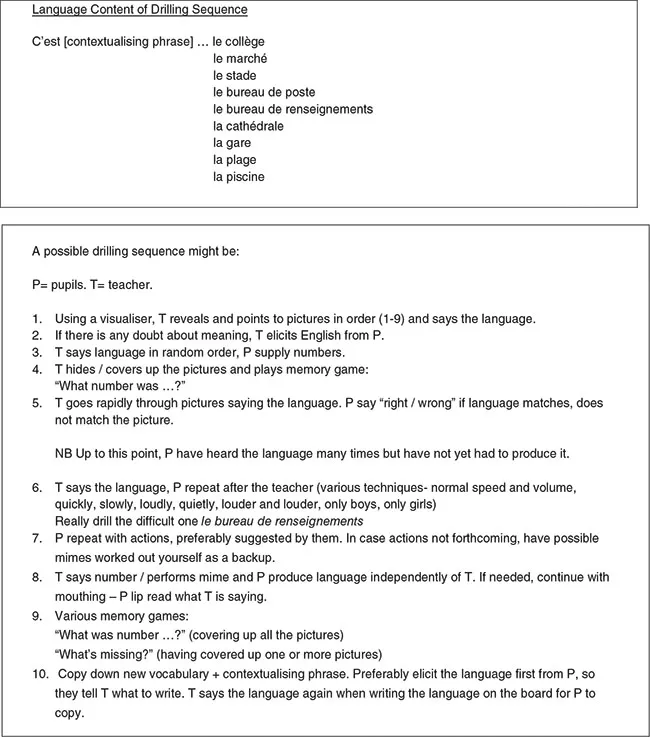
The mini-plan in Figure 1.1 shows what a typical drilling sequence might look like; I have based this on a model first introduced to me by James Burch. In terms of the PPP model, new language is presented and practised. Please bear in mind that this is just one possible way of drilling the new language.
It is worth noting that within this drilling sequence the teacher plans to pay attention to slightly different aspects of learning. Let’s look a bit more closely at the different stages of the sequence.
(i) In the first part of the sequence (points 1–5), the teacher provides short bursts of repeated exposure to the language s/he wants pupils to learn. In so doing, s/he is presenting a model for pupils to imitate later on in the sequence. The learning focus here is comprehension.
(ii) The next part of the sequence (points 6–7) is about pupils repeating after the teacher exactly what they hear. The teacher uses different techniques to vary this, but essentially this is mechanical repetition practice. The new learning focus here is pronunciation.
(iii) The final part of the sequence (points 8–10) is less mechanical. Pupils start to repeat, or reproduce, the new language independently of the teacher. The new learning focus here is memorisation.
In short, drilling serves different learning purposes. These have been separated out here for the sake of clarity. In reality, these various layers of learning build on each other within the sequence. For example, learning to comprehend what the new language means continues throughout the sequence.
Planned repetition practice to support comprehension and pronunciation is not always paid the attention it deserves, especially at the planning stage. This may be because it is perceived as low level; it does not involve any higher order thinking or creativity. Yet, this sort of repetition is fundamental to language learning and the ability to lead the class in short bursts of choral repetition is a very useful teaching skill. It is true that drilling, or the need for repetition, cannot always be planned. It is a skill that ML teachers need to be able to draw on at any stage in a lesson, if it is judged that an individual or group of learners needs to hear and repeat the model again. For example, most of the class may be mispronouncing a keyword or an individual pupil may repeatedly struggle with a particular structure. This applies to any stage of learning right up to A-level.
FIGURE 1.1 Example of a drilling sequence
That said, probably the best place for beginning teachers to practise and hone their drilling skills is within the context of planned repetition practice. I will focus in the next five sections on key planning decisions associated with repetition practice when presenting new language to the class. These relate to the following:
■ The language content;
■ Making the meaning clear;
■ Pronunciation;
■ Drilling techniques;
■ Monitoring and checking pupil progress.
Decisions about the language content
When planning to drill new language, the first decisions you need to make relate to the language content of the drill itself, or the ‘content language’. In the first instance, this literally means: what language will you model for pupils to repeat? How much language and in what order?
As a general rule of thumb about seven new pieces of information are recommended for one drilling sequence. Please note this does not necessarily mean seven words! New vocabulary is going to be easier to learn if encountered within a context that helps pupils see how different items are connected. Context is very important for meaning. From a learning point of view, this applies specifically to the linguistic context within which new language is first encountered. For example, it may be quite impressive for pupils to learn how to say in French the names of nine places in the town, such as the town hall or the train station.. However, without a structure to provide linguistic context, what can they do with the words they have learnt? Consider what difference it makes if pupils encounter and learn those lexical items in conjunction with a contextualising phrase or question. The phrase might be as simple as ‘c’est . . .’ or ‘c’est . . .?’, ‘je cherche . . . ’ or ‘où est . . .?’ etc. Essentially this is learning chunks of language that carry meaning rather than isolated or decontextualised words. This means that pupils are not just learning words (e.g. the French for names of places in a town); they are learning to do things with the language (e.g. to use French to identify or ask the whereabouts of places in a town). Even more significantly, research tells us that learning ‘prefabricated chunks’ (Mitchell and Myles, 1998, p12) is helpful to longer-term language learning progress and particularly in relation to grammatical patterns. The acquisition of grammar is considered further in Chapter 6.
When presenting and drilling new language, try to think in terms of chunks of meaning; make use of contextualising phrases or questions so that pupils are learning to use the language, rather than isolated words. Get this right, and you have the best possible basis for exploiting learning potential in the classroom. Your choice of contextualising phrase will depend on why you are teaching this language in the first place. What will pupils be using this language to do? What meanings could they communicate using this language?
Depending upon the topic or context, consider also if there is a best order in which to drill new language. An important point here is to be aware of possible patterns in the language that might help learning. For example, if introducing different hobbies in French, you might want to group together all the phrases with ‘je joue au . . .’ and drill those separately from phrases with ‘je joue du . . .’. With some classes you might start with the simplest items first, probably the ones that sound most like English or are simplest to pronounce; with other classes you might start with the most difficult item and choose a drilling technique so that the class can hear it more often or repeat it in a more memorable way than the other items you are drilling.
The upper panel of Figure 1.1 shows what the outcomes of planning decisions about content language of the drill might look like.
Decisions on how to present the language and get the meaning over
A criticism levelled at repetition is that it is possible for pupils to repeat everything they hear, but without necessarily understanding what they are saying. In my opinion, repetition without meaning should be avoided. To make best use of learning time, you want pupils to know what they are saying when they are repeating the model. A priority when planning therefore is thinking through how you will make the meaning clear to your learners. Once you have identified the content that you want to drill, the next step is to think through how you will present that language so that pupils understand what it means. Learning starts with meaning. Pictures, photographs and film can be very useful, as can artefacts or...
Table of contents
Cover Page
Half Title
Title Page
Copyright Page
Table of Contents
List of Figures
List of Tables
List of Boxes
Acknowledgements
List of Abbreviations
Preface
Introduction
List of References for Introduction
Part I Getting started
Part II Well-planned lessons
Part III Planning for a Balanced Language Learning Experience
Part IV Getting Better at Planning
Final Reflections
Annotated List of Further Reading and Sources
Index
Trusted by 375,005 students
Access to over 1.5 million titles for a fair monthly price.
Study more efficiently using our study tools.
Frequently asked questions
Yes, you can cancel anytime from the Subscription tab in your account settings on the Perlego website. Your subscription will stay active until the end of your current billing period. Learn how to cancel your subscription
No, books cannot be downloaded as external files, such as PDFs, for use outside of Perlego. However, you can download books within the Perlego app for offline reading on mobile or tablet. Learn how to download books offline
We are an online textbook subscription service, where you can get access to an entire online library for less than the price of a single book per month. With over 1.5 million books across 990+ topics, we’ve got you covered! Learn about our mission
Look out for the read-aloud symbol on your next book to see if you can listen to it. The read-aloud tool reads text aloud for you, highlighting the text as it is being read. You can pause it, speed it up and slow it down. Learn more about Read Aloud
Yes! You can use the Perlego app on both iOS and Android devices to read anytime, anywhere — even offline. Perfect for commutes or when you’re on the go. Please note we cannot support devices running on iOS 13 and Android 7 or earlier. Learn more about using the app
Yes, you can access Learning to Plan Modern Languages Lessons by Cheryl Mackay in PDF and/or ePUB format, as well as other popular books in Education & Education General. We have over 1.5 million books available in our catalogue for you to explore.