![]()
Section III
Structural and Individual Development in Computer Worlds
![]()
Chapter 7
Computing Space: A Conceptual and Developmental Analysis of Logo
Greta G. Fein, Ellin Kofsky Scholnick, Patricia Forsythe Campbell, Shirley S. Schwartz, and Rita Frank
University of Maryland, College Park
There is a sense of urgency about research in computer literacy. The invention of the computer may yield a revolution in thinking as broad as that resulting from the invention of the printed word. We must capture the moment before each child is computer literate, lest we lose forever the opportunity to study the impact of a new technology on human thought. But before everyone dashes off to study the consequences of computer literacy, we would urge a few stragglers to pose a different set of questions. There are various forms of computer literacy, from inserting a game disk into a drive to writing a sophisticated program. There are various programming languages. The question is: Which form of interaction and which language will produce consequences of theoretical and functional importance?
Even though the possible consequences of computer programming have preoccupied educational researchers, the assessment of consequences may be premature. We cannot evaluate the consequences of mastery until we know what the individual masters and how this mastery is attained. Additionally, certain entry conditions or precursor skills may influence acquisition and constrain its consequences (see, e.g., Sternberg, 1984). If these precursor skills are absent, little may be gained from exposure to a computer language. Most likely, the process of learning will differ in different individuals or in different instructional settings, and different consequences will follow from these variations. Before we invest too much energy in the study of consequences, three sets of preliminary questions must be addressed. First: What are the psychological demands of a particular computer language? Second: What are the prerequisite skills needed to master some or all of these demands? Finally: How can we describe the process of learning?
This chapter is organized around these three questions because, independent of the particular computer language taught or acquired, the conceptual analysis called for by the questions provides a conceptual basis for distinguishing consequences that are important from those that are trivial, and consequences that are likely from those that are wildly improbable. These are familiar, sensible questions, similar to those we ask about other educational innovations and about the process of acquisition in general. We pose them here not merely to redress the neglect of antecedents and processes in regard to computer learning—a careful examination of acquisition in the computer context might also illuminate the acquisition process in broader realms of conceptual development.
Our examination yielded two proposals that appear in this paper: a model describing the acquisition of a computer language, and an evaluation of the advantages of using this domain to explore cognitive development. Because these aims are ambitious, we limit ourselves to one computer language, LOGO, and to stages of its initial mastery.
Conceptual Demands of Logo
When Seymour Papert (1980) proclaimed that LOGO created “mindstorms” of powerful ideas about mathematics and procedural thinking in children, he tempted us to look at the consequences of programming with LOGO graphics. However, LOGO provides an expandable and specified problem space consisting of modest ideas as well as powerful ones. This problem space can be introduced to children at different levels according to our best guesses about their conceptual capabilities. Because LOGO is a well-defined conceptual domain, it provides a tool of remarkable depth and flexibility for studying stages and sequences in the acquisition and application of knowledge. For example, LOGO is a spatial language with a hierarchical structure suggesting that what we know about spatial, linguistic, and category development can be applied to building a model of LOGO learning. Perhaps what children know about space, language, and categories helps them to master LOGO. Because in using LOGO graphics, children create a visible record of ideas they are exploring; their progress is accessible to the investigator. Thus, we can look at what children know about space and language before they enter this domain and then how children transfer this knowledge to a new medium.
When Papert was in Geneva he absorbed the Piagetian philosophy of learning as an active process. The computer language he created provides us with a powerful tool for examining children actively acquiring powerful ideas. The purpose of our chapter is to examine what this acquisition process might look like. Following the structuralist tradition, we begin by considering the nature of LOGO’S conceptual domain defined in terms of the primitive commands used to move the cursor. Two questions are central in this discussion. First: What prior knowledge is needed for a child to comprehend the conceptual, spatial, and linguistic context of these elementary cursor commands? Second: What kind of conceptual model of the domain must the child acquire in order to coordinate these primitive graphic components into a flexible system? Then we proceed to describe how the child arrives at this model, illustrating the issues with data drawn from a study of the initial stages of LOGO learning in a group of kindergarten children. We hope this tentative model of the structure and process of LOGO acquisition will persuade you not only that the study of LOGO can illuminate the child’s encounter with a new technology, but also that LOGO offers a technology for studying the child’s cognitive and linguistic development.
The Nature of Logo
Among those interested in Artificial Intelligence, it is common to create limited domains of discourse, make-believe worlds within which fanciful events can be represented. One well-known invented domain is the block world inhabited by a robot named Robbie (see Winston, 1977, for a concise discussion of this program). Robbie has at his disposal a limited number of sensorimotor schemes (e.g., grasp-ungrasp, pick up-put down) for manipulating a limited number of objects (e.g., blocks of different shapes and colors), in a space consisting of a limited number of topological/projective relations (e.g., in front of, on top of, supported by). Even though Robbie is the presumed agent within his world, he lacks a unique spatial position in it. Robbie’s spatial perspective is exactly that of the human operator; spatial relations such as “in front of are interpreted from the operator’s perspective as if the monitor screen were a window into a three-dimensional environment. In Robbie’s world, objects and relations are predetermined. In order to communicate with Robbie, it is necessary to appreciate the semantic categories of entities within his world and the grammar controlling his behavior, which, as it turns out, has many properties of natural language. However, unlike natural language and the intelligent systems from which it emerges, Robbie’s language is not generative. Although the language of the block world permits the user to discover what Robbie knows how to do, it does not require the user to comprehend a different spatial perspective, or ask the user to construct new components of action, or permit the user to learn powerful principles from the exchange.
The microworld of LOGO graphics is also an invented, limited-discourse domain dealing with spatial relations. However, there are several notable differences. In LOGO, one takes the perspective of the cursor, not the operator. The surface of the monitor screen is treated as it is, a two-dimensional plane. Rather than predefined objects, objects are constructed on this plane using a few primitive, path-making commands. Thus the conceptual domain of LOGO graphics describes the organization and appearance of paths through space. The com-mands themselves portray Newtonian vectors that, when combined, may yield the objects and spatial relations of Robbie’s world or of some other world we choose.
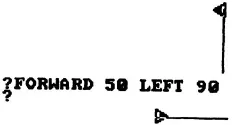
What is the LOGO domain? At its most tangible level, it consists of a conventional keyboard and a caret on the screen called a “turtle” (Figure 7.1). When certain keys are pressed, the turtle’s position changes, moving forward or back, or turning left or right. Mastering LOGO requires learning the precise and predictable contingencies between actions on the keyboard and observable events on the screen expressed in primitive commands such as forward, back, left, and right. LOGO learning is aided by understanding that one’s personal knowledge of movement through space applies to the movement of the cursor on the screen.
Next, LOGO learning involves mastery of syntactic rules for combining these primitive elements into ordered sequences. Then the turtle can be made to travel anywhere on the screen. In Figure 7.2, the turtle has been turned 90° to the left and moved 50 paces forward. Figure 7.3 shows the same commands in a different order: first forward 50 paces and then 90° to the left. When the order is changed, the turtle travels a different path. In Figure 7.4 the turtle has rotated 90 ° to the right and moved 50 paces back. Whereas different LOGO primitives are used in Figures 7.2 and 7.4, the cursor has traveled the same path. Relations among these visible movements are the source of the conceptual structure the child will eventually infer.
Once having grasped the four primitive commands and how to combine them, the child can design a sequence to achieve some goal such as drawing a squiggle or a house. When the goal is achieved, the sequence can be stored in the system as a procedure. The turtle now “knows” how to squiggle or how to “house.” Unlike Robbie’s world, the turtle’s world is expandable. The child’s interaction with Turtle Graphics progressively changes from the management of spatial movements, to the construction of graphic objects, to the modularized components of a procedural language. Our analysis focuses only on the beginnings, the child’s comprehension of the semantic and syntactic organization of primitive LOGO movement commands.
Prerequisites to Learning Logo
Entry Conditions
From the beginning, LOGO graphics invite children to imagine a world, somewhat like the ordinary, mundane world they know so well, but different from it in important ways. Children must select from their knowledge of spatial movements and language those things that apply to this new domain, rejecting those that do not apply. This analysis of the similarities and differences between old and new culminates in the detection of relevant knowledge and creation of its appropriate transformation. This relevant and transformed knowledge enables entry into the LOGO environment.
The child must realize that LOGO is an invented world in which the turtle is the agent, the only entity that can do anything. The human at the keyboard is the one for whom actions are done. The instrument of action is the turtle’s body, an isosceles triangle whose smallest angle is its nose, and whose smallest side is its back. Much as the expression, “Follow your nose” means to move in the direction your nose is facing, so the turtle’s nose gives its heading. Even though left and right are not graphically marked on the turtle’s body (as they are not marked on your own), it is necessary to interpret these spatial orientations from the perspective of the turtle’s nose. A central aspect of LOGO learning is the human operators’ understanding that despite this difference in perspective, their personal knowledge of movement through space applies to the turtle’s actions. The difference is that when you move in space, you follow your own nose, but when you command a turtle to move, you follow its nose, not your own. The child’s problem is to imagine an independent but controllable agent with familiar spatial properties and its own distinctive perspective.
Perspectives in the microworld differ from those in the real world in other ways as well. We usually move on a horizontal plane, but, from an operator’s perspective, the turtle moves on a vertical plane. Thus when the turtle is in home position, a forward command moves the turtle up, and a back command moves it down. Not only is the plane of action transformed in this space, but what appears subjectively as a physical continuum is now described in terms of units of measurement. Turtles move in units that determine the magnitude of the distance and direction traveled. Among other things, the child setting out to master LOGO must treat a triangular shape as if it had agency and its own perspective with respect to left-right orientation, plane of action, and span of movement.
There is also a language of commands that, although arbitrary, resembles English enough to feel friendly. All language is based on semantic and syntactic relations, and LOGO is no exception. But there are some crucial differences. Unlike natural languages, where some degree of imprecision is tolerated, computer languages require precision. The turtle will do only what it is told to do and only in the language it understands. However, the most intriguing aspect of LOGO is that it requires what few other spatial tasks require, namely a linguistic analysis of spatial movements. In LOGO, the operator is not drawing; the operator is telling the turtle how to draw. If one wishes merely to draw beautiful designs, choose another language, because LOGO is cumbersome. However, LOGO’S commands make explicit the spatial principles behind the graphics, and if these principles are of interest, LOGO has special advantages.
Spatial navigation and linguistic mapping are not new tasks to the child. Presumably, in navigating the natural spatial environment, the child forms some kind of a spatial representation of the external world. LOGO asks the child to use a language to produce spatial representations in a microworld where the spatial constraints are somewhat different from those in the real world and the language is more precise and stable. For these reasons, LOGO allows the developmental psychologist to examine how children transfer real-world knowledge of space and representation to a new domain. If spatial knowledge is an essential precursor to LOGO mastery, one would expect an assessment of spatial knowledge to predict the course of LOGO learning. In our own work with kindergarteners, we found a close relationship between LOGO mastery and children’s ability to coordinate perspectives and use a map to navigate a terrain (Campbell, Fein, Scholnick, Schwartz, & Frank, 1985). Similar relationships have been reported for high school students (Webb, 1984). Thus some aspects of spatial knowledge may facilitate understanding of the LOGO environment. Whether some aspects of semantic or syntactic knowledge also transfer remains to be determined.
The Infrastructure
From understanding how a cursor moves on a screen to programming is a large step. To view LOGO only in terms of grand ideas such as procedures or modules is to underestimate its elegance and its potential for illuminating children’s thinking. LOGO’S grand ideas emerge from an infrastructure of interconnected, modest ideas from which more powerful ones are derived. One set of modest ideas is found in the semantics of LOGO, that is, in the meaning of single commands. Another is found in its syntax, or the way commands are sequenced. Yet a third set is found in the integrated operations whereby the semantics and syntax become coordinated into a system of cognitive-spatial relations.
Discussions of children’s learning of LOGO ultimately depend on analyses of the conceptual structure of the microworld itself and children’s ability to mar-shall their understanding of that structure to command the turtle to achieve some goal. First we turn to a description of that structure and then to the child’s construction of it.
A Taxonomy of Actions. It is useful to think of the command structure of Turtle Graphics in terms of a conceptual hierarchy like that shown in Figure 7.5. At first glance, the lowest levels ...