eBook - ePub
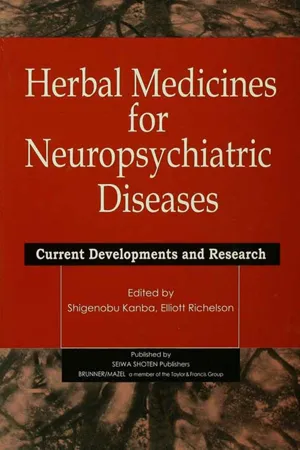
Herbal Medicines for Neuropsychiatric Diseases
Current Developments and Research
- 144 pages
- English
- ePUB (mobile friendly)
- Available on iOS & Android
eBook - ePub
Herbal Medicines for Neuropsychiatric Diseases
Current Developments and Research
About this book
Published in 1999, Herbal Medicines for Neuropsychiatric Diseases is a valuable contribution to the field of Psychiatry/Clinical Psychology.
Information
1
Use of Herbal Medicine for Treating Psychiatric Disorders in Japan
Although Western pharmacotherapy is now the major medical modality in Japan, traditional remedies are still being offered. Research into traditional treatments continues, and a number of studies have described the basic pharmacology and clinical efficacy of Oriental herbal medicine (Kampo medicine) in Japan.After being advised of the advantages, as well as the potentially adverse effects, of both herbal and pharmaceutical treatments, patients may choose the approach they prefer. Many patients recognize the limits of the current medical technology and seek more individualized treatments. According to Kampo medicine, health can be preserved by maintaining a prudent lifestyle, eating proper food, and utilizing natural medicines.
INTRODUCTION
As a result of Japan's gradual acceptance of the role of Kampo medicine, the Ministry of Health and Welfare now includes such prescriptions in the country's National Health Insurance Plan. About 120 different formulations, which are extracted from combinations of herbs, are available. They also can be prepared in the form of powder.
In a 1993 survey of 2000 physicians by the Japan Medical Association (Fig. 1), 77% reported using Kampo, as compared with only 28% in 1979. Common diseases for which Kampo is prescribed include hepatitis and liver disease, upper respiratory infections, menopausal syndrome, psychosomatic disorders, allergic rhinitis, constipation, asthma, gastritis, lumbago, and eczema.
About 30 different pharmaceutical companies produce Kampo formulations

Figure 1. Percentage of Japanese physicians who use Kampo. A survey of 2000 physicians by the Japan Medical Association in 1993 revealed that about 77% use Kampo, as compared with the 28% reported in 1979.
that are registered by the government. Global sales in 1993 totaled about 1400 billion yen ($14 billion U.S.).
HISTORY OF KAMPO MEDICINE
Ancient Chinese medicine traveled to Japan via Korea. It is based on an Oriental philosophy, the yin-yan of taoism. In the year 984, Yasuyori Tamba compiled the Ishinho, a vast compendium of Chinese medicine. Later, in the 16th to 18th centuries, three schools of Kampo medicine were established.
The Gosei-ha, the first independent school of medicine in Japan, was established when Dosan Manase assembled the various elements of medical theory that had been imported from China since the Sung dynasty. The Koho-ha school arose in reaction to the overly theoretical methodology of the Gosei-ha, and turned back to the ancient medicine of China. Then came the Setchu-ha, or compromise, school, which mixed both schools of thought.
Until about 120 years ago, Kampo was the official medicine of Japan. Then, strongly influenced by Western culture and civilization, the government decided that Japanese doctors should practice Western medicine and that it should be taught in medical schools. By the end of World War II, the use of Kampo had virtually disappeared.
In recent decades, however, Kampo medicine has again become popular. Patients, as well as physicians, have reconsidered the value of its holistic and humane aspects. Kampo medicine is recognized for its efficacy and safety; moreover, the cost of such treatment may be covered by medical insurance.
BASICS OF KAMPO MEDICINE
General Concept
The fundamental philosophy of Kampo treatment is the enhancement of the natural healing power. Herbs are believed to affect both the psyche and the soma, and Kampo medicine does not differentiate between them. The treatment not only aims at improving or maintaining physical health, but it also takes into account the patient's psychic and mental balance. Futhermore, the human being is regarded as a microcosm reflecting the macrocosm.
The improvement induced by herbal medicine is usually mild and slow, but it can be dramatic. Side effects are rare, and those that do occur are mostly allergic reactions to natural substances. When herbs are combined with interferon to treat chronic hepatitis, there is an increased risk of interstitial pneumonitis.
The specific prescription is traditionally selected by judging the Sho of a patient. Sho is equivalent to a syndrome, but it comprises psychic and somatic symptoms and signs obtained by a traditional physical examination that focuses on the patient's constitution, general physical condition, pulse, and abdominal signs, and includes an examination of the tongue. A modern diagnosis is also utilized when a prescription is formulated, because most physicians are not trained to determine Sho correctly.
Ki-Ketsu-Sui Theory
The Kampo concept that is most relevant when treating psychiatric problems is Ki-Ketsu-Sui theory. Unhealthy conditions are thought to be caused by the impairment of one, or a combination, of three factors (Terasawa, 1993).
The first factor is Ki (Chi in Chinese, Prana in Aryuveda, Vis Vitalis in the traditional European medical system). Ki is the basic, all-penetrating, maintaining force or energy, the elemental energy that is the source of all other forms of energy. It is also thought to be the source of nourishment and stimulation for the circulation of body fluids. In addition, Ki is responsible for protecting the organism against external and internal noxious forces by circulating as yang-A7 in the outer layers of the body.
Disturbances of Ki are classified as Ki deficiency, Ki stasis, or an imbalance of Ki distribution. In Kampo medicine, depression is considered a Ki deficiency or Ki stasis. For Ki deficiency, Ninjin-to or Keisi-to is typically indicated. For Ki stasis, Koso-san and Hange-koboku-to are indicated.
Another basic component is Ketsu, which is equivalent to blood. According to traditional Chinese medicine, Ketsu refers to the red-stained fluid of the organism. A disturbance of Ketsu is classified as either a deficiency or a stasis.
Some symptoms caused by a deficiency of Ketsu appear in psychiatric disorders. Shimotsa-to, Kyuki-kyogia-to, or Kami-kihi-to is used to treat this condition.
The third component is Sui, body fluid. Statis of Sui includes such conditions as palpitations, vertigo, motion sickness, tinnitus, headache, thirst, nausea, emesis, swollen joints in the morning, and a feeling of heaviness in the body.
When a patient, who will often have psychiatric problems, presents with these symptoms, Ryokei-jutsukan-to or Hange-byakujutsu-tenma-to is indicated.
Ketsuo stasis is often seen in psychiatric patients, especially those who take psychotropic medications. Teito-to, Tokaku-shoki-to, and Kami-shoyo-san are used to correct these disturbances.
HERBAL MEDICINE FOR PSYCHIATRIC DISORDERS
Animal Studies
A variety of plants are believed to exert central effects. Some plants have been demonstrated to have neuropsychopharmacologic effects.
Ninjin (Ginseng) Ginseng has been used in ethnopharmacology for more than 300 years. More than 28 kinds of ginsenosides and other active compounds have been isolated, and some have been shown to have biologic effects (Liu & Xiao, 1992).
Ginseng root saponin (GRS) has antistress effects. GRS, 10 mg/kg intraperitoneally, has been s...
Table of contents
- Cover
- Half Title
- Full Title
- Copyright
- CONTENTS
- Contributors
- Introduction
- HERBAL MEDICINES FOR NEUROPSYCHIATRIC DISEASES
- 1. Use of Herbal Medicine for Treating Psychiatric Disorders in Japan
- 2. Pharmacologic Studies of Himbacine and Huperzine A: Potential Use in Cholinergic Replacement Therapy
- 3. Neuropharmacologc Activity of Constituents Isolated from Chinese Medicinal Plants
- 4. A Double-Blind Control Study of Huperzine A and Piracetam in Patients with Age-Associated Memory Impairment and Dementias
- 5. Medicinal Plants: A Potential Source of New Psychotherapeutic Drugs
- 6. Indian Medicinal Plants as a Source of CNS Active Drugs
- 7. Ginkgo Preparations: Biochemical, Pharmaceutical, and Medical Perspectives
- 8. The Herbal Preparations Kangenkaryu and Shen Yun Wan Reduce Brain Oxidative Stress
- 9. Effect of Herbal Medicine on Learning Disturbances in Senescence-Accelerated Mice
- Subject Index
Trusted by 375,005 students
Access to over 1.5 million titles for a fair monthly price.
Study more efficiently using our study tools.
Frequently asked questions
Yes, you can cancel anytime from the Subscription tab in your account settings on the Perlego website. Your subscription will stay active until the end of your current billing period. Learn how to cancel your subscription
No, books cannot be downloaded as external files, such as PDFs, for use outside of Perlego. However, you can download books within the Perlego app for offline reading on mobile or tablet. Learn how to download books offline
Perlego offers two plans: Essential and Complete
- Essential is ideal for learners and professionals who enjoy exploring a wide range of subjects. Access the Essential Library with 800,000+ trusted titles and best-sellers across business, personal growth, and the humanities. Includes unlimited reading time and Standard Read Aloud voice.
- Complete: Perfect for advanced learners and researchers needing full, unrestricted access. Unlock 1.5M+ books across hundreds of subjects, including academic and specialized titles. The Complete Plan also includes advanced features like Premium Read Aloud and Research Assistant.
We are an online textbook subscription service, where you can get access to an entire online library for less than the price of a single book per month. With over 1.5 million books across 990+ topics, we’ve got you covered! Learn about our mission
Look out for the read-aloud symbol on your next book to see if you can listen to it. The read-aloud tool reads text aloud for you, highlighting the text as it is being read. You can pause it, speed it up and slow it down. Learn more about Read Aloud
Yes! You can use the Perlego app on both iOS and Android devices to read anytime, anywhere — even offline. Perfect for commutes or when you’re on the go.
Please note we cannot support devices running on iOS 13 and Android 7 or earlier. Learn more about using the app
Please note we cannot support devices running on iOS 13 and Android 7 or earlier. Learn more about using the app
Yes, you can access Herbal Medicines for Neuropsychiatric Diseases by Shigenobu Kanba, Elliot Richelson, Shigenobu Kanba,Elliot Richelson in PDF and/or ePUB format, as well as other popular books in Medicine & Psychiatry & Mental Health. We have over 1.5 million books available in our catalogue for you to explore.