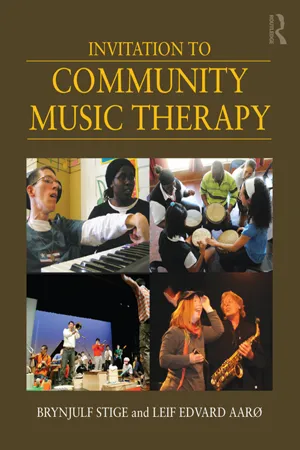
Invitation to Community Music Therapy presents the main perspectives and principles of community music therapy as it is practiced around the world. A relatively recent development within the broader field of music therapy, community music therapy emphasizes human connectedness, health promotion, and social change. This textbook surveys the history, theory, and current practice of community music therapy to develop a comprehensive picture of the field. Along the way it takes full measure of the diverse and vibrant ways community music therapy is practiced around the globe. Including dozens of photographs and pedagogical tools such as chapter questions, textboxes, figures, key terms, and discussion topics, Invitation to Community Music Therapy is the ideal introduction to a growing area of music therapy.
- 330 pages
- English
- ePUB (mobile friendly)
- Available on iOS & Android
eBook - ePub
Invitation to Community Music Therapy
Part I
Introduction to Community Music Therapy
PART I introduces the reader to the idea and practice of community music therapy and to the historical developments that led to the emergence of community music therapy as an international discourse and field of study.
Chapter 1 introduces community music therapy, first by discussing one of the basic metaphors that informs it and then by presenting examples of community music therapy practices around the world. Definitions of community music therapy and ways of describing the family of practices that might enable us to recognize community music therapy are discussed, before community music therapy as a continuation of and contrast to conventional music therapy is considered.
Chapter 2 explores the history of community music therapy. Many of the pioneers of modern music therapy, especially in the 1960s and 1970s, paid attention to a broad, social way of thinking about music and health. In addition to individual sessions they explored the use of improvisation groups, music clubs, therapeutic teaching, chamber music, record sessions, and performances. The pioneers never theorized or researched these broader ways of thinking about music therapy and in many countries their successors paid less attention to these social–musical traditions than to clinical work with individuals and groups. Important undercurrents have existed in several countries, however, and after 2000 a strong international interest in community music therapy emerged, with provocative discussion papers and intriguing practical examples from a range of contexts to fuel the process. We need to understand how and why this happened.
Chapter 1
An Overview
After studying Chapter 1, you will be able to discuss questions such as:
◾ How does the metaphor of “attending to unheard voices” relate to community music therapy?
◾ How is community music therapy practiced in various contexts around the world?
◾ How has community music therapy been defined by various authors?
◾ What are the challenges in defining community music therapy?
◾ What are the seven qualities communicated by the acronym PREPARE?
◾ How could community music therapy be considered a continuation of as well as a contrast to more conventional forms of music therapy?
◾ Why is community music therapy relevant and significant in contemporary societies?
Attending to Unheard Voices
MUSIC can be used to mobilize resources in the service of health, wellbeing, and development. This is something humans have “always” known and acted upon. The idea that music can help has been cultivated over millennia in a range of cultural contexts. Since World War II professional music therapists have gradually developed a body of research-based literature to refine this idea and to support the development of professional music therapy practice. Traditionally, the literature on professional music therapy has focused on problems and solutions as they relate to individuals. The dominating view in modern music therapy, as in many other health-related disciplines, has been that therapists work with individuals and their pathology, often in clinical settings.
Community music therapy practices question this tradition by employing social and ecological perspectives on music and health, which implies that health-promoting connections between individuals and various communities are explored. To study community music therapy involves exploring a broad family of practices and perspectives that enable music therapists to be open for the needs, rights, and possibilities of persons and groups in challenging situations. Part of what is new about community music therapy is its radical willingness to explore the relationships between individual and communal change and development (Pavlicevic & Ansdell, 2004).
Community music therapy ideas and practices are not new in every respect and consequently some have questioned the need for and legitimacy of a separate label. The most heated debates are already some years old and contemporary community music therapy has grown into an international discourse with an ability to cross geographical as well as academic borders. Acknowledgement of the value of human connectedness is part of the identity of contemporary community music therapy, which has emerged as a vital interdisciplinary field of study and practice. In considering its legitimacy it is no longer necessary to measure it against standards established by other traditions. Community music therapy has developed its own relational agenda.

FIGURE 1.1 | Hear my voice! A child from a foster home visited by the Music Therapy Community Clinic in the Greater Cape Town area, South Africa.
Photo: India Baird.
The issues and values of this agenda will be intimated later in this chapter and elaborated in Part III of the book. Attending to unheard voices is one of the metaphors that inform it. The related image of therapy as “giving voice” to experiences that have been silenced has been used within narrative therapy, for instance (Stige, 2002). It is an open metaphor which points to the possibility that the processes leading to silencing can have personal, interpersonal, social, cultural, and material origins. In this book we use “attending to unheard voices” instead of “giving voice,” as voice is a personal performance in social context. We cannot give people a voice, but we can contribute to the construction of conditions that allow for previously unheard voices to be heard. The metaphor links the interest in each individual with the community. It opens a space for a social agenda without neglecting the personal issues of the participants. It also opens a space for visions of a better world.1
To attend to unheard voices is not an intervention instigated by a therapist; it is a collaborative process balancing values such as liberty and parity. The metaphor therefore implies a multi-voiced community (Stige, 2003, p. 283). Community music therapy encourages musical participation and social inclusion, equitable access to resources, and collaborative efforts for health and wellbeing in contemporary societies. It could be characterized as solidarity in practice. In this way community music therapy can be quite different from individual treatment, sometimes closer to practices such as community music, social work, and community work.
Contexts of Contemporary Practice
We will illuminate contemporary developments in community music therapy through presentation of six practice examples, selected from various continents, countries, and cultural contexts. We will start with an example from South Africa, a country with a short history of professional music therapy but a long history of health-related and community-oriented musical practice.
Box 1.1 | The Music Therapy Community Clinic in the Greater Cape Town Area
In Cape Town, South Africa, a group of music therapists including Sunelle Fouché and Kerryn Torrance (2005) have formed a non-profit organization called the Music Therapy Community Clinic, which provides professional music therapy to disadvantaged people from poorer communities within the Greater Cape Town area. Fouché and Torrance describe one of the neighborhoods where they are working in the following way:
Most of Heideveld’s older generation remember being moved here in the 1960’s from inner city suburbs as part of the apartheid government’s Group Areas Act. Where extended families used to live in the same house or in close proximity to relatives in Cape Town city, they became scattered over the different settlements in the Cape Flats, in the ‘hinterland’. These forced removals to Heideveld and other areas of the Cape Flats meant moving into a world of strangers. The social and emotional support which family members and neighbours once provided each other was lost (Fouché & Torrance, 2005).
In Heideveld the music therapists work with adolescents facing the danger of becoming immersed in the gang culture of the suburb. The authors explain that for adolescents who live in a socially fragmented community, gangs provide some social and emotional support. While families often have few resources for providing support, gangs can offer an identity, a sense of belonging, and a feeling of acceptance, power and purpose. After having worked with children in this community, the two music therapists were approached by the police, who asked them to see adolescents at risk; young people involved in local gangs, drug abuse, and acts of crime:
The Police were reluctant to place these youngsters into the criminal justice system as the rehabilitation statistics in Southern African prisons are exceedingly low, with notorious prison gangs constantly recruiting young adolescents to a life of organized crime. The Police saw music therapy as an alternative form of intervention. Each week, the Police fetch the youngsters, disarm them and deliver them to our Music Therapy door. Police supervision ends and the musicking begins….
While the police fetch the youngsters each week, their attendance is not compulsory. Although the group appeared very sceptical and aloof at the first meeting, they have returned willingly and eagerly every week. Music seems to be the magnet. It is a ‘cool’ thing to do. Within the gangs’ Rap/Hip-Hop culture, the musicians are the ‘heroes’, looked up to by the youth; the ones who give social commentary. (Fouché & Torrance, 2005).
The music therapists observe how music energizes the adolescents and gives them a purpose and an opportunity to create new social identities. Creating and relating through involvement in music and movement is motivating and meaningful in itself and also establishes a platform for telling and sharing stories (Fouché & Torrance, 2005).
The above example illuminates several themes that will be discussed throughout the book, such as community music therapy’s potential in relation to social problems, the importance of prevention of problems rather than just treatment, and the need to think and act ecologically, exemplified with the necessary alliance that was developed with the local community and the police in this case.
In describing the active music-making, Fouché and Torrance (2005) employ a term that has become central to the community music therapy discourse, namely musicking.2 Instead of thinking of music mainly as an artifact (as a work of art, for instance), the term musicking suggests that we can think of music as an activity that we take part in. If we start considering music as an activity in a given situation, we are also invited to think about the relationships between those who make sounds and those who make sounds possible. In a concert situation, the importance of the audience is pretty obvious. In the example above, police supervision (and the end of it) made music possible and can be considered part of the musicking, broadly conceptualized. We will elaborate on this term and its ecological implications in Chapter 5.
From this example we will move to South America, where social and contextualized approaches to music therapy have been developed since the 1970s. In a comment about the prospects of the profession in a new millennium, Brazilian music therapist Marly Chagas suggests that the music therapist “will be engaged in situations that involve collective health, awareness of creating expression, artistic expression, or even social life through musical symbols. He/she might contribute to the effective analysis and intervention in local communities” (Chagas, 2000, cited in Zanini & Leao, 2006). This view might be exemplified by descriptions of how Brazilian music therapists have tried to work in relation to the problem of homeless people:
Box 1.2 | Searching for Paths Through Arts in Rio De Janeiro
In Rio de Janeiro, Brazil, music therapists have taken interest in trying to improve the conditions of the many homeless people in this city. Lia Rejane Mendes Barcellos (2002, 2005) writes about how music therapists try to work with this. One specific example is the project Searching for Paths through Art (2002–2004), developed in adult homeless shelters and coordinated by the music therapist Marly Chagas. It offered many kinds of art activities, such as music therapy, storytelling, drama, dancing, and workshops where people could make their own musical instruments. One goal of the project was to “humanize” the relationships between the interns and staff members. Barcellos (2005) labels this practice “social music therapy” and explains that it is an established element of the Brazilian music therapy tradition.
Chagas (2007) explains how some of the goals of the project were related to the development of each individual while others were more social or political, with focus on the enhancement of the milieu and the relationships between people in various roles and situations:
New situations are brought to light: we were able to get a wheelchair; harmonicas; at Carnival the youth drum ensemble from Mangueira (Rio shanty town and home of the Estação Primeira da Mangueira samba school) provided an emotional generational integration and the boys’ trip outside Rio offered the entranced mangueirenses (those from Mangueira) the possibility of crossing the Rio de Janeiro–Niteroi bridge for the first time; one long-term care infirmary sings a samba march about a leafy tree on the patio of the institution, the lyrical composition of which is theirs, the melody having been composed by the music therapists of the Project. An instrumental group is formed, a group of women go to the theatre, a group of men, aided by the employees, organized a music festival, another group a poetry festival. We danced cirandas (children’s dance of Portuguese origin) and forros (musical style from northeastern Brazil) together. We created stories, we drew, we made instruments—in several senses of this term, we are here thinking, examining ideas, exchanging shared experiences. We heard exceptional stories, am...
Table of contents
- Cover Page
- Half Title page
- Title Page
- Copyright Page
- Brief Contents
- Contents
- List of Figures
- List of Text Boxes
- Preface
- Acknowledgements
- Part I Introduction to Community Music Therapy
- Part II Basic Concepts of Community Music Therapy
- Part III Community Music Therapy in Practice
- Part IV Community Music Therapy as Development of Discipline and Profession
- Photo Credits
- References
- Author Index
- Subject Index
Trusted by 375,005 students
Access to over 1.5 million titles for a fair monthly price.
Study more efficiently using our study tools.
Frequently asked questions
Yes, you can cancel anytime from the Subscription tab in your account settings on the Perlego website. Your subscription will stay active until the end of your current billing period. Learn how to cancel your subscription
No, books cannot be downloaded as external files, such as PDFs, for use outside of Perlego. However, you can download books within the Perlego app for offline reading on mobile or tablet. Learn how to download books offline
Perlego offers two plans: Essential and Complete
- Essential is ideal for learners and professionals who enjoy exploring a wide range of subjects. Access the Essential Library with 800,000+ trusted titles and best-sellers across business, personal growth, and the humanities. Includes unlimited reading time and Standard Read Aloud voice.
- Complete: Perfect for advanced learners and researchers needing full, unrestricted access. Unlock 1.5M+ books across hundreds of subjects, including academic and specialized titles. The Complete Plan also includes advanced features like Premium Read Aloud and Research Assistant.
We are an online textbook subscription service, where you can get access to an entire online library for less than the price of a single book per month. With over 1.5 million books across 990+ topics, we’ve got you covered! Learn about our mission
Look out for the read-aloud symbol on your next book to see if you can listen to it. The read-aloud tool reads text aloud for you, highlighting the text as it is being read. You can pause it, speed it up and slow it down. Learn more about Read Aloud
Yes! You can use the Perlego app on both iOS and Android devices to read anytime, anywhere — even offline. Perfect for commutes or when you’re on the go.
Please note we cannot support devices running on iOS 13 and Android 7 or earlier. Learn more about using the app
Please note we cannot support devices running on iOS 13 and Android 7 or earlier. Learn more about using the app
Yes, you can access Invitation to Community Music Therapy by Brynjulf Stige,Leif Edvard Aarø in PDF and/or ePUB format, as well as other popular books in Medicine & Music. We have over 1.5 million books available in our catalogue for you to explore.