Dealing specifically with the origins and development of human language, this book is based on a selection of materials from a recent international conference held at the Center of Interdisciplinary Research at the University of Bielefeld in Germany. The significance of the volume is that it testifies to paradigmatic changes currently in progress. The changes are from the typical emphasis on the syntactic properties of language and cognition to an analysis of biological and cultural factors which make these formal properties possible.
The chapters provide in-depth coverage of such topics as new theoretical foundations for cognitive research, phylogenetic prerequisites and ontogenesis of language, and environmental and cultural forces of development. Some of the arguments and lines of research are relatively well-known; others deal with completely new interdisciplinary approaches. As a result, some of the authors' conclusions are in part, rather counterintuitive, such as the hypothesis that language as a system of formal symbolic transformations may be in fact a very late phenomenon located in the sphere of socio-cultural and not biological development. While highly debatable, this and other hypotheses of the book may well define research questions for the future.
eBook - ePub
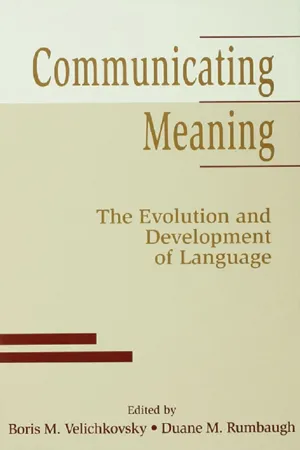
Communicating Meaning
The Evolution and Development of Language
- 352 pages
- English
- ePUB (mobile friendly)
- Available on iOS & Android
eBook - ePub
Communicating Meaning
The Evolution and Development of Language
About this book
Information
Chapter
1
LANGUAGE DEVELOPMENT AT THE CROSSROAD OF BIOLOGICAL AND CULTURAL INTERACTIONS
Dresden University of Technology
Once banned by the Société Linguistique de Paris and the Philological Society of London as notoriously unscientific, the problem of the origin of language today seems to have become one of the most intensely discussed topics at the intersection of several highly respected scientific disciplines. With the emergence of language as a part of anthropogenesis as well as of individual development, new, specifically human forms of communication, learning, and problem solving have become possible, which are transforming the relatively slow pace of the biological evolution of behavior and its control mechanisms into a rather static background of cumulative cultural changes. Indeed, language has always been regarded as the most distinctive attribute of our species. Its analysis, therefore, is indispensable for any serious study of the biological foundations of human culture.
This was the topic of an International Conference on Biological and Cultural Aspects of Language Development organized at the Center for Interdisciplinary Research of the University of Bielefeld in 1992 and generously supported by the Volkswagen-Stiftung (Hannover). The core of the present volume consists of the updated papers presented at this Conference. This volume, however, does not detail the proceedings of the Bielefeld Conference. Whereas the chapters included preserve similarity to the delivered talks, some of the Conference papers are not considered. Furthermore, a number of new contributions have been added to make the interdisciplinary discussion of the evolution and development of language more relevant and coherent. As a product of the project on Biological Foundations of Human Culture, the volume appears now in the series with the same title.
Toward a New Theoretical Foundation
The chapters of this volume deal, first of all, with the consequences of the Chomskyan Revolution of the early 1960s (Chomsky, 1972; Fodor, 1983; Pinker, 1994). In struggling with early behaviorist attempts to explain internal psychological processes by contingencies of external events and reactions of organisms, this new approach postulated abstract symbolic representations and logical operations on them in virtually every domain of cognition and communication. In the field of language studies the information processing paradigm for symbols, in particular, has brought about several claims that have immediate relevance to the present discussion. The most important claims are thorough nativism, the priority of grammar over all other aspects of language, and the assumption that there is computational and often also neurophysiological modularity of underlying processes, (for an analysis of the neuropsychological validity of these views, see Farah, 1994).
A revolution at one point in history, however, may become an outdated orthodoxy at the next. Fascination with the computer metaphor turns out to be a constraint on the discussion of intricated biological and cultural issues in the interdisciplinary field of language studies. The fact that the same program can run on somewhat differently designed versions of von Neumann machines (see Fodor & Pylyshyn, 1988) seems to be an insufficient reason for abandoning evolutionary and social approaches to human language. Because they are committed to this self-sufficient formal conception, leading proponents of the theory often simply ascribe corresponding computational resources to a hypothetical linguistic module of the brain. As William Bechtel (chap. 3, this volume) stresses, however, the problem has just been postponed and arises again when we try to explain how such a computational module could have evolved. He adds that formal symbol manipulation is profoundly different from the kinds of processes we observe elsewhere in the biological domain. That is the reason why its emergence in humans appears mysterious: Arguments for the biology of language rest on biologically implausible claims (E. A. Bates, Thai, & Marchman, 1991). Indeed, although demonstrating perfectly well how logical-sentential formulas could be computed, symbol information approach leaves little, if any, space to explain the development. In a rather direct way this has been spelled out by Chomsky (1967), who admitted that he presented “an instantaneous model of language acquisition” (p. 441). Years later, Fodor (1985) made a similar confession: “Deep down, I am inclined to doubt that there is such a thing as cognitive development in the sense that developmental cognitive psychologists have in mind” (p. 35).
The view of language as an informationally encapsulated, syntactic module of the brain is relativized already by perceptual categorization studies. Rosch (1973), in dealing with ethnographic material, and Bornstein (1979), in investigating early ontogenesis, discovered that it is perceptual processing that determines the type of lexical distinctions, not vice versa. This conclusion disproves, at least in the field of color terms, the age-old linguistic relativity hypotheses (see also Berlin & Kay, 1969). The visual information processing account for semantics of color terms can be valid also for that part of the lexicon that is responsible for the description of location as well as the identities of objects (Jackendoff & Landau, 1991). Taking the perspective of simulation of the early stage of language development, Harnad (1990; chap. 2, this volume) described this field of study as an investigation of the “symbol grounding problem.” Beyond this psychophysical perspective, cognitive linguistics has in the last decade postulated massive visual and spatial involvement in semantic processing: More concrete visual meanings may have been extended by analogical processes to deal with abstract objects and relations, including pragmatic aspects of discourse (Fauconnier, 1985; Lakoff, 1987; Langnacker, 1987). Obviously, this is a correction of the modularity view, because it shows a profound coordination of processing in presumably separate domains of language and visual cognition.
The new connectionist paradigm seems to be better suited to capture precisely this heterogeneous and context-dependent character of meaningful linguistic processing (Hinton & Shallice, 1991; Ramsey, Stich, & Garon, 1991). Again, this new approach seems to be more appropriate for the simulation of pattern recognition, the ability that connects us with our mammalian ancestors, thus warranting continuity in evolution and leading to human forms of communication and cognition (Harnad, Hanson, & Lubin, 1995). An even stronger aspect of connectionism is its role in learning and change. This explains why neural networks are increasingly used to model different aspects of language performance development, including syntactic effects (for an overview see Bechtel, chap. 3, this volume). One of the theoretical perspectives discussed in several contributions (Bechtel, chapt. 3, Scheerer, chap. 9, and Tomasello, chap. 11, this volume) links the connectionist argumentation with the ecological approach and with Vygotskian cultural-historical psychology. In both cases, the emphasis is not so much on “What is inside of your head?” but on “What is your head inside of?” The main difference is that, whereas ecological psychology deals with physical aspects of the environment (for biological positions of “ecological physics” see Kugler, Shaw, Vincente, & Kinsella-Shaw, 1990), the Vygotskian approach presupposes that cultural products of activity influence our behavior, brain, and mind (Vygotsky, 1985).
In this search for a new theoretical foundation, nobody denies that mature linguistic processing has a prima facie symbolic character. The question is whether this should be explained by properties of an inborn “language of the thought” with its “universal grammar” or whether it is a result of an extended evolution that ultimately interacted with human culture. Although individual preferences in reacting to this theoretical dilemma may still differ, development and adaptive plasticity of language are moving into the foreground of discussion.
Within and Beyond the Transition Field
The previously discussed indication of a paradigmatic change is caused, not only by the new horizons of philosophical, logical, and linguistic analysis, but also by recent empirical discoveries. What seemed to be a result of a sudden change can now be traced in more detail and be seen as evolving over time. Interdisciplinary research conducted during the recent decades has produced significant, often spectacular insights into the nature of the early stages of language development, whether it is the reconstruction of the vocal facilities of early hominids, the experimental demonstration of the perceptual categorization in human infants, the investigation of behavior and learning in modern higher primates, or the discoveries of linguistic and genetic research showing that the roots of the big families of modem languages can be traced back to the Paleolithic period.
Thus, the data show that nearly all human vocalizations, especially in the production of consonant sounds (Duchin, 1990), might have been available much earlier than is postulated in the conventional analysis done by Lieberman (1984, 1991), who argued that Neanderthals did not have the faculty of speech because of their vocal tract anatomy. Some authors such as Conroy (1990) see evidence for speech prerequisites already in Homo erectus (nearly 1.5 million years ago), well before Neanderthals appeared about 100,000 years ago. This is, of course, quite a substantial gap, especially if we take into account that the archaeological data on which Lieberman based his theory are even “younger,” going back some 50,000 years. The recent finding of a complete Neanderthal hyoid bone, which is apparently very similar to that of modem humans, only adds fuel to the fire, suggesting that at least Middle Paleolithic populations were anatomically fully capable of modem speech (Arensburg, Schepartz, Tillier, Vandermeersch, & Rak, 1990).
However, the evolution of speech—glossogenesis—seems to be neither the whole nor even the main story. Contemporary neuropsychology provides an appropriate analogy suggesting that relative phonetic and grammatical fluency can be accompanied by severe language disturbances, such as those in Wernicke’s type of aphasia (Luria, 1976, 1980), and Williams’ syndrome (Bellugi, Bihrle, Jerigan, Trauner, & Doherty, 1990). For the evolutionary analysis it is important to note that, despite all the controversy over endocast finds, there appears to be a major agreement on the basic steps leading from Miocene apes to modern humans. In all recent sources, these breakpoints are shown to coincide with transition periods leading to the specification of Homo erectus and archaic Homo sapiens (Bickerton, 1990; Corballis, 1991; Donald, 1991; Lieberman, 1991). Within this broad framework of evolutionary investigations one also can easily recognize two tendencies: Late-language models start to prevail over early-language models, and lexically driven models of language evolution overcome more traditional linguistic emphasis on phonology and on grammar (see Deacon, chap. 5, and Tomasello, chap. 11, both in this volume).
The discussion of the origin of language has been greatly diversified in recent years by considering some of its additional framing conditions. For many authors linguistic abilities depend on previous motor control refinement, a point of view reminiscent of Piaget’s (e.g., 1983) theory of the child’s intellectual development in which sensorimotor coordinations are shown to form a basis for later, symbolic stages of intelligence. The proposals include wholistic “mimetic” (Donald, 1991), hierarchically organized manual (Greenfield, 1991), and gestural-expressive (Corballis, 1991; Kendon, 1991) movements. Some evidence testifies, however, that there is probably no continuous line from sensorimotor activity, specifically gesture, to language either in phylogenesis (Burling 1993) or ontogenesis (Karmiloff-Smith, 1992). Another process under consideration is episodic recollection (Bridgeman, 1992; Donald, 1991), although Tulving (1983), who introduced the notion of episodic memory, preferred to consider episodic recollection as a late and not as an intermediary stage of cognitive development. Other authors have invoked even more complicated determinants, such as generativity (Corballis, 1991), lexical creativity and a readiness to negate associative experience (Deacon, chap. 5, this volume) as well as “second-order” or “reflective” intentionality (Noble & I. Davidson, 1991). Propositional speech, therefore, may depend in its development on pragmatics in the broad sense of the word. Even literacy is now intensively discussed as a factor in shaping not only semantics but also the phonology and syntax of language (Donald, 1991; Scheerer, chap. 9, this volume). Of course, literacy is a purely cultural, continuing stage in the historical memory of humankind.
In a seemingly different endeavor, historical and comparative linguistics provide new arguments, as formulated by the theory of language monogenesis. In elaborating the pioneering arguments of William Jones formulated as early as in 1786 (for more details, see Durham, 1992), the descent relationships of languages were used to infer the historical pattern of sound shifts, and thereby to reconstruct words and expressions of the protolanguages. This procedure was widely applied, generating word lists and associated cultural inferences for many ancestral languages, including Proto-Athapaskan, Proto-Indo-European, Nostratic, Austronesian and Proto-Polynesian, to name a few (Dolgopolsky, 1992; Renfrew, 1988; Ruhlen, 1994). The tentative conclusion is that the human languages form “what is very likely a single language family” (Greenberg, 1987, p. 337) that might converge to a single source somewhere between 30,000 and 100,000 years ago. This approach has reached its ultimate expression for both historical linguistics and biological anthropology in a recent comparison of the global phylogenies of gene pools and languages. Using linguistic evidence on the one hand and populational genetic data on the other, Cavalli-Sforza and his colleagues found that the genetic family tree correlates “surprisingly well” with its still somewhat incomplete linguistic counterpart (see Cavalli-Sforza, Menozzi, & Piazza, 1994; Durham, 1992; Piazza, chap. 8, this volume).
In another recent venture, the very understanding of language as the differentia specifica of our species has been questioned. The main insight enabling investigations into primate language consists of diverting attempts in the study of primarily vocal speech to the investigation of comprehension and communication with the help of manual signs (R. A. Gardner & B. T. Gardner, 1969), plastic tokens (Premack, 1986), or computer-recorded lexigrams (Savage-Rumbaugh et al., 1993). These studies prove that higher primates are able to use referential semantics. Recent results of primate language studies go even further, including the narrow definition of language as a combinatorial grammar system introduced by Chomskyan linguistics and propagated in a symbol information processing ap...
Table of contents
- Cover Page
- Half Title page
- Title Page
- Copyright Page
- Contents
- Preface
- 1 Language Development at the Crossroad of Biological and Cultural Interactions
- Part I Toward a new Theoretical Foundation
- Part II Phylogenetic Prerequisites
- Part III Ontogenesis of Language
- Part IV Environment and Culture as Shaping Forces
- In Place of a Conclusion
- List of Authors
- Author Index
- Subject Index
Trusted by 375,005 students
Access to over 1.5 million titles for a fair monthly price.
Study more efficiently using our study tools.
Frequently asked questions
Yes, you can cancel anytime from the Subscription tab in your account settings on the Perlego website. Your subscription will stay active until the end of your current billing period. Learn how to cancel your subscription
No, books cannot be downloaded as external files, such as PDFs, for use outside of Perlego. However, you can download books within the Perlego app for offline reading on mobile or tablet. Learn how to download books offline
Perlego offers two plans: Essential and Complete
- Essential is ideal for learners and professionals who enjoy exploring a wide range of subjects. Access the Essential Library with 800,000+ trusted titles and best-sellers across business, personal growth, and the humanities. Includes unlimited reading time and Standard Read Aloud voice.
- Complete: Perfect for advanced learners and researchers needing full, unrestricted access. Unlock 1.5M+ books across hundreds of subjects, including academic and specialized titles. The Complete Plan also includes advanced features like Premium Read Aloud and Research Assistant.
We are an online textbook subscription service, where you can get access to an entire online library for less than the price of a single book per month. With over 1.5 million books across 990+ topics, we’ve got you covered! Learn about our mission
Look out for the read-aloud symbol on your next book to see if you can listen to it. The read-aloud tool reads text aloud for you, highlighting the text as it is being read. You can pause it, speed it up and slow it down. Learn more about Read Aloud
Yes! You can use the Perlego app on both iOS and Android devices to read anytime, anywhere — even offline. Perfect for commutes or when you’re on the go.
Please note we cannot support devices running on iOS 13 and Android 7 or earlier. Learn more about using the app
Please note we cannot support devices running on iOS 13 and Android 7 or earlier. Learn more about using the app
Yes, you can access Communicating Meaning by Boris M. Velichkovsky, Duane M. Rumbaugh, Boris M. Velichkovsky,Duane M. Rumbaugh in PDF and/or ePUB format, as well as other popular books in Développement personnel & Histoire et théorie en psychologie. We have over 1.5 million books available in our catalogue for you to explore.