- 432 pages
- English
- ePUB (mobile friendly)
- Available on iOS & Android
eBook - ePub
About this book
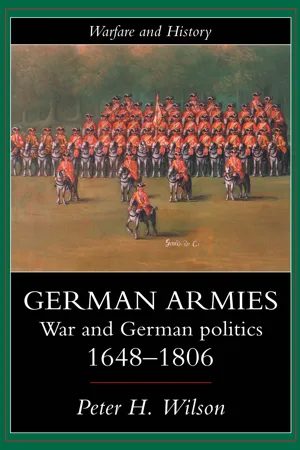
German armies examines the diversity of German involvement in European conflict from the Peace of Westphalia to the age of Napoleon. Challenging assumptions of the Holy Roman Empire as weak and divided, this study provides a comprehensive account of its survival in a hostile environment of centralizing belligerent states. In contrast to the later german states, the Empire was inherently defensive, yet many of its component territories embarked on expansionist, militaristic policies, creating their own armies to advance their objectives. The author examines the resultant tensions and explains the structure and role of the different German forces. In addition, a number of wider issues are addressed, such as war and the emergence of absolutism, the rise of Austria and Prussia as great powers, non-violent forms of conflict resolution and the relative effectiveness of German military and political institutions in meeting the challenge of revolutionary France. Drawing on a range of sources, the author provides a detailed analysis of the German dimension of the great struggles against Louis XIV's France, competition for supremacy in the Baltic and Mediterranean and the prolonged wars with the Ottoman Turks. German armies extends the boundaries of military history by placing ancien regime warfare within a wider social, cultural and international context.
Trusted by 375,005 students
Access to over 1.5 million titles for a fair monthly price.
Study more efficiently using our study tools.
Information
Subtopic
German HistoryIndex
HistoryChapter One
War and German politics
Aspects of state formation
In 1667 the German philosopher Samuel Pufendorf famously described the Reich as a “monstrosity”, because it did not fit the normal categor ies of European political science.1 Though possessed of sufficient human and material resources to hold the entire continent in awe, the Reich was scarcely able to defend itself , because it lacked the central co-ordination necessar y to har monize its disparate elements. Constant inter nal feuding, inflamed by sectar ian hatred since the Reformation, further weakened it, contr ibuting to the carnage of the Thirty Years War, which only served to widen the gap between it and its we ster n European neighbour s. Most subsequent commentators have agreed that the lack of a strong hereditary monarchy was a fundamental weakness, condemning Ger many to a largely passive international role until Prussia and Austr ia acquired sufficient power to act independently and emerge as rivals for political leadership.
Though familiar, this picture no longer stands modern scrutiny, not least thanks to a fuller understanding of French, English and Dutch development as well as revisions to Ger man history. New analytical devices, many of them borrowed from political science and social theory, have also led to a reappraisal of what constituted power and state for mation in early moder n Europe. This chapter begins by examining some of these ideas, which are then applied to Ger man political developments and their place in inter national relations. Ger man territorial fragmentation and its importance to regional politics is analyzed in the third section before concluding with an assessment of the mechanisms established before 1648 to co-ordinate collective secur ity acrossthe Reich.
States are character ized by their monopoly of powers denied to other institutions or organizations.2 Chief among these is the monopoly of violence, meaning organized coercion or military power. Creation of such a monopoly involves a process of militar ization whereby the central power not only establishes the exclusive right to wage war but creates the infrastructure necessary to do so. Vital to sustaining this is a monopoly of taxation to extract material resources from the economy and population through legally enforceable obligations. There are other monopolies, of which justice is probably the most important, enabling the state to regulate society and, depending on its application, reward clients and punish internal opponents.
Most of these monopolies are terr itorially bounded in that they apply only to the district geographical area controlled by the state. To be fully sovereign, the state must exclude all influence over its internal affairs from external agencies. Full sovereignty is attainable only in theory, and throughout Europe’s history states have been subject to degrees of external influence, most notably papal author ity over the Catholic Church. However, while the political power of one state is excluded from the territory of other sovereign states, its military power has the capacity to reach beyond its frontiers. Moreover, historically, organizations other than states have controlled coercive power, like the commercial trading companies of England and the Dutch Republic, which had their own ar mies and fleets in the seventeenth century. Establishing control over these for ms of extra-terr itorial violence is an important element of the state monopoly of military power.3
The exercise of all monopoly powers is qualified by their level of legitimacy. Histor ically, legitimacy has been a highly flexible concept, dependent on what has been ter med the “ideological power” of the political elite and the extent to which they can foster acceptance for their beliefs.4 This has never been an entirely top-down, one-way process whereby those in author ity imposed ideas on a subject population and enforced acceptance through direct coercion or manipulation of theology. Instead, legitimacy was established by a complex bargaining process as powerholders not only pushed as far as they could until they met popular resistance, but those below successfully compelled those above to take some account of their own desires. Throughout there were always people at all levels of society who disagreed with the broader consensus, expressed variously in ter ms of religious confession, social behaviour or political philosophy. The presence of such individuals ensured that the concept of legitimacy was never total but was constantly being subtly reworked, usually in opposition to, but sometimes in collaboration with, the dissenters.
If states are character ized by their possession of leg itimate power monopolies, it follows that state development is a process of monopoly for mation.This process can be broken down into three stages, the first of which involves the establishment of an undisputed fiscal-military monopoly in the hands of a recognized central author ity, generally a monarch who had defeated all other r ivals for control over a specific area.5 Most wester n European states reached this stage by the mid-fifteenth century, when the major monarchies like those of France and England had accumulated both significant executive or “despotic” power, recognized as the author ity to rule, and built up an infrastructure of royal administration sufficient to put their commands into effect.6 Their rule was still largely indirect in the sense that it was mediated by g roups and institutions enjoying considerable autonomy. In addition to assemblies or estates that claimed the right to negotiate with the king on behalf of sections of the population, gover nment also depended on an administration staffed not by salar ied professionals but men who regarded their position as a right or privilege and who were integrated as much into civil society by informal patronage networks as they were tied by loyalty to the crown. Such ties were still personal, and the state powers, as far as they had been accumulated, were still essentially a private monopoly of the monarch.7
The existence and extent of these powers remained in dispute throughout much of the sixteenth and seventeenth centur ies, a factor that accounts for much of the violent political turmoil troubling many parts of Europe, including the Thirty Years War. These internal struggles became part of the second stage of monopoly for mation, and as it became obvious that the centralization of fiscal-military power could no longer be reversed, conflict centred on efforts to control it and distr ibute the associated benefits and burdens among different social g roups. The varying outcomes of these str uggles help explain the differ ing constitutions of European states, ranging from the Dutch republican government to the limited monarchy of England and royal absolutism in France by 1660.8 Though formal power was already shifting to wider social groups in the former two cases, that of the latter and other absolute monarchies remained narrow private monopolies.
The final stage was a transition from personalized rule to wider public control, a change associated in France with violent revolution in 1789 and generally with profound consequences for the nature of the state. The state became an entity transcending the lives of individual monarchs and administrators, who became its servants rather than its “owners”. Frequently, though not necessarily always, this transition was accompanied by the move to direct rule whereby the administrative apparatus required to sustain the power monopolies was fully integrated into the state and began for the first time to penetrate the previously largely private and autonomous spheres of everyday life through ever-increasing surveillance and regulation.9
The imperial constitution and international relations
Monopoly for mation did not follow a simple path within the Reich due to a number of factors, not least the practical difficulties of establishing firm control over such a vast area. Despite considerable contraction since its fullest extent in the ninth century, the Reich still encompassed over 750,000km2 in 1648, inhabited by perhaps 18 million people, with an additional 2 million or so living in the further 65,000km2 of northern or imperial Italy (Reichsitalien).10 German politics fragmented into four distinct but related levels, and the easiest way to understand the otherwise baffling imperial constitution is to examine it on this basis.11
Unlike other European states, centralization at national level was paralleled by a similar development at that of the component terr itor ies, prolonging the medieval fragmentation of political and military power. As the emperor sought to concentrate power in his own hands as supreme overlord for the entire area, the individual territorial rulers were affecting the same within the areas under their author ity, creating two distinct levels of monopoly for mation. Control over the central mechanisms for raising money and men for common action was shared between the emperor and those princes and other lesser rulers who gained formal representation as Reichsstände (imperial estates) at national level through member ship of the Reichstag (Imperial Diet). 12 Interposed between the national institutions and the princes was the secondary level of the Kreise, or imperial circles, acting as a forum for political co-operation on a regional basis amongst groups of terr itor ies meeting in their own Kreis Assemblies. Political activity within the territories constituted a fourth level when it took place within local institutions formally recognized in the complex web of imperial law. Chief among such institutions were the territorial estates or assemblies (Landstände), composed usually of representatives from the local clergy, nobility, towns and, in rare cases, villages, who claimed roughly similar powers in respect to negotiations with their own ruler as those exercised by the princes in the Reichstag.13 Monopoly for mation at territorial level thus involved a two-way process; on the one hand of bargaining between prince and estates for access to local resources, and on the other between prince and emperor to limit interference from either Kreis or national institutions.
Power and status were unequally distr ibuted both between and within the different levels, reflecting the hierarchical character of the traditional constitution and Ger man society as a whole.14 An individual’s place within the wider framework was decided pr imar ily by birth and gender. With rare exceptions, only men had access to political power, and the level to which they could wield it var ied largely according to which social group they belonged. Though practice deviated substantially from the ideals expanded by theologians and bureaucrats, society was still divided along functional lines, segregating people according to what role they perfor med to promote the wider common good.
In the most basic sense these divisions did not differ from those in other parts of Europe once touched by Roman Catholicism. Lowest in status was that broad section of society that cor responded to the Third Estate in France. Subdivided into numerous groups on the basis of occupation and further split by region and religion, this section was united by the common function of providing for society’s material welf are and by the general absence of hereditary privileges associated with noble status. Also varying considerably in wealth, these commoners for med the bulk of the urban and rural population but had little access to formal political power beyond that at the most localized level. Most Germans lived in small communities governed by the heads of the r icher well-established families, who nor mally controlled the election or appointment of the village council and law court, except in eastern Germany, where the nobility had greater influence over these affairs. Though terr itorial rulers were trying to bring these positions under their control by integrating them into their own administrative infrastructure, most communities retained considerable autonomy over their own affairs until well into the nineteenth century. Vital elements of the fiscal-military monopoly thus ultimately rested on these patr iarchs upon whom most rulers depended to enforce orders to collect taxes, select militiamen, find recruits and billet soldiers. Though they had considerable scope in how they distr ibuted these burdens within the community, most village headmen had little say in deter mining their level, as few ter r itorial estates contained peasant representation. In compar ison, the urban population, accounting for about a quarter of Germans by 1800, was often comparatively privileged, as most major towns were entitled to send one or two members of their council to sit in the local assemblies alongside the clergy and nobility. Those free imperial cities (Reichsstädte) that had escaped incorporation within the pr incipalities continued to function as autonomous civic republics under their own magistrates also secured access to national politics by 1648.15
The clergy’s function of praying for society’s salvation gave them greater proximity to God and with it nominal social pre-eminence. They continued to recruit their members predominantly from the other social groups even after the Reformation, which introduced cler ical mar r iage into the Protestant areas. Since that time Ger man politics had been character ized by a process known as confessionalization whereby r ulers sought to establish religious unifor mity within their terr itor ies by excluding both dissenting minorities and external ecclesiastical jurisdiction as far as possible.16 As a result, there was nonational Ger man church and the Protestants created their own distinct territorial institutions, while the Catholics remained subject to varying deg rees of papal influence. Protestant clergy were subject to greater state supervision than their Catholic counter par ts, but both enjoyed considerable autonomy, and many Protestant territories retained cler ical representation in their estates as well as separate ecclesiastical foundations outside the reach of the princely treasury.
High clerics, especially in Catholic areas, were predominantly nobles who, as a group, enjoyed particular privileges associated with their nominal function as society’s warriors in addition to the wealth they derived from land ownership. Socially, the Ger man nobility belonged to the same broad group as their prince, but unlike him they lacked the special distinction of immediacy (Reichsunmittelbarkeit) indicating no other overlord than the emperor himself. Their political power der ived less from their formal representation in terr itorial estates than their informal influence through patronage and control of economic resources. Even where peasants were not tied directly to the nobles as serfs, like those in parts in northern and eastern Ger many, they were usually still bound by other feudal obligations in varying degrees of dependency and servitude.
Increasingly, the terr itor ial ruler was intruding into these relationships in ways that were to influence war making. Often the prince himself was a major landowner and der ived part of his income directly from exploitation of his own economic undertakings. In an age when state power was still largely a private monopoly, these domainal revenues formed a major source of military finance, supplemented by whatever the ruler could borrow or bargain in additional taxation from the estates. These bargains, often cemented in charters endorsed by the emperor, had consolidated the estates as a formal element of the imperial constitution since the late fifteenth century and contributed to the development of a parallel infrastr ucture to collect their tax grants and administer that portion of the prince’s debts they had agreed to amortize. Such decentralization under mined princely power and ultimately threatened terr itorial monopoly for mation, prompting moves to curb the estates’ autonomy by assuming their functions where possible within the prince’s own administration. The growth of this administration fostered the emergence of another distinct group, the state bureaucrats, who were often universityeducated and enjoyed corporate privileges marking them out within the wider society, to which they remained related by marr iage, kinship and patronage.
While the practical extent of each prince’s power depended on the outcome of these developments within his territory, his position within the Reich was determined by a combination of his formal status and material resources. Land and formal political power were related with rule over specific areas conferr ing certain rights within the imperial constitution. The first broad distinction was between those whose territorial immediacy also brought voting rights within the Reichstag (Reichstandschaft) and those who lacked this quality. All princely land (Fürstentümer) enjoyed this privilege, but those of the counts (Reichsgrafen), prelates (Reichsprälaten) and ...
Table of contents
- Front Cover
- Copyright
- Title
- Copyright
- Dedication
- Contents
- Maps
- Preface
- List of Abbreviations
- Note on Form
- Introduction
- 1 War and German Politics
- 2 From Westphalia to the Réunions, 1648–84
- 3 War on Two Fronts, 1683–99
- 4 Habsburg Strategy in Continental Conflict, 1700–21
- 5 Princely Leagues and Associations
- 6 The Reich and the European Powers, 1714–40
- 7 Between Civil War and Partition, 1740–92
- 8 The Challenge of Revolution
- 9 Conclusion: Why the Reich Collapsed
- Appendix
- Notes
- Select Bibliography
- Index
Frequently asked questions
Yes, you can cancel anytime from the Subscription tab in your account settings on the Perlego website. Your subscription will stay active until the end of your current billing period. Learn how to cancel your subscription
No, books cannot be downloaded as external files, such as PDFs, for use outside of Perlego. However, you can download books within the Perlego app for offline reading on mobile or tablet. Learn how to download books offline
Perlego offers two plans: Essential and Complete
- Essential is ideal for learners and professionals who enjoy exploring a wide range of subjects. Access the Essential Library with 800,000+ trusted titles and best-sellers across business, personal growth, and the humanities. Includes unlimited reading time and Standard Read Aloud voice.
- Complete: Perfect for advanced learners and researchers needing full, unrestricted access. Unlock 1.5M+ books across hundreds of subjects, including academic and specialized titles. The Complete Plan also includes advanced features like Premium Read Aloud and Research Assistant.
We are an online textbook subscription service, where you can get access to an entire online library for less than the price of a single book per month. With over 1.5 million books across 990+ topics, we’ve got you covered! Learn about our mission
Look out for the read-aloud symbol on your next book to see if you can listen to it. The read-aloud tool reads text aloud for you, highlighting the text as it is being read. You can pause it, speed it up and slow it down. Learn more about Read Aloud
Yes! You can use the Perlego app on both iOS and Android devices to read anytime, anywhere — even offline. Perfect for commutes or when you’re on the go.
Please note we cannot support devices running on iOS 13 and Android 7 or earlier. Learn more about using the app
Please note we cannot support devices running on iOS 13 and Android 7 or earlier. Learn more about using the app
Yes, you can access German Armies by Peter Wilson in PDF and/or ePUB format, as well as other popular books in History & German History. We have over 1.5 million books available in our catalogue for you to explore.