Violence is a male biological trait. When women fight, no one gets seriously hurt. Lesbians don't abuse their spouses. The truth revealed in Janice Ristock's groundbreaking book is that lesbian relationships sometimes do turn violent. Based on interviews with more than one hundred lesbians who have suffered abuse and seventy-five case workers, No More Secrets is the first in-depth account of this startling phenomenon. Although one in four gay and lesbian couples are affected by domestic violence, the problem has remained hidden for several reasons. By giving voice to the victims, Ristock helps women to address violence by breaking silences, sharing secrets, and naming the forms of abuse.
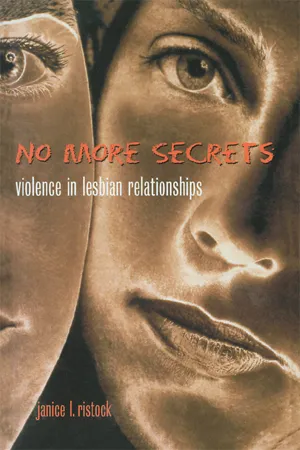
- 224 pages
- English
- ePUB (mobile friendly)
- Available on iOS & Android
eBook - ePub
About this book
Information
ONE
The Emergence of Lesbian Partner Abuse
Creating a New Category
Publicly addressing the issue of lesbian battering, while necessary, is done with the recognition that we live in increasingly repressive times. The hard-won gains of the civil rights movement, women’s movement and gay and lesbian rights movement over the past twenty-five years have been met by increasing resistance and setbacks. Many lesbians are understandably reluctant to air issues related to lesbian battering, for fear of triggering homophobic attacks on our communities. In a society where there has been no acceptance of lesbian relationships, the fears are legitimate. By discussing these issues openly we risk further repression. Yet our only alternative is one of silence, a silence that traps battered lesbians into believing that they are alone and that there are no resources available to them.
Kerry Lobel, 19861
THIS QUOTATION is from Naming the Violence: Speaking Out About Lesbian Battering, the first published book to address the issue of abuse in lesbian relationships. In many ways, we have moved beyond the silence and secretiveness that once surrounded this issue. There have now been very public education campaigns in Boston, New York, and San Francisco that include billboards and posters in subway stations with slogans stating that one in four gay and lesbian couples will experience domestic violence.2 There have been public stories that refer to same-sex partner abuse in popular magazines such as People where, for example, gay Olympic diver Greg Louganis and lesbian actress Amanda Bearse both spoke openly about having experienced physical abuse at the hands of their same-sex partner. In many major cities in the United States, Canada, the United Kingdom, and Australia, there are programs within gay and lesbian organizations and within women’s organizations to specifically respond to lesbian partner abuse. Over the past fifteen years, then, there has been a great deal of response since a few brave lesbians in the early 1980s began talking about lesbian battering within the domestic violence movement.3 Yet the words of Kerry Lobel that suggest “we risk further repression” in openly discussing lesbian battering still have relevance. Intense debates about the dangers of publicly acknowledging this issue continue as they did in the 1980s within feminist, lesbian, and queer communities. Surrounding these debates are urgent discussions about how we can best respond to lesbians who have been victimized, and lesbians who have engaged in abusive behaviors. I begin this book by providing an extensive overview of the information that we currently have on lesbian partner violence and exploring why the stakes remain so high in naming and responding to this form of abuse.
The Emergence of a New Category
Breaking silences, sharing secrets, and naming forms of violence are the acts women have undertaken as ways to address male violence. As our knowledge has increased, we have insisted that our language be more precise, moving from generic terms such as domestic violence and family violence to specific terms rooted in women’s experiences, such as wife assault, woman abuse, child sexual abuse, and date rape. Naming forms of violence within feminism is a political act of high stakes, not just semantic quibbling: it frames the way we see and understand the issues and therefore how we respond to them—whether we focus on rehabilitation of the abuser or challenge the power structures of dominant culture as causing or worsening the abuse, for example.4 There is often resistance from dominant culture to these feminist framings. For example, resistance can take the forms of not believing women when they speak of being sexually abused as children, seeing women as teasing men sexually rather than really saying no to date rape, and viewing women as vindictive liars rather than as battered wives. Yet resistance to naming abuse in lesbian relationships has occurred not only in the mainstream, but within the women’s movement.
Within the women’s movement, there have been two main forms of resistance to examining abuse in lesbian relationships: one stems from the desire to keep a focus on male violence, thereby minimizing women’s violence; the other arises from the fear that this issue will create a backlash against feminism and lesbians. The ideology that only men were violent was adopted by the radical lesbian feminist culture of the 1970s as one way of validating lesbian relationships and working against dominant constructions of lesbians as sick, perverted, or deviant. However, accepting this ideology also created the conditions to make violence in lesbian relationships into a secret or private issue, In their historical study of working-class lesbians in Buffalo, Elizabeth Kennedy and Madeline Davis show that violence in lesbian relationships used to be observed and talked about in public places such as the bars. Many fights happened in lesbian spaces, allowing other women to see the violence, intervene, and put a stop to abusive behavior. When a new ideology of violence took hold as something that men did to women, violence between lesbians became a private issue and left women who were being battered without protection from other women in the community.5 More recently, Ellen Faulkner describes a cultural feminist perspective that continues to see violence as a male biological trait, and that argues for the development of lesbian communities and ethics as a way to prevent male violence from infecting women’s culture; according to this view, women would not have this violent tendency on their own.6 This tidy logic completely sidesteps the issue of lesbian abuse that happens in this world. Because of the Utopian view of lesbian relationships still presented in some strains of feminism, many lesbians feel they will not be believed.7 Another form of disavowal happens outside the women’s movement, where there is a tendency to trivialize violence between two women as a “cat-fight.” Of course this dominant cultural view does not see lesbian relationships as Utopian, but rather sees “the fight” as trivial either because women are incapable of inflicting harm or because lesbians are trying to act in “mannish” ways. In either case, the context of the violence as occurring within an intimate relationship is most often ignored.8
A larger form of resistance emerges from the well-founded fear that public discussion of abuse in lesbian relationships will contribute to negative stereotypes that exist about lesbians and will hurt the battered women’s movement by fueling a backlash against feminism. There is still a concern among some lesbians that we need to have more conversations about violence in relationships within lesbian communities, refraining from speaking with heterosexual women until we develop our own accurate—but politically strategic—analysis. In practice, though, a common starting place for addressing abuse in lesbian relationships has been to educate mainstream services by correcting heterosexist misconceptions that understand lesbian relationships as mimicking heterosexual relationships. For example, efforts go into dispelling assumptions that abuse occurs mainly in “butch/femme” relationships in which the butch is the batterer and the femme is the victim, as well as more subtle misconceptions that suggest that abuse occurs only in nonfeminist lesbian relationships.9 In other communities there is a concern that the category “lesbian partner abuse,” should be broadened to “woman-to-woman abuse” which would take the limiting emphasis off lesbians, be more inclusive of bisexual and queer women,10 and force all women to look at their own propensity for violence. These kinds of debates remain grounded in the concern about the dangers of acknowledging this issue and grounded in the discursive opportunity to construct a “new” category of abuse that is at once accurate, meaningful, and politically astute.
Perhaps the biggest source of resistance from feminist communities in general is that acknowledging lesbian abuse will threaten a dominant feminist analysis of violence against women in intimate relationships, which most often assumes a male perpetrator and sees the roots of violence in patriarchy and misogyny.11 Gender and power are the main components of this perspective. With this analysis lesbian abuse is either seen as an impossible contradiction in terms, or lesbian violence is explained within a theory of male domination and internalized misogyny and homophobia, where a lesbian has to be seen as tainted by male cultural influences for the analysis to fit. Preserving a gender-based analysis has been a central concern of the women’s movement as we have tried to confront the overwhelming level of male violence against women. To avoid disturbing this analysis, when we acknowledge lesbian abuse we keep our focus primarily on the victims and plug lesbian abuse into the theories we have developed to explain heterosexual abuse. This additive approach does allow for a recognition of different categories of abuse: lesbian abuse/heterosexual abuse/woman of color abuse/women with disabilities abuse. Yet it falsely compartmentalizes women’s experiences while leaving in place a homogenizing foundation that all forms and causes of abuse are the same.12 The primacy of a gender-based analysis in feminism does not mean we are selectively keeping secrets, as the title of this volume might suggest, but it has meant we can be reticent about revealing things that disrupt our efforts to create seamless, unitary understandings of violence. Although my work in this volume offers a critique of this tendency within feminism (a movement I am a part of), I understand the fortitude at work and the desire to create a sturdy “regime of truth” in the face of both male violence against women and antifeminist backlash efforts.
Backlash against Feminism
Within Canada and the United States there has been a specific backlash against feminist research and activism on male violence against women.13 This countermovement defines itself as “pro-family,” idealizing traditional, patriarchal, heterosexual normative models of the family. Feminists are accused of exaggerating the rates of men’s violence against women14 and of promoting the false view of woman as innocent victims.15 A key tactic in challenging feminist research is to say that “women do it too” or that “women are just as bad as men.”16 In the 1990s, several popular texts by backlash writers focused on examples of women as perpetrators of violence as a way to expose a gender bias in feminist scholarship, claiming we cannot use gender as part of our analysis to understand the dynamics of battering relationships because it presents a limited view in which women are seen only as good/victims and men are seen only as bad/perpetrators. Several of these texts use the example of abuse in lesbian relationships to support their arguments against feminist research and analyses of violence.
In the book Who Stole Feminism, Christina Hoff Sommers mentions lesbian abuse studies as an example of scholarship that could help shed light on the dynamics of battering relationships but claims it is ignored by gender feminists (her term for feminists who believe women are oppressed by a male hegemony). She refers specifically to the research of Claire Renzetti,17 which she says suggests that violence in lesbian relationships occurs with about the same frequency as violence in heterosexual relationships. Sommers then concludes that “once again, it appears battery may have very little to do with patriarchy or gender bias. Where non-criminals are involved, battery seems to be a pathology of intimacy, as frequent among gays as among straight people.”18
Similar to the view of Sommers is the work of Canadian Donna Laframboise in The Princess at the Window, which is particularly critical of the report prepared by the Canadian Panel on Violence Against Women. Laframboise feels this government-sanctioned panel constructed a politically biased report that claims that men’s violence is always an example of “deliberately carrying out a political agenda of oppression whenever they mistreat female persons.”19 She argues that women who are violent are held to a different standard and using the example of lesbian abuse, raises the question, “why do lesbians who batter other lesbians get to blame it on the stress that a society hostile to lesbians places them under? What is so unique about this sort of pressure that nothing remotely approximates it?”20 To support her argument of double standards for men and women, she quotes directly from the report:
Although research into the incidence and prevalence of lesbian battering is virtually non-existent in Canada, women who spoke to the panel contend that it is the result of institutionalized heterosexism which isolates lesbians and adds pressure to their relationships.21
Laframboise acknowledges that this is one form of women’s violence that the report discusses, but is critical of the fact that the Panel ignores research done in the United States, which she says suggests that lesbian abuse is just as prevalent as heterosexual abuse. Laframboise concludes that lesbian battering is excused as an example of women being doubly oppressed by patriarchy and homophobia; and lesbian batterers are not held accountable in the same way that men are. (She also applies this discourse of “double standards” to people of color who have used violence.) In her view, oppression is used as an excuse for violent behavior. She cannot imagine an analysis of violence that would include both individual accountability and systemic oppression, and seems to want to jettison any political analysis altogether.
Finally, Patricia Pearson, a journalist who is critical of second wave feminism for ignoring examples of women’s violence and insisting on women’s stance as victims, also raises the issue of lesbian abuse to make her case. She even shows concern for gay and lesbian communities in bringing forward this example of violence:
Feminists who refuse to admit that heterosexual women can be violent leave the gay community by itself out on a limb, vulnerable to further slander by self-appointed keepers of public morals. There is a long tradition in our culture of depicting aggressive or criminal women as sexually perverse. That link can only be fortified if feminists refuse to concede straight women’s violence, forcing lesbians to appear as the only ones who abuse.22
Her review of research on lesbian abuse is far more extensive than that of Sommers or Laframboise, and she presents some of the findings that challenge a feminist analysis of violence. For example, she says relationship violence cannot be understood in terms of male social and economic power because in many abusive lesbian partnerships it is the woman with the higher earning power and self-esteem who gets assaulted (again based on Claire Renzetti’s work). She also reports on the pattern of some abused lesbians becoming abusers in other relationships (something my research has also confirmed23) as another example that goes against the gender-power theory of violence. Pearson’s critique, then, raises some interesting questions about the nature of power, and the meaning of the discrete categories, perpetrator and victim. Yet, she too, like Sommers and Laframboise, relies on Renzetti’s work to make a definitive claim that violence in lesbian relationships occurs with the same frequency as violence in heterosexual relationships, and adds “with the smaller, more conventionally feminine partner often being the one to strike” to emphasize her point that feminine female abusers exist.24
Although some of these writings may be provocative as challenges to a dominant feminist analysis of violence, they remain intent on using lesbian abuse to show that “women are just as bad as men” rather than to actually work on the problem of lesbian relationship violence (with the momentary exception of Pearson). Nor are they interested in widening t...
Table of contents
- Cover Page
- Half Title page
- Title Page
- Copyright Page
- Dedication
- Contents
- Preface
- The Emergence of Lesbian Partner Abuse Creating a New Category
- Troubling Tales Telling Stories, Exposing Language, Raising Questions
- A Material Tale Telling Stories
- What the Body Remembers Lesbians' Experiences of Relationship Violence
- An Innocence Lost Responses to Violence
- A Discursive Tale Exposing Language
- What's Written on the Body
- The Politics of Responding to Violence in Lesbian Relationships
- A Reflexive Tale Raising Questions
- Looking Forward
- Notes
- Bibliography
- Index
Trusted by 375,005 students
Access to over 1.5 million titles for a fair monthly price.
Study more efficiently using our study tools.
Frequently asked questions
Yes, you can cancel anytime from the Subscription tab in your account settings on the Perlego website. Your subscription will stay active until the end of your current billing period. Learn how to cancel your subscription
No, books cannot be downloaded as external files, such as PDFs, for use outside of Perlego. However, you can download books within the Perlego app for offline reading on mobile or tablet. Learn how to download books offline
Perlego offers two plans: Essential and Complete
- Essential is ideal for learners and professionals who enjoy exploring a wide range of subjects. Access the Essential Library with 800,000+ trusted titles and best-sellers across business, personal growth, and the humanities. Includes unlimited reading time and Standard Read Aloud voice.
- Complete: Perfect for advanced learners and researchers needing full, unrestricted access. Unlock 1.5M+ books across hundreds of subjects, including academic and specialized titles. The Complete Plan also includes advanced features like Premium Read Aloud and Research Assistant.
We are an online textbook subscription service, where you can get access to an entire online library for less than the price of a single book per month. With over 1.5 million books across 990+ topics, we’ve got you covered! Learn about our mission
Look out for the read-aloud symbol on your next book to see if you can listen to it. The read-aloud tool reads text aloud for you, highlighting the text as it is being read. You can pause it, speed it up and slow it down. Learn more about Read Aloud
Yes! You can use the Perlego app on both iOS and Android devices to read anytime, anywhere — even offline. Perfect for commutes or when you’re on the go.
Please note we cannot support devices running on iOS 13 and Android 7 or earlier. Learn more about using the app
Please note we cannot support devices running on iOS 13 and Android 7 or earlier. Learn more about using the app
Yes, you can access No More Secrets by Janice Ristock in PDF and/or ePUB format, as well as other popular books in Social Sciences & Sociology. We have over 1.5 million books available in our catalogue for you to explore.