![]()
Part I
Traditions and transformations
![]()
1
Scripture in the modern Muslim world: the Quran and Hadith
Jonathan Brown
Introduction: modernity and the global challenge to scripture
The pre-modern heritage of scripture in Islam
Setting the stage for modern Islamic thought
Modern Muslim schools of thought on scripture
Islamic modernists
Modernist Salafis
Traditionalist Salafis
Late Sunni traditionalists
Conclusion
Introduction: modernity and the global challenge to scripture
Jews, Christians and Muslims all believe in sacred scriptures, books that claim in some way to be the inspired word of God and truth itself. These scriptures tell stories of the past, often predict events of the future and instruct man on the nature of faith and morality. Beyond the pages of these books, however, lies the reality of the outside world. Today, our understanding of this reality makes powerful claims about what can and cannot have happened in the past, about the nature of the cosmos and about what is fair or moral. What happens when the sacred book and the world seem to contradict one another? Which one convinces us, and how do we maintain belief in scripture or reconcile its message with the outside world when a conflict arises? This, in a nutshell, is the problem of scripture in the modern world.
For Western civilization, this tension between the truth of scripture and the reality of the world came into sharp contrast with the emergence of modernity in the eighteenth century, and this challenge has spread globally as modernity has gradually transformed new regions. For Muslims, the challenge to scripture was imposed from the outside with the coming of European colonialism and the sudden economic, political and social changes that it introduced. For Muslims, the problem of scripture in the modern world has thus presented itself not only with a jarring abruptness but also in the context of foreign cultural and political domination. Muslim debates over scripture and how it should be read in recent history have thus swirled around the contending themes of “tradition,” “modernity,” “the West,” reform and cultural authenticity.
The pre-modern heritage of scripture in Islam
Islamic thought is a universe in which precedent and tradition carry tremendous weight. As such, understanding how Muslims approach scripture today must take into account how they understood it in the pre-modern period. Islam holds that God revealed two bodies of knowledge to the Prophet Muhammad. The first, the foundational scripture, was the revealed book of the Quran, the direct words of God sent down to Muhammad via the angel Gabriel. The second was Muhammad’s authoritative precedent, his Sunna, the divinely inspired lifestyle and teachings that explained and implemented the Quran’s message.
The Quran was not revealed all at one time. Muslims believe that God sent it down piecemeal over the 23 years of Muhammad’s prophetic career, often to address the needs or questions of the Muslim community. After the Prophet’s death in 632, the Quran was compiled and eventually promulgated around 650 in an official edition by a committee of learned Muslims appointed by the caliph Uthman, the third leader to succeed Muhammad. Although there are some variations in pronunciation and occasionally some minor differences over wording, the Quran as compiled by Uthman is and has been the Quran known and used by Muslims worldwide.
Unlike the Quran, the Sunna of Muhammad was not originally compiled in book form. Muhammad’s followers understood his Sunna as the totality of his words, deeds, attitudes and approaches to questions of faith, lifestyle and law. As the Muslim community spread throughout the Middle East, different schools of thought appeared with contrasting ideas of how best to understand the Sunna. One group, known later as the Partisans of Tradition, believed that the Sunna should be known primarily through individual reports, called Hadiths, describing in detail the Prophet’s words and deeds. Another group, later known as the Partisans of Reason, believed that, while Hadiths were important, the Sunna is best known through the living tradition of practice and problem-solving inherited from Muhammad’s followers.
The Partisans of Reason had important concerns. Unlike the Quran, which was compiled soon after the Prophet’s death and was agreed upon by all Muslims, the Hadiths were not written down systematically for a century. It was not long before Hadiths began appearing in the thousands. Some were clearly forgeries made up by the various sides in the severe political and sectarian rifts that opened up within the Muslim community in the century after Muhammad died. Although the Partisans of Reason were happy to act on Hadiths if they were well-known and authentic, they preferred their deductions based on the Quran and the rulings of the early Muslim community to uncertain Hadiths. The Partisans of Tradition, however, felt that Muslims had to stick closely to the revealed teachings of Muhammad in order to preserve the true and untainted message of Islam. They developed a method of sorting through Hadiths in order to sift the forged from the authentic ones. This method centered on demanding a chain of transmission (isnad) for each Hadith, then evaluating whether each person in this chain was reliable, whether he or she had really heard it from the supposed source, and how well corroborated the report was. Beginning in the late 700s, followers of this school of thought compiled the Hadiths of which they approved into written collections. For Sunni Muslims, six collections produced in the ninth century became particularly authoritative. The most famous are the Sahihayn (The Two Authentic Books) of al-Bukhari (d. 870) and Muslim (d. 875). In Imami Shiism, four books became the authoritative references.
The Quran and the Sunna provided the basis of Islamic law and theology. This was true for both Sunni and Shiite Muslims, although they differed greatly on how the Sunna should be understood. For Sunnis it was through Hadiths and the derivation of law by the Ulama, or Muslim scholars. For Shiites it was through the teachings of the Imams, or descendants of the Prophet who inherited his infallible understanding of God’s message and whose teachings were then built on by Shiite Ulama.
In Sunni Islam, Hadiths would become the major source of Islamic law and dogma. The Quran contained only a small amount of information about Islam’s ritual and law—even the famous five daily prayers are not specified in it. Important elements of Islamic dogma, such as the existence of an Antichrist and the second coming of Jesus, also are only explicitly known from Hadiths. For Sunnis, Hadiths could add to, explain and even overrule Quranic verses (since the Prophet might change a ruling over time or simply explain a Quranic verse in a way that changed its evident meaning).
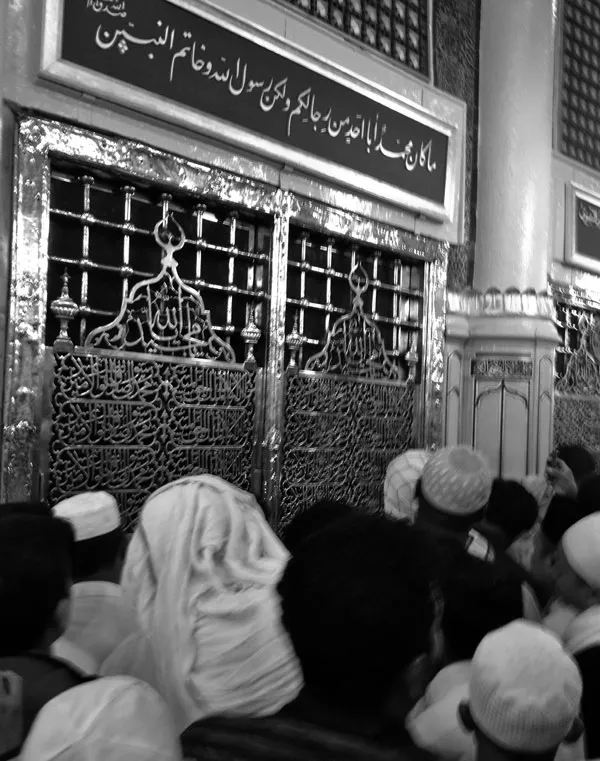
Figure 1.1 Muslim pilgrims visiting Muhammad’s tomb in Medina follow the tradition of saying “Peace be upon you” to him. Courtesy of Jonathan Brown.
Another pillar of Sunni interpretive activity was the concept of ijma’, or consensus. Sunni scholars believed that, since the Prophet had said in a Hadith that “My community will never agree in error,” if the Ulama came to a consensus on a particular stance then that stance was known with as much force and certainty as the word of God itself. Consensus has been crucial for Sunni law and dogma. The requirement for Muslim women to cover their hair, for example, is not explicitly mentioned in the Quran and only appears in unreliable Hadiths. But it is agreed upon by the Ulama, so it has long been considered established law.
Submission to Hadiths was a central tenet of Sunni Islam. Even if a Hadith seemed implausible or seemed to contradict the Quran, if the chain of transmission was authentic, Sunni scholars would accept it. Another school of theology that emerged as a competitor to Sunni Islam in the eighth and ninth centuries, however, was far more skeptical. Known as Mutazilism, this school would not accept a Hadith if it contradicted reason or compromised what they understood to be the Quranic vision of Islam. For example, Sunnis and Mutazilites disagreed vehemently about a Hadith in which the Prophet tells that during the last third of the night God descends to the lowest heavens to answer the prayers of believers. Mutazilites objected that if God moves then God must have a body, and that is unacceptable anthropomorphism. Sunnis maintained that man has no right to question the Prophet’s pronouncements. In another Hadith that Sunnis upheld, the Prophet tells his followers that if a fly lands in their drink, they should submerge the fly fully and then take it out and drink. The Prophet explains that if there is disease on one wing of the fly, on the other is the cure. Mutazilites rejected this because they doubted that Muhammad could know such things.
It may seem that I am spending too much time on Hadiths. What about the Quran in classical Islamic thought? The Quran was the touchstone of all Muslim piety and doctrine, but it was always understood through the Sunna (however Sunnis, Shiites and groups within these two sects might define it). Early on, Sunni Muslims declared that it is the Sunna that rules over the Quran, not the Quran that rules over the Sunna. The Mutazilite school of theology disagreed. It believed that only the historical certainty of the Quran should be the basis for Islamic beliefs, but this school was eclipsed by Sunni Islam in the ninth century.
Even the way that the Quran was read and understood was often dictated by the Sunna and the circumstances of the Prophet’s life. Muslim scholars did not read Quranic verses in a vacuum or assume that their meaning was independent of context. They relied on identifying the “occasions of revelation (asbab al-nuzul)”, or the situations in which and the causes for which Quranic verses were revealed. They also asserted that verses of the Quran revealed later in the Prophet’s career could overrule or adjust instructions given in earlier verses, a phenomenon known as abrogation (naskh).
In one sense, this attention to context and development was essential. Many Quranic verses only make sense when taken in the context of specific circumstances, debates or battles of the Prophet’s life. For example, the context of revelation alerted Muslim scholars that the verse “Fighting has been prescribed for you though it be hateful to you” (Quran 2:216) was only directed at the Prophet and his companions at a certain point in their conflict with the Meccans. It was not a general commandment to fight for all time. Other verses of the Quran clearly mark a chronological development in Islam’s teachings—such as a series of verses that first merely discourage drinking wine but then later prohibit it.
Because there were sometimes many Hadiths and reports about when and why a Quranic verse was revealed, Muslim scholars often came to different conclusions about what verses of the Quran meant. For example, one verse states “There is no compulsion in religion” (Quran 2:25). Some medieval Muslim scholars held that this verse was revealed by God to the Prophet as a general principle: people had to be free to choose their beliefs. Others believed that the verse was revealed as a response to a particular episode during the Prophet’s life, in which a Muslim family’s child decided to become Jewish. In this interpretation, the verse was only a commentary on this one case; it was not an order for Muslims to respect people’s freedom of religion in general. Another group of scholars held that this verse had been superseded by a later verse ordering the Muslims to fight the unbelievers. The challenge of looking at the varied Hadiths, “occasions of revelation” and instances of naskh led Muslim scholars to write huge Quranic commentaries. Known as tafsir, this was a popular genre of Muslim scholarship.
The meaning of the Quran was also strongly influenced by Muslim scholars’ intensive study of the Arabic language. Like the circumstances of revelation, the meaning of Arabic words at the time of the Prophet controlled interpretation of the Quran. Muslim scholars believed that language, especially Arabic, was divinely bestowed upon mankind, and the meaning of Quranic words was thus firm and decreed. Once a Muslim scholar had studied the language and occasions of revelations of a verse, the meaning of the verse was set.
Setting the stage for modern Islamic thought
Modern Islamic thought has been formed by two main forces, one internal to the Muslim community and one external. Modernity, which we discussed briefly above, is an economic, political, social and intellectual transformation that began in Britain and Western Europe and has been transforming the globe ever since. For Muslims from Constantinople to Delhi, modernity did not emerge organically within their own societies as it did in Europe. It was imposed through European colonialism. The force of British, Dutch and French arms brought many of the Muslim peoples of India, Southeast Asia and North Africa under European rule by the early 1800s. Muslims, long confident in the might of their armies and their station as the adherents of God’s true religion, were faced with the overwhelming technological and economic superiority of nonbelievers. The order and advancement of European societies was undeniable, and Muslims were faced with the daunting question “If we are following God’s true religion, why are we behind? Is it due to a flaw in Islam or to some failing in how we Muslims understand and practice our religion?” Answering these questions, Muslims had to decide, if they had strayed from the true understanding of Islam, how much should modernity and the ways of the West be taken into account in charting a course back to greatness? Muslim scholars and intellectuals have pondered these questions until today.
The second major influence has been internal and emerged totally separate from interactions with Europe. In the mid-1700s, in areas such as central Arabia and India that had previously been marginal in the Muslim world, powerful movements of revival and reform appeared. Although distinct from one another, these movements shared a common idea that the Muslim community had lost touch with the untainted, theologically pure Islam of the Prophet and the early Muslim community. The cultural influences of the Greek and Persian worlds had adulterated Muslim thought with an obsession with formal logic and mysticism. Rigid schools of law and Sufi brotherhoods had become fossilized churches in a religion that should erect no barrier between man and God and should be based on a loyalty to the Quran and Sunna alone. Some of these revival movements were scholarly, like that of the Indian scholar Shah Wali Allah (d. 1762...