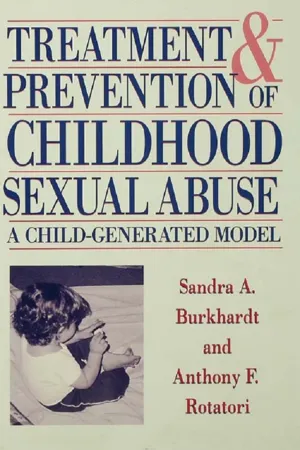
eBook - ePub
Treatment And Prevention Of Childhood Sexual Abuse
- 220 pages
- English
- ePUB (mobile friendly)
- Available on iOS & Android
eBook - ePub
Treatment And Prevention Of Childhood Sexual Abuse
About this book
This practice-oriented book provides a model of intervention for sexually abused children. Its approach is that intervention strategy should be based on child-generated information. Models of intervention based on adult-generated information are ineffective - simply because children do not have the cognitive capability of utilising such strategies to prevent or stop abuse. In contrast, therapeutic strategies presented in this text emphasising child-generated information enable the clinician to assess and understand the vulnerability of sexually abused children in regards To Their Cognitive Level Of Understanding And Their Emotional Reactions.; The book guides mental health professionals to: acquire information about what and how children think about adults, in general, and perpetrators in particular; inventory children's own strategies for responding to perpetrators; document children's underlying logic for the strategies they identify; and use the information provided by children to guide the selection of treatment and prevention techniques.; After the introduction of the topic, the book moves on to a discussion of the correlates of child sexual abuse. Information on a systematic research endeavour examining victim vulnerability is then presented, as well as children's responses to perpetrators. Other chapters focus on the Burkhardt child- generated model of sexual abuse intervention and procedures for assessment. Finally, the appendix provides a description of educational and psychological materials on child sexual abuse which can be used for prevention and intervention.
Information
Chapter 1
Toward an Understanding of Childhood Sexual Abuse
Even as the question Why are children sexually abused? remains unanswered, caring adults are eager to understand how children are victimized. Identifying the complex psychological, social, and physical factors that contribute to children's vulnerability to sexual abuse may be essential to successful prevention and treatment efforts. Understanding childhood sexual abuse may begin with defining abuse, but rapidly mobilizes a desire to halt that which is being defined.
Aimed at promoting and preserving public health, sexual abuse interventions, like other prevention efforts, can be categorized as primary, secondary, and tertiary prevention (Felner, Jason, Moritsugu, & Farber, 1983; Goldston, 1977). Primary prevention of childhood sexual abuse involves preventing abuse from happening in the first place. Secondary prevention includes early detection and reporting of perpetrators for the purpose of stopping the perpetrator and minimizing negative effects for the child. Tertiary intervention focuses on the treatment of abused children and adults who have developed signs and symptoms of distress. In general, prevention programs, such as school-based “stranger awareness” presentations and reporting hotlines, are aimed at primary and secondary prevention. Professional and self-help therapies, such as individual psychotherapy, support groups for incest survivors, and residential programs for offenders, are examples of tertiary care.
Prevention of childhood sexual abuse has proved a difficult task with unreliable outcomes (Daro, 1991; Melton, 1992b; Pelcovitz, Adler, Kaplan, Packman, & Krieger, 1992). Treatment of victims and perpetrators, based on a range of theories and opinions, has proceeded without consensus regarding the therapeutic goals to be achieved and the methods to be employed. Effective treatment of perpetrators has not been reliably accomplished (Furniss, 1991), and clinical populations include substantial numbers of adults who were sexually abused as children (Green, 1993). These findings suggest a pressing social need to better understand childhood sexual abuse.
Both the popular press and professional literature are filled with surveys, studies, and speculations about the causes, effects, and implications of childhood sexual abuse. Recent developments regarding retrieval of repressed/false memories, celebrity disclosures of childhood sexual abuse, and horrid headlines of murder and mayhem have pitted parents against their adult children, therapists against family members, and professionals against each other. Challenges and debates regarding society's awareness of and response to childhood sexual abuse have emerged (Olafson, Corwin, & Summit, 1993). Disputes over the veracity of victims’ reports, the use of unproved treatment methods such as hypnosis, and the possibility that childhood sexual abuse provides legal justification for the killing of the perpetrator remain unresolved (e.g., Goldstein, 1992; Yapko, 1993).
Amid the adult posturing, the children's views are seldom heard. A child-generated model of sexual abuse intervention studies the phenomenon of childhood sexual abuse from the child's perspective. A child-generated model maintains that understanding how children reason about themselves and perpetrators is essential to effective prevention and treatment of sexual abuse. In contrast to models that stem from adults’ ideas and observations about what children should know, a child-generated model seeks to understand what a child can know. Understanding sexual abuse from a child's perspective begins with an overview of the terms and concepts associated with childhood sexual abuse.
DEFINING CHILDHOOD SEXUAL ABUSE
In 1978, the National Center on Child Abuse and Neglect (NCCAN) defined childhood sexual abuse as follows:
Contacts or interactions between a child and an adult when the child is being used for the sexual stimulation of the perpetrator or another person. Sexual abuse may also be committed by a person under the age of 18 when that person is either significantly older than the victim or when the perpetrator is in a position of power or control over another's child, (p. 2)
This definition of childhood sexual abuse includes a variety of activities perpetrated by relatives (intrafamilial abuse) or unrelated adults (extrafamilial abuse), such as strangers, neighbors, community helpers, or friends. Definitions of specific sexually abusive activities, including exhibitionism, child pornography, and child prostitution, appear in chapter 6. Yet beyond technical definitions of who is doing what to whom is the implication that children are vulnerable to perpetrators in psychological as well as physical ways.
The NCCAN definition notes that a child “is being used.” Wurtele and Miller-Perrin (1992) observed that “... sexual abuse involves the exploitation of children's ignorance, trust, and obedience” (pp. 5–6). Thus, one would expect to find children's reactions to perpetrators filled with confusion, mislaid loyalty, and automatic compliance with authority figures. If, as Wurtele and Miller-Perrin maintained, definitions of childhood sexual abuse are “culture-bound” and “direct reflections of the values and orientations of communities and societies at large” (p. 3), one would expect children's views of sexual abuse to reflect a “subculture of childhood” characterized by knowledge, beliefs, actions, values, and hopes shared by most children.
How are children to develop an understanding of sexual abuse? For example, sexual abuse is frequently referred to as “bad touch,” with little or no emphasis on the sexual nature of sexual abuse (Finkelhor & Strapko, 1992; Melton, 1992a). Children may be unaware that the physical contact associated with “bad touch” is considered “bad” because it is stimulating to the perpetrator (Wurtele & Miller-Perrin, 1992). Children may be unaware of any difference between the “good” feeling of sexual arousal and the supposed “bad” feeling of sexual abuse (Melton, 1992b). Adding to this confusion is the possibility that, as in the case of intrafamilial abuse, the perpetrator is a known and, often, loved caregiver.
An illustration of some forms of intrafamilial sexual abuse suggests why both children and adults have difficulty understanding childhood sexual abuse. Lawson (1993) described five different types of intrafamilial sexual abuse, including mother-son incest. The first type is subtle abuse, which is defined as behavior that is not intended to be sexual or harmful to the child, yet in some way gratifies the perpetrator's sexual needs “at the expense of the child's emotional or developmental needs.” This type of abuse does not involve coercion, and it may or may not involve genital contact. Instead, some parents may believe that their child needs special attention, or that their behavior is simply an expression of parent–child love.
The second type of child abuse is seductive abuse, defined as sexual stimulation that is inappropriate for the child's age and is motivated by the perpetrator's sexual needs or desires. This type of abuse includes seductive posing or gestures, allowing a child to see nude and/or sexual displays, or verbal arousal.
The third type of abuse is perverse abuse, defined as behavior that is intended to sexually humiliate the child. This abuse may include taunting a child about his or her development during puberty, implanting fears about sexual preference in the child, or forcing the child to wear or do things typically associated with the opposite sex.
The fourth type of abuse is overt sexual abuse, defined as direct sexual contact between the perpetrator and the child. This abuse includes intercourse, digital penetration, or fondling, and it involves some type of coercion.
The fifth type of abuse is sadistic sexual abuse, defined as any sexual behavior that is also intended to physically harm the child. Lawson gave an example of this type of abuse: a boy whose mother sodomized him with a broomstick. He later became a serial killer of women.
Should children be prepared for all the complex, confusing, perverted realities that childhood sexual abuse encompasses? Limited understanding of sexual abuse can leave children unprepared to respond to a perpetrator, yet too much information may deprive them of the safe and secure feelings that they deserve during childhood. Alerting children to the existence of “bad touch” may seem a reasonable compromise between dangerous lack of awareness and brutal overexposure to concepts that alarm even adults.
PREVALENCE OF CHILDHOOD SEXUAL ABUSE
For sexual abuse involving contact between the victim and perpetrator, reported prevalence rates for children under the age of 18 range from 7% to 45% for females and 3% to 5% for males. Other noncontact estimates range from 10% to 62% for females and 3% to 16% for males, depending on the sample population and definition of abuse (i.e., Bolton, Morris, & MacEachron, 1989; Faller, 1989; Finkelhor, 1984; Green, 1993; Russell, 1983; Whitcomb, 1992; Wurtele & Miller-Perrin, 1992). Ratios of girl:boy victims range from 2:1 to 10:1 (e.g., Finkelhor, 1986; Green, 1993).
VULNERABILITY TO CHILDHOOD SEXUAL ABUSE
Melton (1992a) noted that sexually abused children and their families have few features in common. To distinguish between individual traits and environmental forces that contribute to the occurrence of childhood sexual abuse, a distinction is made between vulnerability and risk factors. Vulnerability is defined as a characteristic of the child, such as small stature, naivety in social reasoning, or feeling lonely, that increases the likelihood that the child will become a victim. Risk factors are defined as situations in the environment that increase the likelihood that the child will be exposed to a perpetrator, such as living in a single-parent home or having a parent who was molested as a child.
Finkelhor (1986) proposed four preconditions necessary for the occurrence of childhood sexual abuse: factors within the perpetrator, the child, the family, and society. Factors within the child include lack of knowledge regarding sexual behavior, hunger for attention, low self-esteem, emotional neediness, and insecurity. Other risk factors include membership in a discordant family, lack of supervision, emotional estrangement from parents, marital conflict involving uneven power distribution between husband and wife, the sexual milieu of the family, isolation of the family, and characteristics of the mother, such as being absent, physically sick, mentally ill, or working outside the home.
Children are particularly vulnerable to incest. Survivors’ reports of incest include references to the trickery, deception, coercion, persuasion, and betrayal experienced by children at the hands of a parent or parent figure (Armstrong, 1978; Bass & Davis, 1988; Poston & Lison, 1989). Survivors frequently report feelings of powerlessness in response to a related perpetrator and confusion about whether the sexual activity is some sort of special attention, punishment, or game.
Incest is more likely to occur in households in which the mother was a victim of childhood sexual abuse (Gomes-Schwartz, Horowitz, & Cardarelli, 1990; Goodwin, McCarty, & DiVasto, 1981). Another risk factor is alcohol abuse by the perpetrator (Abel et al., 1987; Finkelhor, 1984). Risk of mother-son incest increases for a boy in a single-mother or lower income household (Banning, 1989). For boys, risk factors associated with being molested outside of the home include: low-income household, divorced parents, neglectful parents, history of runaway, and drug or alcohol use.
Research resulting from the increased reporting of male victims of child sexual abuse has identified potential vulnerabilities and risk factors for boys. For example, Banning (1989) and Vander Mey (1988) determined that, in terms of recognizing and resisting female perpetrators, boys may be vulnerable because early sexual activity for males is viewed as “good experience.” In terms of reporting the abuse, boys’ vulnerability may be increased due to socialization: to be macho and not show pain, referred to as the “I'm fine” syndrome. Furthermore, boys face negative social consequences for reporting same-sex and incestuous activities, which violate existing taboos.
The occurrence of childhood sexual abuse exposes children's vulnerability in interactions with adults. Melton (1992a) argued for interpretation of children's vulnerability based on knowledge of normal child development. For example, one area of research related to child development focuses on how children acquire trust. Interpersonal trust has been defined as “a child's confidence that a person's verbal and nonverbal communications accurately represent, or correspond to, internal states and external events,” and includes the child's “sensitivity to lying, deception, and promise violation” (Rotenberg, 1991, pp. 1–2). Bugental, Kopeikin, and Lazowski (1992) determined that children under the age of 7 averted their eyes from the faces of strangers displaying deceptive smiles while continuing to gaze at authentic smiles. By age 10, children ignored deceptive smiles and displayed greater interest in authentic smiles. The authors suggested that the older children understood the false, “polite” smile to be a common, minor social deception, whereas the younger children were confused by a “polite” smile and responded with social avoidance. The authors concluded that the older children's responses reflected “increased understanding of the significance of these two types of smiles” (p. 75). Girls demonstrated the ability to make this distinction earlier than boys. Abused children at all ages in the Bugental et al. study displayed eye aversion to polite smiles.
Such findings suggest that a child's understanding of social interactions with adults undergoes changes throughout childhood, and that the quality of the adult– child interaction may have a profound effect on a child's chances for normal development. At least two implications of the findings related to social development are relevant to a discussion of childhood sexual abuse. First, the findings suggest that any child may be easy prey for perpetrator deception due to children's undeveloped interpersonal capabilities. Second, abuse, including sexual abuse, may be associated with negative effects for victims, not only in terms of emotional development, but also in the realm of cognitive development, including social reasoning, interpersonal trust, and social inference (Bugental et al., 1992).
AGE FACTORS PERTAINING TO CHILDHOOD SEXUAL ABUSE
A child's age plays an unclear role in terms of vulnerability to sexual abuse. Childhood sexual abuse has been perpetrated on infants as young as 3.5 months, and has been reported for individuals reaching age 18, at which time they are no longer considered children. The modal age of sexual abuse onset is reportedly around 10 (Peters, Wyatt, & Finkelhor, 1986); the mean age for reporting sexual abuse is also reported to be between 9 and 11 (Gomes-Schwartz et al., 1990). Reports of prevention education efforts suggest that children become less vulnerable to sexual abuse as they grow older (Wurtele & Miller-Perrin, 1992). Daro (1991) stated that perpetrators may target younger children because these children more readily maintain secrecy. Adding to the uncertainty about risks and vulnerability associated with age is the necessary distinction between when abuse occurs and when a child reports that abuse, or when the abuse is detected. Because many instances of sexual abuse, particularly incest, involve ongoing and escalating activity, the onset of the abuse may precede the reporting or detection of the abuse by many years.
Age may affect childhood sexual abuse in at least two ways. First, increasing age for children is likely to bring decreasing supervision, with older children unsupervised more often than younger children and younger children more likely to be under constant adult care. Thus, younger children may risk being sexually abused by caregivers, such as parents, baby-sitters, and relatives. Older children may be at increased risk for abuse by strangers and acquaintances, such as neighbors, coaches, group leaders, and so on. Second, age is correlated with increased knowledge and awareness of sexual abuse (Wurtele & Miller-Perrin, 1992). Younger children may be abused, but be unaware of the implications of abuse or a need to report:
Developmental variables also contribute to delayed disclosure. Because of their naivete, young children may not know that the activity is wrong or they may lack the verbal ability to report an incident; older children may be too embarrassed to report. Young children's tendency to accommodate to the demands of adults (Summit, 1983) makes it likely that they will participate in the activity and keep the secret. (Wurtele & Miller-Perrin, 1992, p. 16)
Secrecy is a prevalent feature of childhood sexual abuse. Victims do not report their abusers, families do not report the occurrence of incest, and abuse is hidden from extended family, friends, and the community. Only a small percentage of victims may reveal sexual abuse during childhood. For example, Summitt (1983) reported 2% of females experiencing intrafamilial abuse and 6% experiencing extrafamilia...
Table of contents
- Front Cover
- Half Title
- Title Page
- Copyright
- Contents
- Foreword
- Preface
- CHAPTER 1: Toward an Understanding of Childhood Sexual Abuse
- CHAPTER 2: Correlates of Child Sexual Abuse
- CHAPTER 3: Vulnerability to Childhood Sexual Abuse as a Function of Social Reasoning
- CHAPTER 4: How Children Respond to Perpetrators
- CHAPTER 5: A Child-Generated Model of Sexual Abuse Intervention
- CHAPTER 6: Assessment of Child Sexual Abuse
- Appendix
- References
- Index
Trusted by 375,005 students
Access to over 1.5 million titles for a fair monthly price.
Study more efficiently using our study tools.
Frequently asked questions
Yes, you can cancel anytime from the Subscription tab in your account settings on the Perlego website. Your subscription will stay active until the end of your current billing period. Learn how to cancel your subscription
No, books cannot be downloaded as external files, such as PDFs, for use outside of Perlego. However, you can download books within the Perlego app for offline reading on mobile or tablet. Learn how to download books offline
Perlego offers two plans: Essential and Complete
- Essential is ideal for learners and professionals who enjoy exploring a wide range of subjects. Access the Essential Library with 800,000+ trusted titles and best-sellers across business, personal growth, and the humanities. Includes unlimited reading time and Standard Read Aloud voice.
- Complete: Perfect for advanced learners and researchers needing full, unrestricted access. Unlock 1.5M+ books across hundreds of subjects, including academic and specialized titles. The Complete Plan also includes advanced features like Premium Read Aloud and Research Assistant.
We are an online textbook subscription service, where you can get access to an entire online library for less than the price of a single book per month. With over 1.5 million books across 990+ topics, we’ve got you covered! Learn about our mission
Look out for the read-aloud symbol on your next book to see if you can listen to it. The read-aloud tool reads text aloud for you, highlighting the text as it is being read. You can pause it, speed it up and slow it down. Learn more about Read Aloud
Yes! You can use the Perlego app on both iOS and Android devices to read anytime, anywhere — even offline. Perfect for commutes or when you’re on the go.
Please note we cannot support devices running on iOS 13 and Android 7 or earlier. Learn more about using the app
Please note we cannot support devices running on iOS 13 and Android 7 or earlier. Learn more about using the app
Yes, you can access Treatment And Prevention Of Childhood Sexual Abuse by Sandra A. Burkhardt, Anthony F. Rotatori, Sandra A. Burkhardt,Anthony F. Rotatori in PDF and/or ePUB format, as well as other popular books in Psychology & Developmental Psychology. We have over 1.5 million books available in our catalogue for you to explore.