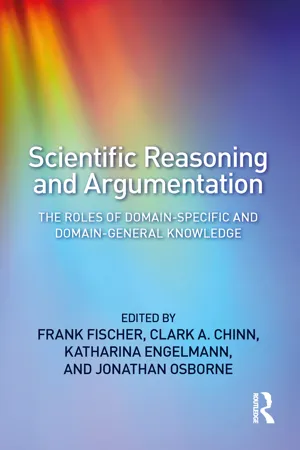
Competence in scientific reasoning is one of the most valued outcomes of secondary and higher education. However, there is a need for a deeper understanding of and further research into the roles of domain-general and domain-specific knowledge in such reasoning. This book explores the functions and limitations of domain-general conceptions of reasoning and argumentation, the substantial differences that exist between the disciplines, and the role of domain-specific knowledge and epistemologies. Featuring chapters and commentaries by widely cited experts in the learning sciences, educational psychology, science education, history education, and cognitive science, Scientific Reasoning and Argumentation presents new perspectives on a decades-long debate about the role of domain-specific knowledge and its contribution to the development of more general reasoning abilities.
eBook - ePub
Scientific Reasoning and Argumentation
The Roles of Domain-Specific and Domain-General Knowledge
- 280 pages
- English
- ePUB (mobile friendly)
- Available on iOS & Android
eBook - ePub
Scientific Reasoning and Argumentation
The Roles of Domain-Specific and Domain-General Knowledge
About this book
Information
1
THE ROLES OF DOMAIN-SPECIFIC AND DOMAIN-GENERAL KNOWLEDGE IN SCIENTIFIC REASONING AND ARGUMENTATION
An Introduction
Katharina Engelmann, Clark A. Chinn, Jonathan Osborne, and Frank Fischer
Scientific reasoning and argumentation (SRA) has become a more and more intensely discussed topic in psychology, education, and beyond. Investigations range from research on the metaphor of children as natural scientists who develop intuitive theories, reason statistically, and experiment playfully (Gopnik, 2012) to studies of the scientific practices of scientists (Dunbar, 2000). One of the most pressing questions targets the age and expertise range in between these two extremes: How can SRA be addressed in school and higher education? The question is grounded in the often-discussed demand for an increased skill level of SRA in all citizens of an increasingly technology- and science-based society (e.g. National Research Council, 2012). According to this argument, understanding scientific discourse and scientific evidence provided by experts is a prerequisite to participating in today’s society as well as making individual decisions, such as detecting fallacious scientific claims in advertising (e.g. Federal Trade Commission, 2011, 2015).
How SRA can be addressed in school and higher education has not yet been adequately answered. Research on the topic is vigorous. Much investigation focuses on how to promote SRA in specific fields such as mathematics education (e.g. Chinnappan & Lawson, 1996; Kollar et al., 2014; Sommerhoff, Ufer, & Kollar, 2015), biology education (e.g. Babai & Levit-Dori, 2009; Zion, Michalsky, & Mevarech, 2005), physics education (e.g. Chen & She, 2012, 2015; Syed, 2015), or history education (e.g. Monte-Sano & De La Paz, 2012; Reisman, 2012; Wineburg, 1991). Other research aims to teach more general SRA competencies (e.g., Iordanou, 2016; Kuhn & Crowell, 2011).
Simultaneously, a range of competences in SRA are amongst the most valued outcomes of academic programs in secondary and higher education. Students are supposed to learn to understand and use SRA to apply scientific concepts, methods, and findings when solving problems in research, in professional practice, or even in everyday life. Moreover, they are supposed to learn how to collaborate effectively and communicate using SRA. These skills are more clearly integrated in descriptions of learning goals in, for instance, the United States of America and Germany (Conference of the Ministers of Education [KMK], 2005; National Research Council, 2012, 2013), where they are often taught across disciplines but also within the area of teaching natural sciences.
One reason why it is difficult to develop effective empirically grounded instruction to achieve SRA-related learning goals is that we have insufficient knowledge of the role and function of SRA in school and higher education. A particular challenge is the extent to which SRA skills are domain-general or domain-specific. As we have noted, much of the research focuses on learning in different domains, such as mathematics, physics, biology, and history, with a corresponding emphasis on SRA as domain-specific processes. Is it possible that SRA could also have a domain-general component that contributes meaningfully to applying SRA in specific tasks? Therefore, a critical issue is to determine the role and interplay of domain-specific and domain-general knowledge and skills in SRA. In short, what, if anything, can be taught productively across several domains? And what is specific of a particular domain?
The approach to effective instruction will be contingent on the answers to these questions. So far, however, the questions have not been sufficiently addressed by scientific research on SRA. For instance, a broadly applicable and largely domain-general approach such as teaching The Scientific Method was common practice in schools and higher education. However, this has been criticized for its failure to address a range and diversity of methods in the sciences, resulting in an argument for a more content-specific approach to science reasoning (Windschitl, Thompson, & Braaten, 2008). Moreover, the idea of domain-general skills has been challenged from several directions. In particular, expertise research has provided strong evidence for the dominating role of deliberate practice in developing highly domain-specific excellence (Ericsson, Krampe, & Tesch-Römer, 1993). Approaches to situated cognition have advanced the view that knowledge is tied to specific activities in specific contexts and cannot easily be transferred to different activities or contexts. However, if research stays within its disciplinary borders and does not investigate the role or interaction of domain-general and domain-specific knowledge and skills, our knowledge of how to best advance the teaching and learning of SRA will remain limited. Hence, this book seeks to address the following questions:
(1)What roles do domain-general and domain-specific knowledge play in SRA?
(2)What is the interaction between domain-general and domain-specific knowledge and how is this interaction dependent on factors such as age, domain, and level of expertise?
Beyond advancing our understanding of this complex phenomenon, answers to these questions are urgently needed to inform curricular reforms and to advance pedagogies in secondary and higher education. Different approaches to advancing our understanding of the answers to these questions were discussed in an international workshop held at Ludwig-Maximilians-Universität München (LMU), Germany, in July, 2016 at the Center for Advanced Studies. All authors who contributed chapters to this book participated in the workshop. In addition, four experts who did not attend the conference were asked to offer an external view on the contributions.
Three perspectives to approaching the questions above are explored in the different parts of this book: (1) an exploration of the limits to domain-general SRA, (2) an examination of differences in SRA within different disciplinary frameworks, and (3) the role of domain-general knowledge in SRA. Each part concludes with a commentary by one or two of our contributors. Thus, the chapters in this book explore the possible functions and limitations of domain-general knowledge for SRA, but also the substantial differences between disciplinary frameworks and the important role of domain-specific knowledge, epistemologies, and reasoning practices. A particularly innovative focus is on the relationship and the interplay of domain-general and domain-specific factors in SRA.
Part 1. Exploring the Limits of Domain-Generality. The four chapters in this part address the limits of domain-generality from four different perspectives. The first chapter (by Schauble) argues that domain-general knowledge is not useful instructionally, at least not in the earlier stages of learning reasoning and argumentation. Schauble argues for a “bottom-up” approach, using modeling to engage young students in SRA as a knowledge-building enterprise. The second chapter (by Daxenberger, Csanadi, Ghanem, Kollar, & Gurevych) makes a case for the limits of domain-generality based on work in machine learning and natural language processing. They found that domain-specific elements are very significant in analyzing reasoning and argumentation in think-aloud and dialog protocols, and limit the range of contexts that automated coding systems can be generalized to. In the third chapter, Samarapungavan argues that reasoning about evidence is not a matter of learning domain-general knowledge, but rather that students learn detailed, highly domain-specific patterns of reasoning in order to reason about evidence in a particular domain. The fourth chapter, by Chinn and Duncan, accepts that domain-general knowledge can be shown to exist, but argues that this knowledge has limited value in aiding reasoning about real-world topics. Nevertheless, it can facilitate a deeper understanding of the general processes experts use and provides a strong warrant for trusting these processes.
Each of these chapters acknowledges that domain-general knowledge relevant to SRA may exist, but argue – each using a different line of argument – that such knowledge has limited usefulness for SRA, even in students and lay individuals. Rather, it seems the authors of all chapters agree that usable SRA is heavily domain-specific. However, the question of how domain-specific and domain-general aspects of SRA interact is addressed differently in these chapters: Samarapungavan, for instance, questions whether there is any role for domain-general aspects in evidentiary reasoning; domain-general descriptions might be useful to educators but they have questionable value for student learning. Employing a very different methodological approach of automatic coding of think alouds and dialogs and then comparing domains, Daxenberger, Csanadi, Ghanem, Kollar, and Gurevych come to a similar conclusion: Domain-general aspects do not seem to play a relevant role in SRA. Schauble argues that a range of domain-specific experiences can, over time, result in the development of more general SRA heuristics that are grounded in these experiences. Her argument is to see the interaction between domain-general and domain-specific aspects as occurring on a developmental/expertise level. Chinn and Duncan argue differently, with a focus on the difficulties in transferring any domain-general aspects of SRA to meaningful real applications. In their argument, successful performance on tasks involving SRA on scientific issues requires domain-specific aspects of SRA (i.e. a degree of domain expertise is needed). Further issues in the chapters, regarding interpersonal differences in scientific reasoning, the goal(s) of science education, demands for science teachers, and students’ beliefs, are discussed in more depth by Shavelson.
Part 2. Exploring Disciplinary Frameworks. The chapters in this part share a commitment to the idea that disciplinary reasoning and argumentation in science and in history are deeply connected to domain-specific knowledge, epistemologies, and reasoning practices. At the same time, each of these chapters describes a pattern of reasoning that is viewed as generally applicable across different topics within a discipline. The first chapter in this part (by Goldman, Ko, Greenleaf, & Brown) characterizes epistemic practices within literature, history, and science, and discusses systematic differences in epistemic practices across the three disciplines. In the second chapter, van Boxtel and van Drie characterize SRA within the field of history as rather domain-specific, while noting domain-general aspects and describing SRA in history as informal reasoning that is similar to reasoning in disciplines that also deal with ill-structured problems, while incorporating some knowledge specific to history. In the third chapter, Osborne draws on philosophical work to characterize scientific practices in terms of six styles of scientific reasoning, focusing on an examination of the product rather than the process of SRA in order to discern these six styles.
In considering the interaction of domain-specific and domain-general aspects of SRA, each of the chapters in this part makes strong claims about the domain-specificity of reasoning within disciplines, but also notes some commonalities in patterns of SRA that are shared within disciplines and also in some cases across disciplines. Specifically, both the chapter by Goldman, Ko, Greenleaf, and Brown and the chapter by van Boxtel and van Drie describe domain-specific aspects as the basis of SRA in their domain. Both chapters go beyond the domain-specific view by describing a meta level at which some aspects of SRA can be viewed as sharing commonalities across disciplines, such as having a notion of causation in both history and science, although they take different forms in the different domains. Taking a different theoretical approach, Osborne argues for six distinct SRA styles that can be found in various scientific domains. Each chapter explicates an account of how the interaction of domain-specific and domain-general can be interpreted: While SRA in practice is dominated by domain-specific requirements, some or many aspects of SRA can be described in more general terms in taxonomies across domains. In two discussion chapters, Stark and Renkl then discuss the theoretical implications of the three chapters in more depth, particularly the specificity and uniqueness of SRA in the mentioned domains.
Part 3. Exploring the Role of Domain-General Knowledge. The chapters in this part analyze the role of domain-general knowledge and skills in SRA. The first chapter (by Hetmanek, Enge...
Table of contents
- Cover
- Title Page
- Copyright Page
- Contents
- List of Contributors
- 1. The Roles of Domain-Specific and Domain-General Knowledge in Scientific Reasoning and Argumentation: An Introduction
- Part 1: Exploring the Limits of Domain-Generality
- Part 2: Exploring Disciplinary Frameworks
- Part 3: Exploring the Role of Domain-General Knowledge
- Index
Trusted by 375,005 students
Access to over 1.5 million titles for a fair monthly price.
Study more efficiently using our study tools.
Frequently asked questions
Yes, you can cancel anytime from the Subscription tab in your account settings on the Perlego website. Your subscription will stay active until the end of your current billing period. Learn how to cancel your subscription
No, books cannot be downloaded as external files, such as PDFs, for use outside of Perlego. However, you can download books within the Perlego app for offline reading on mobile or tablet. Learn how to download books offline
Perlego offers two plans: Essential and Complete
- Essential is ideal for learners and professionals who enjoy exploring a wide range of subjects. Access the Essential Library with 800,000+ trusted titles and best-sellers across business, personal growth, and the humanities. Includes unlimited reading time and Standard Read Aloud voice.
- Complete: Perfect for advanced learners and researchers needing full, unrestricted access. Unlock 1.5M+ books across hundreds of subjects, including academic and specialized titles. The Complete Plan also includes advanced features like Premium Read Aloud and Research Assistant.
We are an online textbook subscription service, where you can get access to an entire online library for less than the price of a single book per month. With over 1.5 million books across 990+ topics, we’ve got you covered! Learn about our mission
Look out for the read-aloud symbol on your next book to see if you can listen to it. The read-aloud tool reads text aloud for you, highlighting the text as it is being read. You can pause it, speed it up and slow it down. Learn more about Read Aloud
Yes! You can use the Perlego app on both iOS and Android devices to read anytime, anywhere — even offline. Perfect for commutes or when you’re on the go.
Please note we cannot support devices running on iOS 13 and Android 7 or earlier. Learn more about using the app
Please note we cannot support devices running on iOS 13 and Android 7 or earlier. Learn more about using the app
Yes, you can access Scientific Reasoning and Argumentation by Frank Fischer, Clark A. Chinn, Katharina Engelmann, Jonathan Osborne, Frank Fischer,Clark A. Chinn,Katharina Engelmann,Jonathan Osborne in PDF and/or ePUB format, as well as other popular books in Bildung & Bildung Allgemein. We have over 1.5 million books available in our catalogue for you to explore.