- 450 pages
- English
- ePUB (mobile friendly)
- Available on iOS & Android
eBook - ePub
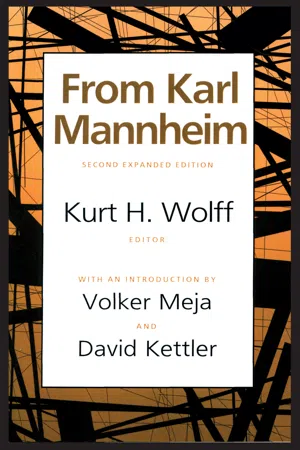
From Karl Mannheim
About this book
Karl Mannheim's thought cuts across much of twentieth-century sociology, politics, history, philosophy, and psychology. This enlarged anthology convincingly demonstrates his centrality to present-day interpetive social and political theory. The posthumous publication of Structures of Thinking and the full text of Conservatism have made From Karl Mannheim more relevant than ever. This volume demonstrates Mannheim's self-awareness and self-critical rhetoric, his sensitivity to cultural contexts, his experimental approach to systems of ideology, his recognition of multiple modes of knowing, and other features of his unfinished theorizing.There is a strong affinity between Mannheim and contemporary interest in problems of cultural interpretation. New sensitivity to the issue of relativism in both social and cultural studies also depends heavily on Mannheim. The recent demise of communism in Eastern Europe and Russia has focused attention once more on relations between intellectuals in politics, and Mannheim is arguably the most influential thinker who placed this relationship at the center of informed discussion. The range and variety of the articles in this volume reveal him, once again, as a formidable experimental and innovative thinker.This expanded edition includes Mannheim's brilliant essay "The Problem of Generations." In a new substantial introduction, Volker Meja and David Kettler analyze previously unpublished writings by Mannheim. From Karl Mannheim is essential reading for social and political theorists, as well as for psychologists. As Emory S. Bogardus noted: "Mannheim's life-work is seen as an important, far-reaching and thoughtful complement to the work of sociologists who concentrate then- research in terms of behavioral science."
Information
Introduction:
A Reading of Karl Mannheim
KARL MANNHEIM, the only surviving child of a Hungarian father and a German mother, was born in Budapest in 1893. There he passed his childhood, graduated from the humanistic gymnasium, and began his university studies. But then he followed friends to Freiburg, Heidelberg, and for a briefer period Paris. He married a fellow student in Budapest and Heidelberg, Juliska Lang. She was a psychologist and became his lifelong companion and adviser, surviving him by nine years.
Mannheim’s earliest interest was philosophy, in particular epistemology (he wrote his doctoral dissertation on its ‘structural analysis’). Among his most influential teachers were the Hungarians György Lukács and Béla Zalai and the Germans Emil Lask, Heinrich Rickert, and Edmund Husserl. In the course of his studies he turned more and more to the social sciences, especially to Max Weber, Max Scheler, and Karl Marx. In 1925 he became a Privatdozent (unsalaried lecturer) in Heidelberg, and in 1929 professor of sociology and economics in Frankfurt. Dismissed in 1933, he joined the London School of Economics as a lecturer in sociology. Eight years later he moved to the Institute of Education at the University of London, where he became professor of education in 1946. Shortly before his unexpected death on 9 January 1947, he was nominated director of UNESCO, a position he could no longer accept. During his stay in England he edited the International Library of Sociology and Social Reconstruction, thereby greatly contributing to the diffusion of sociology in England and its eventual acceptance as an academically respectable discipline.1
Karl Mannheim moved from Hungary, where he gave lectures toward the end of World War I, to Germany, and eventually to England. He moved from ‘Soul and Culture’ (1918) to problems of interpretation, epistemology, knowledge—knowledge in general and particular kinds of knowledge (e.g., historicist knowledge, conservative knowledge)—and social processes impinging on knowledge (of generations, of intellectual competition, of economic ambition)—all of this between 1921 and 1930. In 1929, with Ideology and Utopia, he published his most searching and most influential work. For a while, then, he took stock, as it were, of the position he had reached (e.g., ‘Problems of Sociology in Germany’ [1929], ‘The Sociology of Knowledge’ [1931], The Tasks of Sociology Called for by the Present [1932]). In 1933, although his professional ground was cut from under his feet, he yet managed to gain a new perspective when he transferred to England, a perspective on a haunting landscape that he felt committed to enter: the planned society. He described what he saw, at first still writing in German (Man and Society in an Age of Reconstruction, originally 1935), then only in English (Diagnosis of Our Time [1943], and Freedom, Power and Democratic Planning [1950], which he finished just before his death but which was published only posthumously).
Mannheim died young, but his work is weighty and the course of its development may well concern us. To present this through the selections contained in the present volume and through this introduction, illustrates a problem with which Mannheim himself was occupied deeply and for a long time. The problem is: how can a unique human being, or group, or period, or Weltanschauung—how can what the Historicist School called a ‘historical individual’—be presented or mediated? Fundamentally it is the problem of how to go about interpreting intellectual or spiritual phenomena. It is the more or less exclusive topic of Mannheim’s review of Lukács’s Theory of the Novel (1920) and of his essays ‘On the Interpretation of Weltanschauung” (1921-22), ‘Structural Analysis of Epistemology’ (1922), and ‘The Ideological and the Sociological Interpretation of Intellectual Phenomena’ (1926). Further, the paper on historicism (1924), like that on conservative thought (1927), not only is an application of what he had meanwhile learned about interpretation and of what he was learning in the course of writing these papers, but it is also an interpretation of his own thought and the thought of his generation. ‘The Problem of Generation’ preoccupied him, not only in the essay by this title (1928), but also much earlier: in his first or second publication (‘Soul and Culture’) he spoke as a member, if not as the voice, of a generation in a more literal sense.2
The problem of interpretation is also inseparable from his sociology of knowledge, which is clearly shown in his first essay on the sociology of knowledge (1925). Sociological interpretation, he wrote a year later in his more systematic discussion of kinds of interpretation, is new—it was new for himself and, through his communication of it, for the world. It enriches ‘immanent’ interpretation, that is, the effort to come as close as possible to an intellectual phenomenon in its own terms. For precisely by going beyond immanent, or intrinsic, interpretation, and interpreting extrinsically, above all sociologically, we may be able to identify ‘those meaningful existential presuppositions’ to which intrinsic interpretation is necessarily blind. This does not mean that sociological interpretation abandons the intellectual sphere. For the ‘existential presuppositions’ are not ‘non-intellectual’ but ‘meaningful’, even though pre-theoretical or a-theoretical. For, as Mannheim says in the last two sentences of ‘Competition as a Cultural Phenomenon’ (1928)—which might serve as a motto to much of Mannheim’s work—sociological interpretation does not imply
that mind and thought are nothing but the expression and reflex of various ‘locations’ in the social fabric, and that there exist only quantitatively determinable functional correlations and no potentiality of ‘freedom’ grounded in mind; it merely means that even within the sphere of the intellectual, there are processes amenable to rational analysis, and that it would be an ill-advised mysticism which would shroud things in romantic obscurity at a point where rational cognition is still practicable. Anyone who wants to drag in the irrational where the lucidity and acuity of reason still must rule by right merely shows that he is afraid to face the mystery at its legitimate place. [Essays on the Sociology of Knowledge,3 pp. 228-29]
Sociological interpretation, or the sociology of knowledge,4 is Mannheim’s synthesis of two components which deeply mark his work. Genetically these two components are idealism and Marxism; systematically they are spirit and society. One of Mannheim’s fundamental questions—perhaps the fundamental question—might be formulated thus: how, in the face of the demonstration that the spirit is socially conditioned, can I still do right by its inexhaustibility and unforeseeability? Or perhaps: how can I, nevertheless, save it? But also: how, in the face of the overwhelming spirit, can I ascertain as accurately as possible its intimate connection with society, and how can I proclaim this connection precisely for the sake of both spirit and society? And later, ever more urgently: how can I save society?
Let us try to understand what this means and what it may mean for us today by following Mannheim’s writings in their development.5
I. Soul and Culture (1918)
In this essay—the title of which might almost be read as ‘Spirit and Society’—Mannheim laments a distance that characterizes his time. This is the distance between the individual and ‘objective culture’ (religion, science, art, the state, forms of life) or the ‘objectifications of the spirit’. It can be bridged by ‘subjective culture’, when ‘the soul strives for its fulfillment, not on its own . . . but by way of those cultural objectifications—by incorporating them’. Or the distance can be rendered irrelevant through fulfillment ‘beyond cultural appropriation’, such as is practiced by Indian ascetics or Christian saints. This alternative, however, is not available to us, for if we were to take our position ‘outside of what happens’ (in this world), we would lose ourselves, since we are ‘unredeemed’, ‘not elect’, and must find our ‘contact with life, with external reality, and time-given culture’. At most we have ‘moments of such gracelike experiences, but not redemption, because our fall makes any enduring encounter with ourselves impossible’.
This means that we live in a time in which men depend on society if they would be themselves, would be worthy of being men. Did Mannheim mean that in earlier times the spirit was distributed less evenly through society, living in only a few blessed individuals, whereas its modern diffusion also has brought with it its socialization, which we cannot escape except in blessed moments? If we look forward to his paper on economic ambition (1930; XIII below), to Man and Society (1935; XVIII), above all to ‘The Democratization of Culture’ (XVII: 3), then we can retrospectively recognize in such an idea a vague anticipation of what he was to say later about democratization. We also have here the earliest instance of his effort to diagnose his time. The connection between this effort and Mannheim’s ‘fundamental questions’ is this: I can identify spirit only in a given historical form, hence only by grasping a historical period (the influence of Hegel but also of Dilthey is evident here)—or I can identify a period only by grasping its spirit. We shall soon be more concerned with this circular statement.
And another theme that will become important in Mannheim’s sociology of knowledge can already be found here: that of ‘de actualization’. We live in a time ‘in which the presence of new, formlessly flashing contents de-actualizes much that is old’. Here ‘de-actualization’ does not refer to a process of alienation perceived in a sociological perspective. But beginning with ‘The Problem of a Sociology of Knowledge’ of 1925 (VII) and fully developed in the Ideology and Utopia of 1929 (XIV), this concept (though not the term) is transformed into an explicitly sociological tool for the perception of ‘total ideology’.
While on the whole, and admittedly, ‘Soul and Culture’ is in the tradition of idealism, the theme of ‘de-actualization’ foreshadows a Marxist component. Biographically speaking, its most direct source appears to have been Lukács, a member (see n. 2 above) of the ‘generation’ that sponsored the series of lectures introduced by Mannheim’s ‘Soul and Culture’.6
Its religious language may surprise readers of Ideology and Utopia and of his essays in the sociology of knowledge; and it may interest readers of some of his writing during the English phase, notably perhaps of some of the essays contained in Diagnosis of Our Time (1943). The religious concern of the twenty-four year old Mannheim found only rare expression during his subsequent years in Germany, but it came out again in England, though ‘de-actualized’ (if we may apply this term) into attention to a sociologically interesting human dimension. Thus, part of the title footnote to ‘Towards a New Social Philosophy’ (early 1940’s), reads:
In order to preclude any misunderstanding, and as personal feelings are more easily roused in the sphere of religion than perhaps in any other, he [the author] wishes to emphasize that he speaks as a sociologist, and as a sociologist only. The question put to the sociologist can only concern the relationship to, and the function in, society which religion has as one among other spiritual phenomena in the social process. Whatever this approach may yield, it does not judge the intrinsic values of Christianity and Christian Ethics. [Diagnosis of Our Time, p. 109, n]
And yet in 1933, Mannheim had written ‘that achieving from time to time a certain distance from his own situation and from the world is one of the fundamental traits of man as a truly human being. A man for whom nothing exists beyond his immediate situation is not fully human’.7 Let us remember this problem of religion in Mannheim’s thought when we come to later writings where it is expressed again.
*II. Review of Lukács’s ‘Theory of the Novel’ (1920)
Mannheim’s comments on the Theory of the Novel—the only book by Lukács he ever reviewed—is the earliest appearance, not of the Marxist component in his thought, but of the problem of interpretation. Mannheim here shows the exuberant curiosity of one who has discovered the inexhaustible interpretability of the world of the mind. To catch objects in their immediacy, he urges the most unconditional exposure to them possible. For this, man must overcome the deep-seated traditional way of perceiving them as things external to himself and realize that his perception of them depends on how he sees them, which in turn depends on how he looks at them. In his enthusiasm Mannheim does not stop to deal with the epistemological problem, implicit in his approach, of whether man’s perceptual apparatus derives from the nature of objects or from the nature of mind.
Intellectual phenomena ‘can be explained in more than one frame of reference’. Furthermore, Mannheim distinguishes between ‘dogmatic’ and ‘logical’ objects, or interpretanda, and warns against confusing them (for ‘semantic’ reasons, we might say). For instance, I call ‘work of art’ an object which I can consider in reference to the psychic development of the artist who made it, or in regard to its aesthetic character (lines, colors, motifs, structure, etc.), or in respect to its position in the history of style, as well as in many other respects. Using the same term ‘work of art’ in all such analyses, I may be led to believe—erroneously—that I am speaking about the same ‘object’, whereas it is a different one every time I change my frame of reference. It is the same only ‘dogmatically’, not ‘logically’. Moreover, Mannheim points out, these logical objects which are covered by the same dogmatic object are ordered hierarchically. He stresses the danger of wanting to ‘explain from below upward’, that is, to explain the ‘upper’ on the basis of the ‘lower’, which he says is mistaken, and he argues the inverse direction, ‘from up downward’. For instance, the attempt at exhaustively ‘explaining’ a work of art in terms of its origin is false, because in such a procedure ‘work of art’ is a psychological object which ‘does not yet contain at all that which is hierarchically higher, namely, the spiritual element or, in our case, the art form’. On the contrary, it is correct to ‘explain’ or, ‘in the narrower sense of the word’, to ‘interpret’,8 the ‘work of art’, that is, the logical object ‘art form’, by starting from the higher logical object ‘spiritual-metaphysical phenomenon’ or ‘objectification of the spirit’. This is what Lukács does with respect to the form of the novel, which he tries to interpret ‘from a higher point of view, that of the philosophy of history’. But it is ‘extremely difficult to grasp’ the spirit of a time ‘and its ultimate points of orientation, if only because it never explicates itself in its creations but only manifests itself through them’. The result of such an interpretation can therefore never be directly demonstrated by means of quotations, ‘for such a demonstration always presupposes the reader’s capacity in a specific, separate act to read in the example presented what is essential in it’.
Still, only in this fashion, that is, in the direction opposite to that of the reductionist, is it possible to attain a total view. In other words, if we would know what is essential in an object, we must appreciate its nature and understand, in a fashion Mannheim evidently patterns after Wilhelm Dilthey,9 how in the course of development it has come to be at the place where we find it. To see what is essential, however, is ‘not a matter of construction or induction but a particular ability, which in rudimentary form is possessed by everybody’. This may hint at an elite view of men of knowledge as well as at the germ of a view of education. T...
Table of contents
- Cover
- Title Page
- Copyright Page
- Contents
- Introduction to the Transaction Edition
- Introduction: A Reading of Karl Mannheim
- I A Review of Georg Lukacs’ Theory of the Novel
- II On the Interpretation of Weltanschauung
- III The Problem of a Sociology of Knowledge
- IV The Ideological and the Sociological Interpretation of Intellectual Phenomena
- V Conservative Thought
- VI The Problem of Generations
- VII Competition as a Cultural Phenomenon
- VIII Problems of Sociology in Germany
- IX The Democratization of Culture
- X The Crisis of Liberalism and Democracy as seen from the Continental and Anglo-Saxon Points of View
- XI On the Diagnosis of Our Time
- XII Education, Sociology and the Problem of Social Awareness
- Index
Trusted by 375,005 students
Access to over 1.5 million titles for a fair monthly price.
Study more efficiently using our study tools.
Frequently asked questions
Yes, you can cancel anytime from the Subscription tab in your account settings on the Perlego website. Your subscription will stay active until the end of your current billing period. Learn how to cancel your subscription
No, books cannot be downloaded as external files, such as PDFs, for use outside of Perlego. However, you can download books within the Perlego app for offline reading on mobile or tablet. Learn how to download books offline
Perlego offers two plans: Essential and Complete
- Essential is ideal for learners and professionals who enjoy exploring a wide range of subjects. Access the Essential Library with 800,000+ trusted titles and best-sellers across business, personal growth, and the humanities. Includes unlimited reading time and Standard Read Aloud voice.
- Complete: Perfect for advanced learners and researchers needing full, unrestricted access. Unlock 1.5M+ books across hundreds of subjects, including academic and specialized titles. The Complete Plan also includes advanced features like Premium Read Aloud and Research Assistant.
We are an online textbook subscription service, where you can get access to an entire online library for less than the price of a single book per month. With over 1.5 million books across 990+ topics, we’ve got you covered! Learn about our mission
Look out for the read-aloud symbol on your next book to see if you can listen to it. The read-aloud tool reads text aloud for you, highlighting the text as it is being read. You can pause it, speed it up and slow it down. Learn more about Read Aloud
Yes! You can use the Perlego app on both iOS and Android devices to read anytime, anywhere — even offline. Perfect for commutes or when you’re on the go.
Please note we cannot support devices running on iOS 13 and Android 7 or earlier. Learn more about using the app
Please note we cannot support devices running on iOS 13 and Android 7 or earlier. Learn more about using the app
Yes, you can access From Karl Mannheim by Kurt H. Wolff in PDF and/or ePUB format, as well as other popular books in Social Sciences & Political History & Theory. We have over 1.5 million books available in our catalogue for you to explore.