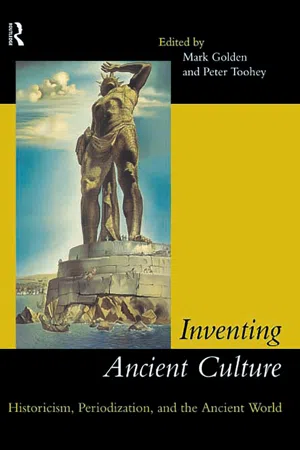
Inventing Ancient Culture discusses aspects of antiquity which we have tended to ignore. It asks the reader how far we have reinvented antiquity, by applying modern concepts and understandings to its study. Furthermore, it challenges the common notion that perceptions of the self, of modern societal and institutional structures, originated in the Enlightenment. Rather, the authors and contributors argue, there are many continuities and marked similarities between the classical and the modern world. Mark Golden and Peter Toohey have assembled a lively cast of contributors who analyse and argue about classical culture, its understandings of philosophy, friendship, the human body, sexuality and historiography
eBook - ePub
Inventing Ancient Culture
Historicism, periodization and the ancient world
- 248 pages
- English
- ePUB (mobile friendly)
- Available on iOS & Android
eBook - ePub
Part I
ANTIQUITY AND THE ENLIGHTENMENT: INVENTING THE PRESENT
INTRODUCTION
Whether it is bodies or boredom (Laqueur 1990, Spacks 1995), there is a tendency these days for those interested in the broader field of Cultural Studies to claim that modern perceptions of self (Taylor 1989), modern affectivities (Aries 1981, Foucault 1978, 1985, 1986), modern societal and institutional structures (Ariès 1962 and 1981, Foucault 1967, 1973, 1977) date from the century beginning with the Enlightenment (compare Saul 1992). The basis for this claim is usually said to be empirical: modern formulations of these matters could not be found before this period. This is an empiricism backed up alarmingly by common sense. The loosening of the ecclesiastical control over society, the weakening of the powers of the European aristocracy, the emergence of a bourgeoisie based on a vigorous mercantile economy, the Industrial Revolution and the empowerment it provided to new social classes, the philosophical and economic championing of reason that flowed from these social changes, all of these forces combine to create a world that more obviously resembles our own than anything that preceded. The mentality of this new world seems to match that of our own.
The five chapters of this first part of our book all confront, directly or indirectly, this pervasive, over-simple, and unhistorical notion. The Enlightenment may indeed have been marked by great discursive and institutional change. But to claim that modern societal institutions and modern formulations of many affective states have their first appearances, even their discovery here is to misrepresent history.
The first chapter concerns body history. When does the modern concept of the body begin? Amy Richlin in her ‘Towards a history of body history’ (Chapter 1) maintains that many contemporary attitudes to both gender and sexuality are to be found in Roman literature. Following on from Foucault, many scholars (Halperin 1992 and Winkler 1992, for example) have argued that antiquity had a one-sex model (sexual status was defined by power: by who penetrates and who is penetrated) and that the two-sex model is something of very recent provenance (Laqueur 1990). Richlin maintains that there is ample evidence to support a two-sex model in antiquity. That this evidence has been ignored is in part a reflection of the marginality of Classical Studies within the universities and in part the result of a desire of the disempowered to seek in the past a better, liberating vision.
Martin Kilmer in ‘Painters and pederasts: Ancient art, sexuality and social history’ (Chapter 2) offers some support for Richlin’s revisionism. Kilmer examines the representation of homoerotic relationships on Greek black-figure vases. He concludes that the generalizations made by Dover (1989 [1978]), Foucault (1978, 1985, 1986), Halperin (1990), and Winkler (1990b) are too broad. Kilmer makes two points. First he argues that they privilege the male homoerotic relationships represented in literature by Plato and in art by fifth-century red-figure vase painters. In these the younger, passive partner is pursued by the older, active partner; the relationship is ennobling for the young man, but he ought not to display erotic pleasure in it; he should on maturity take on an ‘active’ sexual role. But they provide only part of the story. Kilmer maintains that the distinction between young and old, active and passive is not rigidly adhered to in black-figure painting, the form that immediately preceded red-figure. Kilmer’s second point is that the popular view which maintains that Athens pursued the one-sex model is too generalized and is contradicted by some black-figure vases. Kilmer thus (here we should compare Richlin’s conclusions) argues for a continuity between modern notions of sexuality and those of black-figure painting, but also argues that change exists between red-figure and black-figure representations of homoerotic acts.
Eros, one expression of sexuality, is also important within Peter Toohey’s argument (Chapter 3: ‘Trimalchio’s constipation: Periodizing madness, eros, and time’). Like Richlin and Kilmer, Toohey is interested in how culture shapes institutions, concepts, and emotional states. He looks at three seemingly independent entities - madness, eros, and time - and attempts to link the three into a discursive whole. Toohey argues that the lineaments of the modern views of these cultural constructs are to be found in ancient literature, above all in the texts of the first century of our era. But Toohey’s case, like Kilmer’s, does allow for change. The ‘modern’ views (privileging above all a type of affective passivity) are indeed invented, but in this period.
Not sexuality, nor eros, but the calmer emotion of friendship is David Konstan’s topic (Chapter 4: ‘Philosophy, friendship, and cultural history’). Konstan’s elegant argument explains first how modern concepts of friendship (which includes qualities such as self-disclosure, personal intimacy, sincerity, sympathy, informality, openness, voluntariness of association) have been traced primarily to the rise of commodity capitalism in the century following the Enlightenment. Konstan urges that ancient friendship also reflects its cultural context. Friendship for Aristotle is conditioned by the values of the democratic polis of the fifth and fourth centuries. Thus the concept can reflect the modern form of friendship (‘a voluntary, informal, intimate, and expressive relationship’), but it can also refer to ‘any type of reciprocal love, including that within the family or larger community’. A more particularized and private concept of friendship - one mirroring the modern form - emerged during the third century BCE in response to the emergence of Hellenistic kingship: there too developed ‘a new discourse of friendship as a private and personal bond that was … independent of and conceptually distinct from the sphere of civic obligations in a more radical way than that which characterized the democratic polis.’
Love, affection, and friendship within the Roman family provide the focus for Suzanne Dixon’s paper (Chapter 5: ‘Continuity and change in Roman social history: Retrieving “family feeling(s)” from Roman law and literature’). Dixon presents a profoundly sceptical view. Examining the evidence for ‘family feelings’, she comes to challenge ‘the very quest for a historical narrative - that is, a story of change’ (cf. now Saller 1994: 4–8, 231–32). Dixon believes that the evidence for such emotions is too vague and too contradictory for us to chart change nor, and this is as important, can one posit continuity. Thus, although Dixon’s position provides a sharp challenge to the arguments of Richlin, Kilmer, Toohey, and Konstan, that change and continuity can be mapped both within antiquity and between antiquity and the modern world, it likewise tends to render false, by implication, claims by those who would locate affective and familial change within the Enlightenment or later.
Why has this faith in change so dominated so many disciplines during the last two decades and caused them to valorize the Enlightenment and to downplay the importance of Greek and Roman culture? We think that Richlin has part of the answer. She states that people who study body history, for example, have no one in Classics to talk to. In the major US research universities, Women’s Studies, Gay Studies, and body history, were or are not a part of Classics department programmes. When colleagues in other departments came to research topics which might loosely be termed Cultural Studies (for a useful, if hostile discussion of this designation, see Collini 1994), they found that they had no classicists to talk to. What else could they conclude but that, for the study of the history of cultural institutions and affectivities, Classical Studies were of no importance? We also suspect that the focus on the Enlightenment and after offers an easy way out for both individuals (who are thus excused from extensive researches in earlier periods, with their many linguistic and other challenges) and for institutions. These are provided with a convenient rationale for the neglect or excision of programmes no longer deemed relevant for the modern world.
1
TOWARDS A HISTORY OF BODY HISTORY1
Amy Richlin
‘We … F, said Leslie that night, ‘need to understand how the scream of Dachau is the same, and how it is a different scream from the scream of Hiroshima. And after that I need to learn how to listen to the selfsame sound that rises out of the Hell in which the torturer is getting what he’s got coming.’
(Lore Segal, ‘The Reverse Bug’)
The human body has more often been the subject of comedy than of history. Let me start from a text - one often appealed to as originary - about origin texts. In Plato’s Symposium, Plato makes the comic playwright Aristophanes into a character in the dialogue and has him define love by telling a mythic origin story about ludicrous huge blobby human beings who lived before the separation of the sexes. Although ‘Aristophanes’ tells his history of bodies in all seriousness, it is a funny story, entirely appropriate to be put in the mouth of Aristophanes as a character in a story; and indeed Aristophanes in the Symposium represents comedy, as the ending of the dialogue clearly shows. There Socrates (philosophy) drinks the last of his fellow guests under the table - first comedy (Aristophanes), then tragedy (Agathon) - in the course of making them admit that the same man could write both comedy and tragedy. The other characters’ descriptions of love are much more abstract, less embodied, than Aristophanes’ - even the speech of the doctor, Eryximachus, who moves up to take Aristophanes’ turn in the lineup when the comedian is overcome by a case of hiccups (the comedian thus embodying the comic body). In the West, bodies have been discussable only in certain kinds of discourse: comedy, horror stories, pornography, medicine.2 But history has rarely been a language for talking about bodies. Today it seems as if that is changing, and the ‘history of the body’ and the ‘history of sexuality’ seem to be turning into recognized fields of history. What is this ‘body history’? Why has it begun now, and why does it look as it does? And what does the study of Greek and Roman sexualities have to contribute to body history, and to questions of continuity and change?
Certainly it is possible to take bodies seriously. The epigraph to this essay, from Lore Segal’s parable ‘The Reverse Bug’, suggests how rooted body history is in the specific agonies of the twentieth century; and (hence?) how embroiled it is in moral and epistemological issues. Dachau and Hiroshima unsettle the notion of the impartial historian. Segal’s image of a vocabulary of screams, understood by a listener, as both similar and different, I here borrow to represent the history of bodies, studied by scholars, who argue vigorously over whether those bodies are similar or different. Body history itself constitutes a deliberate change; graduate seminars in Classics, for example, used to study the Peloponnesian war or the constitution of Athens and not bodies. This change is not arbitrary, but stems from a belief or hope that the study of what was abjected can promote or participate in general social change. In an earlier essay (Richlin 1993b) I talked about what is at stake for people who focus on continuity and similarity versus people who focus on change and difference. But both groups are listening to screams; they are united at some point by their consciousness of human suffering and their urge to end it. They are also listening to screams in another sense: they have chosen to write a history of what other historians have found unintelligible. In this essay, I shall be talking about what I know best, the history of the body as sexual, gendered, and marked; a full history of body history would have to include as well a survey of writing on food, excrement, race, the care of the self, clothing, hair, gesture, and death. Hence the ‘Towards’ in the title.
BODY HISTORY: WHAT IS IT?
This essay condenses into a small space many arguments I have made previously, and must provide a similarly condensed overview of the field as a whole. The reader should add boiling water (or read more) to get the whole bouillon.
Writers of body history might be divided into three main groups, with overlaps: historians, feminists, and classicists.
Most visible as pure body historians, so to speak, have been Americans coming out of the Annales school and the Berkeley New Historicists (on whom, see Veeser 1989). The American Annali...
Table of contents
- Cover
- Title Page
- Copyright Page
- Dedication
- Table of Contents
- List of illustrations
- List of contributors
- General Introduction
- Part I Antiquity and the Enlightenment: Inventing the Present
- Part II Reconstructing the Past: The practice of periodization
- References
- Index
Trusted by 375,005 students
Access to over 1.5 million titles for a fair monthly price.
Study more efficiently using our study tools.
Frequently asked questions
Yes, you can cancel anytime from the Subscription tab in your account settings on the Perlego website. Your subscription will stay active until the end of your current billing period. Learn how to cancel your subscription
No, books cannot be downloaded as external files, such as PDFs, for use outside of Perlego. However, you can download books within the Perlego app for offline reading on mobile or tablet. Learn how to download books offline
Perlego offers two plans: Essential and Complete
- Essential is ideal for learners and professionals who enjoy exploring a wide range of subjects. Access the Essential Library with 800,000+ trusted titles and best-sellers across business, personal growth, and the humanities. Includes unlimited reading time and Standard Read Aloud voice.
- Complete: Perfect for advanced learners and researchers needing full, unrestricted access. Unlock 1.5M+ books across hundreds of subjects, including academic and specialized titles. The Complete Plan also includes advanced features like Premium Read Aloud and Research Assistant.
We are an online textbook subscription service, where you can get access to an entire online library for less than the price of a single book per month. With over 1.5 million books across 990+ topics, we’ve got you covered! Learn about our mission
Look out for the read-aloud symbol on your next book to see if you can listen to it. The read-aloud tool reads text aloud for you, highlighting the text as it is being read. You can pause it, speed it up and slow it down. Learn more about Read Aloud
Yes! You can use the Perlego app on both iOS and Android devices to read anytime, anywhere — even offline. Perfect for commutes or when you’re on the go.
Please note we cannot support devices running on iOS 13 and Android 7 or earlier. Learn more about using the app
Please note we cannot support devices running on iOS 13 and Android 7 or earlier. Learn more about using the app
Yes, you can access Inventing Ancient Culture by Mark Golden,Peter Toohey in PDF and/or ePUB format, as well as other popular books in History & Ancient History. We have over 1.5 million books available in our catalogue for you to explore.