eBook - ePub
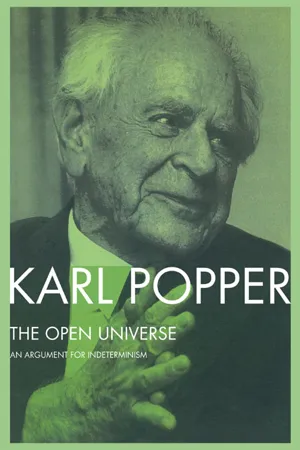
The Open Universe
An Argument for Indeterminism From the Postscript to The Logic of Scientific Discovery
- 212 pages
- English
- ePUB (mobile friendly)
- Available on iOS & Android
eBook - ePub
The Open Universe
An Argument for Indeterminism From the Postscript to The Logic of Scientific Discovery
About this book
The Open Universe is one of the three volumes of Karl Popper's Postscript to the Logic of scientific Discovery. The Postscript is the culmination of Popper's work in the philosophy of physics and a new famous attack on subjectivist approaches to philosophy of science.
Information
CHAPTER I
KINDS OF DETERMINISM
I INTEND to set forth here my reasons for being an indeterminist.1 I shall not include among these reasons the intuitive idea of free will: as a rational argument in favour of indeterminism it is useless. A man may well believe that he is acting deliberately, and of his own free choice, when in fact he is acting under the influence of suggestion, or of compulsion, or of drugs. But once we have succeeded in rejecting the idea of determinism by arguments which do not involve an appeal to our intuitions regarding free will, it may perhaps be possible, to a limited extent, to re-establish the validity of these intuitions; for the counterexamples just mentioned might then be treated as special cases—as cases of delusion, perhaps, by which these intuitions are temporarily made unreliable. However, none of these questions will be discussed here. What I am going to do in the following is to criticize the commonsense arguments, the philosophical arguments, and especially the scientific arguments, which have been used in support of determinism.
My central problem is to examine the validity of the arguments in favour of what I call ‘scientific’ determinism; that is to say, the doctrine that the structure of the world is such that any event can be rationally predicted, with any desired degree of precision, if we are given a sufficiently precise description of past events, together with all the laws of nature.
The problem is relevant mainly because exponents of the quantum theory often present the situation in the following way. Classical physics, they say, entails what I call ‘scientific’ determinism; and only quantum theory forces us to reject classical physics, and ‘scientific’ determinism with it. In opposition to this view, I intend to show that even the validity of classical physics would not impose upon us any deterministic doctrine about the world.
In criticizing determinism, I shall be concerned with a view of the physical and biological sciences which was held by physicists, practically without exception, until 1927, and by Einstein, it seems, almost until his death in 1955.2 It was held also by philosophers such as Spinoza, Hobbes, Hume, Kant, Schopenhauer, J. S. Mill, and (at least until 1927) by M. Schlick. Schlick was still in two minds about the problem in 1930, as the following interesting quotation shows.
Since this assumption that all events are subject to universal laws is usually described as the principle of universal causation, I may put [my thesis] in this way: Every science presupposes the principle of universal causation … All experience supports the belief that this presupposition is satisfied, at least as far as it is necessary for all purposes of practical living, in all contacts with other men and with nature, and also for even the utmost precision which technology requires. But whether the principle of causality is valid absolutely and everywhere, without even the slightest exception—that is to say, whether determinism is correct—that we do not know. What we know, however, is this: that it is impossible to decide the issue between determinism and indeterminism by mere thinking and speculating, by weighing the number of argumentspro and con (all of which would be pseudo-arguments anyway). Such an enterprise is bound to create a ridiculous impression, especially if one thinks of the overwhelming armoury of experimental and logical craftsmanship with which contemporary physics is now cautiously closing in to attack the problem whether or not the principle of causality is valid even for the hyperfine events within the atoms.3
I have quoted this passage because it is, in many ways, representative of the view which I intend to criticize: that the principle of causality is the same as the thesis of determinism, and that we know from experience that it is correct at least for all practical purposes: for ‘all events’, although perhaps not for ‘absolutely’ all events, ‘everywhere, without even the slightest exception’—a doubt raised by quantum theory. Also, because I intend to take up the challenge inherent in Schlick’s suggestion that the problem is arguable, but only with empirical arguments, while speculative thinking on these matters can only use ‘pseudo-arguments’, bound to create a ‘ridiculous impression’. Indeed, I do not feel that it is entirely beyond speculative thought to improve a little upon the empirical arguments.
1. Determinism: Religious, ‘Scientific’, and Metaphysical.
The intuitive idea of determinism may be summed up by saying that the world is like a motion-picture film: the picture or still which is just being projected is the present. Those parts of the film which have already been shown constitute the past. And those which have not yet been shown constitute the future.
In the film, the future co-exists with the past; and the future is fixed, in exactly the same sense as the past. Though the spectator may not know the future, every future event, without exception, might in principle be known with certainty, exactly like the past, since it exists in the same sense in which the past exists. In fact, the future will be known to the producer of the film—to the Creator of the world.
The idea of determinism is of religious origin, although there are great religions which believe in indeterminism—the doctrine that at least some events are not fixed in advance. (Since St. Augustine, at least, Christian theology has for the most part taught the doctrine of indeterminism; the great exceptions are Luther and Calvin.) Religious determinism is connected with the ideas of divine omnipotence—complete power to determine the future—and of divine omniscience, which implies that the future is known to God now, and therefore knowable in advance, and fixed in advance.1
Besides religious determinism, there is a form of the doctrine of determinism which I shall call ‘scientific’.
Historically, one can look upon the idea of a ‘scientific’ determinism as the result of replacing the idea of God by the idea of nature, and the idea of divine law by that of natural law. Nature, or perhaps the law of nature’, is omnipotent as well as omniscient. It fixes everything in advance. By contrast with God, who is inscrutable, and who may be known only by revelation, the laws of nature may be discovered by human reason, aided by human experience. And if we know the laws of nature, we can predict the future from present data by purely rational methods.
It is characteristic of all forms of the determinist doctrine that every event in the world is predetermined: if at least one (future) event is not predetermined, determinism is to be rejected, and indeterminism is true. In terms of what I call ‘scientific’ determinism, this means that if at least one future event in the world could not in principle be predicted by way of calculation from natural laws and data concerning the present or the past state of the world, then ‘scientific’ determinism would have to be rejected.
Thus the fundamental idea underlying ‘scientific’ determinism is that the structure of the world is such that every future event can in principle be rationally calculated in advance, if only we know the laws of nature, and the present or past state of the world. But if every event is to be predictable, it must be predictable with any desired degree of precision: for even the most minute difference in measurement may be claimed to distinguish between different events.
Although the idea of ‘scientific’ determinism seems, historically speaking, to be a kind of translation of religious determinism into naturalistic and rationalistic terms, it is of course possible to see the idea of ‘scientific’ determinism in a different light. One can present it, for example, as resulting from a somewhat sophisticated criticism of the commonsense view of the world according to which one can divide all events into two types: the predictable events, such as the changes of the seasons, or the diurnal and annual motions of the sun and of the fixed stars, or the working of a clock; and the unpredictable events, such as the vagaries of the weather, or the behaviour of clouds.2
Now this commonsense view of the difference between clocks and clouds may be criticized by raising the somewhat sophisticated question of whether these two types of events are really different or whether only the unsatisfactory state of our knowledge makes them appear to be different; whether the behaviour of clouds would be as predictable as that of clocks if only we knew as much about clouds as we know about clocks.
This question, or rather, this conjecture, turned into a conviction as soon as an advance in scientific knowledge made it possible to predict the movements of planets or ‘vagabonds’—once the notorious symbols of caprice—as precisely as those of the fixed stars themselves. It was this success, the success of Kepler’s laws and of Newton’s dynamics of the heavens, that led to the almost universal acceptance of ‘scientific’ determinism in modern times.
The power of the belief in ‘scientific’ determinism may be gauged by the fact that Kant, who for moral reasons rejected determinism, nevertheless felt compelled to accept it as an undeniable fact, established by science. This led to an antinomy in his philosophical system which he could never resolve to his own satisfaction. As I shall try to show, however, Newtonian mechanics does not entail ‘scientific’ determinism. If I am right in this, then Kant was mistaken in believing that by accepting Newtonian mechanics he had committed himself to accepting ‘scientific’ determinism; and his unresolved antinomy simply does not arise.
The critical discussion of ‘scientific’ determinism will be our main task. But besides religious and ‘scientific’ determinism, a third version of the deterministic doctrine will also have to be discussed, if only briefly. It may be described as metaphysical determinism.3
The metaphysical doctrine of determinism simply asserts that all events in this world are fixed, or unalterable, or predetermined. It does not assert that they are known to anybody, or predictable by scientific means. But it asserts that the future is as little changeable as is the past. Everybody knows what we mean when we say that the past cannot be changed. It is in precisely the same sense that the future cannot be changed, according to metaphysical determinism.
Metaphysical determinism is clearly not testable. For even if the world constantly surprised us, and showed no sign of any predetermination or even of any regularity, the future might still be predetermined, and even foreknown by those able to read the book of destiny. Metaphysical indeterminism is also untestable. For even if the world had a completely regular and deterministic appearance, this would not establish that no undetermined event of any kind exists. Now lack of testability, or of empirical content, is indicative of logical weakness (not meaninglessness, of course): a doctrine may be logically too weak to be tested. And for the same reason, it may be entailed by some other doctrine. Thus metaphysical determinism is, because of its weakness, entailed by both religious and ‘scientific’ determinism; and it may be described as containing only what is common to the various deterministic theories. It is irrefutable just because of its weakness. But this does not mean that arguments in its favour or against it are impossible. The strongest arguments in its favour are those which support ‘scientific’ determinism. If they collapse, little is left to support metaphysical determinism. For this reason, I am going to examine them first. Only towards the end of my discussion (in section 26), will I advance some more direct arguments against the acceptance of metaphysical determinism.
In the following sections, commonsense arguments and philosophical arguments in favour of ‘scientific’ determinism will be examined first; only afterwards will I turn to the arguments based upon classical physics.
2. Why-Questions. Causality and ‘Scientific’ Determinism.
In the preceding section I suggested a commonsense or prima facie distinction between predictable and non-predictable events, or between clocks and clouds, and that ‘scientific’ determinism can be viewed as arising out of a sophisticated criticism of this distinction. Another way for common sense to approach the idea of determinism is through the popular idea of causality. One of the simplest and most plausible arguments in favour of determinism is this: we can always ask, of every event, why it happened; and to every such why-question we can always obtain, in principle, a reply which enlightens us. Thus every event is ‘caused’; and this seems to mean that it must be determined, in advance, by the events which constitute its cause.
We could admit the truth of these considerations without, however, admitting that they can lead us all the way to the idea of ‘scientific’ determinism. It is, in fact, of considerable interest to pin-point the place where the commonsense arguments end and sophistication begins.
Let us first consider some typical why-questions, and some typical answers to them which are perfectly satisfactory on the commonsense level.
‘Why do bees store honey?’ Answer: ‘Because they need it for food during the winter.’ (This is hardly a theoretical statement at all.) ‘Why is there a lunar eclipse today?’ Answer: ‘Because the earth is standing today between the sun and the moon, so that its shadow falls on the moon.’ (This is not yet a statement of theory from which we could predict the eclipse.) ‘Why did he die?’ Answer: ‘Because when he went to a funeral last week, he stood in the rain for nearly half an hour. So he caught a cold which developed into pneumonia; and after all, he was seventy-three.’ (Many have survived the ordeal even at seventy-four.)
We may assume that all these answers are perfectly acceptable, and that they give precisely the kind of information asked for. Even children who insatiably reiterate their why-questions are not usually asking to be given a ‘better’ explanation—in the sense of one which would allow them to predict events of the kind in question. What they want to be given is, as a rule, merely a statement of further causes—causes which temporally precede those given, or which would motivate them further: they do not reiterate their questions because they want a fuller set of conditions, but because they want to be given a consecutive ‘causal chain’ of events.
The fact that we can always ask why-questions, and that we can always obtain relevant answers to them has not in itself, then, very much to do with determinism, whether ‘scientific’ or otherwise.
But we may now go one step farther, and demand that the answers to our why-questions—that is to say, the explanations offered—should indeed consist of initial conditions (causes) from which the facts to be explained can be logically deduced, if the relevant universal laws are given.1 This is certainly a step away from the popular theory of causation, and towards a more sophisticated theory. Let us accept this demand, and assume, in addition, a ‘law of universal causation’, to the effect that every ‘event’ can in principle be causally explained in the sense of our demand; that is to say, we assume that there are always ‘causes’ (initial conditions) and universal laws which would allow us to deduce ...
Table of contents
- Cover Page
- Half Title page
- Series page
- Title Page
- Copyright Page
- Dedication
- Contents
- Editor's foreword
- Acknowledgements
- Preface 1982
- Chapter I Kinds of determinism
- Chapter II 'Scientific' Determinism
- Chapter III The case for indeterminism
- Chapter IV Metaphysical issues
- Addendum 1: Indeterminism is not enough: an afterword1
- Addendum 2: Scientific reduction and the essential incompleteness of all science1
- Appendix 3: Further remarks on reduction, 1981
- Index of Names
- Index of Subjects
- About the Author
- About the Editor
Trusted by 375,005 students
Access to over 1.5 million titles for a fair monthly price.
Study more efficiently using our study tools.
Frequently asked questions
Yes, you can cancel anytime from the Subscription tab in your account settings on the Perlego website. Your subscription will stay active until the end of your current billing period. Learn how to cancel your subscription
No, books cannot be downloaded as external files, such as PDFs, for use outside of Perlego. However, you can download books within the Perlego app for offline reading on mobile or tablet. Learn how to download books offline
Perlego offers two plans: Essential and Complete
- Essential is ideal for learners and professionals who enjoy exploring a wide range of subjects. Access the Essential Library with 800,000+ trusted titles and best-sellers across business, personal growth, and the humanities. Includes unlimited reading time and Standard Read Aloud voice.
- Complete: Perfect for advanced learners and researchers needing full, unrestricted access. Unlock 1.5M+ books across hundreds of subjects, including academic and specialized titles. The Complete Plan also includes advanced features like Premium Read Aloud and Research Assistant.
We are an online textbook subscription service, where you can get access to an entire online library for less than the price of a single book per month. With over 1.5 million books across 990+ topics, we’ve got you covered! Learn about our mission
Look out for the read-aloud symbol on your next book to see if you can listen to it. The read-aloud tool reads text aloud for you, highlighting the text as it is being read. You can pause it, speed it up and slow it down. Learn more about Read Aloud
Yes! You can use the Perlego app on both iOS and Android devices to read anytime, anywhere — even offline. Perfect for commutes or when you’re on the go.
Please note we cannot support devices running on iOS 13 and Android 7 or earlier. Learn more about using the app
Please note we cannot support devices running on iOS 13 and Android 7 or earlier. Learn more about using the app
Yes, you can access The Open Universe by Karl Popper, W.W. Bartley, III in PDF and/or ePUB format, as well as other popular books in Philosophy & Free Will & Determinism in Philosophy. We have over 1.5 million books available in our catalogue for you to explore.