- 200 pages
- English
- ePUB (mobile friendly)
- Available on iOS & Android
eBook - ePub
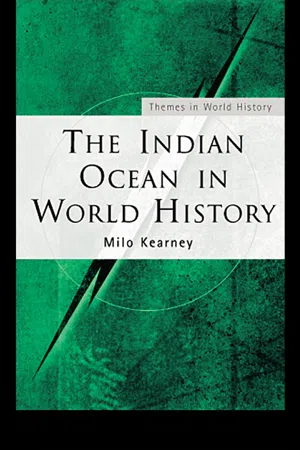
The Indian Ocean in World History
About this book
Throughout history, dominance of the Indian Ocean has been a critical factor in defining a nation's supremacy and power. It is well known that it played a major part in the success of the Portugese nation at the start of the sixteenth century. In this concise survey, Milo Kearney shows how the trading and imperial expansion offered by the Indian Ocean were exploited by many leading powers from the third millennium BC to the very recent past.
The nations included range from the ancient Egyptians of the new Kingdom to the Han Chinese and, later, from the Moghul to the British Empire. Milo Kearney goes on to show what a critical territory the Indian Ocean was during the Cold War because of its rich supply for oil.
The history of the Indian Ocean provides a snapshot of many of the key issues in world history, such as colonialism, trade and spread of cultures and religions. It is important reading for all students of world history.
Chapter 1
Introduction
What is the role of the Indian Ocean and its region in world history? The thesis of this book is that significant participation in Indian Ocean trade has always been a major indicator of a state’s or region’s prominence and leadership from a global perspective. It is conventional wisdom that Indian Ocean trade played a large role in the Portuguese success at the start of the sixteenth century. However, its consistent influence on the rise and fall of other states or regions has either been understated or, most commonly, not acknowledged at all. This is not to say that the Indian Ocean floated the economy of every state or region that reached a top position, but that a major presence in Indian Ocean trade has always indicated a level of economic health essential to world leadership. In presenting this thesis, this book will discuss five different international trading patterns benefiting from the Indian Ocean that have prevailed in succession spanning world history from the beginning to the present. It will be argued that the participating states or regions were those making a prime contribution to world progress and cultural creativity. The reasons for the shifts, and the contributions and results of each trading configuration will be considered in turn.
Because of the highly controversial nature of a possible New World tie-in to these patterns before the fifteenth century (and the relatively subordinate role of Latin America in Indian Ocean trade and world leadership), principally Old World trading patterns will be considered. The Western Hemisphere through much of history lagged behind the Eastern Hemisphere’s levels of civilization precisely because of its distance from the Indian Ocean and the major trade routes leading from it. Within the Old World, the impact of Indian Ocean trade on the rise and fall of European states and regions is the most unusual and controversial part of the thesis, and thus will require the most detailed attention. The importance of Indian Ocean trade to the nations around its rim is far more obvious and accepted, and its role in the history of China and Japan only slightly less so.
Trade, wealth, power, creativity, and geography
What are the factors that determine which states or regions take a lead in history? Biologists point out that more changes in physical variations in a species tend to occur with an increase in the size of the gene pool. A corollary states that the most change within a particular gene pool tends to occur toward the geographic center of the population, where the greatest contact occurs. Thus, the paleontological record shows a preponderance of new species appearing in the Old World, then spreading gradually first to North America, then to South America, and finally to Australia. Applied to history, this principle suggests that change in general, other factors being constant, should center in the Eastern Hemisphere, with its heavier population concentration. Within the Eastern Hemisphere, change (and thus leadership) should be expected especially in the Middle East, where the Old World’s three main continents converge. This is exactly where human history received its initial impetus and long retained its primary focus.
Another principle is that culture grows fastest along the main trade routes. Trade, as emphasized by Fernand Braudel in his study of the Mediterranean in the sixteenth century, follows mainly those waterways that bring together the greatest variety of peoples and lands, along with their products. The protected inland seas and rivers, encouraging commerce, are stimulated all the more. Highly indented coastlines, rich soil, a good climate, and a plentitude of rivers and side seas all enhance trading opportunities. Long-distance trade brings a meeting of different peoples, with an exchange of ideas and the leisure and investment in learning which the trading wealth bestows. The greatest such favorable maritime trade route on earth, by a long shot, is the water route in the very middle of the Old World, stretching from the Indian Ocean through either the Persian Gulf and the Tigris and Euphrates Rivers or through the Red Sea to the Mediterranean, and thence up the Rhone and down the Seine, the Moselle, the Scheldt, the Meuse, or the Rhine to the English Channel, or alternatively through the Strait of Gibraltar and up the Atlantic coast. This is the world’s major contact route between West and East.
The Indian Ocean, which forms a central hub of this long trading belt, is also favored by its monsoon wind patterns, which move dependably to the northeast in the summer, and to the southwest in the winter. The hospitable warm climate and waters throughout much of the Indian Ocean coastal region encouraged similar cultural traits to move from one port to another (the arid Arabian and Persian coasts in the far northwest and Australian coasts in the far southeast being the main climatic exceptions). The gigantic bay shape of the Indian Ocean further encouraged trading contacts. In addition, the merchants of the lands lying on the Mediterranean (the world’s largest inland sea), particularly those along its northern, better-watered and highly indented coast (good for harbors and trading contacts) which were favored as dominant merchant societies, along with the merchants of China to the east, were consistently drawn into the Indian Ocean trade.
The combination of the above factors of waterways, topography, and wind patterns determined that civilization has been led overwhelmingly by a small number of the regions of the world, as predestined by their locations along these and corollary trade routes. These form one long, continuous belt stretching from China through India, Iran, Iraq, Egypt, Syria, Greece, Italy, France, Spain, and Portugal to England (and its modern extension the United States). Principal ‘wannabe’ countries lying somewhat off this trade belt that have made what (to date) have been unsuccessful bids for ‘top dog’ status have included Japan, Russia, and Germany. History has not been egalitarian. This prime world trade route with its Indian Ocean focus has showered its blessings and curses in turn on selected parts of various continents, blind to the claims of any particular race or tongue.
The Indian Ocean factor
Thus, which land (or lands) has (or have) been in the lead in world wealth, power, and creativity at any particular time has been determined to a significant extent by, or been correlated with, control of or significant participation in the trade of the Indian Ocean and the lands of its periphery. This region represents the largest single chunk of exploitable wealth on earth, with such lucrative products as spices, gems, oil, gas, uranium, gold, tin, manganese, nickel, bauxite, and zinc. The Persian Gulf region is believed to hold over half of the world’s oil reserves. India still leads in the production and export of spices, which have been sought after through the centuries for flavoring food and as medicines. The forests of the Western Ghats range of mountains along India’s southwestern Malabar coast provided ginger and pepper (which was later spread to Sri Lanka, Thailand, Sumatra, and the Lesser Sunda Islands). Here pepper plant vines with aerial roots covered the palms, their tendrils producing peppercorns waiting to be stripped off into bags and dried. The local ginger grass root was ground up, and in part used to produce curry powder (colored yellow by the expensive saffron derived from the turmeric or Indian saffron’s dried flower stigmas). These plants require just the right climatic conditions to prosper, and the Western Ghats provide an unbeatable combination of heat with high humidity and high altitude. Cinnamon (from the bark of the cinnamon tree stripped, rolled into sticks, and then dried) grew on the western coast of the island of Sri Lanka. Distillate of cinnamon and ginger was thought to help the complexion and to cure paralysis. Indigo grew along India’s southeastern Coromandel coast, as well as in Gujarat and Rajasthan.
The Moluccas (or spice islands) in the Indonesian archipelago supplied cloves, nutmeg, and mace. Clove spice is the dried, unopened flower buds (the ‘black rose’) of the clove tree (myrtle family) of Ternate, Tidore, Bacan, Motir, and Makian Islands, and is used either whole or ground up as a seasoning. Nutmeg is the dried and ground large seed from inside the fruit of the Myristica fragrans tree of the six small Banda Islands; and mace is the dried and ground bright red lacey covering from around the fruit of the same tree.
Diamonds were mined in Golconda and other parts of India, which also exported emeralds and rubies. Onyx and carnelian came from Gujarat in western India. Sri Lanka provided pearls and gems. Gold was found in the rivers of Mozambique. Exportable woods included the teakwood and sandalwood of Malabar, the west coast of India.
In addition to such natural wealth, the Indian Ocean region also holds the world’s largest exploitable mass market for buying the goods of any dominant state or region. Its geographic location in the middle of the world’s main trading belt has made it eminently accessible. Its peoples (mainly for religious reasons which will be detailed in the sections on Hinduism, Buddhism, and Jainism) have been neither notably militaristic nor especially aggressive traders abroad, but have been eager to trade with foreign merchants coming to their ports. By contrast, China, which also has a dense population, has been less prodigiously showered with trading products, has less of its area and population close to a coast, and does not have a conjunction of so many neighboring states clustered around its China Sea.
Four blocks of would-be exploiter states or regions have been drawn to this beckoning wealth, eager to control it. The lands in these blocks have frequently acted as allies, due to their common interest in emphasizing a particular trade route in and out of the Indian Ocean area. The four blocks, by their major entry route, can be outlined as follows:
- The Strait of Malacca route. This is the route leading between the Malay Peninsula and the island of Sumatra to China and Japan. China controlled trade through this route most energetically in the Yuan, and early Ming (and possibly already in the Han) Dynasties. Japan tried to establish a similar domination briefly during World War II.
- The Persian Gulf route. This route has been the most favorable for Iraq, Iran, and Russia. It was the favored trading path in the Copper Age, Iran’s periods of prominence, and the Abbasid caliphate.
- The Red Sea route. This is the route that has been preferred by Egypt, Palestine, Lebanon, Greece, and Italy. It has also been favorable for France. This route has been emphasized through more centuries than any other, including in the Bronze Age, the Iron Age, the Roman Empire, the early Byzantine Empire, the Umayyad Dynasty, the Fatimid Dynasty, the Ayyubid Dynasty, and the Circassian Mamluk Dynasty.
- The Cape of Good Hope route. Not developed until the start of the sixteenth century, this route came to be favored by Portugal, Spain, the Netherlands, France, the British Empire, and the United States. It was the favored trading path of early modern times.
In the competition for world leadership between the powers favoring one trading route or the other, certain factors have repeatedly come into play. A shift in technological or military advancement has often allowed a new society to rise to the top. The resulting change is usually sudden, as one society makes use of its new advantage while the innovation is still its monopoly. Social enervation sometimes results from success, as self-indulgence weakens a society that has made its way to the top. Assuming that the power they enjoy will last indefinitely, the people may become lax, allowing an alert and determined rival power to grab control in its turn. States or regions in power are sometimes pushed to overextend their resources in order to consolidate their control even more, with a consequent weakening of their position, allowing other states or regions to defeat them.
States or regions out of power may ‘gang up’ on the state or region at the top to bring it down, underscoring the importance of diplomacy and public relations. The cohesiveness of a state or region, dependent on the unity of its leaders and on harmony between its social classes and ethnic groups, can affect the rise and fall of societies. Religious beliefs can add a fervor that may push a society to the top or destroy it. Religious beliefs have helped or hindered mercantile development, just as trading interests have in turn shaped religious developments. Furthermore, the clash of religions has often gone hand in hand with the conflict of rival commercial and power interests. Those states or regions that allow foreign mercenary elements to take a strong position in their armed forces may risk collapse due to lack of a loyal military. The personalities of the leading figures can have a major impact on developments. An element of chance may be taken into consideration, unless the reader is convinced of the rule of destiny or providence in human affairs. While every historical period builds, to an extent, on the accomplishments of the previous period, the borrowing is more extensive if the previous state or region was still productive at the time of its demise.
States or regions out of power may ‘gang up’ on the state or region at the top to bring it down, underscoring the importance of diplomacy and public relations. The cohesiveness of a state or region, dependent on the unity of its leaders and on harmony between its social classes and ethnic groups, can affect the rise and fall of societies. Religious beliefs can add a fervor that may push a society to the top or destroy it. Religious beliefs have helped or hindered mercantile development, just as trading interests have in turn shaped religious developments. Furthermore, the clash of religions has often gone hand in hand with the conflict of rival commercial and power interests. Those states or regions that allow foreign mercenary elements to take a strong position in their armed forces may risk collapse due to lack of a loyal military. The personalities of the leading figures can have a major impact on developments. An element of chance may be taken into consideration, unless the reader is convinced of the rule of destiny or providence in human affairs. While every historical period builds, to an extent, on the accomplishments of the previous period, the borrowing is more extensive if the previous state or region was still productive at the time of its demise.
These factors are interwoven with a state or region’s presence in Indian Ocean trade, and will be considered as the histories of states or regions shifting in and out of power are traced. However, it is argued that significant participation, directly or indirectly, in Indian Ocean trade, is one of the consistent and key factors in explaining a state or region’s leading role in history. This book is thus not meant to be strictly a maritime or trade history, but rather a presentation of the thesis that the rise and fall of the leading states and regions of the world through history is linked in important measure to the extent of their participation in Indian Ocean trade.
The trading contacts in and with the Indian Ocean area will be considered for each period, along with a consideration of other factors in the rise, fall, and creativity of states and regions through time. Western scholarship is currently undergoing an adjustment in perspective that for many years has viewed the world through Western eyes, downplaying the role of non-Western nations while highlighting the classical-studies approach that traces the spread of civilization from the Fertile Crescent and eastern Mediterranean to western Europe. Such an approach has left the period from the sixth century to the twelfth century under the rubric of the Dark Ages, rather than the Golden Age, as it will be termed here. This study will point to the importance of South Asia from first to last, emphasize the Chinese contribution in opening the eastern Indian Ocean to world trade, detail the Indian role in the blossoming of Southeast Asia, and underline the Mongol and Ming Chinese role in transforming world trade for many centuries.
On the other hand, it is possible to distort in the opposite direction as well. Europe already in antiquity played a more important role in world history and trade than might be expected, for two main reasons: (1) the Mediterranean’s relatively calm seas (in the summer), highly indented coasts, and diverse regions easily attainable by navigable rivers drew ships early to the west; and (2) the disruptive impact of the military destruction and epidemics caused by the thirteenth century Mongol conquests was far more severe for Asia than for Europe, leaving European states for half a millennium as the main competitors for Indian Ocean trade.
Certainly it cannot be a coincidence that each dominant state or region has striven for and obtained a large part of the Indian Ocean trade. Indeed, the period of its significant participation in Indian Ocean trade has coincided with its period of historical prominence. As the American military moves into an increasing confrontation and potential friction with Muslims of the Indian Ocean fringe, an understanding of this pattern of world history has become particularly critical.
This book will look at five successive patterns of suggested world leadership in wealth and power (and usually creativity, as well). These five general periods are:
- The original monopoly of Indian Ocean trade by lands lying either directly on its shores or on seas leading immediately from it (down to the sixth century BC);
- The first period of intrusion of Mediterranean European influence from the west and of Chinese influence from the east (from the sixth century BC through the sixth century AD);
- The receding of the European and Chinese impact in the Arab golden age (seventh century AD through the eleventh century AD);
- A period of resurgence of Chinese and...
Table of contents
- Cover Page
- Title Page
- Copyright Page
- Maps
- Acknowledgments
- Chapter 1: Introduction
- Chapter 2: The Earliest Leadership In Indian Ocean Trade
- Chapter 3: Early Northern Mediterranean and Chinese Influence
- Chapter 4: The Arab Golden Age
- Chapter 5: The Chinese and Northern Mediterranean Resurgence
- Chapter 6: The First Assertion of North Atlantic Influence
- Chapter 7: The British Raj Period
- Chapter 8: The Cold War Period
- Chapter 9: The Latest Turn of the Wheel
Trusted by 375,005 students
Access to over 1.5 million titles for a fair monthly price.
Study more efficiently using our study tools.
Frequently asked questions
Yes, you can cancel anytime from the Subscription tab in your account settings on the Perlego website. Your subscription will stay active until the end of your current billing period. Learn how to cancel your subscription
No, books cannot be downloaded as external files, such as PDFs, for use outside of Perlego. However, you can download books within the Perlego app for offline reading on mobile or tablet. Learn how to download books offline
Perlego offers two plans: Essential and Complete
- Essential is ideal for learners and professionals who enjoy exploring a wide range of subjects. Access the Essential Library with 800,000+ trusted titles and best-sellers across business, personal growth, and the humanities. Includes unlimited reading time and Standard Read Aloud voice.
- Complete: Perfect for advanced learners and researchers needing full, unrestricted access. Unlock 1.5M+ books across hundreds of subjects, including academic and specialized titles. The Complete Plan also includes advanced features like Premium Read Aloud and Research Assistant.
We are an online textbook subscription service, where you can get access to an entire online library for less than the price of a single book per month. With over 1.5 million books across 990+ topics, we’ve got you covered! Learn about our mission
Look out for the read-aloud symbol on your next book to see if you can listen to it. The read-aloud tool reads text aloud for you, highlighting the text as it is being read. You can pause it, speed it up and slow it down. Learn more about Read Aloud
Yes! You can use the Perlego app on both iOS and Android devices to read anytime, anywhere — even offline. Perfect for commutes or when you’re on the go.
Please note we cannot support devices running on iOS 13 and Android 7 or earlier. Learn more about using the app
Please note we cannot support devices running on iOS 13 and Android 7 or earlier. Learn more about using the app
Yes, you can access The Indian Ocean in World History by Milo Kearney in PDF and/or ePUB format, as well as other popular books in History & Asian History. We have over 1.5 million books available in our catalogue for you to explore.