![]()
PART 1
Dimensions of World Food and Development Problems
Rural family in Colombia.
![]()
CHAPTER 1
Introduction
Most hunger is caused by a failure to gain access to the locally available food or to the means to produce food directly.
— C. Peter Timmer, Walter P. Falcon, and Scott R. Pearson1
This Chapter
1. Examines the basic dimensions of the world food situation
2. Discusses the meaning of economic development
3. Considers changes that occur during agricultural and economic development.
OVERVIEW OF THE WORLD FOOD PROBLEM
One of the most urgent needs in the world today is to reduce the pervasive problems of hunger and poverty in developing countries. Despite many efforts and some successes, millions of people remain ill-fed, poorly housed, underemployed, and afflicted by a variety of illnesses. These people regularly suffer the pain of watching loved ones die prematurely, often from preventable causes. In many countries, the natural resource base is also being degraded, with potentially serious implications for the livelihoods of future generations.
Why do these problems persist, how severe are they, and what are their causes? What does the globalization of goods, services, and capital mean for agriculture, poverty, and environment around the world? How does the situation in poor countries feed back on industrialized nations, and vice versa? An understanding of the fundamental causes of the many problems in poorer countries is essential if solutions are to be recognized and implemented. What role does agriculture play and how might it be enhanced? What can rich countries do to help? How do the policies in developed countries affect developing countries? These are some of the questions addressed in this book. Globalization will continue, and a key issue is how to manage it to the betterment of developing and developed countries alike.
Much has been learned over the past several years about the roles of technology, education, international trade and capital flows, agricultural and macroeconomic policies, and rural infrastructure in stimulating agricultural and economic development. In some cases, these same factors can be two-edged: they contribute to economic growth on the one hand, but lead to price and income instability or environmental risk on the other. These lessons and other potential solutions to development problems are examined herein from an economic perspective. The need is stressed for improved information flows to help guide institutional change in light of the social, cultural, and political disruptions that occur in the development process.
World Food and Income Situation
Are people hungry because the world does not produce enough food? No. In the aggregate, the world produces a surplus of food. If the world’s food supply were evenly divided among the world’s population, each person would receive substantially more than the minimum amount of nutrients required for survival. The world is not on the brink of starvation. Population has roughly doubled over the past 40 years, and food production has grown even faster.
If total food supplies are plentiful, why do people die every day from hunger-related causes? At its most basic level, hunger is a poverty problem. Only the poor go hungry. They go hungry because they cannot afford food or cannot produce enough of it themselves. The very poorest groups tend to include: families of the unemployed or of underemployed landless laborers; the elderly, handicapped, and orphans; and persons experiencing temporary misfortune due to weather, agricultural pests, or political upheaval. Thus, hunger is for some people a chronic problem and for others a periodic or temporary problem. Many of the poorest live in rural areas.
Hunger is an individual problem related to the distribution of food and income within countries, and a national and international problem related to the geographic distribution of food, income, and population. Roughly one-fifth of the world’s population (about one billion people) lives on less than $1 per day; about one-half lives on less than $2 per day. These people are found primarily in Asia and Africa. The largest number of the poor and hungry live in Asia, although severe hunger and poverty are found in Sub-Saharan Africa and in parts of Latin America. Great strides have been made in reducing global poverty; between 1981 and 2001, the proportion of the world’s population living on less than $1 per day fell from around 40 percent to near 20 percent. However, more remains to be done to alleviate poverty-related problems.2
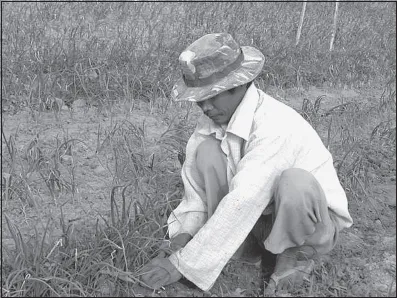
Many farm workers earn about two dollars per workday.
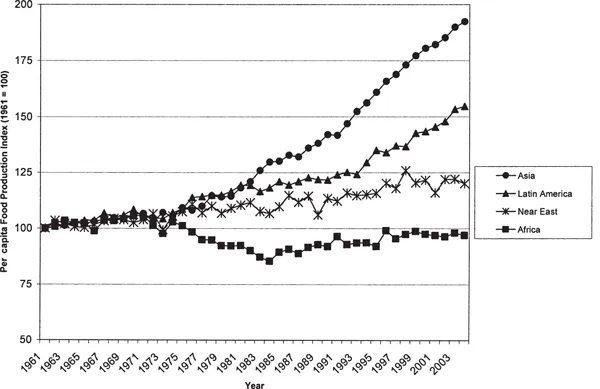
While hunger and poverty are found in every region of the world, Sub-Saharan Africa is the only major region where per capita food production has failed to at least trend upward for the past 30 years. As Figure 1-1 shows, per capita food production in Africa has stagnated since 1980 and had experienced a downward trend for several years before that time. Latin America, and particularly Asia, have experienced relatively steady increases. The result has been significant progress in reducing hunger and poverty in the latter two regions, while per capita calorie availability remains below minimum nutritional standards in many Sub-Saharan countries. Low agricultural productivity (farm output divided by farm inputs), wide variations in yields due to natural, economic, and political causes, and rapid population growth have combined to create a precarious food situation in these countries.
Annual variation in food production is a serious problem, particularly in Sub-Saharan Africa (Fig. 1-1). This variation has caused periodic famines in individual countries, particularly when production problems have been compounded by political upheaval or wars that have hindered international relief efforts. Production variability causes wide price swings that reduce food security for millions who are on the margin of being able to purchase food. If the world is to eliminate hunger, it must distinguish among solutions needed for short-term famine relief, those needed to reduce commodity price instability (or its effects), and those needed to reduce long-term or chronic poverty problems.
Figure 1-1 Index of per capita food production.
Malnutrition
Hunger is most visible to people in developed countries when a drought or other disaster results in images in the news of children with bloated bellies and bony limbs enduring the pain of extreme hunger. Disturbing as such images are, in a sense they mislead. The less conspicuous but more pernicious problem, in terms of people suffering and dying, is chronic malnutrition. While accurate figures of the number of malnourished in the world are not available, and even good estimates depend on the definition used, a conservative estimate is that roughly 800 million people suffer from chronic or severe malnutrition associated with food deprivation. More than 10 million people, many of them young children, die each year from causes related to inadequate food consumption. Increasing per capita food production has allowed more of the world’s population to eat better. But for those in the lower income groups, the situation remains difficult.
Health
People born in developing countries live, on average, 14 years less (in Sub-Saharan Africa, 27 years less) than those born in developed countries. Health problems, often associated with poverty, are responsible for most of the differences in life expectancies. Mortality rates for children under age five are particularly high, often 10 to 20 times higher than in developed countries (Fig. 1-2). Though countries with high rates of infant mortality are found in all regions, Sub-Saharan African countries are particularly afflicted. The band of high infant mortality stretching from the Atlantic coast across Africa to Somalia on the Indian Ocean covers some of the poorest and most undernourished populations in the world.
Poverty affects health by limiting people’s ability to purchase food, housing, medical services, and even soap and water. Inadequate public sanitation and high prevalence of communicable diseases are also closely linked with poverty. A major health problem, particularly among children, is diarrhea, usually caused by poor water quality. According to the World Bank, 5 to 10 million children die each year from causes related to diarrhea. Respiratory diseases account for an additional 4 to 5 million deaths, and malaria another million. Many people have never been vaccinated against such common — but preventable — diseases as rubella and measles, although...