eBook - ePub
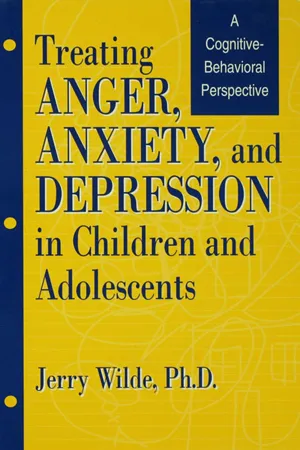
Treating Anger, Anxiety, And Depression In Children And Adolescents
A Cognitive-Behavioral Perspective
- 198 pages
- English
- ePUB (mobile friendly)
- Available on iOS & Android
eBook - ePub
Treating Anger, Anxiety, And Depression In Children And Adolescents
A Cognitive-Behavioral Perspective
About this book
Nearly all childhood problems fall somewhere within the big three - anger, anxiety and depression, claims Jerry Wilde, PhD, author of this new guide to treating the most prevalent problems facing children and Adolescents Today Way Of Rational-Emotive Behaviour Therapy REBT.; Wilde applies a cognitive-behavioural perspective to the big three when working with young people in both individual or group and school or private settings. He teaches novice and seasoned practitioners the requisite techniques for turning cognitive-behavioural theory into actual REBT progress in the lives of children and adolescents.; For each of the big three, the book examines causes and effective treatments/interventions and supplies a six to eight week group counselling guide, plus verbatim transcripts of sessions with clients. Also provided is an extensive overview of REBT.; As young people learn that they are not disturbed by events, but by views they take of events, they acquire skills for a lifetime of self-control over anger, anxiety and depression in the classroom, workplace and home. The techniques detailed in this guide should make that goal more accessible.
Information
Publisher
Taylor & FrancisYear
2013Print ISBN
9781560324829
9781560324812
Edition
1eBook ISBN
9781134939053
PART C
ANGER
ANGER
Chapter 7
ANGER
As has been stated previously, most children and adolescents believe that situations outside their control create their emotions. This statement applies to any and all emotional reactions including anger. Clients typically blame their anger on either the actions of others or events they dislike.
Not a day passes without hearing numerous remarks that support the contention that others have the power to make people angry.
• “She made me so mad.”
• “If he says that to me, I’ll have no choice but to tell him off.”
• “When people say things behind my back, I get ticked.”
Some of the more popular theories regarding the source of anger state that anger is an emotion caused by frustration (Dollard, Doob, Miller, Mowrer, & Sears, 1939). This belief, which has been called the frustration-aggression hypothesis, states that when people are frustrated, the aggressive drive is aroused naturally and automatically. The only way this aggressive drive can be reduced is by acting out in an aggressive manner.
According to REBT theory, anger is not being caused by frustration but by the demand that we not be frustrated. Which is correct?
If the frustration-aggression hypothesis were correct, every time a student is frustrated he/she will become angry because frustration causes anger. The question then becomes, “Can students experience a negative event such as unfair treatment and not anger themselves?” While nearly all students would dislike being treated unfairly, it is entirely possible that a student could receive such unfortunate treatment and not become overly upset. Students can and do react differently to the same situation.
A student could have received time in detention because he/she was accused of cheating on a test even though he/she actually had not cheated but inadvertently looked across at another student’s paper. Instead of thinking and stating, “I didn’t cheat. I was thinking, and my eyes were just pointed in that direction. It’s not fair!” a child could think, “I knew the rule Mr. Douglas has about keeping your eyes on your own paper. While I didn’t cheat, I did make a mistake. Hopefully, I won’t be this unlucky in the future.” By accepting responsibility for their behavior, children can acknowledge that they had acted inappropriately in some manner and deserved a consequence.
It also would be possible for children to believe that they had been treated unfairly but still refuse to make themselves angry. They could believe, “It’s not fair. I really don’t deserve this punishment. Mr. Douglas made a mistake, which we all do from time to time. I would like it if I wasn’t being treated unfairly, but that’s the way it goes sometimes. I can certainly see how he would think I was cheating.”
Students still would be disappointed about being assigned to detention but would not be enraged. The rational thought, “It’s not fair, but people have the right to make mistakes,” would keep the emotional response at an appropriate level.
Ellis (1973) drew a distinction between
1. healthy anger–which is moderate in intensity and includes such feelings as irritation, disappointment, and displeasure and
2. unhealthy anger–which includes feelings such as rage, hate, and bitterness. These emotions are deemed unhealthy because they do little to aid in survival and help clients reach their goals. If the child’s goal is to be able to avoid detention, rage and hate toward his teachers only will interfere with this goal. Such emotions certainly will not help the child control his/her behavior.
Emotions such as irritation and disappointment are viewed as healthy because they motivate clients to change. Students in the above example who are irritated over receiving detention will try to make certain their eyes do not move accidentally onto another’s paper. Irritation or disappointment will do nothing to interfere with their behaving in a manner that will allow them to be included in class activities and will serve as a reminder to follow the class rules.
A common misconception is that REBT does not support an individual’s right to be angry. This is patently false as people have the right to feel whatever emotion they are feeling. There are times when it is entirely appropriate to feel irritated and annoyed at someone’s obnoxious behavior. In fact, it would be difficult not to be irritated with some situations. This healthy anger is rational.
However, when the feelings reach extremes such as rage, clients no longer are thinking rationally because these emotional extremes are almost always self-defeating. Also, rage and extreme anger usually are produced by thoughts pertaining to the character of the person, rather than the behavior in question. For example, if someone lies to you, it is rational to feel irritated with the person’s behavior but irrational to think the individual is a “rotten person” who should be punished for being such a liar. As long as the evaluation remains focused on the person’s behavior, it may be rational. When it extends to the person’s character, it is irrational.
Social psychologists have long known of a phenomenon called fundamental attribution error, which can be defined as the tendency to attribute others’ failings to their dispositions (or characters). Conversely, people attribute their own difficulties largely to situational factors beyond their control. In short, people have the tendency to make excuses for their own difficulties and blame others for their problems and shortcomings.
REBT therapists are not “emotional fascists” who tell clients what they can and cannot feel. People have the right to feel whatever emotions they choose to experience, including rage and hate. Continually feeling such extreme emotions is not advisable because these emotions rarely, if ever, lead to positive results. Extreme emotions such as rage and hate often lead to behavior that is out of control.
Clients often convince themselves and others that events cause them to be angry but, logically, this can be disproved. Events have an influence over the children’s emotional reactions and contribute to feelings but are not solely responsible for emotions. This is an important distinction because it is the key to helping children control their anger. It is children’s beliefs, attitudes, and ideas about events that are primarily responsible for their emotional reactions.
PRIMARY BELIEF LEADING TO ANGER
Anger is created by a demand of some type. Typically the demand is formulated by key words such as should, must, ought to, have to, etc.
• The world should be fair.
• 1 must have things go my way.
• I ought to be able to do what I want.
• I have to have respect.
Ellis (1976) stated on numerous occasions that humans have a tendency to escalate their desires or wishes into absolute demands. This is especially true when these desires are strong. The fact that nearly all humans share this habit lead Ellis to believe that this tendency is innate. Undoubtedly this tendency also is influenced by sociocultural factors.
A child may see a candy bar in a store and think to himself/herself, “I really want that candy bar.” Is this a rational belief? Absolutely. The child is expressing a desire, and there is evidence to support his/her belief. The fact that the child continually asks his/her parents to buy the candy bar is evidence that the child does indeed want it. The problem lies in the fact that there is typically a second portion to this statement that is an automatic thought and often goes unheard. The second portion adds, “I really want that candy bar, and therefore I have to have it!” This second portion is an absolute demand and is the cause of the child’s anger.
If the belief were stopped after, “I really want that candy bar,” chances are the child might be disappointed without the treat, which is understandable. Possessing the candy bar has significant advantages: (1) If the child is hungry, the candy bar will satisfy the desire for food; and (2) We all know the real advantage of the candy bar is that it tastes good, certainly better than the dinner the child will be served...
Table of contents
- Cover
- Halftitle
- Title
- Copyright
- Table of Contents
- List of Figures
- Acknowledgments
- Part A Fundamentals of Rational-Emotive Behavior Therapy
- Part B Pretherapeutic Considerations
- Part C Anger
- Part D Anxiety
- Part E Depression
- Part F Group Work
- References
- Index
- About the Author
Trusted by 375,005 students
Access to over 1.5 million titles for a fair monthly price.
Study more efficiently using our study tools.
Frequently asked questions
Yes, you can cancel anytime from the Subscription tab in your account settings on the Perlego website. Your subscription will stay active until the end of your current billing period. Learn how to cancel your subscription
No, books cannot be downloaded as external files, such as PDFs, for use outside of Perlego. However, you can download books within the Perlego app for offline reading on mobile or tablet. Learn how to download books offline
Perlego offers two plans: Essential and Complete
- Essential is ideal for learners and professionals who enjoy exploring a wide range of subjects. Access the Essential Library with 800,000+ trusted titles and best-sellers across business, personal growth, and the humanities. Includes unlimited reading time and Standard Read Aloud voice.
- Complete: Perfect for advanced learners and researchers needing full, unrestricted access. Unlock 1.5M+ books across hundreds of subjects, including academic and specialized titles. The Complete Plan also includes advanced features like Premium Read Aloud and Research Assistant.
We are an online textbook subscription service, where you can get access to an entire online library for less than the price of a single book per month. With over 1.5 million books across 990+ topics, we’ve got you covered! Learn about our mission
Look out for the read-aloud symbol on your next book to see if you can listen to it. The read-aloud tool reads text aloud for you, highlighting the text as it is being read. You can pause it, speed it up and slow it down. Learn more about Read Aloud
Yes! You can use the Perlego app on both iOS and Android devices to read anytime, anywhere — even offline. Perfect for commutes or when you’re on the go.
Please note we cannot support devices running on iOS 13 and Android 7 or earlier. Learn more about using the app
Please note we cannot support devices running on iOS 13 and Android 7 or earlier. Learn more about using the app
Yes, you can access Treating Anger, Anxiety, And Depression In Children And Adolescents by Jerry Wilde in PDF and/or ePUB format, as well as other popular books in Psychology & Abnormal Psychology. We have over 1.5 million books available in our catalogue for you to explore.