- 296 pages
- English
- ePUB (mobile friendly)
- Available on iOS & Android
eBook - ePub
About this book
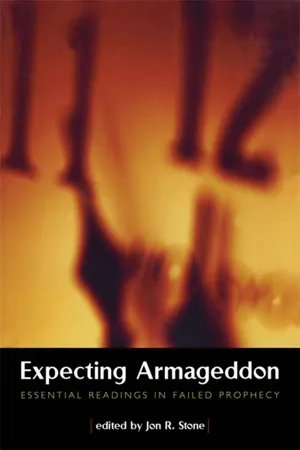
The expectation of an end to time and the yearning for a millennial paradise have been recurring themes in Western religious thought. But when we speak of expectation of the world's end we are mindful of the fact that generation after generation of millenarians have been disappointed. Their endtime hopes and prophecies have not come true. What happens, one might ask, when prophecies fail? Does failure spell the end of the very movements that embrace such expectations? The aim of this anthology is to gather together in one volume the essential research from the fields of sociology and psychology that seeks to answer this intriguing question as first raised by Festinger in his 1956 work, When Prophecy Fails. Cross-cultural and comparative, this collection chronicles forty years of research into failed prophecy and response to the attending cognitive dissonance it produces that is at once timely and informative.
Information
Unfulfilled Prophecies and Disappointed Messiahs |
A man with a conviction is a hard man to change. Tell him you disagree and he turns away. Show him facts or figures and he questions your sources. Appeal to logic and he fails to see your point.
We have all experienced the futility of trying to change a strong conviction, especially if the convinced person has some investment in his belief. We are familiar with the variety of ingenious defenses with which people protect their convictions, managing to keep them unscathed through the most devastating attacks.
But man's resourcefulness goes beyond simply protecting a belief. Suppose an individual believes something with his whole heart; suppose further that he has a commitment to this belief, that he has taken irrevocable actions because of it; finally, suppose that he is presented with evidence, unequivocal and undeniable evidence, that his belief is wrong: what will happen? The individual will frequently emerge, not only unshaken, but even more convinced of the truth of his beliefs than ever before. Indeed, he may even show a new fervor about convincing and converting other people to his view.
How and why does such a response to contradictory evidence come about? This is the question on which we focus. We hope that we will provide an adequate answer to the question, an answer documented by data.
Let us begin by stating the conditions under which we would expect to observe increased fervor following the disconfirmation of a belief. There are five such conditions.
1. A belief must be held with deep conviction and it must have some relevance to action, that is, to what the believer does or how he behaves.
2. The person holding the belief must have committed himself to it; that is, for the sake of his belief, he must have taken some important action that is difficult to undo. In general, the more important such actions are, and the more difficult they are to undo, the greater is the individual's commitment to the belief.
3. The belief must be sufficiently specific and sufficiently concerned with the real world so that events may unequivocally refute the belief.
4. Such undeniable disconfirmatory evidence must occur and must be recognized by the individual holding the belief.
The first two of these conditions specify the circumstances that will make the belief resistant to change. The third and fourth conditions together, on the other hand, point to factors that would exert powerful pressure on a believer to discard his belief. It is, of course, possible that an individual, even though deeply convinced of a belief, may discard it in the face of unequivocal disconfirmation. We must, therefore, state a fifth condition specifying the circumstances under which the belief will be discarded and those under which it will be maintained with new fervor.
5. The individual believer must have social support. It is unlikely that one isolated believer could withstand the kind of disconfirming evidence we have specified. If, however, the believer is a member of a group of convinced persons who can support one another, we would expect the belief to be maintained and the believers to attempt to proselytize or to persuade nonmembers that the belief is correct.
These five conditions specify the circumstances under which increased proselytizing would be expected to follow disconfirmation. Given this set of hypotheses, our immediate concern is to locate data that will allow a test of the prediction of increased proselytizing. Fortunately, there have been throughout history recurring instances of social movements which do satisfy the conditions adequately. These are the millennial or messianic movements, a contemporary instance of which we shall be examining in detail. Let us see just how such movements do satisfy the five conditions we have specified.
Typically, millennial or messianic movements are organized around the prediction of some future events. Our conditions are satisfied, however, only by those movements that specify a date or an interval of time within which the predicted events will occur as well as detailing exactly what is to happen. Sometimes the predicted event is the Second Coming of Christ and the beginning of Christ's reign on earth; sometimes it is the destruction of the world through a cataclysm (usually with some select group slated for rescue from the disaster); or sometimes the prediction is concerned with particular occurrences that the Messiah or a miracle worker will bring about. Whatever the event predicted, the fact that its nature and the time of its happening are specified satisfies the third point on our list of conditions.
The second condition specifies strong behavioral commitment to the belief. This usually follows almost as a consequence of the situation. If one really believes a prediction (the first condition)—for example, that on a given date the world will be destroyed by fire, with sinners being destroyed and the good being saved—one does things about it and makes certain preparations as a matter of course. These actions may range all the way from simple public declarations to the neglect of worldly things and the disposal of earthly possessions. Through such actions and through the mocking and scoffing of nonbelievers there is usually established a heavy commitment on the part of believers. What they do by way of preparation is difficult to undo, and the jeering of nonbelievers simply makes it far more difficult for the adherents to withdraw from the movement and admit that they were wrong.
Our fourth specification has invariably been provided. The predicted events have not occurred. There is usually no mistaking the fact that they did not occur and the believers know that. In other words, the unequivocal disconfirmation does materialize and makes its impact on the believers.
Finally, our fifth condition is ordinarily satisfied—such movements do attract adherents and disciples, sometimes only a handful, occasionally hundreds of thousands. The reasons why people join such movements are outside the scope of our present discussion, but the fact remains that there are usually one or more groups of believers who can support one another.
History has recorded many such movements. Some are scarcely more than mentioned while others are extensively described, although sometimes the aspects of a movement that concern us most may be sketchily recounted. A number of historical accounts, however, are complete enough to provide an introductory and exploratory answer to our central question. From these we have chosen several relatively clear examples of the phenomena under scrutiny in an endeavor simply to show what has often happened in movements that made a prediction about the future and then saw it disconfirmed. We shall discuss these historical examples before presenting the data from our case study of a modern movement.
Ever since the crucifixion of Jesus, many Christians have hoped for the Second Coming of Christ, and movements predicting specific dates for this event have not been rare. But most of the very early ones were not recorded in such a fashion that we can be sure of the reactions of believers to the disconfirmations they may have experienced. Occasionally historians make passing reference to such reactions, as does Hughes in his description of the Montanists:
Montanus, who appeared in the second half of the second century, does not appear as an innovator in matters of belief. His one personal contribution to the life of the time was the fixed conviction that the second coming of Our Lord was at hand. The event was to take place at Pepuza—near the modern Angora—and thither all true followers of Our Lord should make their way. His authority for the statement was an alleged private inspiration, and the new prophet's personality and eloquence won him a host of disciples, who flocked in such numbers to the appointed spot that a new town sprang up to house them. Nor did the delay of the second advent put an end to the movement. On the contrary, it gave it new life and form as a kind of Christianity of the elite, whom no other authority guided in their new life but the Holy Spirit working directly upon them… . [Italics ours.]1
In this brief statement are all the essential elements of the typical messianic movement. There are convinced followers; they commit themselves by uprooting their lives and going to a new place where they build a new town; the Second Advent does not occur. And, we note, far from halting the movement, this disconfirmation gives it new life.
There is somewhat better documentation of millennial movements in more recent history. For example, the Anabaptists of the early sixteenth century believed that the millennium would occur in 1533. As Heath puts it:
But these high thoughts were obscured by Hoffmann's prediction that the end of all things was at hand. Strassburg, according to him, had been chosen as the New Jerusalem; there the magistrates would set up the kingdom of righteousness, while the hundred and forty and four thousand would maintain the power of the City, and the true Gospel and the true Baptism would spread over the earth. No man would be able to withstand the power, signs and wonders of the saints; and with them would appear, like two mighty torches, Enoch and Elias, who would consume the earth with the fire proceeding from their mouths. The year 1533 was the time in which, Hoffmann declared, the great fulfillment would begin.2
This adventist prediction was apparently proclaimed with vigor and was accepted by many persons who then acted accordingly, that is, they began to prepare for the Second Advent and the end of the temporal world. Heath says, for example:
The followers of Rothmann [a disciple of Hoffmann], were at this time, as was their leader, distinguished for earnestness and self-sacrificing devotion. They sought to exemplify equality and brotherhood in their lives. Well-to-do Brothers and Sisters gave all their goods to the poor, destroyed their rent-rolls, forgave their debtors, renounced worldly pleasures, studying to live an unworldly life.3
Such was the situation in 1533, when the end of the world was due. Many people had accepted this belief and some were even disposing of their worldly goods. What happened as the end of 1533 approached and, indeed, when 1534 arrived, without the Second Coming having materialized?
From all accounts it would seem that instead of dampening the ardor of the Anabaptists, the disconfirmation of the predicted Second Coming increased their enthusiasm and activity. They poured greater energy than ever before into obtaining new converts, and sent out missionaries, something they never had done before. The following excerpts from Heath's study illustrate this increase of enthusiasm and activity following the disconfirmation:
… The year 1533 was almost at an end, the half-year during which it had been prophesied Hoffmann should be imprisoned had nearly elapsed, the two years' cessation from baptism had nearly run out when a new prophet [Matthysz] arose.
The Dutch Baptists felt that a leader had risen up amongst them, and they yielded themselves to his guidance. Matthysz began by sending out apostles … These apostles went forth announcing, among other things, that the promised time had come, that no more Christian blood would be poured out, but that in a short time God would overthrow the tyrants and blood-shedders with all the rest of the wicked. They travelled through many states and visited many cities, going to the gatherings of the faithful, and offering them the kiss of peace. They baptized, and ordained bishops and deacons, committing to the former the duty of ordaining others.
The new tide of enthusiasm rose higher than ever. Jakob van Kampen, who, assisted by Houtzager, worked among the poorer homes in Amsterdam, baptized in February, 1534, in one day, a hundred persons. About two months later it was estimated that two-thirds of the population at Monniaendam were adherents of Jan Matthysz, and it is said to have been the same in the neighbourhood of most of the great cities of Holland.4
Another, and rather fascinating, illustration of the reaction to disconfirming evidence is provided by the messianic movement of which Sabbatai Zevi was the central figure.5 Sabbatai Zevi was born and raised in the city of Smyrna. By 1646 he had acquired considerable prestige through living a highly ascetic life and devoting his whole energy to the study of the cabala. Indeed, though he was only twenty years old, he had already gathered around him a small group of disciples. To these disciples he taught and interpreted the highly mystical writings of the cabala.
Prevalent among Jews at that time was the belief that the Messiah would come in the year 1648. His coming was to be accompanied by all manner of miracles and the era of redemption would dawn. Sometime in 1648 Sabbatai Zevi proclaimed himself as the promised Messiah to his small group of disciples. Needless to say, the year 1648 passed and the era of redemption did not dawn and the expected miracles were not forthcoming.
There is but scant information about immediately subsequent events but apparently the disconfirmation of his messiahship did not daunt Sabbatai or his disciples. Indeed, it seems that after 1648 he made his claim known to the community at large. Graetz writes: “When Zevi's pretensions became known some years later, the college of rabbis, at their head his teacher Joseph Eskapha, laid him and his followers under a ban … Finally, he and his disciples were banished from Smyrna [about 1651].”6 The significant point for our interest is that it was after the year 1648 h...
Table of contents
- Front Cover
- Half Title
- By the Same Author
- Title Page
- Copyright
- Dedication
- Contents
- Preface
- Introduction
- 1 Unfulfilled Prophecies and Disappointed Messiahs
- 2 Prophecy Fails Again
- 3 Prophetic Failure and Chiliastic Identity
- 4 When Prophecies Fail
- 5 The Effects of Prophetic Disconfirmation of the Committed
- 6 Prophecy Continues to Fail
- 7 When the Bombs Drop
- 8 Spiritualization and Reaffirmation
- 9 Had Prophecy Failed?
- 10 How Do Movements Survive Failures of Prophecy?
- 11 “It Separated the Wheat from the Chaff”
- 12 Coping with Apocalypse in Canada
- 13 When Festinger Fails
- 14 When Prophecy Is Not Validated
- 15 Fifteen Years of Failed Prophecy
- Sources
Trusted by 375,005 students
Access to over 1.5 million titles for a fair monthly price.
Study more efficiently using our study tools.
Frequently asked questions
Yes, you can cancel anytime from the Subscription tab in your account settings on the Perlego website. Your subscription will stay active until the end of your current billing period. Learn how to cancel your subscription
No, books cannot be downloaded as external files, such as PDFs, for use outside of Perlego. However, you can download books within the Perlego app for offline reading on mobile or tablet. Learn how to download books offline
Perlego offers two plans: Essential and Complete
- Essential is ideal for learners and professionals who enjoy exploring a wide range of subjects. Access the Essential Library with 800,000+ trusted titles and best-sellers across business, personal growth, and the humanities. Includes unlimited reading time and Standard Read Aloud voice.
- Complete: Perfect for advanced learners and researchers needing full, unrestricted access. Unlock 1.5M+ books across hundreds of subjects, including academic and specialized titles. The Complete Plan also includes advanced features like Premium Read Aloud and Research Assistant.
We are an online textbook subscription service, where you can get access to an entire online library for less than the price of a single book per month. With over 1.5 million books across 990+ topics, we’ve got you covered! Learn about our mission
Look out for the read-aloud symbol on your next book to see if you can listen to it. The read-aloud tool reads text aloud for you, highlighting the text as it is being read. You can pause it, speed it up and slow it down. Learn more about Read Aloud
Yes! You can use the Perlego app on both iOS and Android devices to read anytime, anywhere — even offline. Perfect for commutes or when you’re on the go.
Please note we cannot support devices running on iOS 13 and Android 7 or earlier. Learn more about using the app
Please note we cannot support devices running on iOS 13 and Android 7 or earlier. Learn more about using the app
Yes, you can access Expecting Armageddon by Jon R. Stone in PDF and/or ePUB format, as well as other popular books in Social Sciences & Social Psychology. We have over 1.5 million books available in our catalogue for you to explore.