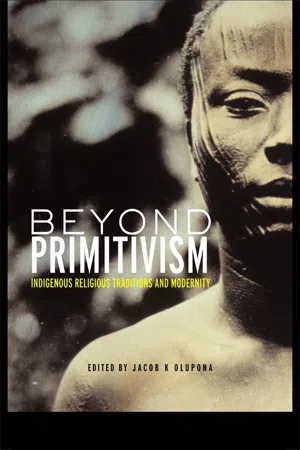
What role do indigenous religions play in today's world? Beyond Primitivism is a complete appraisal of indigenous religions - faiths integrally connected to the cultures in which they originate, as distinct from global religions of conversion - as practised across America, Africa, Asia and the Pacific today. At a time when local traditions across the world are colliding with global culture, it explores the future of indigenous faiths as they encounter modernity and globalization. Beyond Primitivism argues that indigenous religions are not irrelevant in modern society, but are dynamic, progressive forces of continuing vitality and influence. Including essays on Haitian vodou, Korean shamanism and the Sri Lankan 'Wild Man', the contributors reveal the relevance of native religions to millions of believers worldwide, challenging the perception that indigenous faiths are vanishing from the face of the globe.
- 368 pages
- English
- ePUB (mobile friendly)
- Available on iOS & Android
eBook - ePub
About this book
Information
Part I
Modernity and methodology
Chapter 1
Do Jews make good Protestants? The cross-cultural study of ritual1
Naomi Janowitz
Usually, a ritual becomes the object of investigation only when it is perceived to be exotic, bizarre, nonsensical, or absurd. That is to say, when it is someone else's ritual. The “someone else” has classically been an indigenous person; the investigators, in the main, Protestants. The distorting lens of Protestant-based theories of ritual is addressed in S.J. Tambiah's book, Magic, Science, Religion and the Scope of Rationality. He presents a thorough critique of scholars such as Edmund Tylor and James George Frazer, demonstrating the straitjacket that their theories constructed for analyzing indigenous rituals.
Despite decades of such critiques, the legacy of these scholars continues to shape debates about ritual. Tambiah's elegant critique of much prior scholarship and his own influential observations about ritual demands careful consideration. In the first section of this chapter, I will address some of the theoretical problems Tambiah raises for us about comparing “Western” and “indigenous” rituals; in the second part, I will examine a test case, Israelite and Ancient Near Eastern scapegoat rituals, chosen because it intersects with material Tambiah discusses. We will see both the tenacity of and the distortions brought by Protestant-based theories of ritual, problems that are at the core of improving our study of indigenous religions. I will offer some suggestions about alternative terminology that can be used in the study of rituals.
Relativism and the problem of efficacy
Tambiah's short book addresses what is often called the demarcation question, that is to say, how to distinguish between magic, religion, and science. In an attempt to avoid using Western notions of science to judge traditional/indigenous rituals, he delineates a variant of the now-common “relativist” position. According to relativist theories, the norms from one society for definitions of rationality should not be used to study, and judge, another culture. He posits that
it is when we transport the universal rationality of scientific causality and the alleged rationality of surrounding moral, economic and political sciences with the claims to objective rules of judgment…and try to use them as yardsticks for measuring, understanding and evaluating other cultures and civilization that we run into the vexed problems of relativity, commensurability, and translation of culture.
(1990: 132)
These vexed problems are epitomized for Tambiah in Robin Horton's controversial continuity thesis. This thesis, which compares African traditional thought with Western science, has two parts: (1) the structure of traditional African thought is similar to the structure of Western scientific theories; and (2) nevertheless, African thought is dissimilar to Western science in other ways.2 By making this comparison, Horton appears to many scholars to present indigenous peoples as attempting to indulge, rather poorly, in scientific thinking when they employ traditional modes of thought. For Tambiah, this is just another version of earlier claims that traditional thought is childlike or primitive.
Both halves of Horton's thesis had come under serious attack before Tambiah's critique.3 Some of the criticisms of Horton are based on his notion of science, which appeared to some to suffer from its positivistic stance.4 A simple reference to Thomas Kuhn is thought to be sufficient to destroy the basis for Horton's position, and thus his equation of African and Western thought.5 This criticism does not, however, demolish Horton's enterprise, but simply sends his supporters in search of a more up-to-date philosophy of science.6
Another tack taken in refutation of Horton's comparison is to argue that traditional thought is distinct from scientific thought and does not overlap in any way. Any attempt to compare them is a “category mistake.” Scientific thought relies on notions of cause and effect while religious thought does not. According to this view, ritual is a purely symbolic activity whose practitioners do not expect a particular outcome from their ritual activities.7 Instead, they are participating in a symbolic expression of cultural concepts. Beattie, for example, argues that “myth dramatizes the universe, science analyzes it” (1966: 65). Ritual is not an attempt to assert human influence but a meditation on the limitations of being human.8
The motivation behind this type of theory is laudable since it frees the “natives” from believing in what appear to be ridiculously simple or misguided notions of cause and effect. Indeed, as Penner notes, “one of the strengths of the symbolic approach is its criticism of ethnocentric explanations of religious beliefs and practices” (1989: 71). However, a symbolic approach to ritual is fraught with problems, two of which will be discussed here briefly.9
First, at a theoretical level, a symbolic approach does not tell us what the rituals are symbolic of, nor how to decode the symbols. Clifford Geertz, for example, places symbols at the heart of his definition of religion but does not tell us how symbols work (Asad 1993). The notion of symbol is used by Geertz “sometimes as an aspect of reality, sometimes of its representation” (ibid.: 30).10
Second, symbolic explanations negate the statements by participants who believe that their rituals are supposed to have specific effects. The implicit accusation that participants are wrong in their understanding of rituals is not itself grounds for rejecting symbolic theories, but negating their direct statements about rituals is an odd way to develop more indigenous-friendly interpretations. The theorist may be rescuing the indigenous people from accusations of misguided action, but he is also telling them that they do not understand their actions.
In sum, symbolic theories may look less pejorative on the surface, but they fail to offer a theoretical basis for the analysis of symbols. Symbolic theories cannot account for the perceived efficacy of rituals and they eviscerate ritual of any real purpose.11
Returning to Tambiah, he tries to vitiate Horton's comparisons by emphasizing the “expressive-performative” or “participatory” aspects of ritual. “Participation” appears to be an alternative ordering or reality to causality (Tambiah 1990: 108). This stance brings Tambiah very close to the symbolic theorists, leaving him vulnerable to all the criticisms of their position.
In addition, Tambiah's own two concluding examples undermine his argument. His first example concerns Sri Lanka and South India, where smallpox epidemics were attributed to the anger of a mother goddess. Control of the disease was attempted through annual religious festivals. Tambiah notes that with the introduction of modern vaccines, the festivals died out (ibid.: 133). The Western germ theory replaced the indigenous explanation on the basis of its better record of cure and prevention. The smallpox-averting rituals had a major participatory component, but this component was not enough to save them when the goal-directed dimensions were no longer important.
Tambiah's second example compares Indian (ayurveda) and Western healing systems for mental illness:
[T]hey may both agree that certain behavioral and somatic systems – such as withdrawal from social relations, a depressed emotional state, lack of appetite, and so on – are indices of mental ill-health…But if each system in its context is no more rational and efficacious than the other, then we are faced with the conundrum whether it is possible to delineate a single transcultural context-independent profile of mental states like hysteria or depression.
(ibid.: 134ff.)
The Western philosopher of science is apt to be delighted, not dismayed, that ayurveda is as efficacious as Western modes of dealing with mental health. The various branches of psychiatry, psychoanalysis, and psychotherapy are not strong cases for definitions of science because of their comparatively weak empirical success.12 This example calls for a reconsideration of the demarcation question in relation to the Western material itself (is psychotherapy a science?) and not in relation to an East–West comparison. The question must be: if “Western” science is able to come up with a more effective therapy for mental illness, would that replace traditional Indian methods? If so, we will only be able to explain this situation by using concepts of efficacy, which Tambiah rejects.
In both cases we see that, despite his notion of category mistake, Tambiah does allow for a valid trans-cultural judgment (ibid.: 132ff.). This trans-cultural judgment looks suspiciously similar to Horton's attempts. Apparently, Tambiah has no way to explain to us which rituals will be replaced with the introduction of modern science, and which will not, unless he turns to the very notions of efficacy that he rejects. Tambiah realizes that “elements of participation are not lacking in scientific discourses” (ibid.: 109). Hence, it is not clear why having located some participatory component in a ritual immunizes it against comparative judgment predicated on the efficacy of the causal component.
Unsurprisingly, the case in which Tambiah's distinction between scientific “causality” and ritual “participation” appears to be valid is Protestant-based theories of ritual. These theories are locatable in a specific cultural and historical context. As Horton himself pointed out, once non-theistic paradigms in science achieved unprecedented success in explanation, prediction, and control of the natural world, Christian theologians redefined religion, restricting it to spheres where it was safe from scientific refutation. From then on, assertions about natural science based on Scripture and assertions about deities (especially their non-existence) based on “science” could both be labeled category mistakes. Secularization is a cultural process which influences not only the concepts of science but also those of religion. Looking over the specific historical debates which have led to a Western differentiation of religion from science, it seems impossible to claim that “traditional thought” possessed this identical differentiation.
Similar ambiguities plague Tambiah's characterization of “scientific” versus “persuasive” analogies. In his influential article “The form and meaning of magical acts,” Tambiah argues that these two types of analogy are distinct, and that “persuasive” analogies should not be judged by the same standards as “scientific” analogies (1985).13 In one analogy the Mujiwu compare a tree which has many roots and a woman who wants to have many children. Tambiah explains that
[t]here is no intrinsic reason why the tree should be similar to a mother and the roots to children, but the analogy which says that roots are to the tree as children are to the mother makes relational sense that can be used to “transfer” effect.
(ibid.: 76)
Here Tambiah begs the question: what is “relational sense” and how exactly is it employed to transfer effects? The premise of an analogy is some similarity weaker than identity between two objects; a particular aspect of one is imputed to resemble, for some reason, a corresponding aspect of the other. The more the similarity compels the second correspondence, the more persuasive it is. If by “relational sense” Tambiah is referring to culturally dependent criteria of the probative force of a similarity, then this is a statement about analogies in general.
One of the examples Tambiah gives is the treatment of scabies with chicken excrement. Not only do the two look the same, as has often been pointed out, but Tambiah also argues that part of the negative analogy is the relationship of excrement as a waste product (unwanted) to the scabby skin on the child as an unwanted adherence to the body. Thus a “persuasive analogy” appears to have both a positive and a negative component, pointing out how something is not like something else as much as how it is similar.
However, Tambiah does not show us how to tell when natives think that the negative part of a possible analogy would turn it into an unpersuasive analogy, that is to say, one where the evident dissimilarity leads to rejection of the putative conclusion. This is not surprising, because natives are aware of the positive analogies, as Tambiah notes, but appear never to point out the negative ones. It is not difficult to construct negative analogies out of positive ones because the two items are never identical. Until the relationship of the negative analogy to the positive analogy is clarified, an observer can construct his own negative analogy based on speculation about the natives’ methods of reasoning without being able to prove or disprove them.
Finally, Tambiah's work is widely cited for his use of speech act theory, as outlined by J.L. Austin. Scholars eager for a means of characterizing the compulsive nature or perceived efficacy of ritual turned with enthusiasm to Austin's How to do Things with Words. Austin attempts to capture and describe the sense people have that verbal formulas have effects and accomplish ends. In particular, he created the term “performativity” to capture the sense of “doing” of some types of speech.14 However, it should be noted in passing that Austin's model is not a sufficient theoretical model for finding “performativity” in any language or ritual system. His categories stem from English verbs, and no argument has ever been made that the functions of these forms are easily transferable to other languages.15 A more useful theory of “performativity” would have to explain at a theoretical level how certain linguistic forms are related to their context of use (have a perceived efficacy).
To compound the problem of simply adopting Austin's notion of “performativity,” Tambiah creates by analogy a category “performative act.” T...
Table of contents
- Cover Page
- Title Page
- Copyright Page
- Illustrations
- Contributors
- Preface
- Introduction
- Part I: Modernity and methodology
- Part II: The Americas
- Part III: Africa and Asia
- Part IV: The Pacific Islands
Trusted by 375,005 students
Access to over 1.5 million titles for a fair monthly price.
Study more efficiently using our study tools.
Frequently asked questions
Yes, you can cancel anytime from the Subscription tab in your account settings on the Perlego website. Your subscription will stay active until the end of your current billing period. Learn how to cancel your subscription
No, books cannot be downloaded as external files, such as PDFs, for use outside of Perlego. However, you can download books within the Perlego app for offline reading on mobile or tablet. Learn how to download books offline
Perlego offers two plans: Essential and Complete
- Essential is ideal for learners and professionals who enjoy exploring a wide range of subjects. Access the Essential Library with 800,000+ trusted titles and best-sellers across business, personal growth, and the humanities. Includes unlimited reading time and Standard Read Aloud voice.
- Complete: Perfect for advanced learners and researchers needing full, unrestricted access. Unlock 1.5M+ books across hundreds of subjects, including academic and specialized titles. The Complete Plan also includes advanced features like Premium Read Aloud and Research Assistant.
We are an online textbook subscription service, where you can get access to an entire online library for less than the price of a single book per month. With over 1.5 million books across 990+ topics, we’ve got you covered! Learn about our mission
Look out for the read-aloud symbol on your next book to see if you can listen to it. The read-aloud tool reads text aloud for you, highlighting the text as it is being read. You can pause it, speed it up and slow it down. Learn more about Read Aloud
Yes! You can use the Perlego app on both iOS and Android devices to read anytime, anywhere — even offline. Perfect for commutes or when you’re on the go.
Please note we cannot support devices running on iOS 13 and Android 7 or earlier. Learn more about using the app
Please note we cannot support devices running on iOS 13 and Android 7 or earlier. Learn more about using the app
Yes, you can access Beyond Primitivism by Jacob K. Olupona in PDF and/or ePUB format, as well as other popular books in Theology & Religion & Comparative Religion. We have over 1.5 million books available in our catalogue for you to explore.