- 128 pages
- English
- ePUB (mobile friendly)
- Available on iOS & Android
eBook - ePub
About this book
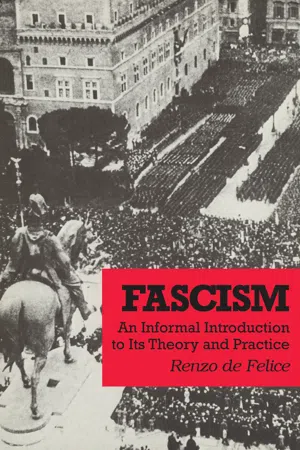
For Italian intellectuals, the terms fascist and antifascist continue to be the hard currency of contemporary political debate-to the point that if you are not one, you must be the other. When professor Renzo de Felice suggests that fascism describes a moment in the Italian past-and only that-he is challenging the very heart of current orthodoxy. The nature of his analysis of the recent Italian past is itself at odds with the traditional version, and represents a radical departure from conventional wisdom. De Felice's ideas about fascism have a broad signifi cance, quite apart from their importance in the contemporary Italian scene. Perhaps no one knows as much about fascism, and no one has given the subject such a rigorous historical analysis.
Information
1
Historical and Theoretical Background of De Felice’s Work
Ledeen: Where and with whom did you study Italian history? Who have been the major influences in your development?
De Felice: It is difficult to say who the major influences upon me have been. It is much easier to say with whom I have studied. I studied with and earned my degree with Chabod. I continued to study with him in Naples and then in Rome in the last days of his life. Having said this, however, I must add that I do not believe there are such persons who can be considered the professors or masters of their students: If someone is a student in the strict sense of the word, he is a person with no intellectual autonomy. It is possible to speak of a series of influences. Chabod’s influence has been very important in shaping the way I study history, both from the standpoint of methodology and the way in which he posed empirical problems. I knew the Chabod of the lectures, of the seminars in Rome, of the courses in Naples, who worked on the [French] Revolution or on the Renaissance. The “contemporary” Chabod—the Chabod of Italian foreign policy or of fascism itself—I only knew through his books, or at best through the stories, the rumors, or the episodes one heard from his assistants early in the morning in Naples. Chabod represents something quite precise and concrete in my development.
There are also other scholars who have been of primary importance. Their relative importance is quite different, both from each other and from Chabod. These are Cantimori—and in a certain sense I consider myself to be more a student of Cantimori than of Chabod—and Giuseppe De Luca. My concern with De Luca is quite simple: De Luca has influenced me with a kind of historical sensitivity, his history of the Pietà, his method of integration of all kinds of stimuli and suggestions from literature and the arts, and his method of the utilization of a series of other disciplines into historical analysis.
The relationship with Cantimori is perhaps the most important, especially since I was a young man when I knew him. I got to know him while I was working on my thesis, and I continued to have friendly relations with him, relations that grew ever closer, notwithstanding the difference between our ages, up until the time of his death. It is complicated to define my relationship with Cantimori. At the beginning of the fifties it was inevitable for a young man who went to the university to have a certain fascination for the man who was considered the great master and patriarch of Marxist historiography in Italian universities. This aspect was always secondary in my relations with Cantimori. It was based on a communality of interests.
One of the main historiographical interests of Cantimori concerned a certain aspect of the Enlightenment, the Italian Jacobinism, and I began my historical research by studying the Italian Jacobins.1 As this predilection for the Jacobins continued and as I worked in close contact with Cantimori (the second volume on the Italian Jacobins in the series Scrittori d’Italia, published by Laterza,2 was done in coauthor-ship) it became increasingly evident—from friendly conversations between the two of us and from various reminiscences of Cantimori and bits of research we did together—that we also shared another interest, an interest in contemporary Italy, an interest in fascism that finally became more precise when I began my work on the Jews. What was most helpful to me in my relationship with Cantimori was the confirmation of certain ideas I had on how to analyze these problems.
Cantimori used to get very angry, especially in private—above and beyond my own memories there are several of his letters in this regard that are very important—with what he called the sublime moralism of certain Italian intellectuals. He considered such moralism both irrelevant and dangerous for the study of contemporary history. At the same time he rejected all the pseudopolitical generalizations in the field of contemporary history. Looking at his last writings, even the most episodical ones like those gathered in Conversando di storia,3 we find various hints, various emphases, frequently consisting of two- and three-word phrases, which are typical of the way in which he conceived of contemporary history. For example, with regard to university instruction, he says that this must not consist of liberal democratic sermons, or those of any other ideology or political position. In particular I wish to recall that beautiful letter in which he faced the problem of fascism and said that he was against any and all generalizations: fascism and antifascism are themes without meaning at a historiographical level. Neither constitutes a unity. One must look within and behind these realities. In this connection, I often think of that stupendous page on fascism where Cantimori compares it with the great white whale of Moby Dick, saying that it must be considered in all its components and in all its developments.4
Ledeen: This brings us to your interest in fascism. How is it that beginning with the Jacobins you arrived at the fascists?
De Felice: This is a complicated subject. I could answer you with a paradox that is profoundly false; nonetheless, like all those things that are profoundly false, it has at its base an element of truth. I have always had—and Cantimori wrote this, too, with regard to an article of mine on Preziosi5—a certain taste, a psychological and human interest in a particular kind of personality that is both coherently cold-blooded and Luciferian. There is something in common between my Jacobins and a certain kind of fascism—in particular the fascists of the first years. This element in common is surely false historio-graphically, but perhaps true psychologically.
There is something even more important than this: I began to get interested in fascism through the study of the Jews under fascism. This, too, is a complicated problem. When I began to study history, one of the great themes—and instead of “great themes” it might be more accurate to say “great fashions”—was the period of the French Revolution, the period of Italian Jacobinism, which was studied in an effort to understand the successive evolution of Italian history, the period of the Risorgimento. That kind of analysis— which interested me then and which continues to interest me even now—could not in the end explain recent developments of Italian history. It was necessary to confront the period of fascism itself and grab it by the throat.
Existing material on the fascist period did not satisfy me because in my work with Chabod and Cantimori I was used to reasoning on the basis of research and documents. It was not possible to write the history of fascism until one had looked at documents of the period. Although I did not entirely reject it, the kind of historiography of fascism written several decades ago was unsatisfactory. Twenty or thirty years ago, fascism was too recent an experience, it was still too hot a subject, and an objective, scientific kind of historical analysis was impossible. Still, I was convinced that the moment had come to attempt a more fully historical analysis, a less political discussion, which could not have been requested of the generation that lived through fascism, fought it, or witnessed it. This would have required a truly exceptional person, a kind of person that I do not believe exists.
Croce’s remark to his students at the Institute in Naples is highly symptomatic: “I will not do the history of fascism because it disgusts me; however, if I had to do it, I would do it opposite the current manner.”6 I was convinced that history had to be done in a different way, and that this was the task of the new generation; of those who either had not lived through fascism or had lived it as spectators. They were sufficiently young that they could not have been totally conditioned by the passions of the time. It was necessary to revisit fascism, to restudy it, with greater objectivity and with the greatest critical serenity possible. Fascism, which I call “historical fascism”—that which existed between 1919 and 1945—is dead, and it cannot be revived. It is a closed chapter, and because of this it is possible to study it historically, with a historical method and a historical mentality.7
You may say this is a problem that concerns historians. But there was and is a greater problem: an ethical-political problem. Fascism did great damage, but one of its most terrible achievements was to leave an inheritance of a fascist mentality to nonfascists, to the generation that followed fascism, to those people who, both in word and in action, are truly and decisively antifascist. This fascist mentality must be fought in every manner because it is terribly dangerous. It is a mentality of intolerance and of ideological oppression, which seeks to disqualify its opponents in order to destroy them.
Ledeen: How did you begin your studies of fascism? What path has your study of fascism taken?
De Felice: In the context of my eighteenth-century studies, I became involved in the study of the Jews during the Napoleonic period.8 These studies provoked a reaction in the Italian Jewish world, which then made me an exceptional offer. The leaders of the Union of Italian Jewish Communities said to me that since I had done all this work on the Jews of the eighteenth-century during the Napoleonic period, and written two articles on anti-Semitism during the post-World War I period, why did I not do a study of the Jews during fascism? I replied that this interested me very much, but that there was a big obstacle—documentation. The information we had was not sufficient; the testimony of the participants, while very important, was not enough, and furthermore might lead one into error. There were thorough collections of journals and newspapers of the period, but this, too, was insufficient. Something else was necessary. Those who were trying to interest me in the project said at this point that they were willing to open up all the archives of the Union of the Italian-Jewish Communities. This was a giant step forward, but it was still not enough. It was necessary to see the official documentation of the Italian state, the government archives, the Fascist archives. Up until that moment no one had managed to gain permission to see these archives.
As a result of a series of circumstances (probably due to the uniqueness of the theme and to its moral importance above and beyond its historical importance), at the end of the fifties I was able to look at all the documentation that concerned the entire Fascist period, including the Social Republic and the Foreign Ministry. I then undertook to write the book, and from this book9 all the rest was born, in particular the biography of Mussolini. Once I had started work on the problem, it seemed even more necessary to carry the analysis of fascism forward, both for its historical importance and for its cultural, moral, ethical, and indirect political implications. The decision to do a biography of Mussolini was a difficult one even then, because it was clear that this would be an extremely arduous enterprise, if for no other reason than that modern historiography—and in particular modern Italian historiography—did not have much sympathy for biography.
Aside from the fact that I believed in this project and wanted to do it, Cantimori gave me great moral and practical encouragement. He always told me that I had to deal with the project in a manner that I considered proper, and said this to me even when he strongly disagreed with the way I was doing it. He would say: “I do not agree with you on this and that point. However, if I have not convinced you, by all means continue to work in a manner that you consider proper, because it is quite likely that I have made a mistake. I told you that I do not agree, but you must not change your work if you are not convinced.” In this way my work went forward, and I am pleased with the way it is continuing because I believe I am doing something significant.
If when I began work on Mussolini’s biography I had known exactly what this work was to mean in my life, I am not sure that I would have done it. At the beginning of the project I thought I would write four volumes and that it would take about five or six years of work. Now I am at the end of the fourth volume (and some of these, like the last one, go on for a thousand pages) and there are still two tomes to be done. Italians had to endure Mussolini and fascism for twenty years; I have had to endure them for an additional twenty. Maybe twenty years, maybe even more—it is a lifetime. I do not know if, once the biography of Mussolini is done, I shall be able to finish with fascism and return to my Jacobins and my men of the Enlightenment. For better or worse, if I am tied to something, I am tied to these studies on fascism.
Many people have asked me if I do not get nauseated by the whole business after a while, if Mussolini and fascism do not start to come out of my ears. The answer is no, because in even the tiniest episodes and most marginal activities, I think I have found the explanation of very many things, not only of historical events, but also of things that are happening today. This fascinates me and terrifies me at the same time. When I say that I think I have found the explanation of things happening today, I do not intend to speak about the resurrection of Mussolini or a Mussolini number two, or a new political fascism, rather I am speaking about a psychological fascism. But we shall return to this theme later on.
Ledeen: In the course of your research on fascism, aside from the official Italian archives, the archives of the Fascist state, the archives of the Jewish community, and so on, have you found it useful to speak to some of the personalities, some of the figures who were alive during the fascist period? Are there human archives, men and women who were involved in the fascist period who have been particularly useful to you or particularly important to your research on the fascist period?
De Felice: Aside from really tiny episodes to which three or four lines or a small footnote are dedicated in my biography of Mussolini, oral testimony has not given me anything fundamental in terms of data or evidence for the major explanations I have given of fascism. Memory is a very tricky business, and people’s memories deceive them. Recollections are imprecise, and with the passage of time memories of things change, they serve to justify a person’s activities and given the perspective of thirty, forty, or fifty years, they undergo substantial modification. Oral testimony has given me a great deal of assistance in understanding the atmosphere, people’s behavior, various states of mind, and attitudes. It also provided an ideal of the major personalities. This sort of thing has been enormously important for me. It has given me both the opportunity to become sensitized to certain problems, and the motivation to search for additional documentation in many areas. From this point of view people like Nenni or Grandi, like De Stefani or Ottavio Pastore, like Cesare Rossi or Alfonso Leonetti have been extremely useful. To explain this better I would like to take three cases, each very different and yet extremely typical. Anybody who has read my biography of Mussolini must have realized that, much as I tried to be critical and objective, there are certain positions and persons whom I cannot humanly treat dispassionately. There is a psychological and moral incomprehension on my part. The Nationalists are a major element in this category. Often they seem ingenuous, naive, and stupid, even if I have to recognize the great intellectual acumen of Rocco. This difficulty of understanding them humanly was confirmed in an event that took place a few years ago. In the course of my work I have gone to all the people that I could possibly find in my search for documentation of the fascist period. Most of them showed me the documentation that they had; some tried to fool me, some spoke at great length, some showed me very little or virtually nothing. However, this almost invariably took place on a very civilized plane. Only one person refused not only to show me the documentation he had, but also refused even to see me, saying that he could not do so for a variety of reasons. Ostensibly these were the reasons, the true reason being that we were—as he later wrote to me—on two different sides of the barricade. I was dealing with a combative mentality, with someone who absolutely refused to embark upon a historical analysis. It is typical that he was a nationalist. It was Federzoni. It is possible that the negative picture I have drawn of Italian nationalism corresponds in part to the incapacity I have discovered in those members of its major exponents that I have known that even attempt to come to the level of historical analysis after all these years. This represents a lack of coherence and dignity in the face of their defeat. It is a posthumous demonstration that Italian nationalism was more a moral and psychological attitude than a political position, an attitude that completely lacked the capacity of measuring itself effectively against the Italian society of its time and then taking a realistic position in the face of that reality.
There is another case completely different from that of Federzoni, which refers not to the biography of Mussolini but to the book on the Jews. I had the great fortune to speak at length—an entire afternoon one winter—with Margherita Grassini Sarfatti shortly before she died. From this conversation I learned absolutely nothing in terms of factual or documentary discovery. However, it was an enormous benefit to see this woman and to understand the kind of influence that she must have had for several years. After that conversation, I asked myself how much of the myth of “Rome and Romanness” came from Mussolini, and how much was due to Grassini Sarfatti’s influence. I had never met anyone so obsessed with Romanness.
Years ago someone suggested that after I finished my biography of Mussolini I should write a book about the “personalities of an epoch.” Since I had met so many of the personages of fascism and antifascism who have died off one by one in the course of time, it was suggested that I write a book containing thumbnail sketches of those personalities. But to do a book of this sort one needs someone who writes well in this genre, and I do not. Even if I were capable I would not do it, because there are certain rules of civilized life that must be respected. These people have been correct and courteous with me and I see no reason why I should repay them by writing portraits of them that would inevitably emphasize those aspects of their personalities that most impressed me. Therefore, I am not going to tell you any of the episodes that took place during my meeting with Grassini Sarfatti. What is important is that these episodes were extremely indicative and useful to my understanding Grassini Sarfatti, the kind of mentality and importance she must have had for Mussolini.
Let me provide you with one more example. I knew a person who, through his family, was in very close contact with Preziosi. After the death of his father, who had been one of Preziosi’s teachers, the two families had remained very friendly. At the beginning of the racial campaign against the Jews, there were various discussions among these friends and Preziosi (here I must mention that Preziosi had adopted an orphan). In the course of one of these discussions, the person of whom I am speaking said to Preziosi: “But has it never occurred to you that your son might be a Jew?” This person said to me that Preziosi acted as if he had been struck by lightning, that this thought had never occurred to him, that he had never considered thi...
Table of contents
- Cover
- Halftitle Page
- Title Page
- Copyright Page
- Contents
- Introduction—Michael A. Ledeen
- 1 Historical and Theoretical Background of De Felice’s Work
- 2 Seeking a Definition of Fascism
- 3 General Characteristics of Fascism
- 4 Italian Fascism: Historical and Comparative Analysis
- 5 Fascism, Foreign Policy, and World War II
- 6 True Examples of Fascism
- 7 Fascism Today
- 8 Fascism and Totalitarianism; Aspects for Further Research
- Notes
- Glossary
- Biography/Bibliography
Trusted by 375,005 students
Access to over 1.5 million titles for a fair monthly price.
Study more efficiently using our study tools.
Frequently asked questions
Yes, you can cancel anytime from the Subscription tab in your account settings on the Perlego website. Your subscription will stay active until the end of your current billing period. Learn how to cancel your subscription
No, books cannot be downloaded as external files, such as PDFs, for use outside of Perlego. However, you can download books within the Perlego app for offline reading on mobile or tablet. Learn how to download books offline
Perlego offers two plans: Essential and Complete
- Essential is ideal for learners and professionals who enjoy exploring a wide range of subjects. Access the Essential Library with 800,000+ trusted titles and best-sellers across business, personal growth, and the humanities. Includes unlimited reading time and Standard Read Aloud voice.
- Complete: Perfect for advanced learners and researchers needing full, unrestricted access. Unlock 1.5M+ books across hundreds of subjects, including academic and specialized titles. The Complete Plan also includes advanced features like Premium Read Aloud and Research Assistant.
We are an online textbook subscription service, where you can get access to an entire online library for less than the price of a single book per month. With over 1.5 million books across 990+ topics, we’ve got you covered! Learn about our mission
Look out for the read-aloud symbol on your next book to see if you can listen to it. The read-aloud tool reads text aloud for you, highlighting the text as it is being read. You can pause it, speed it up and slow it down. Learn more about Read Aloud
Yes! You can use the Perlego app on both iOS and Android devices to read anytime, anywhere — even offline. Perfect for commutes or when you’re on the go.
Please note we cannot support devices running on iOS 13 and Android 7 or earlier. Learn more about using the app
Please note we cannot support devices running on iOS 13 and Android 7 or earlier. Learn more about using the app
Yes, you can access Fascism by Renzo De Felice in PDF and/or ePUB format, as well as other popular books in Politics & International Relations & Italian History. We have over 1.5 million books available in our catalogue for you to explore.