
eBook - ePub
Structural Geology and Geomechanics
Proceedings of the 30th International Geological Congress, Volume 14
- 324 pages
- English
- ePUB (mobile friendly)
- Available on iOS & Android
eBook - ePub
Structural Geology and Geomechanics
Proceedings of the 30th International Geological Congress, Volume 14
About this book
The 30th International Geological Congress was held in Beijing, China in August 1997. Leading scientists convened to present their findings and views to the international geological research community. Volume 14 of 26 focuses on structural geology and geomechanics. All articles in the proceedings have been refereed and keynote papers have been included in Volume 1. These proceedings aim to present a view of contemporary geology and should be of interest to researchers in the geological sciences.
Trusted by 375,005 students
Access to over 1.5 million titles for a fair monthly price.
Study more efficiently using our study tools.
Information
Topic
Physical SciencesSubtopic
Geology & Earth SciencesPART 1
MECHANISM OF DEFORMATION
Netlike and Homogeneous Plastic Flows in the Crust and Mantle and the Flow Law
Institute of Geology, State Seismological Bureau. Beijing 100029, China.
Abstract
Netlike flow (NF) and homogeneous flow (HF) are two basic types of ductile solid-state flow. NF is a viscoplastic flow, i.e. a viscous flow accompanied by localized ductile shear deformation, forming plastic-flow belts and their conjugate network, i.e. plastic-flow network (PFN), which is dominant in the lower crust and mantle lid, playing an important role for controlling intracontinental tectonic deformation, stress field, seismicity, and other geological-geophysical processes. HF, or called convective flow (CF), is a viscous flow without solid deformation localization but similar to liquid-state flow with heterogeneity in thermal, density and velocity structures, which exists in the asthenosphere and deeper mantle. Based on a viscoplastic model in which NF and HF are taken into account, a “power / linear-binomial” combined flow law is proposed for describing the rheological behavior of steady-state creep. The netlike-flow coefficient, β, is used in it for measuring the development level of PFN in specimen and the conventional power flow law is only a special state of the combined flow law with β equal to zero. The combined flow law provides a theoretical basis for understanding the rheological behavior of the Earth's interior and confirms further the inevitability of PFN in some depth ranges of the crust and mantle.
Keywords: Crust Mantle Netlike flow Homogeneous flow Combined flow law
INTRODUCTION
The author’s previous studies [21, 22, 23, 24] indicate that the mechanical behavior of rocks depends not only on microscopic mechanisms, but is also associated with macroscopic structures of deformation involving the development of localized “weakness planes”, such as brittle fractures or ductile shear belts and their conjugate networks. In the light of plastic flow with or without shear network, i.e. plastic-flow network (PFN). it is divided into two types, netlike flow (NF) and homogeneous flow (HF).
Conjugate shear belts or slip lines as a localized deformation phenomenon in the ductile field have long been recognized since slip bands or the so-called Lüders’ bands were observed on the surfaces of forged pieces [11]. It was later mentioned by a number of researchers that localized deformation traces similar to the Lüders’ bands are also seen on deformed specimens of single crystals, such as NaCl and KCl [15, 16, 18], and rocks, such as marble, limestone and sandstone [4, 5, 13]. All these phenomena were, however, regarded only as a consequence of deformation rather than considering the effects of them on the mechanical behaviors of rocks.
As a matter of fact. PFN is not only a consequence of ductile shear deformation, but plays an important role in controlling rheological behavior of rocks. It was inferred that NF may exist in the lower lithosphere, including the lower crust and lithospheric mantle, where temperature and confining pressure conditions are suitable for it [23, 25, 26], In this paper the types of plastic flow and the evidences of NF are discussed and. in particular, a new combined flow law is suggested instead of the conventional power flow law for describing the rheological behavior of NF and HF comprehensively.
TWO TYPES OF PLASTIC FLOW
NF and HF are two basic types of ductile solid-state flow. NF is a viscoplastic flow. i.e. a viscous flow accompanied by localized ductile shear deformation, forming plastic-flow belts and their conjugate network, PFN. HF is characterized by relatively homogeneous deformation without PFN structure. HF can also be called convective flow (CF) because it exists in the mantle where convection takes place. Note that CF, as large-scale convection in the mantle, is similar to liquid-state flow which is heterogeneous in thermal, density and velocity structures.
It is inferred in consideration of the transition of deformation from brittle to ductile in the crust and mantle that NF is dominant in the lower lithosphere and HF in the asthenosphere and deeper mantle [23, 24]. For instance, a PFN system manifested by the netlike distribution of earthquakes exists in the central/eastern Asian continent (Fig. 1) [23]. As is well known, intracontinental earthquakes occur dominantly in the upper crust, forming the so-called seismogenic layer. However, the distribution of earthquakes is controlled by PFN in the lower lithosphere, because the energy necessary for earthquakes comes mainly from NF in the underlying layer, as a result, forming a “plastic-flow / seismic” two-layer network system. This network system is driven by the compression of the Indian plate at the Himalayan arc and is distributed over a large area of the central-eastern Asian continent. Furthermore, it is easy to estimate the directions of the maximum compressive stresses in the lower crust, as shown by the arrows in Fig. 1, using the method of bisecting conjugate angles of PFN.
NF in the lower lithosphere is also responsible for the netlike distributions of magmatic and volcanic activities, velocity structures, etc., because the shear displacement along plastic-flow belts and its frictional-thermal effect result in the decrease of density and strength of intrabelt media, promoting the upwelling of magma and the variations of velocity in the lithosphere. Moreover, the effects of PFN on the temporal-spatial distribution of seismicity opens possibility to use the hypothesis of PFN for earthquake prediction. In summary, the existence of PFNs in the lithosphere and the effects of them on continental dynamic processes and tectonic deformation have so far been confirmed by the following evidences:
1. Geological and geophysical evidences
(1) Netlike distribution of earthquakes defining the “plastic-flow / seismic” networks such as those in central/eastern Asia, western Asia and southern Europe [23, 25, 26].
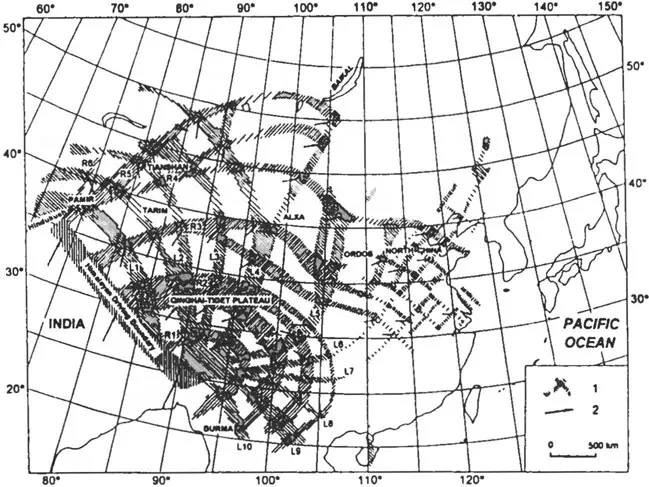
Figure 1. The “plastic-flow / seismic” network system in central-eastern Asia [23]. Symbols: 1, “plastic-flow/seismic” belts; 2, direction of maximum compressive stress; L1, L2, …, numbers of the left-handed belts; R1, R2, …, numbers of the right-handed belts.
(2) Netlike distribution of magmatic rocks, i.e. PFN-controlled magmatic networks, such as the late-Paleozoic. Mesozoic and Cenozoic magmatic networks ...
Table of contents
- Cover
- Half Title
- Title Page
- Copyright Page
- Table of Contents
- Preface
- Part 1 MECHANISM OF DEFORMATION
- Part 2 TECTONOPHYSICAL SIMULATION AND DIGITAL MODELLING
- Part 3 EXTENSIONAL TECTONICS
- Part 4 STRIKE-SLIP AND TRANSPRESSION TECTONICS
- Part 5 CONTRACTIONAL TECTONICS
- Part 6 CONTINENTAL DEFORMATION AND GEOMECHANICS
Frequently asked questions
Yes, you can cancel anytime from the Subscription tab in your account settings on the Perlego website. Your subscription will stay active until the end of your current billing period. Learn how to cancel your subscription
No, books cannot be downloaded as external files, such as PDFs, for use outside of Perlego. However, you can download books within the Perlego app for offline reading on mobile or tablet. Learn how to download books offline
Perlego offers two plans: Essential and Complete
- Essential is ideal for learners and professionals who enjoy exploring a wide range of subjects. Access the Essential Library with 800,000+ trusted titles and best-sellers across business, personal growth, and the humanities. Includes unlimited reading time and Standard Read Aloud voice.
- Complete: Perfect for advanced learners and researchers needing full, unrestricted access. Unlock 1.5M+ books across hundreds of subjects, including academic and specialized titles. The Complete Plan also includes advanced features like Premium Read Aloud and Research Assistant.
We are an online textbook subscription service, where you can get access to an entire online library for less than the price of a single book per month. With over 1.5 million books across 990+ topics, we’ve got you covered! Learn about our mission
Look out for the read-aloud symbol on your next book to see if you can listen to it. The read-aloud tool reads text aloud for you, highlighting the text as it is being read. You can pause it, speed it up and slow it down. Learn more about Read Aloud
Yes! You can use the Perlego app on both iOS and Android devices to read anytime, anywhere — even offline. Perfect for commutes or when you’re on the go.
Please note we cannot support devices running on iOS 13 and Android 7 or earlier. Learn more about using the app
Please note we cannot support devices running on iOS 13 and Android 7 or earlier. Learn more about using the app
Yes, you can access Structural Geology and Geomechanics by Zheng Yadong,Davis,Au Yin in PDF and/or ePUB format, as well as other popular books in Physical Sciences & Geology & Earth Sciences. We have over 1.5 million books available in our catalogue for you to explore.