Facing the Challenges of a Multi-Age Workforce examines the shifting economic, cultural, and technological trends in the modern workplace that are taking place as a result of the aging global workforce. Taking an international perspective, contributors address workforce aging issues around the world, allowing for productive cross-cultural comparisons. Chapters adopt a use-inspired approach, with contributors proposing solutions to real problems faced by organizations, including global teamwork, unemployed youth, job obsolescence and over-qualification, heavy emotional labor and physically demanding jobs, and cross-age perceptions and communication. Additional commentaries from sociologists, gerontologists, economists, and scholars of labor and government round out the volume and demonstrate the interdisciplinary nature of this important topic.
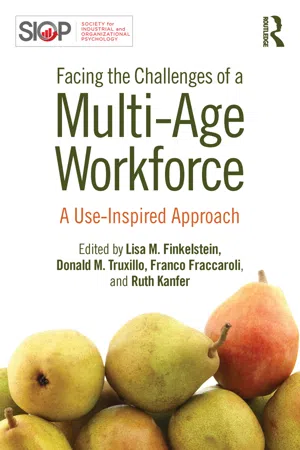
eBook - ePub
Facing the Challenges of a Multi-Age Workforce
A Use-Inspired Approach
- 372 pages
- English
- ePUB (mobile friendly)
- Available on iOS & Android
eBook - ePub
Facing the Challenges of a Multi-Age Workforce
A Use-Inspired Approach
About this book
Information
Part I Overview
DOI: 10.4324/9780203776322-1
1 An Introduction to Facing the Challenges of a Multi-Age Workforce: A Use-Inspired Approach
DOI: 10.4324/9780203776322-2
This volume addresses what is arguably one of the industrialized world’s most pressing challenges at the start of the 21st century; namely, how best to promote employability and well-being in an increasingly older work-force and age-diverse workplace. In North America, Asia, and Europe, aging populations, reductions in birth rates, and new patterns of late life workforce participation have already begun to influence societal norms, public policy, and organizational practices. Organizational and work scholars have also begun to devote systematic attention to the issues associated with these population trends, as evidenced by the growing number of special journal issues and books devoted to effectively managing an aging workforce. In this edited volume, we seek to provide readers with an overview of the substantial progress on this topic and the insights of researchers pursuing these issues pertaining to what needs to be done in the future.
The issues associated with workforce aging demand an interdisciplinary understanding of the psychological, economic, and sociocultural forces that dynamically shape worker behavior and organizational practices. In psychology, accumulating research in developmental lifespan psychology documents the different trajectories of growth, stability, and decline in human cognition, skills, preferences, and competencies over the lifespan. Taken together, these findings portray a complex picture of the individual as a “work in progress,” whose contributions to the workplace develop and change over the lifespan as a function of biology and work and non-work conditions.
Research in industrial-organizational (I-O) psychology paints a similarly intricate picture of the role that age diversity may play in managerial practices, in key organizational practices, such as personnel selection and job training, and the impact that organizations have on major life decisions that workers make in later adulthood, such as when and how to retire. Findings in labor economics further show the role that societal laws, social norms, family demands, education, and gender may have on patterns of work participation in midlife and late life, particularly following periods of unemployment. As the contributors to this volume repeatedly suggest, a modern account of work life aging requires the contribution of findings from multiple disciplinary perspectives.
In addition to the aging trend in many national workforces, there have also been dramatic changes in the nature of work. As discussed in several chapters in this volume, jobs that demand heavy physical labor are on the decline and are being rapidly replaced by jobs that demand high levels of problem-solving and interpersonal skill. The near ubiquitous use of teams in organizations, for example, has created strong interest in understanding the role of age in how people get along with others in teams. In the organizationally flatter world of knowledge work, performance is often defined in terms of innovation, spurring new interest in understanding the role of age in divergent thinking.
Accordingly, we argue that it is not possible to study workforce aging without taking into account the changing nature of job demands; that is, that these forces operate in unison to create unique situations in which older workers may experience difficulty maintaining or finding suitable work.
The simultaneous aging of the workforce and changes in the nature of work create a host of new challenges for I-O psychology. Although there is a long history of research from the socio-technical perspective for understanding the impact of new technologies on worker performance, there is far less work directed toward understanding how these changes operate in an age-diverse workforce. Similarly, I-O psychologists have made substantial progress investigating the impact of inter-individual differences in knowledge, skills, and abilities on job performance. What is far less well understood, however, is the impact of intra-individual differences on the antecedents and processes that influence job performance. Understanding how and where these simultaneous trends operate in the vast and volatile modern employment landscape represents a critical first step in developing organizational practices that both promote older worker employability and organizational performance. Thus, a second major objective of this volume is to identify the specific research questions that need to be asked and studies that should be undertaken in order to practically address the challenges associated with an aging workforce in a changing workplace.
This volume seeks to step into this breach, with the goal of setting an agenda for I-O research to address the coming age-related changes to the workforce. Specifically, our primary goal is not to review past research on age at work, but rather to identify what research we should be doing to address age in the workplace. In this chapter, we set the stage for this book, describing the demographic, economic, societal, and technological changes most relevant to the aging workforce; age-related changes that can affect the workplace; and how a use-inspired approach to I-O research can address these issues.
Demographic Perspectives
It is widely recognized that economically developed societies are characterized by an overall process of aging. This process is a combined effect of two demographic trends: a general decline in fertility and an increase in life expectancy. Due to these dynamics, the composition of labor forces in these developed societies is changing, and additional change is expected in the coming 30–50 years. The aging phenomenon is exacerbated by the “baby boomer” generation (persons born between 1946 and 1964) that is now entering into the late career and retirement phases, without a new generation of the same size that is entering the labor market.
To provide some figures, the future scenario of the aging process can be summarized through an index, the projected old-age dependency ratio (POADR), widely used in demographic studies that seek to monitor changes in population structure. The POADR is the ratio between the projected total number of people aged 65 and over (usually retired people) and the projected number of people of working age (15–64 years old). The projection makes some assumptions about fertility rate, mortality (or life expectancy), and immigration in different countries. For this reason, the index is a good indicator for comparability across countries, although the overall accuracy is limited because of the high level of uncertainty of the assumptions (Eurostat, 2011; Kinsella & Phillips, 2005; United Nations, 2012).
Eurostat (2012a) produced a scenario based on 2008 data, using changes in the POADR from 1960 to 2060 in 27 European countries. This analysis provides critical insights into the adequacy of pension systems and sustainability of public finances. At the same time, it allows for some forecasts related to the age structure of the working population in the future (Giannakouris, 2008).
These documents can be summarized as follows. First, the portion of people aged 65 years or over is projected to become 30% of the entire population in 2060 from 17.1% in 2008. Second, the POADR is expected to increase to 53% in 2060 from 25.9% in 2010. That means that while today in the EU there are four working people for every retired person, in 50 years this ratio will be two working persons for each retired person. Third, among the EU countries there is strong variability in the aging process. For instance, the POADR will be particularly burdensome (over 60%) for Eastern European countries while it is expected to be lower than 45% for some Nordic countries.
Similar estimates for the USA (Eurostat, 2011) show that the POADR’s growth will be from about 19.5 “older dependents” over 100 “workers” in 2010, to 36.8% in 2060; that is, an aging process similar to the European one, but less pronounced. A complete international comparison (Eurostat, 2011) shows that the level of old age dependency is variable between geographical areas, with a more critical situation in Japan and Europe. At the same time, the projections indicate that some developing countries, such as Brazil and China, which now have relatively low old age dependency ratios, will be not immune to the aging phenomenon in the future.
The trends analyzed with POADR assume certain structural processes (fertility, migration, life expectancy) that could potentially be influenced by national governments and international institutions only through long-term policies. But there are some other processes that could exacerbate the age dependency ratio and the sustainability of pension systems. The most crucial one of these is the employment rate for people aged between 55 and 64 years—a rate that, of course, is strongly related to the average age of retirement. In 2000, this rate was around 60% in the USA and Japan, 50% in all the members of the OECD (Organization for Economic Cooperation and Development), which includes more than 30 economically developed countries, and only 37% in the EU (27 countries). The European Commission established a target of 50% for 2010, in an attempt to encourage national governments to adopt policies for postponing retirement. In fact, this objective has not been achieved, considering that in 2011 the employment rate for people aged from 55 to 64 in the EU (27 countries) was still 47.4%. Only 12 countries (of 27) in 2011 achieved 50%. In the same period, the USA (60%) and Japan (65%) maintain a quite stable rate, whereas the rate for the OECD countries reached 54% in 2011 (OECD, 2012).
Taken together, these data show, first, that there is a general historical trend toward postponing retirement and toward increasing the length of working life. This happened after a long period (during the first three-quarters of the past century) in which the working life has been progressively reduced. This general trend is consistent with improvements in life expectancy (today in Europe and USA the life expectancy at age 65 is 20 and 17 years, respectively, for females and males). This trend is also dictated by public finance constraints. Second, these data show that the pension systems seem still far from financial sustainability in some countries, mostly in Europe. Consider that in 2009 the average age of retirement in the EU was 61.4 years. In the future, the number of people still working at the age of 55–65 will increase in many geographical areas. This trend needs to be accompanied by social policies to improve the quality of working life for elderly people and organizational strategies to manage late careers. Third, there are some substantial differences in the rate of employment between countries and between geographical areas. These differences could have some direct effects on the economic systems of each country in terms of public debt (direct costs to pay pensions) and in terms of general competitiveness. These dynamics could produce intergenerational conflicts and the necessity to improve flexibility in the labor market and employment contracts for older workers.
Economic Issues
Related to these demographic shifts—longer lifespans, a general aging of the population, and, in some countries, a decline in birth rates—there are economic challenges on the horizon for both older and younger workers. These include the need for people to continue to work longer to maintain retirement systems that can no longer be supported by dwindling numbers of younger workers; an increased need for certain job types, such as medical jobs and those requiring post-secondary education; and employment challenges for persons at either end of the age spectrum.
First, longer lifespans, compounded by decreased birth rates in some countries, have the potential to place significant pressures on retirement systems (European Commission and Economic Policy Committee, 2012). These issues have caused many countries to raise the statutory retirement age, although this has also been met with fierce resistance from some workers (e.g., Donadio & Alderman, 2012). Taken together, these events suggest that industrialized societies will need for people to work longer to be able to support their retirement systems; and that employers and societies will need to find ways to keep workers engaged, motivated, and productive, all with sufficient work-life balance and the best health possible. It also suggests that not only will the workforce age, with the workforce participation of those over 55 continuing to increase in both the US and Europe (Eurostat, 2012b; Toossi, 2012), but that people of very different ages will need to work side by side, at a rate previously unseen in industrialized workplace...
Table of contents
- Cover Page
- Half Title Page
- Title Page
- Copyright Page
- Dedication
- Table of Contents
- Series Foreword
- Preface
- List of Figures
- List of Tables
- About the Editors
- About the Contributors
- Acknowledgments
- Part I Overview
- Part II Science Confronts the Global Challenges
- Part III Multidisciplinary Viewpoints
- Part IV Editor Viewpoints
- Author Index
- Subject Index
Trusted by 375,005 students
Access to over 1.5 million titles for a fair monthly price.
Study more efficiently using our study tools.
Frequently asked questions
Yes, you can cancel anytime from the Subscription tab in your account settings on the Perlego website. Your subscription will stay active until the end of your current billing period. Learn how to cancel your subscription
No, books cannot be downloaded as external files, such as PDFs, for use outside of Perlego. However, you can download books within the Perlego app for offline reading on mobile or tablet. Learn how to download books offline
Perlego offers two plans: Essential and Complete
- Essential is ideal for learners and professionals who enjoy exploring a wide range of subjects. Access the Essential Library with 800,000+ trusted titles and best-sellers across business, personal growth, and the humanities. Includes unlimited reading time and Standard Read Aloud voice.
- Complete: Perfect for advanced learners and researchers needing full, unrestricted access. Unlock 1.5M+ books across hundreds of subjects, including academic and specialized titles. The Complete Plan also includes advanced features like Premium Read Aloud and Research Assistant.
We are an online textbook subscription service, where you can get access to an entire online library for less than the price of a single book per month. With over 1.5 million books across 990+ topics, we’ve got you covered! Learn about our mission
Look out for the read-aloud symbol on your next book to see if you can listen to it. The read-aloud tool reads text aloud for you, highlighting the text as it is being read. You can pause it, speed it up and slow it down. Learn more about Read Aloud
Yes! You can use the Perlego app on both iOS and Android devices to read anytime, anywhere — even offline. Perfect for commutes or when you’re on the go.
Please note we cannot support devices running on iOS 13 and Android 7 or earlier. Learn more about using the app
Please note we cannot support devices running on iOS 13 and Android 7 or earlier. Learn more about using the app
Yes, you can access Facing the Challenges of a Multi-Age Workforce by Lisa M. Finkelstein,Donald M. Truxillo,Franco Fraccaroli,Ruth Kanfer in PDF and/or ePUB format, as well as other popular books in Psicologia & Psicologia dello sviluppo. We have over 1.5 million books available in our catalogue for you to explore.