eBook - ePub
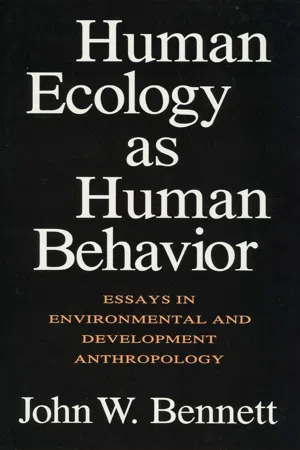
Human Ecology as Human Behavior
Essays in Environmental and Developmental Anthropology
- 387 pages
- English
- ePUB (mobile friendly)
- Available on iOS & Android
eBook - ePub
Human Ecology as Human Behavior
Essays in Environmental and Developmental Anthropology
About this book
Human interaction with the natural environment has a dual character. By turning increasing quantities of natural substances into physical resources, human beings might be said to have freed themselves from the constraints of low-technology survival pressures. However, the process has generated a new dependence on nature in the form of complex "socionatural systems," as Bennett calls them, in which human society and behavior are so interlocked with the management of the environment that small changes in the systems can lead to disaster. Bennett's essays cover a wide range: from the philosophy of environmentalism to the ecology of economic development; from the human impact on semi-arid lands to the ecology of Japanese forest management. This expanded paperback edition includes a new chapter on the role of anthropology in economic development.Bennett's essays exhibit an underlying pessimism: if human behavior toward the physical environment is the distinctive cause of environmental abuse, then reform of current management practices offers only temporary relief; that is, conservationism, like democracy, must be continually reaffirmed. Clearly presented and free of jargon, Human Ecology as Human Behavior will be of interest to anthropologists, economists, and environmentalists.
Information
PART I
Theory and Concepts
1
Underlying Ideas: Ecological Transitions, Socionatural Systems, and Adaptive Behavior
The theoretical background of most of the chapters in this book is informed by three concepts: “ecological transition,” “socionatural system,” and “adaptation.” The first pertains to changes in relations of Homo sapiens and the physical environment, as sapiens entered into his full capacity to shape the environment to his own ends. The second concept emphasizes an enduring reciprocity between humans and the environment, regardless of the level of technological complexity or the particular “transition” under consideration. The third concept concerns the distinctive features of human behavior that underlie the human relationship to the environment—in particular, the remarkable plasticity of response and the ability to solve problems arising from such responses.
Ecological Transition
The phrase was used as the title of a book (Bennett 1976), but the term was mainly rhetorical, used to convey a sense of ever-changing adaptations to the earthly environment (including other humans). That is, human adaptive behavior is responsible for these changing and expanding ways of utilizing the environment—a process that has a dual character: on the one hand, by making use of increasing quantities of natural substances and other living species and enhancing their productivity by transforming them into “natural resources,” humans might be said to have freed themselves from the constraints of Nature; on the other hand, this increased freedom created exponential functions, especially population increase and an increasing dependence on Nature. These are broad generalizations, and the many dimensions of the process give rise to many exceptions. Some resource transformations protect sustainability better than others; some resources, if exhausted, can be replaced by others; population may be controllable in certain places and under certain conditions; and destructive feedbacks from any exploitative process can help to control or scale down such processes and their dangers.
In fact there were several “transitions” in Homo sapiens history. V. Gordon Childe’s presentation (1942) of the panorama of human prehistory and its technical achievements was a pioneer statement, the categories of which remain influential. He distinguished the “food-producing revolution,” or Neolithic, as it was known in nineteenth- and early twentieth-century literature, the “urban revolution,” or the Bronze-Iron Ages, and the Industrial Revolution of our own era (and if he were still alive perhaps Childe would find still another Industrial Revolution taking place in East Asia and even an “information revolution” occurring everywhere). Other, earlier ones may be added: the increase in hunting skills associated with the late Paleolithic development of superior projectile weapons like the spear-thrower or, in North America in later times, the rapid-fire small arrowhead projectile; the first attempts at partially sedentary settlement prior to food production, based on intensive exploitation of particular wild foods (so-called “Mesolithic”). Each of these and other more localized technical achievements was associated with increases in human population, distinctive settlement patterns, and quantity of food intake. The relatively recent history of Homo sapiens sapiens (roughly, the past 50,000 years) thus seems to proceed in a series of leaps or steps, each representing a “transition” in the human capacity to utilize natural substances. Or, as Charles Deevey (1960) pointed out some time ago in graphing the increase in human population, the logarithmic curve becomes a series of step-functions, each more or less associated with some major technological achievement and often combined with major changes in the physical environment. On the other hand, if the demographic data for the same period of time are viewed arithmetically, they display a steep exponential rise. This same exponential function appears to characterize various technological data, like increases in utilized energy and efficiency of tools.
In traditional scholarship the triggering artifact or process in the important transitions was viewed as material or technological. The issue excites anthropologists, who continue to search for primary causes or origins, even though they are far more sophisticated about the systemic relationships of mentality, social organization, and technology than they were in the nineteenth century. The attitude is reinforced by the nature of the data: since earlier transitions must be recovered archaeologically, little other than material objects remain. But through observation of contemporary tribal peoples living mainly by subsistence pursuits, it is possible to show that social organization and symbolic culture play equally important roles. The issue arises again in contemporary history because of the increasing importance of instrumental concerns—technology, economics—in shaping the world system. So the ideology of materialism undergoes recurrent revivals, as in the case of anthropologist Marvin Harris, who proposed that “cultural materialism” represented the only relevant or profitable scientific position (1960). The anthropologist Julian Steward was more cautious: while he considered the econotechnological system of a society to be its “core,” around which other social and cultural phenomena were molded, he recognized that this was prone to overgeneralization (Steward 1955). The real issue is one of constantly shifting parameters of technology and culture: a new tool can encourage new behavior, but a new value can restrict use of the tool, and so on. Thus the transitions are complex interactive matrices of human behavior, its social manifestations, and the objects and processes created by humans to deal with the physical world.
The behavioral significance of such observations concern the way human adaptive capacities, while natively superior to those of any other large mammal, are nevertheless dependent on communication and interactive learning in order to manifest their full potential. The anthropological exegesis is based on both archaeological and ethnological evidence: from archaeology we obtain data on long periods of virtually static technical and aesthetic social culture, punctuated by sudden intrusions of superior tools and evidence of sophisticated social organization—one of the most dramatic of the latter being the apparent replacement, in a relatively few centuries, of the Homo sapiens neanderthalensis populations and their relatively simple culture by the more dynamic culture of the Homo sapiens sapiens types like Cro Magnon. This particular classic case is a bit difficult to handle, since it involves a series of unanswerable questions about the relationship of cultural expressions to different biological varieties of sapiens. More familiarly, the archaeological record of every continent contains dozens of examples of how relatively isolated populations of sapiens with long-persisting, conservative styles of life changed rapidly under the stimulus of in-migrants bearing new artifacts and ways of organizing themselves. The increase in cultural complexity and skills was not due solely to the imported ideas, but also to the inter-stimulation of two groups with simply different ways of conceiving the world and the tasks of survival. In addition, there is the factor of generational locus of social and technical leadership: in longisolated groups leadership tends to devolve on older generations, who have a special interest in maintaining the status quo. In other cases, where leadership can shift downward in the age pyramid, younger and more innovative members tend to speed up change and development.
From ethnology comes abundant data to show how recent and living tribal populations relatively isolated from each other remained in a state of cultural stasis for generations. The condition was especially marked in specialized environments: rainforests, savannahs, deserts, the Arctic. Each of these environments contained human populations that had achieved a highly specialized, low-energy adaptation to resources and that built their symbolic culture around these specializations. The Eskimo and their predecessors, the Australian Aborigines, Indians of the North American Great Basin, the Pueblo Indians of the desert Southwest, the pygmy hunting tribes of the African equatorial forest (see chapter 3), the migratory herdsmen of the Middle East (see chapter 10), and the Indians of the Great Plains (see chapter 9) are all classic examples of such specialized adaptations. Each of these groups figured in the development of ethnological theory since they showed the potential of human populations to achieve an intricate but ingrown adjustment to distinctive habitats. Populations with distinctive cultures always existed on the fringes of civilizations, and only when substantial contact with complex cultures occurred did the tribal groups change significantly. The acceleration of worldwide cultural development in the past several centuries was associated with the opening up of refuge areas and the exposure of indigenous peoples to exogenous ideas, a process ocurring repeatedly through human history but never on the impressive scale of the recent past. “Economic development” in the Third World is the most recent expression of this process.
An ecological transition, then, is also a cultural transition. The changed adaptation is not isolated from human activities and ideas; it is an expression of decisive change in the life-styles and world views—new paradigms—that also imply a change in the level of expectations and in the age of the leaders. The progressive transitions each display a heightened anticipation of rewards, or at least an awareness of the need for increased resource utilization due to rising population. The twin process—increase in demand and increase in the number of demanders— interrelate and reinforce each other to yield alterations in the way of life, a rise in the level of self-confidence, and a sense of mastery over habitat. The evolution of the sapiens relationship to Nature is thus different from that for any other species: the distinctive forms of sapiens behavior are an engine, driving species adaptation through behavioral and mental change, which may have ultimate genetic consequences but which are not caused by genes. Humanity thus continually widens the gap between its own behavioral approaches to the environment and those of all other animal species.
One theme of these chapters is whether this process can be directed into channels less abusive of Earth’s resources. On the whole, the position implied in this book is pessimistic, although this is subject to qualification since the very dynamism of human behavior and its derivative, culture, proscribes easy certainty or prediction. Rational thought may not be the sole or dominant characteristic of human behavior, but its potentiality or availability means that corrective controls or changes are always possible. If we take a generally pessimistic view, it is because institutional complexity is an independent variable affecting the ability to achieve correction: the more complex the social system and the larger number of vested interests, the more difficult it is to initiate corrective measures (hence human ecology is also political ecology).
But an ecological transition is not simply triggered by a cultural transition. Equally important is the incorporation of natural or earthly phenomena into Culture. The classic instance is that of water flowing over a dam: prior to the construction of the dam the water ran free, it was part of Nature. But once it flows over the dam under the guidance of human beings and drives turbines or irrigates fields it becomes a cultural object, a part of human endeavor incorporated into human institutions: the water is assigned value and its value can then be expressed or compared to other values and phenomena either natural or manufactured. This typically engenders a trade-off process: if the water over the dam endangers the population of a valued species of fish it may be counted as a debit. But if the flow of the water over the dam is defined as beautiful it may acquire greater value regardless of what it does to the fish.
As Nature is appropriated by Culture, the process creates philosophical tension. We spoke of the anthropocentrism of civilization, an increasing trend. But by the same token Culture and Nature are dichotomized: Culture is a thing of Man; Nature is outside, free, unspoiled, raw, undeveloped. Depending on the attitude toward the Nature-into-Culture process, the meaning or value assigned to the two halves of the dichotomy will vary. If Culture—that is, Man—is seen as the despoiler, the destroyer, Nature is revered as pristine, and the preservationist position emerges. If Man is seen as the measure and master of all things, then the incorporational process is seen as “progress,” and Nature is viewed as a “resource.” These attitudes have arisen repeatedly through human history, but only since the recent Industrial Transition has the mastery outlook taken on global proportions. This means, in effect, that the Earth and its natural species are at Man’s mercy. This also means, of course, that the environmental situation is at root a moral dilemma. Morality in this context implies two principal issues: one is the question of human wants, which morally becomes the problem of human greed. The second is the question of posterity, that is, the effects of current resource practices on future populations.
The first issue means that any inquiry into ecological and environmental matters that has normative aims must be concerned with the problems of limits to human endeavor and aspiration, the control of blue-sky gratification, a critique of the tendency to make promises before the resource base or fertility rate is assessed, and the consequences of further technological intervention. To question human wants is always politically difficult and in many contemporary cases is defined as an offense against cultural or national self-determination. If we are to safeguard the Earth and its resources, such human-centeredness needs modification.
Let us examine the problem of the causes of human greed (I use the word advisedly and mean by it wanting more than one needs, or wanting more than available resources can bear). There are two principal arguments:
1. Greed is a constant, built into human behavior, and inescapable; it has no finite limits, and it is conferred on humans by their genetic makeup and by their need to realize themselves in a social milieu; it is consequently inevitable both biologically and socially.
2. Greed is a variable; it is ultimately punished or checked, or can be so checked, and it is stimulated or diminished by the social environment or created by cultural values, particularly when Culture refers to satisfactions stimulated by detachment from or ignorance of Nature. The first argument is pessimistic if one assumes inevitability of overweening aspiration; the second is optimistic if one assumes that control is possible through exhortation, discipline, and reason. However, the dichotomy is largely false. Both positions collapse into one: greed is an innate manifestation of human behavior, but human behavior is always capable of modification by Culture. If Culture can encourage greed, it can also restrain it. Greed must be known both in its psychobiological and its cultural aspects; wants are basic to the organism, but wants can also be formed or controlled by experience. So, from an anthropological standpoint, the problem becomes a matter of the social mechanisms that encourage excess in the human spirit. At the most general level, greed is accentuated in human behavior by civilizations that permit large numbers of people to exist in apparent “freedom ” from environmental constraints.
The most recent demonstration of the principle is seen in developing nations since the end of World War II. The energy behind economic development was the promises made to the populations of these countries by their governments and by Western nations extending development assistance, enouraging the belief that resources were infinite and either there for the taking or obtainable at reasonable prices elsewhere. The promises did encourage aspirations: an attempted breakout from ages of acceptance of poverty and hardship. The ancient persisting lifeways were redefined as “poverty” and rapidly took political form. Demands escalated and continue to do so, creating all sorts of secondary effects, including massive environmental destruction.
In the 1950s the problem of development was visualized by social scientists of all fields as simply a matter of finding ways to awaken the spirit of innovation and change in peasant societies (e.g., Hoselitz 1952). Peasants were viewed as innately conservative—whether this was considered to be biologically or culturally caused. However, by the 1970s this was no longer a crucial problem: the awakening had indeed begun, and the problem became one of political control and direction of the energies thereby released. But the need to adjust these attitudes to the realities of physical resources (as well as the consequences of locating oneself in the political-economic realities of a market-oriented world economy) was beyond the capabilities of political leaders. Consequently, almost everywhere expectations have exceeded the possibilities of realization, or at least have failed to conform to practical limits. Anthropological research on development continues, but on the margins of the discipline and not in mainline theory (Bennett 1986). Moreover, the discipline is reluctant to award academic prestige for development-oriented research, even though the underlying cultural issue of development is the morality of human intentions and their environmental consequences. Whatever the academicians think, it will be the problem of the coming century.
The second issue—the effects on posterity—becomes, in the context of morality, a problem of responsibility. Organized social life, and the continuity of that life in both social and biological senses, rests on the carrying out of tasks and duties that arise within the social order, in interaction with the conditions of biological survival in the physical environment. Thus, ecology is incorporated into social systems through this parcelling out of functions and tasks and the consent of members of the society to take responsibility for their wants and actions. Another meaning of the term is didactic: humans are “responsible” for what they do to Nature, especially when their actions jeopardize t...
Table of contents
- Cover Page
- Title Page
- Copyright Page
- Dedication
- Contents
- Preface
- Part I Theory and Concepts
- Part II Field Studies of Resource Management
- Part III Literature Reviews and Field Surveys of Resource Management
- Index
Trusted by 375,005 students
Access to over 1.5 million titles for a fair monthly price.
Study more efficiently using our study tools.
Frequently asked questions
Yes, you can cancel anytime from the Subscription tab in your account settings on the Perlego website. Your subscription will stay active until the end of your current billing period. Learn how to cancel your subscription
No, books cannot be downloaded as external files, such as PDFs, for use outside of Perlego. However, you can download books within the Perlego app for offline reading on mobile or tablet. Learn how to download books offline
Perlego offers two plans: Essential and Complete
- Essential is ideal for learners and professionals who enjoy exploring a wide range of subjects. Access the Essential Library with 800,000+ trusted titles and best-sellers across business, personal growth, and the humanities. Includes unlimited reading time and Standard Read Aloud voice.
- Complete: Perfect for advanced learners and researchers needing full, unrestricted access. Unlock 1.5M+ books across hundreds of subjects, including academic and specialized titles. The Complete Plan also includes advanced features like Premium Read Aloud and Research Assistant.
We are an online textbook subscription service, where you can get access to an entire online library for less than the price of a single book per month. With over 1.5 million books across 990+ topics, we’ve got you covered! Learn about our mission
Look out for the read-aloud symbol on your next book to see if you can listen to it. The read-aloud tool reads text aloud for you, highlighting the text as it is being read. You can pause it, speed it up and slow it down. Learn more about Read Aloud
Yes! You can use the Perlego app on both iOS and Android devices to read anytime, anywhere — even offline. Perfect for commutes or when you’re on the go.
Please note we cannot support devices running on iOS 13 and Android 7 or earlier. Learn more about using the app
Please note we cannot support devices running on iOS 13 and Android 7 or earlier. Learn more about using the app
Yes, you can access Human Ecology as Human Behavior by John W. Bennett in PDF and/or ePUB format, as well as other popular books in Social Sciences & Ecology. We have over 1.5 million books available in our catalogue for you to explore.