A practical, hands-on workbook, Becoming an EffectiveSupervisor neatly fills the gap in supervision resources available to mental health practitioners. The workbook is designed to help clinical counselors and therapists create effective supervision programs of their own, and to address the individual needs of their students. The leading contemporary models of supervision are discussed, as well as the necessary components of a successful supervision curriculum.
A framework is then provided for counselors and therapists to develop a personalized and highly effective supervisory style to implement with their own students. The unique exploration exercises in each chapter allow readers to actively integrate the information provided, and to apply these lessons and skills to their own supervisory experiences. Students too will benefit from her concise examination of the theories, applications, and goals of the supervision process. Along with a discussion of the ethical, legal, and multicultural issues faced by clinical supervisors, practical analyses and applications ensure that this book will be a valued addition to any clinical counseling or therapy library.
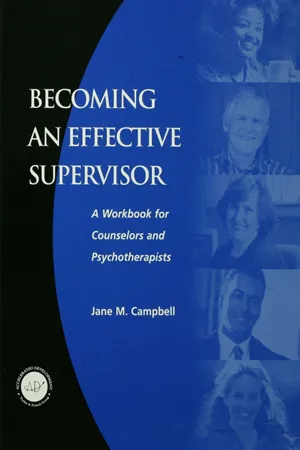
eBook - ePub
Becoming an Effective Supervisor
A Workbook for Counselors and Psychotherapists
- 312 pages
- English
- ePUB (mobile friendly)
- Available on iOS & Android
eBook - ePub
About this book
Information
1
WHAT IS SUPERVISION?
Becoming a clinical or counseling supervisor can be a challenging experience for the mental health practitioner. While supervision is a relationship that is similar in many ways to counseling or psychotherapy, it has a different structure and purpose. The primary purpose of clinical supervision is to ensure the quality of client care while the trainee or supervisee is learning. The supervisor must constantly weigh the needs and welfare of the client with the supervisee’s need to learn and grow professionally. Supervision requires the evaluation of the supervisee’s professional and therapeutic competence as well as suitability for the profession. Therefore, supervision is a hierarchical relationship with evaluation as a key component.
To be an effective supervisor, the practitioner must develop separate skills from those required for the practice of counseling and psychotherapy. Simply because one is a skilled counselor or psychotherapist does not necessarily mean one will be a good supervisor. Because supervisors accept the ethical and legal responsibility for the work of the supervisee with clients, an additional burden of responsibility is placed on the counselor or psychotherapist serving in a supervisory role. Pressures from the work setting, ethical and legal concerns, and a host of practical problems related to practicing in today’s health care climate also affect the supervisor and the supervisory relationship. Mental health professionals are already challenged by the mandate to maintain ethical standards and to follow state laws while operating within licensing guidelines and institutional policies. Factors such as survival in the work setting, conflict resolution, and the impact of larger cultural, socioeconomic, and political issues also affect the supervisory process. Thus, practitioners who become clinical supervisors need to demonstrate competence not only in working with clients but in working with organizational systems as well.
With post-degree supervision for licensure or certification purposes, the task of being a supervisor can be even more difficult, especially for busy practitioners. In this capacity, the supervisor serves as the last gatekeeper for evaluating the skills, expertise, and ethical behavior of the supervisee before independent practice. It is an important role and should not be taken lightly. As more and more states are requiring licensure for all mental health professionals, there is an increasing demand today for competent, trained clinical supervisors in all settings, including schools, agencies, hospitals, and private practice. The National Board for Certified Counselors (NBCC) has just established an Approved Clinical Supervisor credential, and The American Association of Marriage and Family Therapists has had a special supervision credential since 1987. Some states, such as Texas, are requiring potential supervisors in counseling, marriage and family, and social work to be certified and to take a formal, 40-hour course in supervision
Therefore, just as there was a need for training in the techniques of Counseling and psychotherapy, the same is true for supervision. The majority of practitioners who have not received any training in supervision might believe that because they are capable, accomplished, and experienced counselors or therapists, they therefore can supervise. They fail to understand that there is no perfect relationship between being a good therapist and being a good supervisor.
Borders and Usher (1992) have made a strong argument for the value of post-master’s supervision by stating that counselor growth and development upon graduation is related to supervised, not unsupervised, experience. However, little is known about supervision practices or the training of these supervisors outside academic settings (Borders, Cashwell, & Rotter, 1995, Bernard, 1997).
According to Baronchok and Kunkel (1990), few therapists receive formal training in supervision as part of their degree program. Smaller still are the numbers of supervisors who themselves receive formal supervision of their ongoing work with supervisees. As a result, Worthington (1987) expressed concern that supervisors may simply be perpetuating the mistakes of their own supervisors.
One problem for practitioners who want to become effective supervisors is the lack of material available to train supervisors outside of academic settings. This workbook is designed to fill that gap. It is not meant to replace a textbook, but to provide a practical, hands-on tool to facilitate the teaching of supervision to mental health practitioners regardless of degree or setting. Although each area, such as school counseling, social work, marriage and family therapy, and psychology, has information specific to its field, there are certain universal supervision concepts, models, and methods to be learned. The goal of the workbook is to help the practitioner move from the theory of clinical supervision to its practice. It is hoped that readers, on completing the workbook, will feel more comfortable and effective in their role as supervisor and that their interest will be piqued to explore the topic further.
How to Use the Workbook
This workbook is suitable for either the beginning or the more advanced supervisor. It can also be used to teach a formal course in super...
Table of contents
- Cover
- Halftitle
- Title
- Copyright
- Contents
- Acknowledgments
- Preface
- Chapter One: What Is Supervision?
- Chapter Two: What Do Supervisors Do?
- Chapter Three: What Are the Models of Supervision?
- Chapter Four: What Are the Methods and Techniques of Clinical Supervision?
- Chapter Five: What Is the Role of the Relationship in Supervision?
- Chapter Six: How Does the Supervisor Select Methods and Techniques to Help the Supervisor Grow and Develop?
- Chapter Seven: What Are the Ethical and Legal Issues in Clinical Supervision
- Chapter Eight: What Is the Role of Multicultural Issues in Supervision?
- Chapter Nine: What Is the Role of AdministrativeTasks in Supervision?
- Chapter Ten: What Is the Role of Personal Development In Supervision?
- Chapter Eleven: How Does a Supervisor Plan for the First Session?
- Appendices
- References
- Index
- About the Author
Trusted by 375,005 students
Access to over 1.5 million titles for a fair monthly price.
Study more efficiently using our study tools.
Frequently asked questions
Yes, you can cancel anytime from the Subscription tab in your account settings on the Perlego website. Your subscription will stay active until the end of your current billing period. Learn how to cancel your subscription
No, books cannot be downloaded as external files, such as PDFs, for use outside of Perlego. However, you can download books within the Perlego app for offline reading on mobile or tablet. Learn how to download books offline
Perlego offers two plans: Essential and Complete
- Essential is ideal for learners and professionals who enjoy exploring a wide range of subjects. Access the Essential Library with 800,000+ trusted titles and best-sellers across business, personal growth, and the humanities. Includes unlimited reading time and Standard Read Aloud voice.
- Complete: Perfect for advanced learners and researchers needing full, unrestricted access. Unlock 1.5M+ books across hundreds of subjects, including academic and specialized titles. The Complete Plan also includes advanced features like Premium Read Aloud and Research Assistant.
We are an online textbook subscription service, where you can get access to an entire online library for less than the price of a single book per month. With over 1.5 million books across 990+ topics, we’ve got you covered! Learn about our mission
Look out for the read-aloud symbol on your next book to see if you can listen to it. The read-aloud tool reads text aloud for you, highlighting the text as it is being read. You can pause it, speed it up and slow it down. Learn more about Read Aloud
Yes! You can use the Perlego app on both iOS and Android devices to read anytime, anywhere — even offline. Perfect for commutes or when you’re on the go.
Please note we cannot support devices running on iOS 13 and Android 7 or earlier. Learn more about using the app
Please note we cannot support devices running on iOS 13 and Android 7 or earlier. Learn more about using the app
Yes, you can access Becoming an Effective Supervisor by Jane Campbell in PDF and/or ePUB format, as well as other popular books in Psychology & Education in Psychology. We have over 1.5 million books available in our catalogue for you to explore.