eBook - ePub
Everyone's Problem Solving Handbook
Step-by-Step Solutions for Quality Improvement
- 176 pages
- English
- ePUB (mobile friendly)
- Available on iOS & Android
eBook - ePub
About this book
The author covers fourteen tools to help you find the information you need and offers step-by-step instructions for constructing each one. He shows you how these tools can be combined with a set of simple problem-solving steps that can act as a powerful change agent to help reduce or eliminate process problems. Five-Step Problem-Solving Process
Information
Publisher
Productivity PressYear
2019Print ISBN
9780527916527
9781138464124
Edition
1eBook ISBN
9781351449410
One
A New Way of Thinking
The Gap
There is a gap between what we were taught in school and what we need to know. In some of us the gap is wider than in others. The size of the gap depends upon our background, experience, and education. This book addresses that part of the gap that originates from our education, and in particular, the dreaded subject of mathematics.
Have you ever wondered why so many people fear math? Maybe it’s because we never clearly understood the books we were given. Remember your old math books? If you still have one, or if you can get your hands on the one your son or daughter brings home from school, pick it up and look through the pages. Still confusing isn’t it? Most of these math books are just not user friendly. What I mean is that they are mathematically correct, but hard to follow. Most are written by men and women who have an excellent grasp of mathematics. In fact, the authors have more knowledge than I could hope to accumulate. But their math books do little to communicate to those of us who are less knowledgeable. We learners have been attempting to wade through these confusing books for years. Sometimes we are fortunate enough to have a good teacher explain what the authors meant, but in the absence of a good teacher, it’s no wonder so many of us fear math.
Another reason I think we fear mathematics is that we don’t clearly see how it can benefit us. Understanding mathematics takes a fair amount of concentration for the average person. This translates into an investment of time and effort. When the payoff for your investment is not made clear, it’s a small wonder why the investment is never made.
Think about the problems that seem to find their way into almost every math book: Johnny is traveling from Chicago to Los Angeles. His train left at 10 A.M. and is traveling at 60 MPH. The train is scheduled to make one stop for 45 minutes before arriving. If the distance from Chicago to Los Angeles is 1741 miles, when will Johnny’s train arrive?
Now, really, what incentive do you have for calculating this information? Aren’t the train schedules published regularly? Certainly, there is a need to understand how to derive the answer, but my point is that questions like this don’t provide a strong incentive to learn. We need to see clearly how the math we learn can help us cope with day-to-day life before we will be willing to invest the time and effort it takes to learn.
What Do We Need To Know?
There is another problem with the math skills we were taught in school. I don’t believe they are sufficient to equip us for the problems we commonly face in the real world. In the world where I live and work, problems like Johnny’s are a piece of cake. We face tougher problems like: Johnny sent an invoice to the XYZ company on July 7. It is now August 22, and Johnny still hasn’t received his check. Why is the check late? What is causing this problem? What can be done to keep the problem from recurring?
The math tools most of us were taught in school won’t help us solve this problem, or others like it. Yet, these are the kinds of problems that discourage us, because we are not equipped to solve them. We weren’t given the tools we need to make the necessary improvements. Our tool kit is half empty. It’s like trying to unscrew a phillips screw when all you have is a flat-head screwdriver.
Instead of being frustrated by these real world problems, we need to have knowledge of the tools required to solve them. The tools you will be introduced to in this book are provided with the needs of today’s worker in mind. They can be easily understood and applied to help solve the problems you face daily; many examples are included to help with this. The tools are also presented in a format that will enable you to use this book as a reference while developing your skills in using them.
Beyond what has been provided in this book, I can’t give you an incentive to learn the tools for quality improvement. Such inspiration has to come from within. What I can give you though is a quotation from a great American.
Hard work and best efforts, put forth without the guidance of knowledge, leads to ruin in the world that we are in today.
—W. Edwards Deming
W. Edwards Deming has lived his life sharing and searching for knowledge. He is the man who planted the seeds of change in Japan. By adopting Dr. Deming’s philosophies and teachings the Japanese have improved the quality of their products and services from producing what was once considered junk to being respected as a worldwide leader in quality and value.
The opportunity seized by the Japanese is also available to us, but each of us must do our part to accept the challenge. It requires us to close the gap between what we know and what we need to know. We must increase our knowledge. My hope is that you will give yourself the opportunity to use the tools for quality improvement. Don’t let past fears and doubts hold you back. Be open-minded and recognize that there is a better way if you are willing to accept it. Ask questions. Search for answers. Dr. Deming is the perfect example of what I mean. As of this writing he is 91 years young, still searching for knowledge, because he knows that a mind willing to challenge and question is a mind alive with potential.
What Are The Tools For Quality Improvement?
Figure 1–1 lists the tools for quality improvement that are covered in this text.
The figure also suggests how the tools can help you. With the proper application of these simple tools you will be able to solve the vast majority of process-related problems you face both at home and in the workplace.
Knowledge Of A Process
Using the Tools for Quality Improvement effectively requires that you have some understanding of a process. A process is the set of activities necessary to accomplish a task or produce an output. There is a process involved in most everything we do. Driving a car involves a process that begins when we get in the car, insert a key in the ignition, and put the car in gear. In the kitchen there are processes, too. One that is easy to recognize is described in a recipe. Recipes include a set of activities necessary to produce something to eat. Recipes, driving a car, and the way you perform your work all involve processes—activities necessary to accomplish a task or produce an output.
In addition, it is important to understand that all processes have a set of influences (people, machinery, methods, materials) that combine to make each process output unique. This variation in output is the natural result of changes in the combination of influences that occur each time a process is performed. For example, the time it takes to get from point A to point B in a car is dependent on the driver (person), the car (machine), the driver’s driving habits (methods), and maybe the octane of the gas the car is using (materials). In the kitchen, how good a recipe tastes is dependent on the cook (person), the kitchen appliances (machinery), the recipe itself (methods), and the ingredients (materials).
Variation in the output of a process is normal. Controlling the amount of variation, though, can lead to improvements in the quality of process outputs. Processes, and the variation that occurs naturally when they are executed, are what the tools for quality improvement can be used to influence.
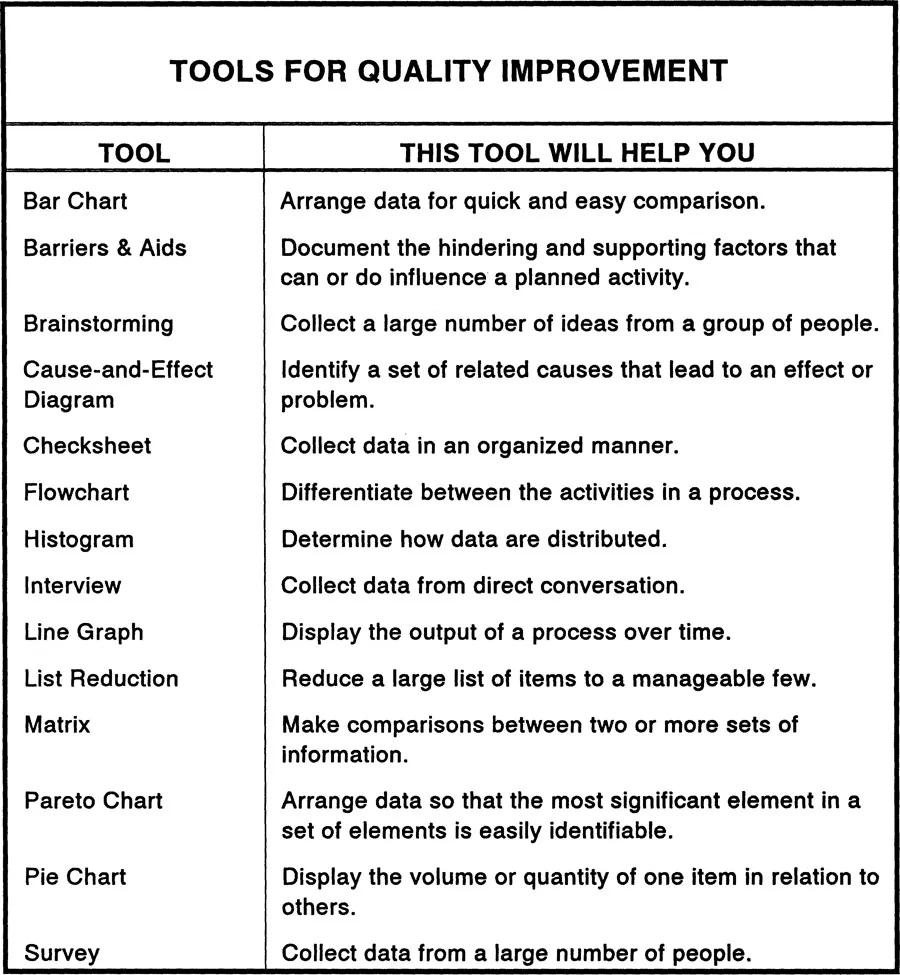
Figure 1–1
An Example
Let’s assume that you operate a car wash business. The owner informs you that during the coming year a 25 percent increase in cars washed is expected. Under normal circumstances this could cause you some pain, but you have applied the tools in this book and respond by saying that you can deliver 30 percent! The owner looks astonished as you continue by stating that this increase will require an up-front investment of $11,000 in advertising and equipment.
“What do you mean?” the owner asks, sounding interested.
You say that a SURVEY* was used to identify the reasons customers choose one car wash over another. The survey findings have been summarized using a PARETO CHART, as shown in Figure 1–2.
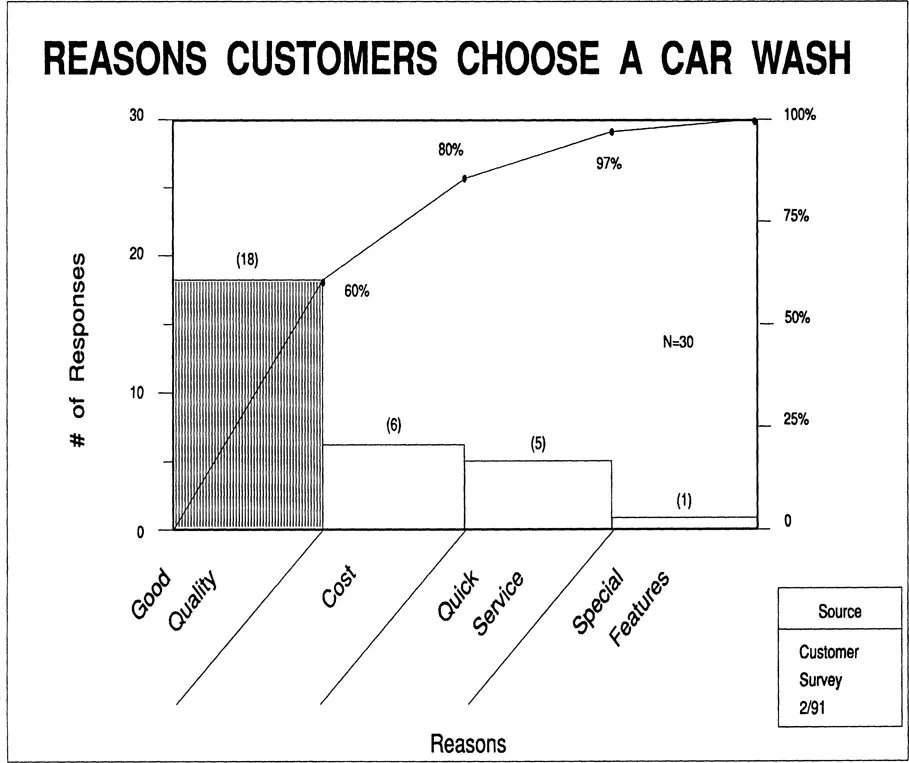
Figure 1–2. Pareto Chart
You tell the owner that the survey indicates that the quality of your car wash is good, but you believe actions can be taken that will improve cost and quickservice. You refer to some analysis that you have performed that has led you to believe that the number of cars washed can be increased if you do two things: advertise discounts and improve equipment efficiency.
Referring to the PARETO CHART in Figure 1–2, you explain to the owner that next to good quality, customers feel cost is most important.
You suggest advertising a discount (good through Saturday) in Wednesday’s paper to attract more customers. The weekend is when most customers get their cars washed, you emphasize, showing a BAR CHART (Figure 1–3) you have constructed from records of cars washed over an eight-week period.
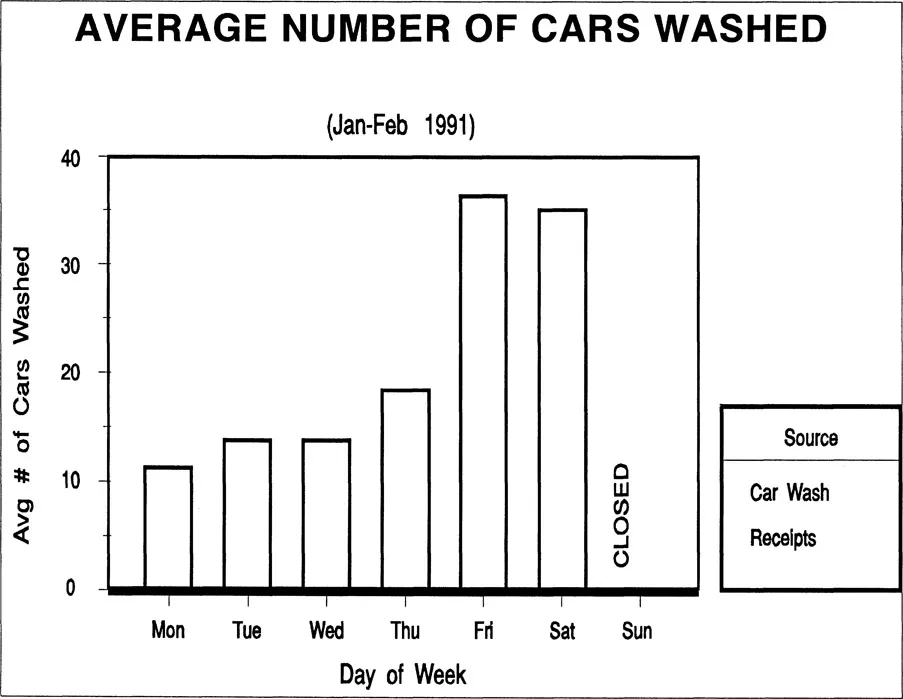
Figure 1–3. Bar Chart
You also tell the owner that you need more towels and another clothes dryer to dry the towels after use. To prove this point, you describe how you arrived at this conclusion. You begin by telling the owner how you keep track of the average time it takes to wash a car using a LINE GRAPH (Figure 1–4). You noticed that the average wash time increased every time it got busy. In other words, when there were more cars to be washed, it took longer to wash them. To determine why this was happening, you decided to look in more detail at major steps involved in the car wash process.
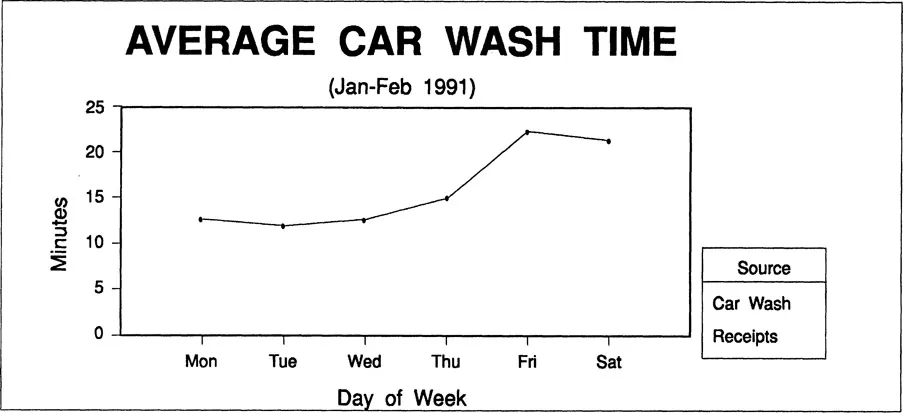
Figure 1–4. Line Graph
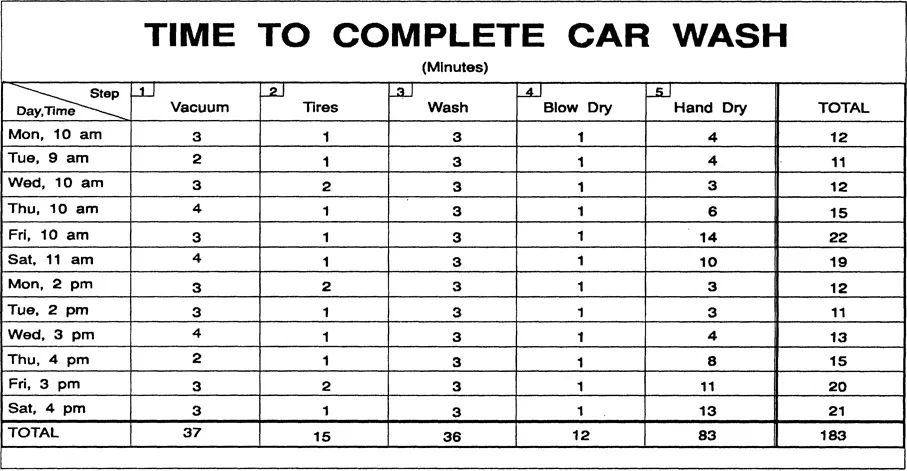
Figure 1–5. Checksheet
There are five major steps involved with washing a car. You collected data on each of them using a CHECKSHEET (Figure 1–5). Looking at this data, you determined that hand drying the car takes the most time. After INTERVIEWING several of your employees, you determined that at busy times there weren’t enough dry towels available, consequently more drying time was required. You remind the owner that reducing the time it takes to wash a car is important to the customer by referring to “quick service” in Figure 1–2.
Summarizing your findings to the owner, you state that the cost of the advertising will be $10,000, and the dryer and towels will cost $1,000. How do you think the owner will react?
Maybe you are thinking, “Sounds great, and even makes sense, but it wouldn’t work here. Where I work the boss wouldn’t listen.” Well, don’t be so sure. More and more these days, management is challenged to be innovative. They need employees who feel encouraged to contribute their experience and knowledge. After all, things are changing. How long ago was it that you couldn’t expect mail to be delivered from New York to San Francisco overnight? How long ago was it that you couldn’t send a written message to someone over a phone line? How long ago was it...
Table of contents
- Cover
- Half Title
- Title
- Copyright
- CONTENTS
- Preface
- Chapter One: A New Way of Thinking
- Chapter Two: A Systematic Approach
- Chapter Three: Tools for Quality Improvement
- Chapter Four: Applying the Tools for Quality Improvement
- Glossary
- Bibliography
- Index
Trusted by 375,005 students
Access to over 1.5 million titles for a fair monthly price.
Study more efficiently using our study tools.
Frequently asked questions
Yes, you can cancel anytime from the Subscription tab in your account settings on the Perlego website. Your subscription will stay active until the end of your current billing period. Learn how to cancel your subscription
No, books cannot be downloaded as external files, such as PDFs, for use outside of Perlego. However, you can download books within the Perlego app for offline reading on mobile or tablet. Learn how to download books offline
Perlego offers two plans: Essential and Complete
- Essential is ideal for learners and professionals who enjoy exploring a wide range of subjects. Access the Essential Library with 800,000+ trusted titles and best-sellers across business, personal growth, and the humanities. Includes unlimited reading time and Standard Read Aloud voice.
- Complete: Perfect for advanced learners and researchers needing full, unrestricted access. Unlock 1.5M+ books across hundreds of subjects, including academic and specialized titles. The Complete Plan also includes advanced features like Premium Read Aloud and Research Assistant.
We are an online textbook subscription service, where you can get access to an entire online library for less than the price of a single book per month. With over 1.5 million books across 990+ topics, we’ve got you covered! Learn about our mission
Look out for the read-aloud symbol on your next book to see if you can listen to it. The read-aloud tool reads text aloud for you, highlighting the text as it is being read. You can pause it, speed it up and slow it down. Learn more about Read Aloud
Yes! You can use the Perlego app on both iOS and Android devices to read anytime, anywhere — even offline. Perfect for commutes or when you’re on the go.
Please note we cannot support devices running on iOS 13 and Android 7 or earlier. Learn more about using the app
Please note we cannot support devices running on iOS 13 and Android 7 or earlier. Learn more about using the app
Yes, you can access Everyone's Problem Solving Handbook by Michael R. Kelly in PDF and/or ePUB format, as well as other popular books in Business & Processo decisionale. We have over 1.5 million books available in our catalogue for you to explore.