- 232 pages
- English
- ePUB (mobile friendly)
- Available on iOS & Android
eBook - ePub
About this book
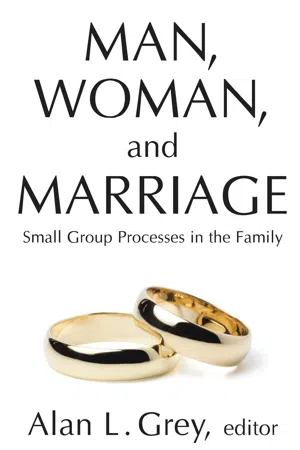
In "Man, Woman and Marriage", noted experts discuss such subjects as the ways in which people choose their mates, how the family social system can entrap its members in neurotic "games," and the complex nature of marital love. Each of the essays has been significant in major controversies on family research and represents a progressive exploration of the "psychosocial" aspects of marriage and family life in the United States.Alan L. Grey's penetrating Introduction traces the history of family research, reviews earlier theories of social interaction, discusses typical research approaches, and furnishes a stimulating commentary on each paper that enumerates the key ideas and themes most relevant to the main emphasis of the debate. Representative of the variety of viewpoints highlighted in this book are the pioneer efforts of Robert F. Winch and his co-workers, and the critical evaluations by George Levinger and Roland G. Tharp as they point out the numerous complexities of the interpersonal process. At the same time, Gerald Bauman and his co-workers demonstrate the use of more flexible and sensitive research devices, Melvin Cohen shows evidence of a type of family homeostasis, and Mirra Komarovsky offers a social-class comparison of typical kinds of husband-wife relationships.Despite the contrasting opinion presented in the volume, the central theme runs through much of social science - the quest for better descriptions of small group process and the actual ways in which family participants affect one another. Bringing together original source materials that are both controversial and cross-disciplinary, "Man, Woman, and Marriage" promotes classroom discussion and is of immediate significance to all studies of marriage and family life whatever social-science discipline is emphasized.
Information
1 The Theory of Complementary Needs in Mate-Selection : An Analytic and Descriptive Study
Robert F. Winch, Thomas Ktsanes and Virginia Ktsanes
In a sense, motives are abstractions from observed continuities in behavior. Prediction is a test of the conceptual worth of, a motivational scheme. We reason that if the motivational pattern of an individual can be adequately described, then it should be possible to make two kinds of predictions: (a) the motivational patterns of persons with whom the first person will seek to interact, and (b) how he will behave with, and hence influence, persons with various kinds of motivational patterns.
In its general form (a) leads to a theory of selective interaction, of which the theory of complementary needs in mate-selection is a special case. This is the specific implication of the theory which we have undertaken to investigate. We have stated only one broad implication of (b) and have not undertaken any study along this line.1
The Theory of Complementary Needs
The theory of motivation used in this study is a modified and simplified version of the Murray need schema.2 Since the theory of motivation is general, it can subsume all human behavior, including such behavior as is involved in the interactional processes of courtship and mate-selection. If the theory is correct, it should be able to explain a considerable proportion of the variance in mate-selection. The theory of complementary needs in mate-selection is a specific application of the general motivational theory plus its implications for selective interaction in mate-selection.3
The theory proceeds from the observation that “love” is regarded as the sine qua non of marriage in middle-class America. For the purpose of this study “love” is defined as the experience of deriving gratification for important psychic needs from a peer-age person of the opposite sex, or the expectation of deriving such gratification.4
The basic hypothesis of the theory of complementary needs in mate-selection is that in mate-selection each individual seeks within his or her field of eligibles5 for that person who gives the greatest promise of providing him or her with maximum need-gratification. It is not assumed that this process is totally or even largely conscious. For the present we leave the level of consciousness unspecified and a subject for investigation. We should anticipate, however, that the level of awareness of this process would vary from one person to another, and that persons who have relatively clear perception of their psychic processes would fall near the “totally aware” end of the continuum.
It follows from the general motivational theory that both the person to whom one is attracted, and the one being attracted, will be registering in behavior their own need-patterns. Then a second hypothesis follows from the first—that the need-pattern of B, the second person or the one to whom the first is attracted, will be complementary rather than similar to the need-pattern of A, the first person.
The latter is the hypothesis which this study is designed to test directly. Our reasoning is based on the postulate that as B acts out B’s own need-pattern, B’s resulting behavior will be a greater source of gratification to A than will be the case with the behavior of C, who is psychically similar to A. And reciprocally, A’s behavior will be a greater source of gratification to B than will be the behavior of some other person who is psychically more similar to B.
Let us note some obvious and highly oversimplified examples. If A is highly ascendant, we should expect A to be more attracted maritally to B who is submissive than to C who, like A, is ascendant. If A is somewhat sadistic, we should expect A to be more attracted maritally to B who is somewhat masochistic than to C who is sadistic. If A is a succorant person, we should expect A to be attracted to nurturant B rather than to succorant C.6 And in each of these cases B should be reciprocally attracted to A.
Perhaps it will facilitate communication if we offer an example in more conventional psychological language rather than in the specialized need .terminology. Let us consider the hypothetical case of a passive-dependent male who, consciously or unconsciously, recognized and accepts this disposition in himself. We should hypothesize that the man would seek out a nurturant, maternal woman. If, however, he should reject his own need-pattern, we should expect the man to seek a very dependent “clinging vine.” In the latter case the woman might find gratification in the man’s behavior resulting from his compensatory defenses.7
Need
It is now in order to explain the terms “need” and “complementary.” We conceive of “need” as a goal-oriented drive, native or learned, which, as Murry says, “organizes perception, apperception, intellection, conation, and action in such a way as to transform in a certain direction an existing, unsatisfying situation.”8 Of course the goal need not be a material object, but any state of affairs which the individual senses would be more gratifying than the “existing, unsatisfying situation.”
To test our hypothesis it is necessary to have some classification of needs (and some procedure for observing them. We begin by assuming that there is no one “correct” classification of needs.) Rather, one’s research problem, and more specifically the kinds of behavior involved, should influence the needs posited and their definitions. This study employs an abridged and amended version of the classification set forth by H. A. Murray and associates in the work previously cited.9
In conceptualizing our study we felt that it would be contrary to common observation and experience if we were to postulate perfectly general needs, such as dominance, recognition, and the like. Rather it appeared necessary to take account of the level of awareness and expression and of the expected locus of gratification (or situation).
Although Freudian psychology specifically denotes three kinds or levels of consciousness (conscious, preconscious, and unconscious), Freud and others have remarked that this threefold classification is a heuristic device and that they really think of consciousness as a continuum with an unlimited number of levels of awareness from the most deeply repressed unconsciousness to completely verbalizable consciousness. Avenues of expression are proliferated, moreover, through the numerous mechanisms of defense. In an effort to keep our conceptual (and hence operational) schema as simple as possible, we posited only two levels—overt and covert. We accepted the overt–covert dichotomy as the most workable compromise with the Freudian view of psychic complexity.
Similarly, the recognition that to a considerable degree behavior is situation-specific can lead to the postulation of a classification containing an unlimited number of situations. Our prime concern is with marital situations. Accordingly, we chose the simplest classification: (a) within the marriage, and (b) all other situations.
Where feasible, therefore, we double-dichotomized our need variables. For example, we posited overt dominance both within and outside the marriage and covert dominance both within and outside. We refer to dichotomized and double-dichotomized variables as subvariables. The application of these dichotomies made our 15 variables (cf. n. 9 above) into 44 subvariables.
Complementariness
When two persons, A and B, are interacting, we consider the resulting gratifications of both to be “complementary” if one of the following conditions is satisfied: (1) the need or needs in A which are being gratified are different in kind from the need or needs being gratified in B; or (2) the need or needs in A which are being gratified are very different in intensity from the same needs in B which are also being gratified.
“An example of (1) is found in the case of a person desirous of attention and recognition [need recognition] who finds gratification in relationship with a person who tends to bestow admiration on the former [need deference]. Alternative (2) is illustrated in the interaction between a person who wants others to do his bidding [high need dominance] and one lacking the ability to handle his environment who is looking for someone to tell him what to do [low need dominance]. It will be recognized that this definition of complementariness embraces two forms of heterogamy.”10
Qualifications
Since the theory of complementary needs asserts that mate-selection is based on the psychic makeup of the individuals engaging in mutual choices and asserts further that the bases of the choices may be unconscious, it follows that the theory should be presumed to operate only where marriage partners are chosen voluntarily and mutually. In other words, it is not to be expected that the theory would be operative in a setting where marriages are arranged (as by parents, marriage brokers, or others). Both man and woman should have some choice in the matter, moreover, even though the discretion excercised be no more than the negative right to reject a proposal for marriage to someone perceived as unsuitable.
For choice to exist, furthermore, each individual must have a field of potential mates. Here we note the relevance of a considerable number of studies which concur in concluding that American marriages are homogamous. At first, it might appear that these studies would contradict the theory of complementary needs in mate-selection. Where homogamy has been conclusively shown, however, it has pertained to such social characteristics as race, religion, educational level, and social class. (We may regard the studies showing residential propinquity of marriage partners as reporting homogamy in a spatial sense.)11 Rather than interpret these studies as contradictory to our theory, we regard them as not bearing directly on motivational variables and instead as denoting a series of variables which serve to define and delimit for each individual a set of marriageable persons. This set of marriageable persons is designated by the term “field of eligibles.”
These qualifications are incorporated into the theory in the following way. The practice of the voluntary and mutual choice of spouses means simply that mate-selection occurs only between people who are acquainted with each other. The principle of homogamy with respect to social characteristics means that those who are acquainted tend to be similar with respect to these characteristics. From the consequently delimited field of eligibles it is hypothesized that each person tends to select as a spouse that person whom the first person perceives as giving the greatest promise of providing himself or herself with need-gratification.12
Procedure
Our general procedure for a series of analyses in process involves ratings by two or more judges on the basis of one or more of three personal documents: (1) an interview structured to elicit evidence on these needs, called by us a “need-interview”; (2) a case-history interview; and (3) an eight-card thematic apperception test. Only one analysis has been completed thus far. Ktsanes and Ktsanes have performed. what is in effect a content-analysis of the need-interviews. They have analyzed each subject’s response to each question, have decided to which need or needs it relates, and have assigned ratings on a five-point basis to the reponses. The fina...
Table of contents
- Cover Page
- Half Title Page
- Title Page
- Copyright
- TAble of COntents
- Introduction
- 1: The Theory of Complementary Needs in Mate-Selection: An Analytic and Descriptive Study
- 2: Psychological Patterning in Marriage
- 3: Note on Need Complementarity in Marriage
- 4: Reply to Levinger’s Note
- 5: Blue-Collar Families
- 6: Psychological Study of Whole Families
- 7: The Individual and the Larger Contexts
- 8: Family Interaction Patterns, Drug Treatment, and Change in Social Aggression
- 9: Interaction Patterns of Parents and Hospitalized Sons Diagnosed as Schizophrenic or Nonschizophrenic
- 10: Interaction Testing in the Measurement of Marital Intelligence
- Appendix: Psychological Tests
- Name Index
- Subject Index
Trusted by 375,005 students
Access to over 1.5 million titles for a fair monthly price.
Study more efficiently using our study tools.
Frequently asked questions
Yes, you can cancel anytime from the Subscription tab in your account settings on the Perlego website. Your subscription will stay active until the end of your current billing period. Learn how to cancel your subscription
No, books cannot be downloaded as external files, such as PDFs, for use outside of Perlego. However, you can download books within the Perlego app for offline reading on mobile or tablet. Learn how to download books offline
Perlego offers two plans: Essential and Complete
- Essential is ideal for learners and professionals who enjoy exploring a wide range of subjects. Access the Essential Library with 800,000+ trusted titles and best-sellers across business, personal growth, and the humanities. Includes unlimited reading time and Standard Read Aloud voice.
- Complete: Perfect for advanced learners and researchers needing full, unrestricted access. Unlock 1.5M+ books across hundreds of subjects, including academic and specialized titles. The Complete Plan also includes advanced features like Premium Read Aloud and Research Assistant.
We are an online textbook subscription service, where you can get access to an entire online library for less than the price of a single book per month. With over 1.5 million books across 990+ topics, we’ve got you covered! Learn about our mission
Look out for the read-aloud symbol on your next book to see if you can listen to it. The read-aloud tool reads text aloud for you, highlighting the text as it is being read. You can pause it, speed it up and slow it down. Learn more about Read Aloud
Yes! You can use the Perlego app on both iOS and Android devices to read anytime, anywhere — even offline. Perfect for commutes or when you’re on the go.
Please note we cannot support devices running on iOS 13 and Android 7 or earlier. Learn more about using the app
Please note we cannot support devices running on iOS 13 and Android 7 or earlier. Learn more about using the app
Yes, you can access Man, Woman, and Marriage by Alan L. Grey in PDF and/or ePUB format, as well as other popular books in Social Sciences & Interpersonal Relations in Psychology. We have over 1.5 million books available in our catalogue for you to explore.