eBook - ePub
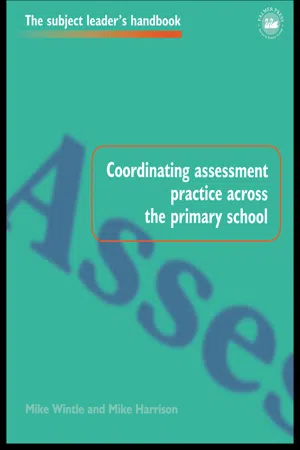
Coordinating Assessment Practice Across the Primary School
- 216 pages
- English
- ePUB (mobile friendly)
- Available on iOS & Android
eBook - ePub
Coordinating Assessment Practice Across the Primary School
About this book
This book is specifically designed for busy teachers who have responsibility for co-ordinating a subject area within their primary school. Each volume in the series conforms to a concise style, while providing a wealth of tips, case studies and photocopiable material that teachers can use immediately. There are special volumes dedicated to dealing with Ofsted, creating whole school policy and the demands of co-ordinating several subjects within a small school. The entire set of 16 volumes is available from RoutledgeFalmer and details of the series can be seen on our website.
Tools to learn more effectively

Saving Books

Keyword Search

Annotating Text

Listen to it instead
Information
Topic
EducationSubtopic
Education GeneralChapter 1
Twelve principles for effective assessment

(Clemson and Clemson, 1996)
The twelve principles of assessment
In a number of schools a policy vacuum (or at the very least a considerable policy confusion) exists with reference to assessment, recording and reporting.
According to Campbell’s (1993) research team who looked at infant teachers at work
(p. 88)
undertaken by primary teachers. This seminal research recommended that the normal expectations for recording and assessment needed to be clarified, for example the frequency of observation of pupils, the frequency of recording, the numbers of pieces of pupil’s work needed for a comprehensive portfolio. They recommended that to do this schools will need to develop their own policies rather than wait for government decree. Soon after this work was published Sir Ron Bearing was appointed to rescue the National Curriculum and assessment in practice but many schools still flounder in their attempt to gain a concerted whole-school approach to the subject.
(OFSTED, 1997)
claims Her Majesty’s Chief Inspector of Schools.
This book draws on methods which work, and work well, to help to define such policies for, as ever the optimist Paul Black (1998) claims,
(p. 6)
The main problem, however, facing any coordinator wanting to help their school to embark upon the sometimes painful process of building and maintaining practice and policy for assessment is where to start! In meeting and working with hundreds of teachers it is obvious that the very thought can turn even the darkest hair grey.
Assessment is like that. This subject is so vast that many coordinators simply buy in a ready-made scheme and breathe a sigh of relief. A few months later they often find that things are not quite that simple. The reasons for this are complicated but not altogether surprising. Schools and children, teachers and governors are different and no school is the same as its neighbour. Building a wholeschool assessment policy is equivalent to reviewing the whole curriculum; engaging in a complete staff-development programme to review and improve practice; and, getting people to agree and then stick to an agreement which some may not like. As assessment coordinator, if you can appreciate that, reality will start to prevail and you may be able to set realistic time limits to achieve your ends. Even the longest journey starts with the first step.
Based on HMI inspections, OFSTED (1998) have recommended that schools take account of the following features of best practice:
- assessment policies are discussed and implemented by all teachers;
- schemes of work identify the points at which pupils are to be assessed;
- medium-term planning includes clear learning objectives and identifies which aspects of the learning are to be assessed;
- assessment tasks and tests in various subjects are coordinated across the school year;
- records provide a clear indication of pupils’ strengths and weaknesses, yet the work involved in maintaining them is kept to a minimum;
- evidence kept to illustrate attainment is discarded once its usefulness is past;
- agreement trialling by the whole team focuses on all the National Curriculum levels represented in the school;
- there is a regular programme for monitoring the implementation of both planning and assessment.
The Task Group on Assessment and Testing (TGAT) under instruction from Margaret Thatcher to produce something
(Gallon, 1995)
created a dual purpose regime but was clear in identifying the main purpose of assessment as formative i.e. concerned with recognising children’s achievements in order to plan the next steps in their learning. This aspect, however, is not the one which gets the publicity and many teachers almost exclusively identify assessment with allocating children to levels to be used to provide a basis for comparisons between the children themselves, between classes and between schools (Campbell, et al. 1993). Policy pressure, league tables etc. have driven this message home and OFSTED practices have tended to lead readers of their reports to equate quality of teaching with the results achieved. Indeed revised briefing notes for Registered Inspectors (RgIs) indicate that inspectors will be required to place even greater importance on these results than before:
- make more effective use of performance data and its interpretation to report on standards and trends in the school, particularly in the core subjects in primary schools;
- focus on weaknesses as well as strengths in the work you see, to be clear about what the school needs to improve;
- explain if there are any significant differences between inspection judgments about the standards of work seen and what the performance data says.
(OFSTED, 1998a, pp. 9–10)
Thus summative purposes are identified with assessment, invoking the fear of children becoming labeled which counters many teachers’ value systems. Furthermore, some teachers associate the rise in assessment requirements with league tables and some of the worst educational practices, such as teaching to the test, cramming, the narrowing of the curriculum, and see these infiltrating the primary school at the expense of life-skills, conceptual thought, creativity and collaborative learning. How then can we persuade colleagues to join together to create a set of practices which will fit with their ethical stance against such a background?
Experience has shown that establishing a set of principles and then practising those principles will guide decisions towards an assessment policy and be of real benefit. The principles presented here—twelve in number—have been used by many heads and coordinators as starting points so that the whole staff can look at their existing practice and identify their next course of action. They also provide an ethical backdrop; albeit with a pragmatic approach. We sometimes need guidance and these principles will ensure that we keep our main focus on the children, their learning and improving our own teaching. With such a focus, rather than say, the intention of climbing up a league table, or satisfying yet anther government edict, you might win a few friends. Putting forward a principled approach could institute a whole staff introduction to the topic and, through debate of each issue, give a rapid boost to staff confidence. This method will lead to the identification of already existing good practice. You will find, as do the authors, that introducing these ideas to staff will produce cries of ‘we already do that’, ‘I forgot I used to do that’. The truth is that no matter how much or how little attention has been paid to the subject, a great deal of assessment is already going on but under a different name, for example marking or observing children in groups and listening to children read.
Your job is to coordinate these behaviours. Marten Shipman (1993) writes:
(p. 67)
The twelve principles of assessment
- The purposes of assessment must be clear, worthwhile and agreed by all those involved in the processes.
- What is to be assessed should be related to the purpose, clearly understood and again agreed.
- Gathering the evidence should become a simple and straightforward task.
- Assessments need to be both systematic and timely.
- The record of the results of assessments must be useful and accessible.
- Children should be involved in the assessment of their own work and progress.
- The demands of assessment should enhance good classroom organisation not hinder it.
- Assessment practices should contribute towards the achievement of equal opportunities.
- The intended access to children’s records should be known before anything is written.
- Parents and governors should be involved in the creation and monitoring of the assessment policy.
- The results of assessments of pupils’ progress should be reported regularly to parents with appropriate detail.
- The policy should be reviewed and evaluated regularly.
Suggestion
Establish a series of meetings with the headteacher to present the current assessment position and the proposed way forward. These meetings need to be well planned and at a time when the head is able to give sufficient uninterrupted time, i.e. not during assembly or first thing in the morning.
Ask if small groups could work on formulating an answer to several questions such as those below and then bring the staff together to seek common ground.
The following twelve principles, distilled from the practice of hundreds of schools, will be useful to you as the basis of dev...
Table of contents
- Cover Page
- Title Page
- Copyright Page
- List of figures
- Series editor’s preface
- Chapter 1: Twelve principles for effective assessment
- Chapter 2: The key role of the assessment coordinator in effective primary schools
- Chapter 3: Planning for assessment
- Chapter 4: Establishing assessment practice across the curriculum
- Chapter 5: Assessment leading to target setting
- Chapter 6: Creating, maintaining and using portfolios of work
- Chapter 7: Records of Achievement
- Chapter 8: Assessment and OFSTED re—inspection
- Chapter 9: Building whole-school policies for assessment
- Bibliography
Frequently asked questions
Yes, you can cancel anytime from the Subscription tab in your account settings on the Perlego website. Your subscription will stay active until the end of your current billing period. Learn how to cancel your subscription
No, books cannot be downloaded as external files, such as PDFs, for use outside of Perlego. However, you can download books within the Perlego app for offline reading on mobile or tablet. Learn how to download books offline
Perlego offers two plans: Essential and Complete
- Essential is ideal for learners and professionals who enjoy exploring a wide range of subjects. Access the Essential Library with 800,000+ trusted titles and best-sellers across business, personal growth, and the humanities. Includes unlimited reading time and Standard Read Aloud voice.
- Complete: Perfect for advanced learners and researchers needing full, unrestricted access. Unlock 1.4M+ books across hundreds of subjects, including academic and specialized titles. The Complete Plan also includes advanced features like Premium Read Aloud and Research Assistant.
We are an online textbook subscription service, where you can get access to an entire online library for less than the price of a single book per month. With over 1 million books across 990+ topics, we’ve got you covered! Learn about our mission
Look out for the read-aloud symbol on your next book to see if you can listen to it. The read-aloud tool reads text aloud for you, highlighting the text as it is being read. You can pause it, speed it up and slow it down. Learn more about Read Aloud
Yes! You can use the Perlego app on both iOS and Android devices to read anytime, anywhere — even offline. Perfect for commutes or when you’re on the go.
Please note we cannot support devices running on iOS 13 and Android 7 or earlier. Learn more about using the app
Please note we cannot support devices running on iOS 13 and Android 7 or earlier. Learn more about using the app
Yes, you can access Coordinating Assessment Practice Across the Primary School by Mike Harrison,Mr Mike Harrison,Mike Wintle in PDF and/or ePUB format, as well as other popular books in Education & Education General. We have over one million books available in our catalogue for you to explore.