eBook - ePub
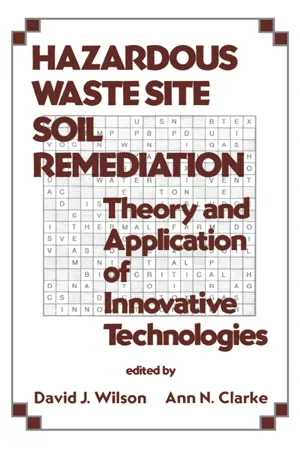
Hazardous Waste Site Soil Remediation
Theory and Application of Innovative Technologies
- 584 pages
- English
- ePUB (mobile friendly)
- Available on iOS & Android
eBook - ePub
Hazardous Waste Site Soil Remediation
Theory and Application of Innovative Technologies
About this book
Introduces the most up-to-date techniques for soil remediation, including chemical fixation/stabilization, soil vapor extraction, thermally enhanced vapor stripping, biodegradation, and air spargingwritten in a style accessible to nonspecialists. Desc4ibes the ex shu technique of thermal desorption of soil contaminants-a low-cost aftemative to incineration for the removal of organics.
Information
1
CONTAMINANT TRANSPORT AND BEHAVIOR IN THE SUBSURFACE
ECKENFELDER INC.
Nashville, Tennessee
Nashville, Tennessee
Louisiana State University
Baton Rouge, Louisiana
and University of Sydney
Sydney, Australia
Baton Rouge, Louisiana
and University of Sydney
Sydney, Australia
ECKENFELDER INC.
Mahwah, New Jersey
Mahwah, New Jersey
INTRODUCTION
An understanding not only of the nature of soil contamination for a given site, but also of the equilibrium and mass transport processes that govern the potential migration of particular chemicals, is a critical first step in any successful soil contamination evaluation and remediation effort. In the following sections of this chapter, information is presented concerning the important physical and chemical properties of the contaminants and the subsurface environment, together with a practical and applied discussion of potential migration pathways, upper limits of contamination based on equilibrium assumptions, and fundamental mass transport processes that govern the fate of a chemical in the subsurface.
Initially, the focus is on the development of a conceptual and predictive model based on the nature of contamination, the actual geological complexity of the subsurface, and the mass transport processes themselves, which is unquestionably oversimplified. Nevertheless, this approach results in an increased understanding of the equilibrium limits and the transport processes, which is most useful as a basis for further evaluation. Often, the assumption of uniform and homogeneous site conditions can enable the use of mathematical models that yield analytical, closed-form solutions that may be reliable within an order of magnitude. This is, in many cases, sufficient for further evaluations. Should more precise estimates be needed, the additional complexity, concerning both the contamination and the subsurface conditions, will typically dictate the need for the use of dynamic numerical models that require an extensive amount of data for reliable calibration and verification. Our objective is not to take the analysis to this level in this treatment, but rather, to focus on providing a good understanding of the contaminant migration pathways that can occur, the definition of pertinent equilibrium states and potential upper limits of contamination, and those steady-state mass transport analyses that can be used to generate predictive estimates most easily. The major focus is on the transport and behavior of organic compounds of low water solubility.
NATURE OF THE SUBSURFACE ENVIRONMENT
Although a comprehensive presentation of groundwater hydrogeology is beyond the scope of this book, there is merit in reviewing some of the fundamental principles of subsurface geology and groundwater movement. These principles are then expanded in subsequent sections of the chapter concerning contaminant migration. Several excellent books are available as resources in fundamental quantitative hydrogeology (Davis and DeWiest, 1966; Freeze and Cherry, 1979; Cedergren, 1977).
It is useful to think in terms of a hierarchy of evaluations concerning the movement of chemicals in the subsurface. Initially, one needs a good understanding of subsurface geology and the movement of water within the subsurface. This can be obtained through the performance of fairly fundamental hydrogeological investigations designed to map the subsurface geology in the vicinity of the chemical release. Typically, soil borings are performed to nee...
Table of contents
- Cover
- Half Title
- Title Page
- Copyright Page
- Dedication
- Table of Contents
- Preface
- 1. Contaminant Transport and Behavior in the Subsurface
- 2. Problems with the Remediation of Diffusion-Limited Fractured-Rock Systems
- 3. Chemical Stabilization of Contaminated Soils
- 4. Soil Vapor Stripping
- 5. Thermally Enhanced Vapor Stripping
- 6. Thermal Desorption
- 7. Enhanced Biodegradation for On-Site Remediation of Contaminated Soils and Groundwater
- 8. Saturated Zone Remediation of VOCs Through Sparging
- 9. In Situ Vitrification
- 10. Soil Surfactant Flushing/Washing
- Contributors
- Index
Trusted by 375,005 students
Access to over 1.5 million titles for a fair monthly price.
Study more efficiently using our study tools.
Frequently asked questions
Yes, you can cancel anytime from the Subscription tab in your account settings on the Perlego website. Your subscription will stay active until the end of your current billing period. Learn how to cancel your subscription
No, books cannot be downloaded as external files, such as PDFs, for use outside of Perlego. However, you can download books within the Perlego app for offline reading on mobile or tablet. Learn how to download books offline
Perlego offers two plans: Essential and Complete
- Essential is ideal for learners and professionals who enjoy exploring a wide range of subjects. Access the Essential Library with 800,000+ trusted titles and best-sellers across business, personal growth, and the humanities. Includes unlimited reading time and Standard Read Aloud voice.
- Complete: Perfect for advanced learners and researchers needing full, unrestricted access. Unlock 1.5M+ books across hundreds of subjects, including academic and specialized titles. The Complete Plan also includes advanced features like Premium Read Aloud and Research Assistant.
We are an online textbook subscription service, where you can get access to an entire online library for less than the price of a single book per month. With over 1.5 million books across 990+ topics, we’ve got you covered! Learn about our mission
Look out for the read-aloud symbol on your next book to see if you can listen to it. The read-aloud tool reads text aloud for you, highlighting the text as it is being read. You can pause it, speed it up and slow it down. Learn more about Read Aloud
Yes! You can use the Perlego app on both iOS and Android devices to read anytime, anywhere — even offline. Perfect for commutes or when you’re on the go.
Please note we cannot support devices running on iOS 13 and Android 7 or earlier. Learn more about using the app
Please note we cannot support devices running on iOS 13 and Android 7 or earlier. Learn more about using the app
Yes, you can access Hazardous Waste Site Soil Remediation by David J. Wilson in PDF and/or ePUB format, as well as other popular books in Technology & Engineering & Environmental Science. We have over 1.5 million books available in our catalogue for you to explore.