It is not unusual for a festschrift to include offerings from several areas of study, but it is highly unusual for those areas to cross disciplinary lines. This book, in doing just that, is a testimony to Bob Abelson's impact on the disciplines of social psychology, artificial intelligence and cognitive science, and the applied areas of political psychology and decision-making. The contributors demonstrate that their association with Abelson, whether as students or colleagues, has resulted in an impressive intellectual cross-fertilization.
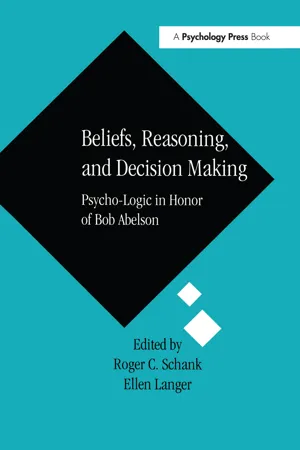
eBook - ePub
Beliefs, Reasoning, and Decision Making
Psycho-Logic in Honor of Bob Abelson
- 426 pages
- English
- ePUB (mobile friendly)
- Available on iOS & Android
eBook - ePub
Beliefs, Reasoning, and Decision Making
Psycho-Logic in Honor of Bob Abelson
About this book
Information
Publisher
Psychology PressYear
2013Print ISBN
9781138987777
9780805814569
Edition
1eBook ISBN
9781134781690
Chapter 1
Goal-Based Scenarios
Roger C. Schank
Northwestern University
PREFACE
When I arrived at Yale in the summer of 1974, Bob Abelson and I started a series of discussions about subjects at the conjunction of our interests. He had, for some time, been interested in what the thinking process might be that underlies political understanding. I was rather taken with the model that he had proposed for the analysis of simplistic political thinking. He suggested that it was possible to understand and predict political explanations by imposing a simple model of causes and effects that underlie any ideology.
At the time I was consumed by the problem of getting computers to understand text, and I was concentrating on simple fairy tales. Bob and I talked at length about one particular fairy tale, called, I believe, “Cap O’Rushes,” something about a girl who lived in marshes and became a princess. Our reason for cooperation was simple enough. In order to do what each of us wanted to do, we needed to understand thinking in a deeper way.
Although politicians could be imitated by simplistic models, there was something more complex behind their thinking. Even Barry Goldwater did not believe that “Communists were likely to throw eggs at the Berlin Wall”—output (as I remember it) from Bob’s Goldwater machine. And, although I tried to represent stories by just analyzing the events they depicted and the causal relationships between those events, it seemed unlikely to me that this was enough. So while I searched for deeper models of complex events to help me understand human stories and enable computers to understand those stories, Bob searched for deeper models of complex events to help in the analysis of the thinking underlying political decision making to allow computers to be more helpful in their prediction of political events.
Thus, in the summer of 1974, in my new office at Yale (computer scientists’ offices were air conditioned, whereas psychologists’ never were) we tried to understand what was going on underneath a fairy tale. Funny stuff for a computer scientist with an interest in language and for a psychologist with an interest in politics to agree to work on, I suppose, but it was a marriage of great intellectual excitement.
Together we discovered that entities we subsequently labeled themes, goals, plans, and scripts were implicitly referred to by our fairy tale. When we thought about Goldwater it was the same. “Throw eggs at” was a plan that satisfied a goal, but it was not a plan that could be implemented unless the object of the action felt embarrassment, or something like that. We thought more deeply about the subject of our mutual interest and discovered the importance of goals. We discussed the deep role that goals played in understanding. We worked on a calculus of goals that explained why sentences like “John doesn’t like chicken so I offered him a Cadillac” did not make sense, whereas sentences like “John wanted to eat at Lutece but he couldn’t afford it so he went bowling instead” did.
Previous work on language understanding and on political understanding had been rather devoid of mention of goals at all, and had certainly not realized the central and complex role they played in understanding. We talked about goals (and the plans to realize them) endlessly. It is perhaps ironic, therefore, that the work that came out of these discussions is remembered as being work on scripts.
We talked about scripts as well, of course. Certainly there were stereotypical ways of putting goals into effect, and understanding depended on knowing about these ways. As the year progressed we invited some promising graduate students into our discussions and they began building software. We tried to get these programs to understand stories by use of the structures we were coming up with. My students built SAM (script applier mechanism) and PAM (plan applier mechanism).
Meanwhile, Bob talked to psychologists about scripts because they seemed a more testable phenomenon in the cognitive paradigm. Further, scripts were a lot easier concept to grasp. The word was easy to understand. (Bob had used it before in a different way; I had to convince him that it was perfect for the phenomenon we were now playing with and that no one would remember how he had used it before.) And, the idea was easy to handle, especially in the context of restaurants.
So we became well known for scripts. (Bob insisted the book was not really properly finished when I insisted on getting it out the door—he may well have been right, but it would not be finished even now in the sense that he meant.) And, although scripts were an important idea, even a right idea as we began to make clearer what the idea was (in Dynamic Memory, a book Bob did not coauthor because I could not get him to write any of it), they were by no means the key idea in our work.
The key idea was the importance of goals. Let me explain why.
GOALS
Every aspect of human behavior involves the pursuit of goals. Sometimes these goals are rather simple, like brushing your teeth to prevent decay. Sometimes they are quite unconscious, like having your mind search for similar experiences when you encounter some new experience. And, sometimes they are quite complex, like trying to build high-quality software to effect change in the school system.
When goals are simple, we really do not think about them much. When they are unconscious we do not think about them at all. And, when they are complex, we may think about them, but find the going so rough that we hone in on the simplest ones and lose the forest for the trees.
But understanding how people pursue goals is a critical aspect of understanding cognition. And, although Bob and I made a nice start in 1974, the problem is difficult enough that it is hard to claim that all that much progress has been made even now. For computers to really understand human stories, they would need a complete model of the goals that people pursue, the plans, the use, and the complexities that arise. For computers, or people, to understand the political process and the thinking of individual politicians operating in a complex environment, the enormity of the problem remains much the same now as then.
So it is with the knowledge of the importance of goals and the complexity of tracking their implementation in a world of events that I derived from those many conversations with Bob and my students, and I began to approach the intellectual problem that most concerns me now, namely education.
I do not mean by this that I had to learn to ask the question, “What is the goal of education?” or that our work in the 1970s directly helped me inquire about goals in the context of education. It is clear enough that there is much confusion on what the goals of education should be, and I knew this long before I arrived at Yale. The work we did on goals had a more profound effect than simply having me ask about goals.
The issue is this. If goals underlie human behavior to the extent that we cannot understand a story or what someone says, or what someone wants, without a clear assessment of the underlying goals and the interaction of those goals, then it follows that goals are at the root of human learning. Why would anyone learn anything if not to help in the pursuit of a goal? Why would anyone try to understand anything if not because they had the goal of learning new information from what they were trying to understand? The desire to change one’s knowledge base, to comprehend what is going on about oneself, and to learn from experience, are all pretty much different ways of saying the same thing. And, all of these are goal directed.
Bob and I did not talk about learning much in the early days because we were content to have models that predicted behavior or simulated behavior without requiring that these models learn to behave in the way that we wanted. Nevertheless, although we were able to suspend the subject of learning, while trying to figure out what was known by a sentient entity before worrying about how it might have gotten there, learning was always lurking in the background.
NATURAL LEARNING
If goals are at the base of the human thought process, then it follows that learning must be a goal-dominated arena as well. This is certainly true of the learning processes of small children, who are quite goal oriented. One-year-olds want to learn to walk because there are places they want to go, because others around them walk, and for a variety of other reasons. Their learning to walk follows the goal of walking (which may well be in service of some other goal).
A 2-year-old learns to speak a language because he wants to communicate. Four-year-olds can find any room in their home, they know the neighborhood in which they live, and in general they understand and can plan in their own environment because these plans are in the service of goals.
Children have natural learning mechanisms, ways in which they progress from babies with innate abilities and no actual knowledge to children with a great deal of knowledge about the physical, social, and mental worlds in which they live. And, these mechanisms, like the understanding mechanisms of adults, are goal dominated.
Small children do not have motivation problems. They are excited by learning, eager to try new things, and in no way self-conscious about failure. In short, they are examples of goal-based learners. Consequently, we never see a 2-year-old who is depressed about how his talking progress is going and so has decided to quit trying to improve. We never see a 2-year-old who has decided that learning to walk was too difficult and thus has decided only to crawl.
The natural learning mechanism that children employ is not very much more sophisticated than trial and error. Children learn by experimentation, by failing, and by being told or copying some new behavior that has better results. Inherent in this model is the idea that children are trying to learn to do something, rather than to know something. Failure is not frustrating in this context; in a deep sense, learning, until 6 years of age, depends on failure.
But at age 6 years, all this changes. Children try to avoid having to learn, they fear failure, their educational goals are to please authority or do less work, and the instruction they receive is more like thirty-on-one than one-on-one, including tremendous ridicule and social difficulties caused by their peer group. What has happened? The 6-year-old has started school.
The goals that are the basis of understanding and of learning ought to be the basis of schooling as well, but they are not. In school, natural learning goals are replaced by artificial ones. Instead of trying to learn something because one wants to be able to do something, like get places, or communicate or utilize objects, children learn in order to please the teacher, in order to avoid ridicule, in order to get good grades, or in order get into a good college. In other words, natural learning goals that have to do with increased understanding or increasing one’s power to operate successfully in various endeavors get replaced by artificial learning goals that have to do with acceptance, approval, and socialization.
It follows, then, that the main problem in the schools is the curriculum. Learning in school rarely looks like learning in the real world. Whereas learners in the real world struggle to learn in order to achieve goals that they want to achieve, learners in school struggle to learn material that their teachers insist that they know in order to achieve the goals of getting good grades, credit for courses and degrees.
Simply put, students are learning the wrong stuff. Why? Because our entire concept of what constitutes an education has been guided by the need for assessment. We do not teach students what they want to know; we do not pander to their real educational goals at all. Rather, we pander to the goals of the system, which usually means finding out who is the best, who can get into Yale, get the top job, and so on. To make these assessments we test what is easily testable, which often means vocabulary items on multiple-choice tests, and rarely means controversial issues for which there is no clear answer. We decide that every student must know some particular body of knowledge, which sounds fine in principle, but forces one to find ways to make sure that everyone has learned this body of knowledge, which brings us back to simplistic tests. A further consequence of deciding what everyone should know is that we implicitly eliminate other subjects that might genuinely interest a child. There is no time for extra stuff, precisely the sort of stuff that might relate to a child’s real goals.
In order to reorganize the schools, then, a theory of what constitutes a reasonable curriculum is necessary. Such a theory ought to be independent of any particular subject matter, dealing instead with principles by which knowledge is acquired and utilized in real life and relating those principles to the schoolroom. Because the assumption that education ought to be goal directed carries with it the idea that education should be self-directed (who knows better what a child’s goals and interests are than the child?) rather than imposed by state mandates of what every child should know, we come to the conclusion that the very idea of curriculum is wrong. The whole idea of curriculum has built in it the idea of lockstep, each child proceeding on the same course at more or less the same pace. Because natural learning proceeds at its own pace, and because there is no absolutely right set of things that everyone needs to know, this cannot be the right way to proceed.
Nevertheless, there are times to bend to reality and this is one of them. School reform requires clear alternatives; in this article I propose a new method for the construction of courses. Courses are important entities in the real world of school and of business training. If we are to have courses, and it seems that they will be with us for the near term at least, then maybe we can have good, high-quality fun and goal-directed courses. I show how we can redesign courses using what we know about natural learning and what we understand about the primacy of goals in understanding and learning.
When I am asked to redesign training for a business by taking their existing training method and putting it into software, a curious question emerges: How long should the course take? Businesses have answers to this question that are based entirely on economics. This should not be surprising. Perhaps more surprising is that universities’ answers to this question are also based on economics.
Businesses will ask for a course that provides 40 hr of instruction. Why? Because trainees are being flown into training centers, to which they travel on weekends, the work week is 40 hr long, and airfare is the same if you stay for 5 days or 3. Universities can only get professors and students to put up with classes that meet 3 hr a week for 10 or 12 weeks. Anything else is heresy and will not be tolerated by anybody—students, professors, graduate schools, or employers.
Nevertheless, we still maintain that a course should be the length necessary to teach students to do what the teacher wants them to know how to do. We know this will continue to be a problem, but we must find ways around it.
COURSE REDESIGN PRINCIPLES
Now we can begin to discuss what characteristics a course, any course, implemented in any way, should have. The first thing we must realize is that an interest is a terrible thing to waste. Human beings, especially children, come with real interests, things they have a genuine desire to pursue, that, left to their own devices, they would learn more about. Unfortunately, schools, and training courses in business, assume that they know what the student should know and that what the student wants to know is of little relevance in this regard. Two important points need to be made here. First, almost any interest of a student can be utilized so that it relates in some way to the subjects that the school wishes to teach. Doing this would certainly capture and maintain the student’s attention. Second, what the school wants to teach may not be so well thought out in the first place. Perhaps, standard courses should be seriously reexamined to see if they accomplish the things that the school intends to accomplish.
Courses need to be created within a context that enables students to pursue their own interests as long as they want to without disallowing the possibility of switching interests at any time. This means that the concept of a curriculum must include an understanding of how materials pertain to specific interests and how they convey general issues independent of a specific context. Once a student selects an interest, accomplishable goals in terms of visible projects will be pursued. Much of the kind of knowledge that is now taught explicitly in school will be taught implicitly, within the context of helping the student achieve the goals of the course he has selected for himself. Teaching will occur as the student discovers his need to know in order to accomplish whatever his current task is. The idea is to understand and utilize the differences betwe...
Table of contents
- Cover
- Halftitle
- Title
- Copyright
- Contents
- Preface
- 1 Goal-Based Scenarios
- 2 The Illusion of Calculated Decisions
- 3 From Natural Language Understanding to Case-Based Reasoning and Beyond: A Perspective on the Cognitive Model That Ties It All Together
- 4 Opportunistic Memory: “Be Prepared”
- 5 Cognition, Computers, and Car Bombs: How Yale Prepared Me for the 1990s
- 6 The Psychology of Strongly Held Beliefs: Theories of Ideological Structure and Individual Attachment
- 7 Dissonance and Balance in Belief Systems: The Promise of Parallel Constraint Satisfaction Processes and Connectionist Modeling Approaches
- 8 “Hot” Versus “Cold” Cognition: An Abelsonian Voyage
- 9 Reason and Emotion in American Political Life
- 10 Facial Maturity and Political Prospects: Persuasive, Culpable, and Powerful Faces
- 11 The Persistence of Persuasion
- 12 Discourse, Probability, and Inference
- 13 An Exploration of Temporality in Human Behavior
- Author Index
- Subject Index
Trusted by 375,005 students
Access to over 1.5 million titles for a fair monthly price.
Study more efficiently using our study tools.
Frequently asked questions
Yes, you can cancel anytime from the Subscription tab in your account settings on the Perlego website. Your subscription will stay active until the end of your current billing period. Learn how to cancel your subscription
No, books cannot be downloaded as external files, such as PDFs, for use outside of Perlego. However, you can download books within the Perlego app for offline reading on mobile or tablet. Learn how to download books offline
Perlego offers two plans: Essential and Complete
- Essential is ideal for learners and professionals who enjoy exploring a wide range of subjects. Access the Essential Library with 800,000+ trusted titles and best-sellers across business, personal growth, and the humanities. Includes unlimited reading time and Standard Read Aloud voice.
- Complete: Perfect for advanced learners and researchers needing full, unrestricted access. Unlock 1.5M+ books across hundreds of subjects, including academic and specialized titles. The Complete Plan also includes advanced features like Premium Read Aloud and Research Assistant.
We are an online textbook subscription service, where you can get access to an entire online library for less than the price of a single book per month. With over 1.5 million books across 990+ topics, we’ve got you covered! Learn about our mission
Look out for the read-aloud symbol on your next book to see if you can listen to it. The read-aloud tool reads text aloud for you, highlighting the text as it is being read. You can pause it, speed it up and slow it down. Learn more about Read Aloud
Yes! You can use the Perlego app on both iOS and Android devices to read anytime, anywhere — even offline. Perfect for commutes or when you’re on the go.
Please note we cannot support devices running on iOS 13 and Android 7 or earlier. Learn more about using the app
Please note we cannot support devices running on iOS 13 and Android 7 or earlier. Learn more about using the app
Yes, you can access Beliefs, Reasoning, and Decision Making by Roger C. Schank, Ellen Langer, Roger C. Schank,Ellen Langer in PDF and/or ePUB format, as well as other popular books in Psychology & Cognitive Psychology & Cognition. We have over 1.5 million books available in our catalogue for you to explore.