Social Enterprise and the Third Sector
eBook - ePub

Social Enterprise and the Third Sector

Changing European Landscapes in a Comparative Perspective

  1. 280 pages
  2. English
  3. ePUB (mobile friendly)
  4. Available on iOS & Android
eBook - ePub

Social Enterprise and the Third Sector

Changing European Landscapes in a Comparative Perspective

About this book

The concepts of social enterprise and social entrepreneurship are rapidly attracting increased attention in academic spheres and from policy-makers, as well as field workers who are setting up new initiatives or reshaping their organizations. These concepts are perceived as defining innovative and dynamic responses to major global challenges in today's societies.

The debate about social enterprise is now world-wide, with lively exchanges between American and European scholars. However, the research and landscapes still differ significantly in different regions, and diversity also exists within specific regions such as Europe. This book presents the most comprehensive set of contributions reflecting the European-wide debate, but with frequent connections to developments in other parts of the world. This book is a result of work carried out by members of the EMES International Research Network, which is a pioneer in this field.

Social Enterprise and the Third Sector will appeal to all researchers who focus on the third sector, social economy and social enterprise, to MBA and postgraduate students, as well as to intellectual social enterprise leaders and practitioners. It will soon become a key reference for all those who want to explore the full richness of these concepts and follow this important academic debate.

Trusted by 375,005 students

Access to over 1.5 million titles for a fair monthly price.

Study more efficiently using our study tools.

Information

Publisher
Routledge
Year
2014
eBook ISBN
9781134619719
Section II
Social enterprise, governance and policy issues

7
Major Perspectives on Governance of Social Enterprise

Roger Spear, Chris Cornforth and Mike Aiken1

1 Introduction

The chapter examines the commonly recognized different types of social enterprise (co-ops, social firms, community business, trading charities, etc.), and explores the typical governance issues they face. Governance here refers to systems and processes concerned with ensuring the overall direction, supervision and accountability of an organization (Cornforth, 2004a).
In the UK, social enterprises are typically understood as third sector organizations that trade for a social or environmental purpose. This means that typically these are the more commercially oriented Non-profits and the more socially oriented cooperatives. In many countries, social enterprises take a variety of legal forms: for example, in the UK, they may be registered as companies limited by guarantee, industrial and provident societies, and community interest companies, or simply take a number of unincorporated forms. And increasingly new legislation is emerging in many countries in Europe and more widely. Some of the most recognized sectors are work integration (training and employment organizations to get disadvantaged people back into the labour market), the provision of welfare services, and in some countries, a broader field of social utility or community benefit which might include cultural and recreational services.
Social enterprise had become increasingly important internationally for a number of reasons. They are seen as having potentially important roles in the restructuring of public services – where the third sector is seen as increasingly important as a service provider in a mixed economy of provision. Social enterprises are also seen as an important vehicle for social innovation to address social problems more effectively in a wide range of fields including community development, urban regeneration, rural deprivation, cultural services, and recycling. They may be seen both as new forms of organization, but also as a reconfiguration of existing organizations (such as Non-profit organizations) as their context is shaped more and more by market forces.
Concerns about the governance and accountability of social enterprises has arisen partly because the sector is new and diverse, and partly because a wide range of issues have led to governance reforms in the private, public and Non-profit sectors. Plus there has been a concern to ensure that the governance and accountability issues faced by social enterprise are fully understood and recognized, so that appropriate governance practices and policies may be put in place. However research and policies for improving the governance of Non-profit organizations and cooperatives provide some foundations for examining and developing appropriate frameworks for social enterprises.
This chapter draws on theoretical and empirical findings to formulate a theoretically grounded framework for explaining the fundamental differences in governance structures between different types of social enterprise and draws out important themes (such as multi-stakeholder structures) which shape governance processes. It begins by reviewing the context for governance reform in the public, private and third sectors. It goes on to examine the nature and characteristics of social enterprise and clarify its governance structures. It continues by examining the main governance issues: board/manager relations, board roles and expertise, stake-holder/member relations and accountability, goal structure (social and financial), market and regulatory framework. Then it goes on to discuss emerging pathways to social enterprise based on their origins and the transitions they make, drawing on a recent empirical research project in the UK (Spear et al. 2008). The study undertaken was based on selecting a number of case studies from a range of types of social enterprise. These were identified from databases based on the UK definition of social enterprise, which specifies three operational criteria for organizations: having a social purpose, with 50 per cent of their income being earned, and reinvesting more than 50 per cent of their profits. Note that this does not include governance criteria, and thus differs from the EMES ideal typical definition which provides a richer perspective on the characteristics of social enterprise but is not an operational definition for specifying a population of social enterprises. The EMES definition specifies three governance dimensions: a high degree of autonomy, a decision-making power not based on capital ownership, and a participatory nature, which involves various parties affected by the activity. All the case studies selected had satisfactory levels of achievement on the first two dimensions, and although most had some form of stakeholder participation, some did not.

2 The context for governance reforms

This section begins by examining the context of governance reforms in the public, private and third sectors. It goes on to examine the nature of social enterprise and their characteristics governance structures. After, it considers different governance issues and challenges, and then the main theoretical perspectives used to help understand and analyze board roles, before developing a paradox perspective on how these perspectives might be combined.
Recently, there has been growing interest in corporate or organizational governance among both policy-makers and academics. This has been partly due to several major governance scandals in the private, public and third sectors that have led to changes to systems of voluntary self-regulation (e.g. codes of good practice) as well as the statutory regulatory framework. The key factors in this changing context have been:
  • Globalization and deregulation in the corporate world, with a recognition of the power of corporations in (often deregulated) markets;
  • Varied institutional frameworks for corporations – in terms of the powers of different stakeholders (such as institutional investors), and the market for corporate control (mergers/takeovers in different countries), and
  • A weakening of government regulatory frameworks.
This has left an emphasis on business ethics and regulatory/advisory frameworks for corporate governance, with an increased emphasis on the role and composition of the board and the ways in which it can exert control. In some cases, this has resulted in a strengthening of the statutory framework for corporate governance, whilst in others, emphasis has been placed on strengthening voluntary codes of practice.

2.1 Governance reforms in private, public and third sectors

A series of major corporate scandals in the private sector has been a major driver of governance reform, which also influenced other sectors. Some very prominent international companies have fallen from grace, including Guinness, BCCI, Enron and WorldCom, and more recently India-based software giant, Satyam Computer Services Ltd, with its accounting fraud. The power of major corporations appears to have increased enormously with globalization, in the context of market deregulation, and the weakening authority of national governments to regulate. This has raised questions about the influence of shareholders and institutions, the transparency of financial accounting, and the accountability of senior managers.
In many countries, but particularly in Anglo-Saxon countries, the emphasis of governance reforms has been on self-regulatory measures – leading to codes of practice, with pressures to conform from shareholders and institutions. One particular well-supported reform is to change the balance between executive directors (the senior managers in the company), and non-executive or independent directors from outside the company, strengthening the position of the latter, so that they could press for more accountable management. Other measures have included a recommended requirement to separate the roles of chair and chief executive (Australia, Canada, UK); suggestions to strengthen remuneration committees (but this appears to have been particularly ineffective); make appointments procedures more transparent and fair; and to strengthen the board through induction and development for directors, and performance appraisals for boards and board members. Similar developments have taken place in the Non-profit and cooperative sectors; however, it has not always been possible for other sectors to adopt all the measures due to their distinctive values and practices – for example, UK consumer cooperatives have resisted the use of outside non-executive directors because they value strengthening the relationship with membership. However there has generally been a much greater emphasis on improving governance through many of the above methods, with a particular emphasis on improving the advice, support and training available to board members of cooperatives and Non-profits. (ACEVO et al. 2005, Co-operatives UK, 2005).

2.2 The nature and characteristics of social enterprises

This section examines the nature and characteristics of social enterprise and develops a new framework for understanding governance structures in social enterprise.
It is not a straightforward matter defining social enterprise’ since, in broad terms, it is the more entrepreneurial part of the third sector. Social enterprises may take a variety of legal forms, as well as varied model rules and bylaws within a particular legal form, and may also be multi-organizational – the classic example is a charity owning a trading company. Official definitions vary by country; for example, in the UK, the government’s Social Enterprise Unit (SEU), originally developed the following definition: “A social enterprise is a business with primarily social objectives whose surpluses are principally reinvested for that purpose in the business or the community, rather than being driven by the need to maximise profit for shareholders and owners” (DTI, 2002).
The influential EMES network2 developed an approach applicable to a wide range of legal contexts; its ideal-typical approach uses nine dimensions covering governance, social and economic characteristics. A more straightforward operational definition of social enterprise is: a (private, formal) organization which has a social or environmental purpose, has more than 50 per cent of its income from commercial activity, and is Non-profit or has limited distribution constraints so that it reinvests the majority of their profits. This means that social enterprises have to operate in an entrepreneurial way to meet financial goals, but they may also rely on subsidies or social capital. And they often adopt a multi-dimensional approach to measuring their social, economic and environmental performance.

A conceptual framework of types of governance in social enterprise

Governance is recognized as an important issue across the social enterprise sector. However, the sector is very varied, and a wide variety of governance structures are used, with for example different levels of formalization3, board size and composition.
In the third sector, there is a considerable diversity of social enterprises – many of which are not differentiated according to legal form, but are commonly recognized self-labelled forms. However, in terms of governance, there is considerable similarity between these apparently different types, in terms of structures and issues. This section attempts to simplify the apparent diversity of social enterprises, suggesting a broad typology of ideal types of governance structures, and identify some the distinctive governance challenges of the different types.
The suggested typology of governance structures is based on a dimension relating to the system of board reproduction. There are three types:
  • The governing body or board is self-selecting, that is where there is no membership or a narrow membership which is identical (or almost identical) with the board;
  • The membership association where the board is democratically elected by the wider membership of the organization;
  • The hybrid structure where board members and the wider membership both have some influence over board recruitment and appointment.
Underlying these differences are the key issues of accountability and control; for example, where the board is formally accountable to membership, it could, in principle, be removed by the members; as well as the distinction between wide and narrow membership. These broad types are summarized in Table 7.1.
The first category, self-selecting boards, refers to third sector organizations which have no membership (like some voluntary organizations, charitable foundations or trusts4), as well as those where membership is in effect limited to board members. Board members in such organizations are thus quite powerful, as they are essentially accountable to themselves. But to a certain extent, this may be balanced by their strong drive towards their mission (or charitable purpose); in a charity the achievement of charitable objects/purposes, which also specify beneficiaries and geography, provides a benchmark for accountability; (this has a much greater force than company objects).5 Self-selecting boards may have an advantage in being able to recruit from a wide range of networks, and may in fact choose to nominate from stakeholder groups, but there remains the issue of accountability to wider stakeholders representing the public interest.
TABLE 7.1 Three broad governance structures in social enterprises
Self-selecting boards Hybrid structures Democratic member-based structures

New board members are appointed by existing board. The board includes a mix of appointed and elected board members. Board members are elected by the wider membership of the organization.
In the membership association (e.g. cooperatives and other types of voluntary organizations or charities with a wider membership) the board is elected by the membership. In these organizations it is important to address issues of member participation (see Spear, 2004), and how members can exert influence or control over managers, but also how the board and management can encourage member participation. In this way, the democratic rights of members can expand the concept of governance by emphasizing board member accountability. In membership structures, typically the influence of the members is through a board of directors representing the members – via an annual general meeting, where board members or directors are elected and major issues are discussed. Thus, there are two important structural relations in the governance of member-based structures: members influence on the board and board influence over managers.
Hybrid structures contain a mixture of the features of the previous two types. There is a wider membership, but the membership only elects a proportion of board members and the others posts are appointed, for example some people may be appointed or co-opted by the board to fill skills gap...
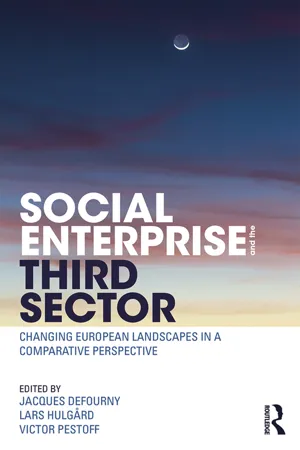
Table of contents

  1. Cover Page
  2. Half Title page
  3. Title Page
  4. Copyright Page
  5. Contents
  6. List of figures
  7. List of tables
  8. Acknowledgments
  9. List of contributors
  10. Introduction to the “SE Field”
  11. Section I The dynamics of social enterprise and social entrepreneurship: Theoretical foundations
  12. Section II Social enterprise, governance and policy issues
  13. Index

Frequently asked questions

Yes, you can cancel anytime from the Subscription tab in your account settings on the Perlego website. Your subscription will stay active until the end of your current billing period. Learn how to cancel your subscription
No, books cannot be downloaded as external files, such as PDFs, for use outside of Perlego. However, you can download books within the Perlego app for offline reading on mobile or tablet. Learn how to download books offline
We are an online textbook subscription service, where you can get access to an entire online library for less than the price of a single book per month. With over 1.5 million books across 990+ topics, we’ve got you covered! Learn about our mission
Look out for the read-aloud symbol on your next book to see if you can listen to it. The read-aloud tool reads text aloud for you, highlighting the text as it is being read. You can pause it, speed it up and slow it down. Learn more about Read Aloud
Yes! You can use the Perlego app on both iOS and Android devices to read anytime, anywhere — even offline. Perfect for commutes or when you’re on the go.
Please note we cannot support devices running on iOS 13 and Android 7 or earlier. Learn more about using the app
Yes, you can access Social Enterprise and the Third Sector by Jacques Defourny,Lars Hulgård,Victor Pestoff in PDF and/or ePUB format, as well as other popular books in Business & Business General. We have over 1.5 million books available in our catalogue for you to explore.