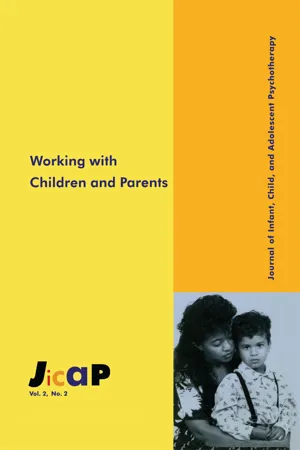
eBook - ePub
Working With Children
Journal of Infant, Child, and Adolescent Psychotherapy, 2.2
- 144 pages
- English
- ePUB (mobile friendly)
- Available on iOS & Android
eBook - ePub
Working With Children
Journal of Infant, Child, and Adolescent Psychotherapy, 2.2
About this book
This is a special issue of JICAP looking at working with children and parents.
Information
INTERACTIVE MOVEMENT PATTERNS AS PORTS OF ENTRY IN INFANT-PARENT PSYCHOTHERAPY: WAYS OF SEEING NONVERBAL BEHAVIOR
When observing and describing an infant’s shifting level of arousal, facial gesture, or kicking rhythm, or when appraising face-to-face social interaction, parental sensitivity, or any of the myriad other behaviors we deem developmentally and clinically relevant, what fashions the lens through which the infant-parent psychotherapist makes observations? What determines the descriptive language used? How do this lens and language influence the attributions made by the clinician?
The subject of this paper1 is the nature of our data: we are closely observing infants and parents and drawing clinical conclusions, but we are doing so without a shared lexicon for the nonverbal behaviors observed. Do some nonverbal behaviors have predetermined meaning? Are there dimensions and patterns of nonverbal behavior that have intrinsic links to levels of psychic functioning and individual psychological proclivities, and if so, what units of behavior are meaningful? In highlighting the value of systematic and coherent approaches to nonverbal behavior, the ways in which behaviors are often observed and identified are examined. Careful observational research has prompted significant advances in theory pertaining to the mutually influencing parent-infant intrapsychic representations of the social world (Beebe and Lachmann 1998, Fonagy 1994, Tronick 1998). Yet it seems possible that insufficient attention has been paid to the selective nature of the behaviors observed and catalogued (as well as those that are not).
The task of identifying which nonverbal patterns are pertinent for the infant-parent psychotherapist, or even defining what establishes a meaningfully distinguished nonverbal pattern at all, has often followed from intuition or a sense of face-validity. In this paper, the importance of seeing patterns relevant to the tasks of the infant-parent psychotherapist is reviewed. The theoretical and research anchors for these classification schemes are described, especially in light of the formalized systems, evolving along both neo-Darwinian and psychodynamic pathways, that have been created. These nonverbal patterns are, after all, the behavioral elements underlying perceptions/attributions of attunement, affect-sharing, empathy, trust, and a host of other clinically relevant features for the therapist focused on the dyad. These are developmentally framed behavioral elements that may be interpreted as reflective of affect states, attentional structure, and/or features of individual temperament or personality that are also relevant clinically.
This paper proceeds to consider the fundamental place of observation and description of the nonverbal in the work of the infant-parent psychotherapist. The need for appropriate classification schemes in psychology are considered, along with their challenges. Distinct levels of categorization bring advantages and disadvantages, and problems of interobserver reliability are encountered. Following an overview, the Kestenberg Movement Profile (Amighi et al. 1999, Kestenberg 1975) is described, as it is unique as a classification system anchored in Laban’s categorizations (Laban 1966) and fundamentally linked to developmental and psychological processes and psychodynamic formulations.
NONVERBAL PROCESSES IN INFANT-PARENT PSYCHOTHERAPY
Observational skills are important tools in all domains of psychotherapy and psychoanalysis. How clinicians listen, and how they select what to respond to in traditional verbal therapies has spawned much literature, and points to multilayered influences, including theoretical orientation, personality of the therapist, and ongoing countertransferential phenomena. Particular observational opportunities are available, and skills called upon, in the special circumstance of infant-parent psychotherapy, where the baby’s presence is such a central ingredient (Lieberman et al. 2000). What tools are therapist-observers to use, however, in the work of identifying individual and interactive themes, emotional states and developmental shifts? What is the relationship among what and how the therapist observes, the manner of the therapist’s empathic attitude, and the potentiation of mutative change in the therapeutic process?
As Fraiberg (1980) had initially envisioned, the powerful influence of parental-representational “ghosts in the nursery” (Fraiberg et al. 1975) illuminates the manner of intergenerational transmission upon the infant, for example, how the parent’s conflictual feelings regarding the baby are anchored in his or her own childhood experiences. Yet, while highlighting the power of a parent’s newfound awareness of relevant childhood experiences in relating to an infant, Lieberman and colleagues (2000), and Lieberman and Zeanah (1999), among others, have clarified some of the limitations of insight-oriented verbal interpretive work in many contexts, highlighting instead the efficacy of nonspoken demonstrations of the therapist’s empathic attitude and behavior toward parent and baby. When the circumstances of the families are particularly laden with stress, for example, impoverishment, the quality of the parent-therapist relationship has been considered especially primary, and the task of the therapist has been especially oriented toward attunement to the parents’ immediate subjective experience. The therapist is certainly in a unique role, perhaps as one existing in the transitional space between infant and parent.
Infant-parent psychotherapies vary in method based on circumstance, orientation, and goals. These therapies differ, in part, in the degree to which clinical attention is focused on parental conflict, upon the connection between past and present that may be distorting the infant’s selfhood in the eyes of caregivers, upon corrective attachment experiences facilitated by the therapeutic relationship, or upon more directive exercise of reciprocal and mutually regulated and gratifying forms of interaction (Lieberman et al. 2000, Stern 1995). Research involving careful observations of infants led to an enhanced appreciation of the baby’s capacities and sense of agency (Stern 1985), and to a greater acknowledgment of the dyadic complexity of the parent-infant relationship when viewed in terms of the quality of mutually and reciprocally regulated experiences (Beebe et al. 1997, Tronick 1998). In fact, increased understandings of the nature of dyadic interchange between parent and infant, and more intricate views of how parent and infant mutually construct meanings, have increasingly influenced the wide body of psychoanalytic and developmental theories, while amplifying constructivist and relational thinking.
In their review of varied infant-parent programs, Lieberman and Zeanah (1999) consider the mutative factors operative in varied therapeutic approaches, such as group interventions and interaction guidance (McDonough 1993). Of significant consequence are the therapist’s positive regard, attentiveness to the parent’s needs, and empathic responsiveness. These researchers suggest that it is through a corrective attachment experience that the parent becomes able to change negative expectations to greater trust, and move increasingly toward mutuality and caring. The therapist must become a secure base (Bowlby 1988) through the utilization of therapeutic empathy. The mutual trust sought between the parent and child should be inherent in the working relationships that include the therapist. This is also aligned with Stern’s (1995) framework, conceptualizing an open-system model of the infant-parent relationship, including constituent factors of the interactive behaviors of both infant and parent (hence, the external components of the relationship), and of the representations of both infant and parent (hence, the internal components of the relationship). An intervention addressing one component (e.g., the parent’s representations) would likely affect the others as well.
Greenspan (1997) described particular “gestural challenges” potentially posed to therapists by patients of various ages, leading him to address the nonverbal communication and gestural negotiations that occur in the context of a therapeutic session. He suggests that the first goal of therapy involves the establishment (or reengagement) of clear, reciprocal, boundary-defining non-verbal communications, often addressing the developmental deficit in the earliest kind of gestural and interactive negotiations. Greenspan suggests that in the process of treatment it is the therapist who chooses how to “countergesture” in such a way that the patient’s regulatory problems are addressed while maintaining the integrity of the gestural system and respecting the patient’s individuality. I suggest that the infant-parent psychotherapist is involved in a complex process in choosing such countergestures, for they may carry multiple meanings. In the treatment of a regulatory-disordered child, a therapist’s gesture may, in one instance, directly offer empathic understanding and yet containment and regulatory support for the child, while simultaneously supporting the parent’s ability both to be contained and to similarly offer containment.
A major influence on theory and practice in infant mental health, and in infant-parent psychotherapy in particular, has been attachment theory (Bowlby 1988, Lieberman and Zeanah 1999), with its heightened concern for direct observation by the therapist, and for its focus on empathy and sensitive responsiveness. Attachment classifications have primarily been made through discriminating observations of the toddler’s attachment strategies in a laboratory situation (Ainsworth et al. 1978, Lyons-Ruth and Jacobvitz 1999, Main and Solomon 1990). This research involves specific operationalizations of mostly nonverbal behavior, especially upon reunion, and insists on the attainment of intercoder agreement. As Solomon and George (1999) note, coding in the Strange Situation does not involve event recording, wherein predefined acts are minutely operationalized. Rather, a multidimensional, categorical template is described, and coders gain experience in placing newly seen behaviors within these templates. The behaviors observed are categorized without reference to any specific system of nonverbal analysis, but rather on agreed-upon gestures and features that allow for reliable differentiation by coders, and that have proven valid through an enormous body of research. Relevant infant/toddler behaviors for classification involve such features as smiling, seeking contact, exploring, seeking distance, visible distress, signs of angry rejection, failing to find comfort (Ainsworth et al. 1978), and/or regarding the disorganized/disoriented category, direct indications of fear/apprehension of a parent (Main and Solomon 1990).
An extension of such a template-driven classification scheme has been clinically applied in the recognition of disturbances and disorders of attachment. Zeanah and Boris (2000) note the challenges of developing clinic-based assessment methods of attachment, as it appears that the more structured research methods lack sufficient sensitivity for the clinician. Features such as “indiscriminate friendliness,” “self-endangerment,” “clinging/inhibited exploration,” “vigilance/hypercompliance,” and “role-reversal” are important patterns used for diagnostic differentiation of attachment disorders, and the nonverbal realm may be the primary channel of expression.
People vary greatly in their ability and style in capturing and documenting observed behaviors, and this is reflected in notably different narratives.2
Stern (1995) notes that “any element of the clinical situation can be used as a privileged port of entry” (p. 131). Indeed, in referring to a case of an 18-month-old, using the interaction as the port of entry, Stern carefully describes the sequentially unfolding videotaped behavior of a child seeking his mother. Upon not attaining her in the manner he apparently wanted, the child showed a reactive microdepression. His vignette ably served to demonstrate the utility of using a videotape of mother-child interaction with the mother to elicit her relevant representations and memories. It is interesting to note Stern’s (1995) descriptors in the following section of this vignette: Focusing on the descriptors themselves, Stern, certainly an endowed and seasoned observer, appeared to identify the child’s arm gesture as carrying great expressive meaning and semiotic weight. Hence, he readily interprets its meaning directly, going on to describe the mother’s gestural reply in terms that we recognize were not fulfilling of the young boy’s inferred wish, ultimately leading to his plaintive posture. Such a style of description resonates with clinicians who similarly employ well-developed eyes for motivationally relevant cues and affectively relevant responses. The clinician in such a case is building upon his or her everyday ability to accurately note, and infer meaning from, nonverbal behavior. No special coding system or language of movement was actuated in Stern’s observational and descriptive task. Yet, in all such descriptions a selection process is evident. Here, for instance, we don’t read directly about the boy’s facial gestures, or the mother’s. The manners in which the chair got dragged and the climbing occurred are not elaborated. We hear of the directionality of the hands, but not of their state of tension. The “long breath” conveys a temporal quality of graduality or extended time, but there was no comment on the time dimension of other behaviors. When the boy’s “posture crumbled” do we picture all planes (horizontal, vertical, and sagittal) equally involved in his becoming “deflated...
Table of contents
- Cover
- Half Title
- Title
- Copyright
- Table of Contents
- Trends in Child Development and the Family: Invited Address to the Chief Justices of the United States
- Parent Work in Analysis: Children, Adolescents, and Adults. Part Three: Middle and Predetermination Phases
- Parent Work in Analysis: Children, Adolescents, and Adults. Part Four: Termination and Post-Termination Phases
- Locating the Metaphor and Sensing the Poetic: Psychotherapy with Children in States of Nonexperiencing
- Introduction to Neil Altman/Toni Heineman Presentations
- Geraldine: On the Way Out of Foster Care
- Not for Love or Money: A Discussion of a Case Presentation
- Beyond Love and Money: Response to Discussion
- Afterword: Response to Neil Altman
- Interactive Movement Patterns as Ports of Entry in Infant—Parent Psychotherapy: Ways of Seeing Nonverbal Behavior
- Book Review: Clinical and Observational Psychoanalytic Research: Roots of A Controversy
- Information for Authors
Trusted by 375,005 students
Access to over 1.5 million titles for a fair monthly price.
Study more efficiently using our study tools.
Frequently asked questions
Yes, you can cancel anytime from the Subscription tab in your account settings on the Perlego website. Your subscription will stay active until the end of your current billing period. Learn how to cancel your subscription
No, books cannot be downloaded as external files, such as PDFs, for use outside of Perlego. However, you can download books within the Perlego app for offline reading on mobile or tablet. Learn how to download books offline
Perlego offers two plans: Essential and Complete
- Essential is ideal for learners and professionals who enjoy exploring a wide range of subjects. Access the Essential Library with 800,000+ trusted titles and best-sellers across business, personal growth, and the humanities. Includes unlimited reading time and Standard Read Aloud voice.
- Complete: Perfect for advanced learners and researchers needing full, unrestricted access. Unlock 1.5M+ books across hundreds of subjects, including academic and specialized titles. The Complete Plan also includes advanced features like Premium Read Aloud and Research Assistant.
We are an online textbook subscription service, where you can get access to an entire online library for less than the price of a single book per month. With over 1.5 million books across 990+ topics, we’ve got you covered! Learn about our mission
Look out for the read-aloud symbol on your next book to see if you can listen to it. The read-aloud tool reads text aloud for you, highlighting the text as it is being read. You can pause it, speed it up and slow it down. Learn more about Read Aloud
Yes! You can use the Perlego app on both iOS and Android devices to read anytime, anywhere — even offline. Perfect for commutes or when you’re on the go.
Please note we cannot support devices running on iOS 13 and Android 7 or earlier. Learn more about using the app
Please note we cannot support devices running on iOS 13 and Android 7 or earlier. Learn more about using the app
Yes, you can access Working With Children by Kirkland C. Vaughns in PDF and/or ePUB format, as well as other popular books in Psychology & Developmental Psychology. We have over 1.5 million books available in our catalogue for you to explore.