- 569 pages
- English
- ePUB (mobile friendly)
- Available on iOS & Android
eBook - ePub
About this book
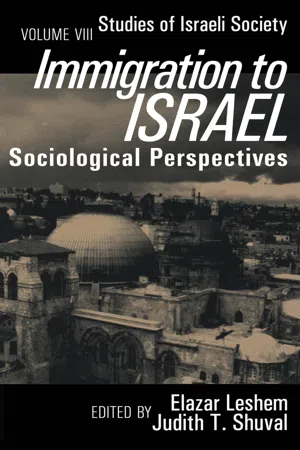
This eighth volume in the Studies of Israeli Society series presents a broad array of topics related to the sociology of immigration to Israel. The focus is on immigration and migration during the 1980s and 1990s. The chapters were selected from a list of approximately 450 articles on the subject by Israeli sociologists. The book covers such issues as migrants in the occupational structure; migration and health; formal and informal mechanisms of integration; ethnic identities and processes of integration; and processes of migration and their implications.Immigration to Israel opens with two papers written specifically for this volume. The first is a theoretical-historical chapter by the editors. They discuss the role and contribution of Israeli sociologists to the ongoing literature of migration.The second by Sergio DellaPergola, provides a historical and comparative perspective of the underlying demographic characteristics of migration to Israel in the context of global Jewish migration processes.Other chapters and contributors include: ""New Entrepreneurs and Entrepreneurial Aspirations among Immigrants from the Former USSR in Israel"" by M. Lerner and Y. Hendeles, ""New Immigrants as a Special Group in the Israeli Armed Forces"" by V. Azarya and B. Kimmerling; ""Iranian Ethnicity in Israel"" by J. L. Goldstein; ""Ethiopian Immigrants in Israel"" by S. Kaplan and C. Rosen; 'The Attitudes of Israeli Youth Toward Inter-ethnic and Intra-ethnic Marriage"" by R. Shachar; and ""Jewish Immigrants from Israel in the United States"" by Z. Eisenbach. Immigration to Israel: Sociological Perspectives concludes with a selected bibliography. This volume contains a wealth of information and will be important to sociologists, historians, scholars of Israeli culture, and ethnicity specialists.
Information
I
Introduction
1
The Sociology of Migration in Israel: A Critical View
Judith T. Shuval and Elazar Leshem
Israel is a society made up largely of immigrants and their children. In 1995, 39 percent of the Jewish population were bom outside the country and an additional 40 percent are children of immigrants. To be an immigrant is therefore normative.
On a formal level, the social category “immigrant” is a short-lived one defined by universalistic, administrative criteria associated with the length of time a person is in the country and the benefits they are entitled to receive during that period. Over the years, immigrants have been entitled to specific benefits beyond those provided to all citizens. These have included housing or financial assistance for housing, easy-term mortgages, assistance in finding a job, free Hebrew courses, occupational re-training, health insurance, significant tax exemptions, stipends for university students and provision of a basic income for the first months. In addition, incentives and financial support have been given to employers who hire immigrants.
In a socially meaningful sense, immigrants are identifiable for variable periods of time by their knowledge of Hebrew and their accent, their external visibility, for example, dress, and their behavior. Clearly these vary over time among ethnic, age and gender groups with regard to their persistence and permanence. Self-definition by individuals of themselves as immigrants and lack of a feeling of “at homeness” often lasts for many years, especially if they were older adults upon arrival. Indeed it is these social definitions and subtle processes of differentiation that are of interest to the sociologist—rather than the short-term issues that concern most policymakers who are constrained by the exigencies of political pressures and limited resources.
Israeli sociologists first began to study migration in the early 1950s when the state of Israel was newly established and the community of sociologists was also in its nascent stages of formation. In a historical sense the society and the community of sociologists within it have developed over the years in tandem. In 1950 there were only a handful of sociologists, all quite young; immigration—then an overwhelming process in the unformed society and a unique, fascinating phenomenon—was one of the first substantive areas on which their research was focused.
Some fifty years have elapsed since that time and the accumulated sociological research in the field of migration is impressive. The present volume includes a selection of papers published since 1980, thus reflecting the more recent research of Israeli scholars in this field especially during the 1990s. At the same time there is reference in many of these papers to an impressive scholarly tradition of cumulative work.
In the interest of readability, the present chapter will not include full references to all of the research mentioned. A number of bibliographic monographs which cover principally the period before 1980 are available and the reader is referred to them (Eisenstadt, 1967; Krausz, 1980; Smooha, 1987; Weller, 1974). The works listed in the Selected Bibliography at the end of the volume refer to the period covered by this book: from 1980 to 1996.
Rather than providing an overview of the book, this chapter presents a critical analysis of the past twenty years of the sociology of migration in Israel in an effort to set the scene against which the volume can be considered. The following issues will be discussed:
- Theories of Migration in Post-Industrial Societies.
- Israel in the Context of Post-Industrial Migration: The Mythology of “Uniqueness.”
- Changing Theoretical Perspectives of Israeli Sociologists: From Monism to Differentiation.
- The Institutional Context of Immigration Research and Its Relevance to Theory and Substance
- Principal Substantive Areas of Migration Research in the 1980s and 1990s.
- Lacunae: Why Have Some Aspects of Migration Not been Studied?
Theories of Migration in Post-Industrial Societies
Migration has been a major social issue in Israel for well over fifty years; indeed its centrality in the value context of the society goes back far before the establishment of the state in 1948. During this period social scientists in many parts of the world have been interested in the phenomenon of migration and theories on the subject have changed considerably over the years. The most active scholars in the field have been demographers and economists whose interests have been in broad trends in population movement and in the economic implications of these trends. Sociologists have occupied a minor role among them.
Until the 1980s and 1990s Israeli sociologists utilized migration theory that was based on the widespread “individual relocation” approach which emphasized push-pull factors and focused on rational decision making, transitions and adaptation processes. These early theories were largely ahistorical and referred to tendencies to move from densely to sparsely populated areas, from low- to high-income areas or in response to fluctuations in the business cycle. Political and religious threats or overt persecution generated populations of “refugees” which were distinguished from the category of “migrant.” Early migration theory emphasized economic factors, social order and equilibrium and focused on the inability of countries of origin to fulfill expectations. In considering the consequences of migration they tended to concentrate almost entirely on the countries of destination and assumed unilinear processes of acculturation and assimilation. Conflict was seen as a temporary expression of dislocation in the normal ordered state of host societies (Castles and Miller, 1993; Heisler, 1992; Zolberg, 1989).
With structural changes that have taken place in contemporary societies, more recent theoretical approaches to migration have taken the view that, in its broadest context, migration in the 1980s and 1990s can be been viewed as a stable, international phenomenon with a structure over space and time. It is widely believed that the massive dimensions of migration in the late 1990s will continue in future years although the origins and destinations of the streams may change in accordance with shifts in economic and social conditions. Population pressures, environmental deterioration, poverty and human rights abuses are among the on-going causes of population movement. The continued disadvantages of the Third World and the end of the cold war which opened the boundaries of East European countries have exacerbated ethnic and national conflicts. These have combined to generate vast numbers of refugees and immense populations seeking to move. In 1995 the United Nations High Commissioner for Refugees estimated that 14.4 million persons are considered refugees, which means that they are outside their country of citizenship and are unable to return for fear of political persecution; another 36 million, who are not formally defined as refugees, have been displaced from their homes but remain within the boundaries of their countries. Thus, it is clear that streams of international migration are on-going and respond to political, social and economic changes in an expanding global economy (Massey et al., 1993; Migration News, December 1995).
Recent thinking has referred to “international migration systems” theory, which proposes a dynamic, historically based, globalist view in which many states are interdependent in the migration process (Massey et al., 1993; Zolberg, 1989). Migration is driven by structural characteristics of societies and tends to generate its own dynamics. The principal structural issues that drive migration in the 1990s are global inequality, the refugee crisis in many parts of the world, use of cheap foreign labor and liberalization of exit from the Eastern European countries. The nation-state is a prime actor in contemporary migration theory especially with regard to its role in policy formation and control of the flow (O’Brien, 1992).
Migration theories can be roughly categorized into two groups: those that refer to the initial motivation for migration and those that refer to the ongoing nature of the migration process (Heisler, 1992). In the former category there is an emphasis on globalization processes which are seen in the political and economic context of an expanding global economy. Migration is viewed as a response to the flow of capital, technology, institutional forms and cultural innovations in an interactive process across the globe. In the second category are theories referring to the linkage of countries by flows and counter-flows of people in sets of networks which are both interdependent and independent of each other. These processes reflect the historical context of the links between origins and destinations which are based on earlier colonization, political influence, trade, investment or cultural ties—as well as the present economic, social and political contexts. The inherent social—rather than predominantly economic—quality of the process is emphasized by a focus on networks which are micro-structures viewed by some theorists as the core of the process because of their role in providing assistance at the destination in job location, financial support, practical information and a base for the migration of additional persons. The ongoing nature of the process is seen in the fact that the larger the number of people who migrate, the thicker the social networks at the destinations and the consequent amount of available help; this tends to decrease the costs and risks of migration for others from the same origin. Widespread policies of “family reunification” reinforce these networks. The “culture of migration” has made the process increasingly acceptable and cumulative in many parts of the world where the notion of migration is more and more of a community value (Castles and Miller, 1993; Fawcett, 1989; Hammar, 1989; Heisler, 1992; Kritz andZlotnik, 1992; Massey, et al., 1993; O’Brien, 1992; Portes, 1989; Salt, 1989; Teitelbaum and Weiner, 1995).
Post-modern migration is distinguished by its extreme diversification in terms of the many types of contemporary immigrants. These include a wide variety of cross-cutting categories and people may shift over time from one type to another. Some of the most prominent categories of migrants are: permanent settlers, temporary workers and seasonal workers; refugees and asylum seekers; legal and illegal immigrants; persons who come for purposes of family reunion; skilled and unskilled persons of varying social-class backgrounds; professionals and managerial workers; persons of urban and rural origins; wage earners and entrepreneurs; many varieties of ethnic groups. In addition to the above types, there has been reference to immigrants from diasporas seeking to return to their homelands (Carmon, 1996; Portes, 1989).
With minor exceptions, host countries admit migrants selectively in terms of policies that consider unemployment rates, labor shortages or surpluses in specific sectors of the economy, potential social conflict, security issues, and family reunion needs. However, despite the fact that no country is obligated to accept refugees or migrants, many developed countries have recognized a moral, humanitarian responsibility to do so, within the limits of their self-interest.
Within this context, extensive illegal immigration characterizes many of the receiving societies. This phenomenon poses a major threat to the authority and power of the state since it represents a loss of control in the flow of people and goods over borders. The permeability of borders has become a major political issue in Germany, France, the United States and Israel and is expressed in heated political debate. Efforts to control illegals have included penalties on employers who provide jobs for illegals as well as limitations on such benefits as welfare payments, tax and housing assistance, family support, student loans and medical treatment. However, as long as there is widespread deprivation and unemployment in the sending countries and the demand for cheap labor continues in the formal and informal markets of the receiving countries, it is extremely difficult to contain or control illegal immigration (Baldwin-Edwards and Schain, 1994; Carmon, 1996; Center for Immigration Statistics, 1995; Migration News, November 1995).
Illegals take the least desired jobs on the market, make their living in the “informal” sector and satisfy employers’ demand for cheap labor. In Western Europe, where there has been high unemployment during the 1980s and 1990s, there is fear that immigrants pose a job threat; there is also concern with rising Islamic fundamentalism and increasing crime rates. Humanitarian concerns have been compromised for security considerations by seeking to impose tighter controls on the entry of illegal immigrants while at the same time seeking measures to encourage policies in the countries of origin that will curtail the initial causes of the flow. It is widely believed that illegal immigrants are a source of narcotics trafficking, terrorism and crime. Fearing cultural differences, job competition at low wages, sky-rocketing costs for schools, welfare, health, and police, wide segments of the public in many countries do not distinguish between legal and illegal migrants, and express increasing hostility and reluctance to admit all forms of migrants (Teitelbaum and Weiner, 1995; Zolberg, 1989).
Teitelbaum and Weiner (1995) note that in the long run a high proportion of temporary migrants become permanent settlers. Despite a system of fines on air companies which bring persons without entry visas to European points of entry, once a person manages to reach Europe, he can be fairly confident that, with legal advocacy and civil rights protection, the sluggish process of asylum adjudication in democratic countries can last almost indefinitely (Massey et al., 1993; Teitelbaum and Weiner, 1995).
When there are barriers to entry but large numbers of people seek to migrate, a lucrative niche is created for the establishment of special institutions relating to migration. These include private entrepreneurs who provide a variety of services and supports for legal and illegal migrants. They encompass business enterprises and humanitarian organizations but also an array of black market enterprises. These offer a variety of counseling, legal advice, social services and protection to immigrants; such bodies provide labor contracts between employers and migrants, counterfeit documents and visas, arranged marriages, housing and credit for legal and illegal immigrants (O’Brien, 1992).
If there are large numbers of immigrants, they may themselves constitute a political power in the host country. Their interests may dictate that they lobby for the admission of groups from specific countries of origin or for limitations in the numbers of immigrants. Large numbers make for influence and power on other public issues as well.
Israel in the Context of Post-Industrial Migration: The Mythology of "Uniqueness”
Value Context of the Discourse
As a subject of research in Israel, immigration has not escaped the strong value connotations and powerful ideological commitments that have been associated with immigration in the broader social context. One of the central goals of the society since its inception has been to encourage and facilitate immigration of Jews and make possible their full integration into the society. Horowitz (1996) has provided a comprehensive historic analysis of the value-oriented policies that have directed these ...
Table of contents
- Cover Page
- Immigration to ISRAEL
- Copyright Page
- Contents
- Sources
- Preface
- Part I: Introduction
- Part II: Migrants in the Occupational Structure
- Part III: Migration and Health
- Part IV: Formal and Informal Mechanisms of Integration
- Part V: Ethnic Identities and Processes of Integration
- Part VI: Processes of Emigration and Their Implications
- Selected Bibliography
- Contributors
Trusted by 375,005 students
Access to over 1.5 million titles for a fair monthly price.
Study more efficiently using our study tools.
Frequently asked questions
Yes, you can cancel anytime from the Subscription tab in your account settings on the Perlego website. Your subscription will stay active until the end of your current billing period. Learn how to cancel your subscription
No, books cannot be downloaded as external files, such as PDFs, for use outside of Perlego. However, you can download books within the Perlego app for offline reading on mobile or tablet. Learn how to download books offline
Perlego offers two plans: Essential and Complete
- Essential is ideal for learners and professionals who enjoy exploring a wide range of subjects. Access the Essential Library with 800,000+ trusted titles and best-sellers across business, personal growth, and the humanities. Includes unlimited reading time and Standard Read Aloud voice.
- Complete: Perfect for advanced learners and researchers needing full, unrestricted access. Unlock 1.5M+ books across hundreds of subjects, including academic and specialized titles. The Complete Plan also includes advanced features like Premium Read Aloud and Research Assistant.
We are an online textbook subscription service, where you can get access to an entire online library for less than the price of a single book per month. With over 1.5 million books across 990+ topics, we’ve got you covered! Learn about our mission
Look out for the read-aloud symbol on your next book to see if you can listen to it. The read-aloud tool reads text aloud for you, highlighting the text as it is being read. You can pause it, speed it up and slow it down. Learn more about Read Aloud
Yes! You can use the Perlego app on both iOS and Android devices to read anytime, anywhere — even offline. Perfect for commutes or when you’re on the go.
Please note we cannot support devices running on iOS 13 and Android 7 or earlier. Learn more about using the app
Please note we cannot support devices running on iOS 13 and Android 7 or earlier. Learn more about using the app
Yes, you can access Immigration to Israel by Elazer Leshem in PDF and/or ePUB format, as well as other popular books in Social Sciences & Demography. We have over 1.5 million books available in our catalogue for you to explore.