- 272 pages
- English
- ePUB (mobile friendly)
- Available on iOS & Android
eBook - ePub
About this book
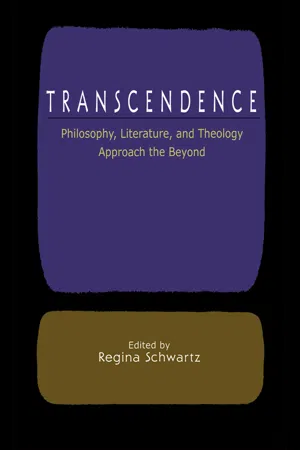
In Transcendence , thinkers from John Milbank, Graham Ward, and Kevin Hart, to Thomas Carlson, Slavoj Zizek, and Jean-Luc Marion have come together to create the definitive analysis of this key concept in modern theological and philosophical thought.
Information
1
A Place for Transcendence?
BY CHARLES TAYLOR
TRANSLATED BY DAMIAN TREFFS
I.
What is the place of transcendence in our societies today? We pose the question because we have the sense, and rightly so, that religion, instead of being at the center of society as it has been throughout the entirety of the course of human history, is often marginalized in the modern West.
We separate out three phenomena in this area that are often confused: a) Religion is no longer at the center of public life in contemporary democracies. In general, they are officially or semi-officially “secular.” b) In most of these societies, many people are no longer practicing; they do not attend church, and often describe themselves as “non-believers.” c) Whereas in the past it was very difficult not to believe, now it is often the reverse: for certain people, and in certain places, faith is difficult, seen as a hardly founded eccentric option.
Paul Valadier speaks of a “rupture in the transmission of faith between generations: …including, in many cases, the very opening to religious meaning, the minimal comprehension of what an act of faith consists in, the simple experience of the sacred, or God…. The understanding that faith is not pure nonsense, but rather a sensible and even exhilarating step is what is missing, and this because the transmission, not of Christian knowledge and custom alone, but of the act itself by which something is able to present itself in the religious universe, is lacking or no longer seems necessary for life and meaning.”1
For many people, the Christian religion is a black box; they have absolutely no comprehension of what takes place inside. How have we arrived at this state of affairs? What has happened between, say, 1500 and 2000 for such a reversal to have taken place? Before locating the place or places of transcendence in the actual world, it will be necessary to attempt to explain this change. In the first part of this paper, I would like to offer some reflections on the important developments which have made this possible.
1. The first, the most striking when one looks at the history of these last centuries, is the disappearance of the “enchanted” world. This expression seems a bit odd2; what I intend here is the opposite of Weberian “Entzauberung,” a word that served as the title for Gauchet’s famous work.3 An enchanted world is one in which we feel spirits, magical and spiritual forces in the things around us.
Our peasant ancestors would ring the church bells during a storm, the so-called “carillon de tonnerre.” It was believed that lightning, which of course threatens us, is guided by spirits, or spiritual forces; that the instruments and actions of the church also carry spiritual force, positive, beneficent, those that are capable of protecting us from the bad forces inhabiting the thunder.
Beliefs such as these are not dead today. A great many people would be quite ready to admit that, in this or that specific context, they are tempted to believe in such “occult” forces. But these beliefs no longer form a system [ne font plus système], are no longer shared by everyone; such that it no longer goes without saying that things can come to pass in this way in the world in which we live. This kind of spiritual force is no longer, phenomenologically, part of our experience of the everyday. To the contrary, when we look at the “official history” of our civilization, that is, from the point of view of science, this type of spiritual force or influence no longer exists for us.
What relation does this process of disenchantment have to the belief in God? There is a certain kind of mentality among non-believers which says that belief in God is nothing more than a function of this vision of an enchanted world. With the disappearance of the whole, the parts are also necessarily erased. But this is false, as the historians well know. Christianity, following Judaism, has had complex, and often hostile, relations with the enchanted world. In fact, the principal motor of disenchantment across the ages has been the Jewish and then Christian religions, the later intensified during the centuries following the Protestant and Catholic Reformations.
The relation is rather that for as long as we lived in an enchanted world, as long as we made the carillon de tonnerre ring, we felt that we were in a world full of threats, vulnerable, so to speak, to the many forms of black magic. In this world, for the majority of believers, God was the source of a positive force capable of defeating magic. God was the principal source of counter-magic, or white magic. He was the ultimate assurance that good would triumph in this world over the legions of evil spirits and forces.
In this world, that is, being deeply submerged in it, truly believing in it, it was practically impossible not to believe in God. To reject God is to give oneself over to the devil. A negligible minority of truly exceptional, or perhaps despairing, individuals may have rejected God during that time. But for the large majority, the question was not one of knowing whether one believed in God or not; the positive force was as palpable a fact as were the threats it thwarted. The question of faith is here played out in the register of confident-belonging, rather than that of accepting certain doctrines. One was, in this sense, closer to the situation of the gospels.
Now, the enchanted world/faith relation is thus: in that world, there was a certain impossibility of not believing in God, comparable in our day to a re fusal to believe in electricity. I have absolutely no doubt whatsoever that Hydro-Québec distributes electricity; that they will maintain the lines to my house, or successfully repair breakdowns, is another story. That is a question of whether I have confidence in them. But existential belief is not a problem.
Moreover, this impossibility of non-existence was a social fact. The channels of this power, its handling insofar as it was possible for human beings, passed through social institutions, primarily the church, at all levels. To make the carillon de tonnerre sound was an act of the parish, of its priest or the one in charge of the bells. The presence of God passed through the texture of the social, which created another form of the impossibility of non-belief: the defense against evil required the solidarity necessary for the handling of this positive force. To call on God’s intervention against the lightning is an act of the parish, and everyone must go along. Abstention is treason.
2. With the disappearance of the enchanted world, an important obstacle to non-belief disappears, so to speak. But there were others. In particular, there is one that was born with disenchantment itself. Because the Reform movements which dispelled the ancient world of spirits and forces were animated by a Christian faith, or, later, a deist vision, that governed a new world order that they instituted, this order followed God’s design, and made God present in another way. If He was no longer essential as a power in the field of forces and spirits, He became even more unavoidable as the architect, the guarantor, the designer of the cosmic as much as the social order. I will turn to the cosmic aspect shortly, but here let us look at the foundation of the United States in order to understand this new form of presence in society. For many of the founders, at issue was a new form of political society that would realize God’s plan. In this they followed the Puritan tradition which had viewed the new American colonies as opportunities to bring to fulfillment the will of God. The new Jerusalem would be “a city on a hill,” radiating all around, a source of light in the darkness.
For the leaders of the Revolution, divine Providence had foreseen a certain order of things. The famous words of the Declaration of Independence attest to this: “We hold these truths to be self-evident, that all men are created equal, [and] that they are endowed by their Creator with certain inalienable rights.” It was a matter of building a society that would put this into practice, and for the first time. It was a decidedly Protestant, or even Deist, milieu. For these individuals, God was not present in the sacraments, not to speak of relics, places of pilgrimage, or sacred gatherings. But He was incontestably present as the Will that they followed, and the moral force that made possible their obedience. He was no longer there in the Sacred, that is, as the intra-worldly concentration of divine power in certain particular objects (relics), actions (consecration), places (Jerusalem, St. James of Compostela), or times (Christmas, Easter); but He was present as the designing Will of the order in which they lived.
Now, it is possible to misunderstand this new form of presence because we are now in the habit of identifying revolution with a form of communal action for which human beings claim complete responsibility and where, therefore, there is no longer a place for God. Yet, while it is true that human responsibility is an integral part of the context of modernity, this does not necessarily exclude God.
If one compares the new American republic with a monarchy with its roots in the Middle Ages, in France, for example, the difference is apparent. Monarchy is never founded solely in the communal actions of its subjects; it is prior to them, and makes their actions possible. However, this framework itself supposes more than human activity. The kingdom is also a “mystical body”; the concrete actual king does not exhaust the kingdom. He is the representative of a superior reality that does not exist in profane, “secular” time, but in another more elevated time. This is the doctrine of the “king’s two bodies.”4
One could say that pre-modern societies were founded in a transcendent reality, in eternity or at least a superior time, beyond profane time, while modern states are founded through common actions in secular time, such as the Declaration of Independence, the Philadelphia Congress, and so forth. In this sense, humans have full responsibility. But this does not exclude God insofar as the plan that we follow in these actions comes from Him.
On the contrary, modernity has opened a new niche for the social presence of God. A society founded on a common action, such as a revolution or constituent assembly, requires a common definition anchored in a social imaginary. One could call this definition the political identity of a society. Yet, this identity can include an essential reference to God, such as in the case of the new American republic. We become “one nation under God.” God is thus anchored in the social imaginary. This constitutes a rather widespread phenomenon in the modern world. The national sentiment of a people, for example, can define itself in relation to a certain confessional membership; the Catholic church, the Polish, Irish, and French Canadians of long ago come to mind.
3. But these loyalties are not sempiternal; the case of the Quebecois brings this point forcefully home. In order to understand the actual world, it is necessary to see what has undermined this second form of the social presence of God. I would like to quickly evoke here three important changes.
First, the creation of an exclusive humanism, humanism excluding the transcendent. Very soon after the American Revolution, the French Revolution gave us the spectacle of a state’s founding on a plan that was no longer (for some at least) attributed to God, but to “Nature.” The transcendent was expressly excluded.
We are accustomed to taking this development for granted; for some, the simple unveiling of the truth of the human, for others, simple apostasy. But, to my mind, it has to do with an extraordinary turn, a surprising and, in certain respects, admirable, realization. How have human beings been able, after the centuries and millennia during which moral life was inconceivable without God or another transcendent reality, to conceive of their entire existence only in terms of immanence?
Without fully discussing this important question here, I do want to say that this realization comprises two facets. First, it was necessary to conceive a human good radically cut off from transcendence. What filled this role in the first place is the conception of a human moral order, derived from Locke and the modern Natural Law thinkers. Human beings pursue life, liberty, and happiness, each for himself. But God (or later, Nature) had fashioned humans to live together. They must associate in order to live well, but their association, fundamentally egalitarian and non-hierarchical, must be constructed such that one’s search for happiness causes no harm and is seen to contribute to the happiness of others. This vision of things is also at the root of our actual conception of universal human rights.
The second facet was more difficult still. It was necessary to reconceive human motivation in order to attribute to us the power to follow this morality without any help from a transcendent source. It is not merely divine grace which is excluded here; the Platonic recourse to the Idea of the Good, the Stoic reference to the divine Logos in us, each become redundant. The sources of morality, and even of the most exalted altruistic sacrifice, are found entirely within the realm of immanence.
The most important immanent sources of morality were: (a) Reason: as the ability to reach the level of universality, to distance itself from our relation to particularity, it allows us to conceive the universal, impartial good, and that gives us the power to realize it. Consider the importance accorded to the concept of the “impartial spectator” in Hutcheson, Adam Smith, and, later, the Utilitarians.
(b) Sympathy: an innate tendency, nature’s endowment, that pushes us to help our fellows, and that makes us fit to live spontaneously in the moral order discussed above. Rousseau is the great inspiration of this line of thought.
Now, what is surprising is not so much that we were able to invent theories of this kind, but that human beings became capable of building their lives out of these sources of morality. This is the extraordinary achievement. Though these sources, in the final analysis, proved to be inadequate, as any believer will admit, one would not deny that this is a difficult and admirable feat.
In any case, the creation of this exclusive humanism changes the entire situation. Henceforth, the social imaginaries of new societies can form themselves around these immanent points of reference. It might have to do with a metaphysical conception of “nature” as with the Jacobins; or we could even attempt to define political identity solely as a function of common interests, concrete and ideal. For individuals as well, a moral life without transcendental reference becomes a clear option.
4. The second important transformation—that is, the second in time—is the passage from the cosmos to the universe. To live in a cosmos is to exist in a world that is limited and structured by a plan, whether the framework is of Plato’s Ideas, or of Creation as described in the Bible (or, obviously, both, as ordinarily they are found together). In spite of our confusion and our ignorance of details, in spite of local appearances of disorder, one knows that the structure is there, holding up, and that arriving at the limit, one could touch it. Now, these are moral structures; that is, the plan is founded in the Good. The cosmos is related to our ethical life. Its message is profoundly positive.
The last two centuries have seen the effacing of this consciousness of the cosmos which has been replaced by the universe. This latter is vast, without imaginable limits, and does not immediately present itself as resting on a plan. If there is a structure, it would seem rather denuded of moral relevance. This universe seems above all indifferent to human life and its little drama that unfolds on the surface of a little planet, around an average star, situated in a galaxy like thousands of others.
We are dealing here with a change of theory, but again it involves more than just that. It is a change of imaginary, this time cosmic, that has come about in our civilization for a century or two. It is not merely that we know that the universe is many millions of years old, instead of the 6000 that our ancestors inferred—a bit hastily—from the Bible. It is also that we sense, when contemplating old rocks or glaciers, that it goes back to time immemorial. We sense that there is behind us what Buffon called “the dark abyss of time.”5 The abyss of time is dark because one cannot see to the bottom, that is, the beginning, as our ancestors thought they could, thanks to a Biblical account of creation taken in a spirit of naïve literalism. The early limit of their world, in a sense, was for them bathed in light. For us it is lost in darkness. And with this, it is also our genesis, from the non-human, or even the non-living, that is lost in the twilight.
This new cosmic imaginary plays in bo...
Table of contents
- Cover Page
- Title Page
- Copyright Page
- Introduction: Transcendence: Beyond
- 1: A Place for Transcendence?
- 2: The Birth of the Modern Philosophy of Religion and the Death of Transcendence
- 3: Philosophy and Positivity
- 4: From the Other to the Individual
- 5: The Betrayal of Transcendence
- 6: Othello and the Horizon of Justice
- 7: Unlikely Shadows: Transcendence in Image and Immanence
- 8: Transcendence and Representation
- 9: Blanchot’s “Primal Scene”
- 10: Kafka’s Immanence, Kafka’s Transcendence
- 11: Walt Whitman’s Mystic Deliria
- 12: Sublimity: The Modern Transcendent
- 13: The Descent of Transcendence into Immanence, or, Deleuze as a Hegelian
- Contributors
Trusted by 375,005 students
Access to over 1.5 million titles for a fair monthly price.
Study more efficiently using our study tools.
Frequently asked questions
Yes, you can cancel anytime from the Subscription tab in your account settings on the Perlego website. Your subscription will stay active until the end of your current billing period. Learn how to cancel your subscription
No, books cannot be downloaded as external files, such as PDFs, for use outside of Perlego. However, you can download books within the Perlego app for offline reading on mobile or tablet. Learn how to download books offline
Perlego offers two plans: Essential and Complete
- Essential is ideal for learners and professionals who enjoy exploring a wide range of subjects. Access the Essential Library with 800,000+ trusted titles and best-sellers across business, personal growth, and the humanities. Includes unlimited reading time and Standard Read Aloud voice.
- Complete: Perfect for advanced learners and researchers needing full, unrestricted access. Unlock 1.5M+ books across hundreds of subjects, including academic and specialized titles. The Complete Plan also includes advanced features like Premium Read Aloud and Research Assistant.
We are an online textbook subscription service, where you can get access to an entire online library for less than the price of a single book per month. With over 1.5 million books across 990+ topics, we’ve got you covered! Learn about our mission
Look out for the read-aloud symbol on your next book to see if you can listen to it. The read-aloud tool reads text aloud for you, highlighting the text as it is being read. You can pause it, speed it up and slow it down. Learn more about Read Aloud
Yes! You can use the Perlego app on both iOS and Android devices to read anytime, anywhere — even offline. Perfect for commutes or when you’re on the go.
Please note we cannot support devices running on iOS 13 and Android 7 or earlier. Learn more about using the app
Please note we cannot support devices running on iOS 13 and Android 7 or earlier. Learn more about using the app
Yes, you can access Transcendence by Regina Schwartz in PDF and/or ePUB format, as well as other popular books in Philosophy & Religious Literary Criticism. We have over 1.5 million books available in our catalogue for you to explore.