Physics for Animators
eBook - ePub

Physics for Animators

  1. 338 pages
  2. English
  3. ePUB (mobile friendly)
  4. Available on iOS & Android
eBook - ePub

Physics for Animators

About this book

Achieving believable motion in animation requires an understanding of physics that most of us missed out on in art school. Although animators often break the laws of physics for comedic or dramatic effect, you need to know which laws you're breaking in order to make it work. And while large studios might be able to spend a lot of time and money testing different approaches or hiring a physics consultant, smaller studios and independent animators have no such luxury. This book takes the mystery out of physics tasks like character motion, light and shadow placement, explosions, ocean movement, and outer space scenes, making it easy to apply realistic physics to your work.

  • Physics concepts are explained in animator's terms, relating concepts specifically to animation movement and appearance.
  • Complex mathematical concepts are broken down into clear steps you can follow to solve animation problems quickly and effectively.

Uniting theory and practice, author Michele Bousquet teaches animators how to swiftly and efficiently create scientifically accurate scenes and fix problem spots, and how and when to break the laws of physics. Ideal for everything from classical 2D animation to advanced CG special effects, this book provides animators with solutions that are simple, quick, and powerful.

Tools to learn more effectively

Saving Books

Saving Books

Keyword Search

Keyword Search

Annotating Text

Annotating Text

Listen to it instead

Listen to it instead

Information

Section 1
Classical Physics

In this section, we’ll go over basic physics concepts that apply to animation. Any motion in animation generally calls upon more than one physics concept at a time. But in order to use these concepts in concert with one another, you’ll need to understand the individual concepts and the terminology that goes with each one. If there are previously discussed topics that pertain directly to the subject, these are listed at the start of the section. This will enable you to review any topics necessary before you dive in.
Some concepts relate directly to the ā€œTwelve Basic Principles of Animationā€ put forth by Disney animators Ollie Johnston and Frank Thomas in their 1981 book The Illusion of Life: Disney Animation. These relationships will be noted as they come up.
fig0001

Chapter 1
Matter and Masses

Matter is a loose scientific term that refers to an object or substance. Anything you can see or touch is considered matter. How the substance behaves is determined, to a large degree, by the type of matter.
In plain English, the term mass means a blob or hunk of something, as in ā€œA giant mass fell from the sky and hit the shed.ā€ In physics, the term mass has a different meaning.
In this chapter, we explore matter and masses. Understanding these terms and how they relate to physics will help you understand later chapters.

Matter

There are, for the purposes of animation, three types of matter:
Solids—Anything that holds together on its own to form a particular mass or shape. Bowling balls, ice, and skin are all considered solids. Solids always retain the same volume, and don’t change shape unless a force is applied to them.
fig0002
Solids.
Liquids—A substance that takes the shape of its container, changes shape easily, and flows when moving. Liquids generally retain the same volume regardless of the container. Water, syrup, melted chocolate, and lava are all considered liquids.
fig0003
Liquids.
Gases—A substance that expands and spreads out to take the shape of its container and fill it up as much as possible, and changes volume as the container changes volume. Examples of gases are steam, oxygen, air, and propane gas.
fig0004
Gases.

Composition of Matter

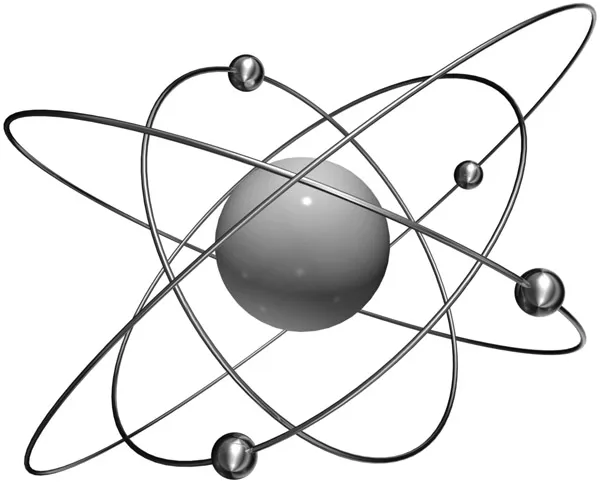
Physics tells us that all matter, whether solid, liquid, or gas, is made up of basic units called atoms. An atom is, theoretically, a tiny blob of matter surrounded by other blobs of matter that float around it. All the blobs have a sort of electrical charge associated with them that binds them together and keeps them from flying apart.
Because atoms are so tiny, we can’t see them the way we normally see objects, where light reflects offthe object and into our eyes. Only recently have we found ways to ā€œseeā€ atoms by using electric current to detect their movement patterns.
fig0005
To start off understanding atoms, you can think of an atom as a balloon with foam packing peanuts stuck to it. If you rub a balloon on your clothes, you cause a little bit of electrical charge to form on the balloon. If you move the balloon near some packing peanuts, the peanuts will lightly stick to the balloon due to electrical attraction.
fig0006
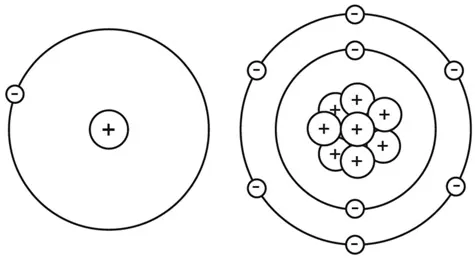
Each basic element on Earth has a unique blob configuration. Hydrogen, for example, has just one inner and outer blob. Oxygen has eight inner and outer blobs.
fig0007
Configuration of hydrogen (left) and oxygen (right).
No one really understands why electrical attraction works the way it does. We only know that it works. While the quantum physicists are hard at work trying to figure this out, no one knows for sure. But electrical attraction explains a bunch of other stuffthat scientists study, so they roll with it.
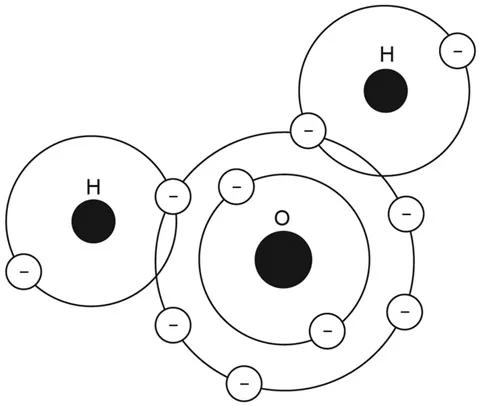
All substances are made up of different combinations of atoms. When the atoms get close together they share their outer blobs, which binds them together. For example, if you throw together one oxygen atom and two hydrogen atoms, you get pure liquid water, or H2O.
fig0008
H2 means two hydrogen atoms, single O means one oxygen.
When two or more atoms join together in a stable state, this is called a molecule. Two hydrogen atoms combine with an oxygen atom to form a water molecule.
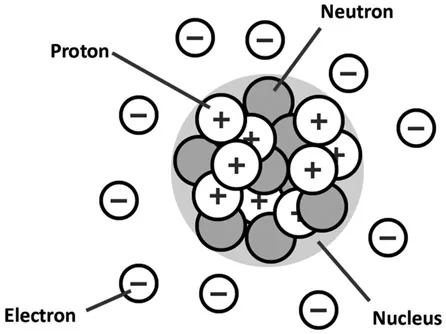
Now for some terminology. In an atom, the central blob is called a nucleus. The blobs floating around it are negatively charged electrons. The nucleus contains of a bunch of positively charged blobs called protons, which attract the negatively charged electrons. The nucleus also contains neutrons, which have no charge at all, but which work as a sort of atomic glue to keep the protons stuck to the nucleus.
fig0009
It’s not vital to memorize these terms, as long as you have an overall understanding of this most basic level of matter (and you know which page in this book to come back to should you need to refresh your memory). Electrons in particular are at the root of a lot of visually interesting phenomena like lightning and electricity. In this book, we go over electrons’ roles in more detail in pertinent chapters.

Atoms and Binding

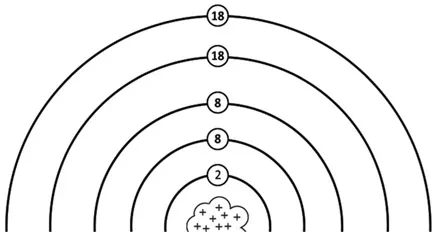
Atoms like to have their electrons arranged a certain way. In the innermost ring around the nucleus, they like to have two electrons. More electrons after that are arranged in another ring or shell outside the first, with at most eight electrons. The third level has at most eight electrons. Any levels outside that like to have at most 18 electrons.
fig0010
Most atoms are neutral, meaning they have the same number of protons as electrons. The number of neutrons can vary in neutral atoms, and is not always the same as the number of protons.
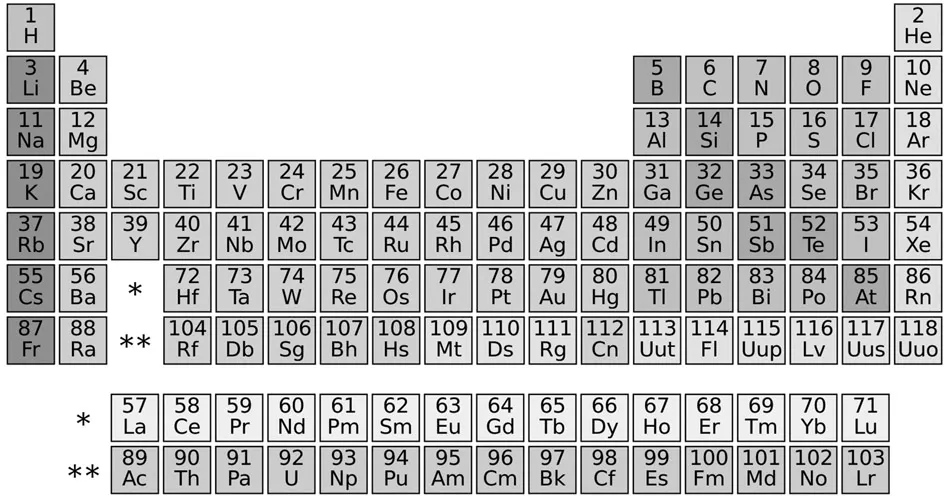
The Periodic Table of Elements organizes the elements in our universe according to how many protons each one has, and how many shells it has.
fig0011
Periodic Table of Elements.
If an atom’s outermost shell isn’t filled with the number of electrons it likes to have, it likes to find other atoms a...
Table of contents

  1. Cover Page
  2. Half Title page
  3. Title Page
  4. Copyright Page
  5. Contents
  6. Acknowledgements
  7. Foreword
  8. Introduction
  9. 1 Classical Physics
  10. 2 Character Design and Animation
  11. 3 Visual Effects
  12. Index

Frequently asked questions

Yes, you can cancel anytime from the Subscription tab in your account settings on the Perlego website. Your subscription will stay active until the end of your current billing period. Learn how to cancel your subscription
No, books cannot be downloaded as external files, such as PDFs, for use outside of Perlego. However, you can download books within the Perlego app for offline reading on mobile or tablet. Learn how to download books offline
Perlego offers two plans: Essential and Complete
  • Essential is ideal for learners and professionals who enjoy exploring a wide range of subjects. Access the Essential Library with 800,000+ trusted titles and best-sellers across business, personal growth, and the humanities. Includes unlimited reading time and Standard Read Aloud voice.
  • Complete: Perfect for advanced learners and researchers needing full, unrestricted access. Unlock 1.4M+ books across hundreds of subjects, including academic and specialized titles. The Complete Plan also includes advanced features like Premium Read Aloud and Research Assistant.
Both plans are available with monthly, semester, or annual billing cycles.
We are an online textbook subscription service, where you can get access to an entire online library for less than the price of a single book per month. With over 1 million books across 990+ topics, we’ve got you covered! Learn about our mission
Look out for the read-aloud symbol on your next book to see if you can listen to it. The read-aloud tool reads text aloud for you, highlighting the text as it is being read. You can pause it, speed it up and slow it down. Learn more about Read Aloud
Yes! You can use the Perlego app on both iOS and Android devices to read anytime, anywhere — even offline. Perfect for commutes or when you’re on the go.
Please note we cannot support devices running on iOS 13 and Android 7 or earlier. Learn more about using the app
Yes, you can access Physics for Animators by Michele Bousquet in PDF and/or ePUB format, as well as other popular books in Computer Science & Digital Media. We have over one million books available in our catalogue for you to explore.