- 236 pages
- English
- ePUB (mobile friendly)
- Available on iOS & Android
eBook - ePub
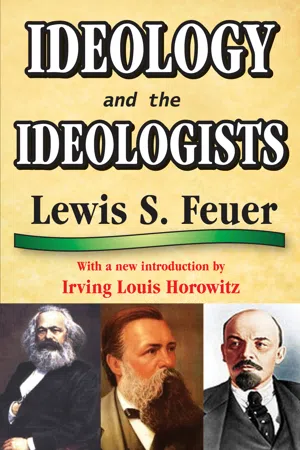
Ideology and the Ideologists
About this book
The revival of ideology, which began early in the second half of the last century, has led to reconsideration of the following questions: What underlies the pattern of the rise and decline of the ideological mode of thought? What leads young intellectuals to search for an ideology? What accounts for the changes in ideological fashion over time and nation, and shifts from one set of philosophical tenets to another? Who indeed are the ""intellectuals?""Studies of ideology have tended to range themselves for or against particular viewpoints, or have concerned themselves with defining perspectives. The purpose of this book is to examine the common causal patterns in the development of various differing ideologies. Feuer finds that any ideology may be said to be composed of three ingredients: The most basic and invariant is some form of Mosaic myth. Every ideology also has its characteristic philosophical tenets spreading from left to right, which conform to the cycle of ideas; and, finally, an ideology must be taken up by some section of the population who can translate it into action.Intellectuals in generational revolt find in some version of the ideological myth a charter and dramatization of their emotions, aims, and actions. Since each generation of intellectuals tends to reject its predecessors' doctrines, a law of intellectual fashion arises the alternation of philosophical doctrines. Ideology has inevitably made for an authoritarian presumption on the part of master-intellectuals and marginal ones and assumes their antagonism to objective truth and science. It is Feuer's contention that only when intellectuals abandon ideology in favor of science or scholarship will an unfortunate chapter in the history of human unreasonbe overcome.
Information
Chapter I
The Structure and Ingredients of Ideology
The end of ideology has been prophesied, but the longing for ideo logy is recurrent and strong. The aim of this essay is to explore the social and emotional sources for the recurrent waves of ideological thought, and the laws which underlie their combinations of doctrine.
I. The Three Ingredients in Ideology
To begin with, we must as chemists of ideas separate the ingredients of ideology. If we examine the ideologies which today attract in tellectuals, ranging from the varieties of Marxism, fascism, structuralism, Marcuseanism, Bakuninism, to African Negritude, and when to this inventory we add the classical ideologies of the nineteenth century, it becomes clear that every ideology (as a first approxima tion) is composed of three ingredients, the first, an invariant myth, the second, a compound of philosophical doctrines which alternate cyclically in the history of ideology, the third, a historically de termined decision as to a chosen class of the time. These three in gredients, an invariant mythological structure, an alternating set of philosophical tenets, and a historically determined chosen group are inherent in every ideology. To understand their workings is to understand the motivations and evolving modes of ideology.
2. The Mosaic Revolutionary Myth: The Invariant Ingredient
Every ideology in some fashion repeats the Mosaic myth,—the dramatic story of the liberation of the Hebrew tribes by Moses. The Mosaic myth is invariant through all ideological transforma tions. There are many themes of myth,—those of creation, the sexes, the rivalries of brothers, the origins of technology, societies, and languages. But the one which is the prototype for the ideologies of intellectuals is the Mosaic. Especially does it give ‘meaning’ to the lives of the younger generational intellectuals. The Mosaic myth can be stated in its most elemental form as a series of situations and incidents:
- (1) A people is oppressed;
- (2) a young man, not himself of the oppressed, appears;
- (3) moved by sympathy, he intervenes, and strikes down an op pressor’s henchman;
- (4) he flees, or goes into exile;
- (5) he experiences the call to redeem the oppressed people;
- (6) he returns to demand freedom for the oppressed;
- (7) he is spurned by the tyrannical ruler;
- (8) he leads the actions which, after initial defeats, overwhelm the oppressor;
- (9) he liberates the oppressed people;
- (10) he imparts a new sacred doctrine, a new law of life, to his people;
- (11) the newly liberated people relapse from loyalty to their his toric mission;
- (12) almost disillusioned, their leader imposes a collective discipline on the people to re-educate them morally for their new life;
- (13) a false prophet arises who rebels against the leader’s authoritarian rule, but he is destroyed;
- (14) the leader, now the revered lawgiver, dies, as he glimpses from afar the new existence.
The Mosaic myth is the drama of the young revolutionary intellectual. Moved by selfless idealism, by pure generosity (as he sees him self), he takes up the cause of the exploited; he suffers exile and im prisonment; but he leads his people to their historic victory; the people, however, are still slavish in their psychology, and incapable of realizing the new society; they require a preparatory period under a tutelary dictatorship; the revolutionary intellectual becomes their benevolent dictator; he quells factious elements; he dies, vouch-safed the sight of the new society, and living in the memory of his people. Thus Karl Marx in the wake of the defeat of the Revolution of 1848 wrote: ‘The present generation is like the Jews, whom Moses led through the wilderness. It has not only a new world to conquer, it must go under, in order to make room for the men who are fit for a new world.’1 Thus the adolescent Ferdinand Lassalle, fifteen years old, felt the stirrings of the Mosaic calling which he would later trans-mute into a more secular equivalent, the vocation of the revolution-ist: ‘Oh, when I yield to my childish dreams, it has always been my favorite idea to see myself sword in hand, leading the Jews to make them independent.’ Ferdinand was ready to con front the scaffold itself could he but make the Jews a ‘respected people’; he writhed in anger that the Jews humiliated in Damascus did not rise in revolt, and if necessary, ‘meet death with their tor mentors’.2 The German Socialist leader, Wilheim Liebknecht, wrote: ‘It was the God of the Jews, Jehovah, and the Jewish heroes, with the Maccabees at their head, who impelled Cromwell to fight for liberty—whereas no war was ever waged in the name of Christi anity for the liberation of peoples, but rather for their subjugation. The only country where the struggle for the liberation of the people has borne a religious character is England—and in England it was not the New Testament, but the Old, which furnished the moral strength for the struggle.’3 In the United States the Abolitionist-ideologist white colonel of a black regiment, the idealistic Harvard intellectual, Thomas Wentworth Higginson returning from the Civil War felt they had passed ‘through a Red Sea which no one would have dared to contemplate’, and ‘attained the Promised Land by the sublimest revenge . . .’4 America’s most famous Communist advocate, Lincoln Steffens, wrote a whole book Moses in Red to show that Exodus was the classical model for all revolutions with Jehovah personifying nature, and ‘Moses as the uncompromising Bolshevik’; the Mexican and Russian revolutions, he asserted, fol lowed the Mosaic pattern in evolving into autocracies.5 The mytho logical ingredient is essential to ideologies; without it their historical use and attractive power cannot be understood. It is altogether in adequate to define an ideology, as Talcott Parsons does, as ‘a body of ideas that is at once empirical and evaluative’ with respect to the states of a social system.6
An essay in economics which set forth the causes of unemployment, and then outlined the measures to be taken to alleviate them, on the stated assumption that material want, insecurity, and enforced idleness were evils, would scarcely be re garded as ideological. What is distinctive in ideology is the drama it sets forth as the ‘meaning’ of the historical process, together with its assignment of the roles of leadership elite, chosen-class, and historical culmination. There is no dualism of fact and value in ideology but only because both are transfigured (and aufgehoben) in myth.
Sometimes the Mosaic myth grates on the socialist in a mood for economic realism and straightforward sense. Thus Bernard Shaw complained in 1896: ‘Socialism wins its disciples by presenting civilization to them as a popular melodrama, or as a Pilgrim’s Progress through suffering, trial, and combat against the power of evil to the bar of poetic justice with paradise beyond; . . . with the fullest conviction that we have attained a Pisgah region far above such Amalekitish superstitions.’7 But without the drama, and the Mosaic role of leadership, even if it fails to take one beyond Mount Pisgah to the Promised Land itself, in short, without ideology, socialism would be devoid of intellectual disciples.
3.The Jacobic Myth of the Elect
The vocabulary of ideology always includes such words as ‘mission’ or ‘vocation’. The historic ‘mission’ of the intellectuals, for instance, as it is conceived from Lenin to Marcuse, with their forebear in Plato, is to bring communist ideology to the ordinary people, and then to serve as philosopher-kings. A second type of myth, which we might call the Jacobic myth, is interwoven with the Mosaic; what it does is to explain or justify the ‘mission’ conferred on the intellectuals. Some Biblical myths revolve around the theme: who will inherit the birthright? who will have the father’s blessing? Thus Jacob conspires (with his mother’s aid) to deprive his brother Esau of the birthright, for it will decide who will be chosen among the peoples. Thus Joseph’s brothers hated him for they saw he was his father’s favorite. Jacob and Joseph preeminently were ‘intellec tuals’ as compared to their brothers; Joseph, the interpreter of dreams, the planner for the reorganization of the Egyptian agricul tural economy, felt the vocation to rule. The Jacobic myth, too, invariant in all ideologies, evokes deep strains in the unconscious,— all the longings and anxieties of the child to be the favorite of its father. The theme echoes in children’s fairy tales; Cinderella, re jected by a stepmother, but chosen by a surrogate fairy godmother, like the voice of history, is a figure beloved by children because she embodies their sadnesses and hopes. And when ideologies, the continuators of myth, assure intellectuals that they are the bearers of a unique historic mission, the latter feel like favored children. Their quarrel with history is appeased; they will be the most indulged, the most favored. The Jacobic myth narrates simply:
- (1) There was a father with several sons;
- (2) the sons contended for the father’s blessing, which would de termine their place in the world’s hierarchy in future times;
- (3) the intellectual son, the younger, is forced by his brothers to undergo ordeals;
- (4) the intellectual, younger son secures the historic birthright.
Whereas the Mosaic myth is one of revolt against the Pharaoh, the established order, the Jacobic myth clarifies the nature of the historic mission; the intellectual favored son is fulfilling the mandate of a Higher Established Order. The revolutionary son is exculpated, for he is indeed the most conservative, the most obedient to the primal mandate. The primary content of the Mosaic myth is revolt against injustice; that of the Jacobic myth is the emergence of a new elite, or new class, in the political cosmos.
4. The Mosaic Myth Among the Classical Ideologists
Through the permutations of ideology, the components of the Mosaic myth repeat themselves. Marx, averring in his youth: ‘The emancipation of Germany will be an emancipation of man. Philo sophy is the head of this emancipation and the proletariat is the heart,’ was casting the philosophers such as himself in the role of Mosaic redeemers.8 Bakunin with his vision of 40,000 student-intellectuals, guided by himself, and leading the ‘uncivilized’ Russian peasantry to revolutionary triumph was assigning different values to the same structural equation.9 Leon Trotsky varied the vocabulary somewhat, and wrote of the Bolsheviks as the Jesuit elite of the socialist movement.10 But when the Russian masses acquiesced to the rule of a new idol, the Soviet autocrat Stalin, Trotsky finally asked at the end of his life, as Moses had asked of the Hebrew ex-slaves, whether perhaps he had overestimated the psychological capacities and the historical heroism of the proletariat;11 the latter, singularly impervious to their presumable historical mission were like actors indifferent to the play in which they have been cast, and finding the ambitious playwright a tedious fellow.
During the last decade, ideologists beginning with C. Wright Mills have given a fresh version to the Mosaic myth; they have per ceived the intellectuals as clearly called upon by history to make the revolution, abetted by their allies located among the ...
Table of contents
- Cover Page
- Half title
- title
- copy
- dedication
- Table of Contents
- Introduction
- Preface
- CHAPTER I. THE STRUCTURE AND INGREDIENTS OF IDEOLOGY
- CHAPTER II. THE PHILOSOPHICAL TENETS IN IDEOLOGY: THE LAW OF WINGS AND THE LAW OF ALTERNATION
- CHAPTER III. THE GENERATIONAL BASIS FOR IDEOLOGICAL WAVES
- CHAPTER IV. THE TRAITS OF THE IDEOLOGICAL MODE OF THOUGHT: LOGICAL AND PSYCHOLOGICAL
- CHAPTER V. IDEOLOGY AND SOCIETY
- CHAPTER VI. IDEOLOGISTS, PROPHETS, AND INTELLECTUALS
- BIBLIOGRAPHICAL NOTE
- INDEX
Trusted by 375,005 students
Access to over 1.5 million titles for a fair monthly price.
Study more efficiently using our study tools.
Frequently asked questions
Yes, you can cancel anytime from the Subscription tab in your account settings on the Perlego website. Your subscription will stay active until the end of your current billing period. Learn how to cancel your subscription
No, books cannot be downloaded as external files, such as PDFs, for use outside of Perlego. However, you can download books within the Perlego app for offline reading on mobile or tablet. Learn how to download books offline
Perlego offers two plans: Essential and Complete
- Essential is ideal for learners and professionals who enjoy exploring a wide range of subjects. Access the Essential Library with 800,000+ trusted titles and best-sellers across business, personal growth, and the humanities. Includes unlimited reading time and Standard Read Aloud voice.
- Complete: Perfect for advanced learners and researchers needing full, unrestricted access. Unlock 1.5M+ books across hundreds of subjects, including academic and specialized titles. The Complete Plan also includes advanced features like Premium Read Aloud and Research Assistant.
We are an online textbook subscription service, where you can get access to an entire online library for less than the price of a single book per month. With over 1.5 million books across 990+ topics, we’ve got you covered! Learn about our mission
Look out for the read-aloud symbol on your next book to see if you can listen to it. The read-aloud tool reads text aloud for you, highlighting the text as it is being read. You can pause it, speed it up and slow it down. Learn more about Read Aloud
Yes! You can use the Perlego app on both iOS and Android devices to read anytime, anywhere — even offline. Perfect for commutes or when you’re on the go.
Please note we cannot support devices running on iOS 13 and Android 7 or earlier. Learn more about using the app
Please note we cannot support devices running on iOS 13 and Android 7 or earlier. Learn more about using the app
Yes, you can access Ideology and the Ideologists by Howard Rosenthal,Lewis S. Feuer in PDF and/or ePUB format, as well as other popular books in Politics & International Relations & Political Ideologies. We have over 1.5 million books available in our catalogue for you to explore.