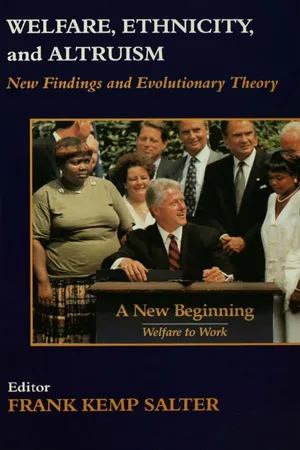
Welfare, Ethnicity, and Altruism applies the controversial theory of 'Ethnic Nepotism', first formulated by Irenäus Eibl-Eibesfeldt and Pierre van den Berghe, to the modern welfare state (both are authors in this volume). This theory states that ethnic groups resemble large families whose members are prone to cooperate due to 'kin altruism'. Recent empirical findings in economics and political science offer confirmatory evidence. The book presents two separate studies that compare welfare expenditures around the world, both indicating that the more ethnically mixed a population becomes, the greater is its resistance to redistributive policies. These results point to profound inconsistencies within ideologies of both left and right regarding ethnicity.
- 368 pages
- English
- ePUB (mobile friendly)
- Available on iOS & Android
eBook - ePub
About this book
Information
1
Introduction: The Symposium Target Paper in Broader Context
Frank Kemp Salter
Introduction
Is welfare less generous in multi-ethnic societies than in relatively homogeneous ones? Does a society’s ethnic heterogeneity alli’ct its foreign aid expenditure? Should such effects exist, can evolutionary theory help explain them? Which policy implications, if any, can be drawn from these effects and their evolutionary interpretation? These were the questions posed to a leading group of social scientists at the symposium ‘Welfare, Ethnicity and Altruism: Bringing in Evolutionary Theory’, hosted by the Werner Reimers Foundation in Bad Homburg, Germany, 10-13 February 1999. The resulting discussion raised additional themes of economic growth, social conflict, social capital, affirmative action, multiculturalism, globalization, and population, all discussed in this volume. Clearly the relationship between welfare and ethnicity has profound ramifications, yet is poorly understood, even by political thinkers on the Left concerned about preserving caring, inclusive societies and protecting the environment.1
The symposium was organized around questions posed in a target paper reproduced below. In the target paper I argued for a link between ethnic heterogeneity and declining welfare. The argument was based on an evolutionary interpretation of a wave of recent findings by economists, political scientists and sociologists. I argued that the decline in welfare rights observed in multi-ethnic states is due to a decline in public altruism; the willingness of citizens to aid strangers. Public altruism declines. I suggested, when fellow citizens are perceived to belong to different ethnic groups, so that the society at large is no longer identified with one’s own ethnic group. People appear, and are, less familiar to one another, and this loss of familiarity, including shared ethnicity, elicits less altruism than found in homogeneous societies.
The majority finding of the chapters in this book support the target hypothesis. The theory responsible for this success was drawn from the research of Irenaus Eibl-Eibesfeldt and Pierre van den Berghe, both present Eibl-Eibesfeldt and Pierre van den Berghe, both present in this volume. The ethological and sociobiological theories that these scholars have (respectively) developed converge on the view that ethnic solidarity is due to individuals conceiving of their ethnic groups as extended families – an ethnic form of familiarity. Ethnic groups do resemble families, primarily because they are descent groups but also because they often have characteristic gene frequencies that distinguish them from other ethnic groups. Shared descent is culturally marked by traditions of language, dress, and religion that are passed on within families and the broader community. It can also be marked physically by racial and familial resemblances. The possession of these ethnic group-markers facilitates the development of public altruism; a willingness to share resources to some extent with citizens at large. As ethnic heterogeneity increases, society resembles less and less an extended family due to accumulating cultural and racial differences. As a result, public altruism declines across the society as a whole, but survives within ethnic groups.
In this introductory chapter, I restate the target paper before making some additions to data and theory. In the target paper, I assumed that welfare depends on altruistic motivation towards recipients on the part of voting taxpayers. That assumption is not wholly true. While the evidence reported in the following chapters indicates an altruism effect, there are undoubtedly other important factors, sociological and economic, influencing welfare. The target paper can also be improved upon by distinguishing redistributive from non-redistributive public goods and intermediate types, a point made by Sanderson and Vanhanen in their joint chapter.
The target thesis finds points of resonance with mainstream political theory of welfare, as I set out more fully in Chapter 15. Political philosophers Michael Walzer and David Miller both apply the family analogy to the welfare state. Political scientist Gary Freeman argued in the 1980s that because welfare relies on a sense of kinship, open borders inevitably degrade welfare rights. In their classic Regulating the Poor: The Functions of Public Welfare,2 Frances Piyen and Richard Cloward conclude that ethnic divisions have kept the American welfare state weak. On the practical side of politics, New York Governor Mario Cuomo proclaimed the ‘family of America’ in arguing for generous welfare policies in the 1984 United States presidential elections. However, until recently these interpretations have lacked much hard data on how ethnic diversity affects public altruism, including welfare, both in the United States and elsewhere. The studies conducted for this volume contribute to the growing empirical support for these views, as well as fresh theory in the form of postulated evolutionary mechanisms.
The symposium’s findings contribute to knowledge of how ethnicity affects modern mass society in the political and economic realms, and how best to manage these impacts. It is important to know that persistent ethnic diversity generates costs as well as acknowledged benefits such as increasing cultural and culinary variety. Those costs are considerable. As documented in the following chapters, they include a tendency to lower redistributive welfare and charity, to increased collective violence, to lower economic growth in economies most in need of it, and to lower foreign aid. Ethnic diversity also tends to reduce the efficiency of government and the fairness of policing, damage social capital in the form of public trust and commitment to the community, and raise levels of inequality and corruption.
The Original Target Paper
Evolutionary theory predicts that altruism should be stronger within ethnic groups than between them.3 This is hardly a controversial view with regard to the negative side of ethnic relations, especially violent conflict, in light of the ravages of nationalist wars and, more generally, the long history of inter-ethnic discord;4 but the theory has not been systematically extended to the quieter, yet significant, positive side of ethnicity – communal solidarity. By focusing on violent conflict and the concomitant opposition between in-group affiliation and out-group hostility, ethnic research has tended to overlook grades of altruism and the effect of such gradations on social processes. Welfare politics and economics are promising areas in which to discover and examine differential altruism. From an evolutionary perspective, welfare systems should be easier to develop and maintain in ethnically homogeneous societies than in more heterogeneous ones; mono-ethnic welfare states should be more generous than multi-ethnic ones.
The evolutionary prediction fbllows from kin selection theory, which interprets the behavioural universal of nepotism to be a product of the evolutionary history of altruism. In that theory, the rigour of natural selection meant that altruism – including the unreciprocated giving of resources to another individual was only viable when practised between close kin.5 Some theorists argue that group selection mechanisms have also shaped human altruism.6
According to van den Berghe,7 who coined the term ‘Ethnic Nepotism Theory’ in 1981, ethnic groups develop solidarity when they come to think of themselves as families. This makes sense from van den Berghe’s kin-selection perspective, Inn also fits with classical, ethological theory as expounded by Eibl-Eibesfelch who, as early as 1970,8 observed that national solidarity is based on family feeling. A similar point is made by Horowitz9 in his major 1985 treatment of ethnic conflict. Horowitz concurs with van den Berghe and Eibl-Eibesfeldt (though without referencing them) that ethnicity is based on a ‘family resemblance’; that kinship is crucial to understanding the central role of family structure in determining ethnic identity and in explaining the intensity of ethnic conflict.
Of course, the genetic relatedness of ethnic groups is greatly diluted compared with that of families. Nevertheless, two randomly chosen members of the same ethnic group share, on average, more genes than they do with members of other groups. Depending on circumstances, it might be adaptive for an individual to make sacrifices fir a large number of co-ethnics, if the result is an increase in the altruist’s genetic representation in the meta-population. Ethnic kinship is too weak to justifY (i.e., pay-off in genetic fitness) significant altruism between individuals. Consistent with this evolutionary logic, ethnic solidarity is most likely to become a strong determinant of interpersonal relationships following indoctrination and manipulation by rituals, symbols and ideologies that generalize familial loyalties to larger populations.10 The critical role of culture does not alter our species’ basic motivational repertoire, and ethnic nepotism theory proposes that the motivational basis of ethnic loyalty is nepotism, a phylogenetically old adaptation. This is consistent with the role of cultural ‘recognition markers’ such as language and religion in demarcating groups, and the salience of racial markers as opposed to cultural ones. Due to this group-level nepotism, individuals are more willing to invest resources and emotions in the whole group.11 The group selection version overlaps a good deal with ethnic nepotism theory in positing the importance of group-markers, but de-emphasizes the importance of biological markers. Both approaches posit a major role for cultural factors in defining group boundaries and level of solidarity. Thus, evolutionary thinking about ethnic relations and social behaviour in general is converging on constructionism, albeit a non-relativistic and biologically infbrmed version that has been called ‘social technology theory’:12.
A related line of evolutionary analysis has been to identify cross-cultural universals underlying human social systems. Disciplines closely connected to the behavioural level, such as human ethology, biological anthropology, and evolutionary psychology, have uncovered social universals resistant to cultural and historical changes.13 Although all social systems rest on behavioural universals at the micro-level, they are strongly influenced by macro-level processes such as cultural evolution, economic forces and social planning. The interdependence of micro- and macro-causes means that the evolutionary perspective should be included as a valuable heuristic in discovering more cross-cultural principles underlying complex socioeconomic phenomena.14 In the case of welfare systems, despite a considerable degree of cultural determination of attitudes and behaviour, some important biological principles may operate.
I noted above that ethnic behaviour is sensitive to cultural influence. Many features of modern culture, such as urban living, mass entertainment and news, are artificial when compared with the small-groups social environments in which humans evolved. In artificial environments it is possible for individuals to consistently behave in maladaptive ways, i.e., in ways that do not promote the reproduction of their genes. Examples are easy to find, and include the large death tolls of soldiers and civilians in industrialized warfare and the disability and mortality resulting from drug addiction. In today’s world, indoctrinability for patriotism15 can in principle pay-off genetically, but the predisposition to ethnocentrism is a far less secure guide to genetic interests than in the environment of evolutionary adaptedness.16
The related theoretical issue to be considered in the symposium is whether evolved mechanisms of ethnocentrism are successfully circumvented by existing welfare institutions.
Consider the case of the United States. The failure of the Clinton initiative on health care to reverse the continued decay of the United States’ public health system17 and the general weakness of American welfare rights stand in sharp contrast to mature European comprehensive welfare systems which, despite recent pressures, are still supported by great majorities in those societies. Political scientist, M. Gilens, has found that in the United States, cross-racial transfers are a major roint of resistance to taxation to support means-tested welfare payments.18 Gilens’ survey-based analysis confirms the thesis advanced by political theorists that racial divisions in the United States have distorted and subverted attempts to construct a European-style welfare state.19 Extensive welfare rights emerged from political struggles and decisions made within ethnically homogeneous states such as France, Germany and Sweden.20 Given the shifting ethnic and racial balance in Western societies, a relevant question now is whether the decline of homogeneity will spell the curtailment of those rights. Emerging research findings indicate this to be a likely outcome. A comparison by sociologist T. Faist21 of US and German welfare politics finds that nationalist-populist reaction to large-scale immigration has led to the polarization of views towards welfare along ethnic and racial lines, and has contributed to the decline of welfare expenditure in both countries. Ethnic and racial diversity present opportunities for nationalist-populist politicians who would deny welfare rights to out-groups. The same diversity appears to be an obstacle for cosmopolitan-liberal politicians who seek a more inclusive and generous welfare system, Faist argues. Further evidence in this direction comes from economic research. A recent multi-city study of municipal spending in the United States analysed the correlation of ethnic dive...
Table of contents
- Cover Page
- Half Title Page
- Series Page
- Title Page
- Copyright Page
- Dedication
- Contents
- List of Figures
- List of Tables
- Notes on Contributors
- Acknowledgements
- Preface
- Series Editor's Foreword
- 1. Introduction The Symposium Target Paper in Broader Context
- Part I Does Ethnic Heterogeneity Depress Public Altruism in Multi-Ethnic Societies?
- Part II Welfare Broadly Defined Ethnic Heterogeneity and Economic Growth
- Part III Explanation and Prediction Does Evolutionary Theory Help?
- Part IV Ethical and Policy Implications
- Index
Trusted by 375,005 students
Access to over 1.5 million titles for a fair monthly price.
Study more efficiently using our study tools.
Frequently asked questions
Yes, you can cancel anytime from the Subscription tab in your account settings on the Perlego website. Your subscription will stay active until the end of your current billing period. Learn how to cancel your subscription
No, books cannot be downloaded as external files, such as PDFs, for use outside of Perlego. However, you can download books within the Perlego app for offline reading on mobile or tablet. Learn how to download books offline
Perlego offers two plans: Essential and Complete
- Essential is ideal for learners and professionals who enjoy exploring a wide range of subjects. Access the Essential Library with 800,000+ trusted titles and best-sellers across business, personal growth, and the humanities. Includes unlimited reading time and Standard Read Aloud voice.
- Complete: Perfect for advanced learners and researchers needing full, unrestricted access. Unlock 1.5M+ books across hundreds of subjects, including academic and specialized titles. The Complete Plan also includes advanced features like Premium Read Aloud and Research Assistant.
We are an online textbook subscription service, where you can get access to an entire online library for less than the price of a single book per month. With over 1.5 million books across 990+ topics, we’ve got you covered! Learn about our mission
Look out for the read-aloud symbol on your next book to see if you can listen to it. The read-aloud tool reads text aloud for you, highlighting the text as it is being read. You can pause it, speed it up and slow it down. Learn more about Read Aloud
Yes! You can use the Perlego app on both iOS and Android devices to read anytime, anywhere — even offline. Perfect for commutes or when you’re on the go.
Please note we cannot support devices running on iOS 13 and Android 7 or earlier. Learn more about using the app
Please note we cannot support devices running on iOS 13 and Android 7 or earlier. Learn more about using the app
Yes, you can access Welfare, Ethnicity and Altruism by Frank Salter in PDF and/or ePUB format, as well as other popular books in Politics & International Relations & Political Economy. We have over 1.5 million books available in our catalogue for you to explore.