eBook - ePub
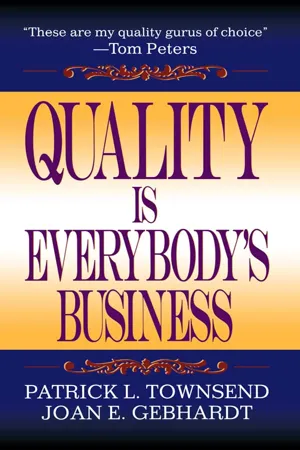
Quality is Everybody's Business
- 392 pages
- English
- ePUB (mobile friendly)
- Available on iOS & Android
eBook - ePub
Quality is Everybody's Business
About this book
Done correctly, Total Quality Management (TQM) will increase your profits and preserve your resources, make your customers and employees happy, and it is the ethical thing to do. The key, of course, is to do it right. Unfortunately, when quality efforts fail to fulfill their potential, business leaders begin to doubt the efficacy of making the pursuit of quality a primary organizational priority.
The most consistent mistake: starting small and implementing only part of the plan. Examples of partial efforts ending in disappointment or disaster abound. As a result, the only thing "total" about TQM processes has been the level of frustration. Quality is Everybody's Business makes it possible for people at all levels of your organization to understand the underlying theory and the specific mechanics of continual improvement.
In an easy-to-read style, the book shows you how to untangle seemingly complex theory into guidelines for everyday managing and leading. The authors provide a comprehensive presentation of the practical details and the reasoning behind defining, implementing, and maintaining a 100% employee involvement process. Taken as a whole, the articles presented in this book address the theory and the practice of TQM in an integrated manner.
Once your customers experience quality, they will continue to look for the quality option. Done correctly, TQM can be defined and implemented in six-to-eight months - and that includes actively involving everyone on the payroll in the process and seeing positive bottom line results virtually immediately. Whether your organization has a TQM process in place or is just beginning to implement one, Quality is Everybody's Business gives you the tools to make it a complete quality process.
4
IF THEY CAN DO IT…
The Military as a Benchmark
The Paul Revere Process
Industry-Specific Examples
In large part because a quality process, when done correctly, involves every person in an organization and, subsequently, affects the lives of every person in that organization, there are almost as many aspects to it as there are to the human personality. Quality, like a tapestry, is woven of many threads. Any insight that illuminates how to make relationships between individuals—or between individuals and groups or between groups and groups—more productive contributes to the final design.
This section contains examples of how specific organizations have mobilized people for action. The first three articles focus on leadership in the United States military and explore the application of the principles to business. The next four detail the first five years of the Paul Revere “Quality Has Value” process. Closing the section are four articles that look at quality in specific settings: health care, communications and computers, software, and the United States Marine Corps.
9
THE MILITARY AS A BENCHMARK
The concept of a “benchmark” in the context of a quality process was introduced to the American business vocabulary by the Xerox company, winner of a Baldrige Award in 1989. Aware that their company did not handle telephone calls particularly well, Xerox (makers of duplicating machines) visited L.L. Bean (providers of casual clothes) to learn from L.L. Bean’s much lauded telephone procedures. The company then adapted the “best practices” they observed to its own operation, a decision which was a key factor in their back-from- the-brink-of-disaster recovery in the late 1980s.
The military, especially the military of a democracy, can likewise serve as a source of information on leadership. This one skill, leadership, can be studied in isolation. With appropriate adaptations, without having a mission in any way similar to the military, best practices can be introduced into an organization looking for ways to improve.
The first article, “Leadership: An Ancient Source for a Modern World,” was originally printed as one of a trilogy. The other two—”Participation: Starting with the Right Question” and “Measurement: Neither a Religion nor a Weapon”—can be found in Chapters 4 and 5 respectively. The eleven Leadership Principles included in this article are an excellent example of the transferability of techniques from the military to the business environment.
“The Three Priorities of Leadership” focuses on a consideration often overlooked in civilian organizations. Like so much of quality, the concept is simple: You must consciously set priorities. The execution, however, is difficult since all three principles are defined by the US Army. The leadership principles included in the other two articles in this chapter are those spelled out by the U.S. Marine Corps.
“What Military Can Teach Business About Leadership” introduces an insight that may catch some readers off-guard: Leadership is a subset of love. The eleven Leadership Principles introduced in the first article in this chapter reappear, this time matched with eleven Principles of Love.
_________LEADERSHIP: AN ANCIENT SOURCE FOR A MODERN WORLD
Virtually everything written on the topic of quality addresses at least one of three themes: leadership, participation, or measurement. Each is important in unique ways, but they have one thing in common. Together they contribute directly to the goal of all quality improvement: customer satisfaction. This article begins a series of three that will present what might be considered controversial looks at each area, beginning with leadership—where all quality must begin.
Among the traits that we admire in our leaders is the willingness to assume risk. Often left undefined, however, is the nature of the risk. We fail to differentiate between those times when a leader puts another’s assets at risk—whether money or prestige or ego—and when a leader puts personal assets at risk. There is a difference; and in failing to differentiate, we short-change the concept of leadership. It isn’t all that tough to put someone else’s money or future in jeopardy, as legendary executives have proven repeatedly. Only when a top level manager is willing to put himself or herself at risk—their ego as well as their funds—is true leadership approached.
What criteria define the difference? It’s more than identification with the success of a project. It’s more than mastering a set of skills. It’s an ephemeral combination of both caring and competence, beginning with knowing what to care about and when, how to direct and how to get out of the way. It’s about people both in the singular and the collective. It’s subtle and it’s simple.
Perhaps a good place to start would be to look at the difference between management and leadership. That much, at least, is straightforward: managers care that a job gets done; leaders care that a job gets done, and they care about the people who do the jobs.
It’s not a fluke that organizations are recognizing how important good leadership is to quality. Quality requires leadership—not management. Management is a subset of leadership in the same way that productivity is a subset of quality. Only the largest concepts produce the maximum results. Only when someone is ready and willing to incorporate courage and judgment, emotion and continual personal growth in their understanding of the task ahead can he or she move from management to leadership—or from productivity to quality.
Having defined leadership as more than mastering a set of skills, it is time to backtrack and say that mastering a set of skills isn’t a bad place to start. Unfortunately, a growing library of books on the topic of leadership urge business men and women to move from manager to leader without any attempt at skill building. These leadership books are biographical in nature, either fullblown descriptions of the life and times of a single person or collections of biographical sketches of men and women commonly accepted as leaders. They are not the best way to learn to do the job yourself.
Starting a study of leadership with such personality-dependent books is like asking someone to hone his abilities to perform a task from looking at the results of another’s efforts. Imagine, for instance, that you happen to wake up at 3:00 AM with the determination to become an expert (despite a total lack of knowledge) on the topic of physics and, indeed, to become a world-class physicist. Suppose further that, upon searching your random collection of books, two possibly relevant books are found: a high school text on physics and a biography of Albert Einstein. While the biography of Einstein might increase your desire to emulate the man, the textbook would provide you with the opportunity to begin to measure your aptitude for physics. Admiring Einstein is not enough.
That is why we are suggesting a text on basic leadership that may at first seem outrageous. At the very least, it will run counter to more than a few, possibly cherished, stereotypes. One profession, and one profession only, has formally studied the topic of leadership for at least 2500 years and has made a practice of transferring that knowledge to 18 year olds. The theory has been tested in a series of experiments where the penalty for error has been quick and severe. The results have been meticulously recorded and are a matter of public record. Even so, as a source of leadership techniques, this knowledge is virtually untapped.
The profession is the armed forces. What follows is a synopsis of several offerings on military leadership that appear in our book Quality in Action.
Conceding the stereotype immediately, when many people hear the phrase “military leadership,” they quietly write it off as an oxymoron. “Military leadership” and “authoritarianism” are synonymous in many minds. When dictatorial practices in the military are trumpeted across headlines, it is well to remember that it is the unusual that gets reported—that’s why it’s newsworthy. Like so many stereotypes—the idea that all females are incapable of being high-level executives comes to mind—it is a stereotype built on the well-publicized failures of the few, rather than successes of the many.
The reality is somewhat different. At its best, military leadership is caring, participative, and lean. It relies on trust and purposeful delegation of authority to the lowest appropriate level. It is, in fact, a valuable resource for anyone intent on initiating or strengthening a quality process.
It is also easily accessible. Two of the best American examples are the United States Army’s Field Manual 22–100 and the United States Marine Corps’ Guide book for Marines. Both texts are public documents; both are written in clear language, what is sometimes called “standard prose.” You will find counterparts of these manuals in virtually every country in the world.
What’s in the manual? For one thing, refutation of the stereotype that the military accepts behavior in its leaders that civilians would never tolerate. FM 22–100 is quite clear on this point:
“Some people think that a leader is using the directing style when he yells, uses demeaning language, or threatens and intimidates subordinates. This is not the directing style. It is simply an abusive, unprofessional way to treat subordinates.”
The text recognizes that there are legitimate uses of the authoritarian or directing style of leadership when practiced with courtesy and clarity. It is a valid and appropriate style when three conditions prevail: you are out of time, you have all the information you need, and your people have high morale. The reason your people have high morale, of course, is that you don’t do this to them very often. An authoritarian leader retains both the authority and the responsibility for accomplishing the task.
Two other styles of leadership are explored. Participative leadership is demonstrated when the leader calls for the opinions of his or her subordinates and engages them in discussion about the components and alternatives. Please note that the leader still makes the final call and retains authority equal to responsiblity. By asking subordinates for their input, there is a positive impact on morale.
The toughest type of leadership to actually practice is delegative leadership. Here the leader delegates not only the task, but the authority to accomplish the task. Please note that it is authority—not responsibility—which is delegated. Responsibility always remains with the leader—no matter what style of leadership is chosen. That’s what makes delegative leadership so unparalleled; the leader trusts subordinates enough to say, “I know you can do the job, but if something goes wrong, I’ll back you.” It’s a tough thing to do, a risky thing to do—risky for the leader. But what a fabulous environment in which to learn. And delegative leadership has the advantage of leaving the leader time to deal with tasks that can’t be delegated.
What is best about the manual is that it models what it wants most to encourage: flexibility and independent thinking. Beginning its discussion of the principles of leadership, the Marine Guidebook invites readers to draw their own conclusions.
Eleven leadership principles are set forth just for the sake of discussion. You may want to add or delete some. That’s OK. We’re not concerned as much about the words and phrases as we are about their application. They’re all commonsense items, anyway. When you get right down to it, a discussion of leadership is only common sense with a vocabulary.
The eleven principles are easily translated to civilianese without loss of meaning, so we’ll go through them one by one:
1. Take responsibility for your actions and the actions of your people The leader alone is responsible for all that the unit does or fails to do. That sounds like a big order, but take a look at the authority that is given you to handle that responsibility. You are expected to use that authority. Use it with judgment, tact, and initiative. Have the courage to be loyal to your organization, your people, and yourself. As long as you are being held responsible, be responsible for success, not failure. Be dependable.
2. Know yourself and seek self-improvement Evaluate yourself from time to time. Do you measure up? OK, you don’t, admit it to yourself. Then get busy. On the other hand, don’t sell yourself short. If you think you are the best at your level in your department, admit that to yourself. Then set out to be the best in your division. Learn how to speak effectively, how to instruct, how to use all the procedures and equipment that your unit might be expected to use.
3. Set the example If you are in a management position, your subordinates are already looking to you for a pattern and a standard to follow. No amount of instruction and no form of discipline can have the effect of your personal example. Make it a good one.
4. Develop your subordinates Tell your people what you want done and by when. Then leave it at that. If you have managers subordinate to you, leave the details up to them. In this way, kill two birds with one stone. You will have more time to devote to other jobs and you are training another leader. A leader with confidence will have confidence in subordinates. Supervise, and check on the results. But leave the details to the person on the spot. After all, there’s more than one way to skin a cat. And it’s the whole fur you’re after, not the individual hairs.
5. Ensure that a job is understood, then supervise it, and carry it through to completion Make up your mind what to do, who is to do it, where it is to be done, when it is to be done, and tell your people why, when they need to be told why (which is the case far more often than not). Continue supervising the job until it has been done better than the person who wanted it done in the first place ever thought it could be.
6. Know your people and look after their welfare Good leaders always get the best they can for their people by honest means. With judgment, you’ll know which of your people is capable of doing the best job in a particular assignment. Leaders share the problems of their people, but they don’t pry when an individual wants privacy.
7. Everyone should be kept informed Make sure your subordinates get the word. Be known as the one with the honest, complete answers. Squelch rumors. They can create disappointment when they’re good but untrue. They can sap morale when they exaggerate the problems at hand. Have the integrity and the dependability to keep your people correctly informed.
8. Set goals you can reach Dont send two people to do something that calls for five. Your people are good, ...
Table of contents
- Cover Page
- Half Title
- Title Page
- Copyright Page
- Introduction
- About the Authors
- Contents
- SECTION ONE: ORIGINS
- SECTION TWO: THE THREE COMPONENTS
- SECTION THREE: GETTING IT DONE
- SECTION FOUR: IF THEY CAN DO IT…
- SECTION FIVE: FINAL THOUGHTS
- Closing Notes
- Sources
Trusted by 375,005 students
Access to over 1.5 million titles for a fair monthly price.
Study more efficiently using our study tools.
Frequently asked questions
Yes, you can cancel anytime from the Subscription tab in your account settings on the Perlego website. Your subscription will stay active until the end of your current billing period. Learn how to cancel your subscription
No, books cannot be downloaded as external files, such as PDFs, for use outside of Perlego. However, you can download books within the Perlego app for offline reading on mobile or tablet. Learn how to download books offline
Perlego offers two plans: Essential and Complete
- Essential is ideal for learners and professionals who enjoy exploring a wide range of subjects. Access the Essential Library with 800,000+ trusted titles and best-sellers across business, personal growth, and the humanities. Includes unlimited reading time and Standard Read Aloud voice.
- Complete: Perfect for advanced learners and researchers needing full, unrestricted access. Unlock 1.5M+ books across hundreds of subjects, including academic and specialized titles. The Complete Plan also includes advanced features like Premium Read Aloud and Research Assistant.
We are an online textbook subscription service, where you can get access to an entire online library for less than the price of a single book per month. With over 1.5 million books across 990+ topics, we’ve got you covered! Learn about our mission
Look out for the read-aloud symbol on your next book to see if you can listen to it. The read-aloud tool reads text aloud for you, highlighting the text as it is being read. You can pause it, speed it up and slow it down. Learn more about Read Aloud
Yes! You can use the Perlego app on both iOS and Android devices to read anytime, anywhere — even offline. Perfect for commutes or when you’re on the go.
Please note we cannot support devices running on iOS 13 and Android 7 or earlier. Learn more about using the app
Please note we cannot support devices running on iOS 13 and Android 7 or earlier. Learn more about using the app
Yes, you can access Quality is Everybody's Business by Patrick L. Townsend,Joan E. Gebhardt,Patrick L Townsend,Joan E Gebhardt in PDF and/or ePUB format, as well as other popular books in Business & Business General. We have over 1.5 million books available in our catalogue for you to explore.