Environmental Archaeology: Theoretical and Practical Approaches outlines and assesses the various methods used to reconstruct and explain the past interaction between people and their environment.
Emphasising the importance of a highly scientific approach to the subject, the book combines geoarchaeological, bioarchaeological (archaeobotany and zooarchaeology) and geochronological information and examines how these various aspects of archaeology may be used to enhance our knowledge and understanding of past human environments.
Drawing from both the practical experiences of the authors and cutting-edge research, Environmental Archaeology: Theoretical and Practical Approaches is a valuable contribution to the subject. It will be essential reading for students and professionals in archaeology, geography and anthropology.
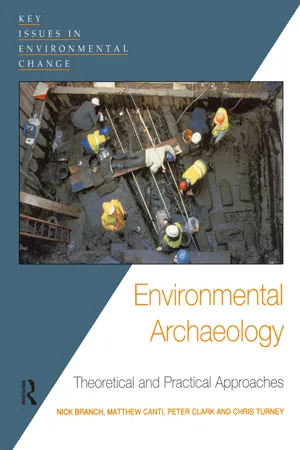
eBook - ePub
Environmental Archaeology
Theoretical and Practical Approaches
- 256 pages
- English
- ePUB (mobile friendly)
- Available on iOS & Android
eBook - ePub
Environmental Archaeology
Theoretical and Practical Approaches
About this book
Information
1
Introduction to environmental archaeology
________________________________________________
1.0 Chapter summary
This introductory chapter presents a detailed discussion of the conceptual framework of environmental archaeology. In the opening section, we make an assessment of the relationship between archaeology and science with the aim of putting environmental archaeology into a clearer context, and ultimately arriving at a better understanding of its role. This is followed by a broader discussion of the concept of time in environmental archaeology, with particular emphasis on the importance of understanding how the biotic and abiotic components of our environment change. We examine the four main spatial scales (micro, meso, macro and mega) of importance to environmental archaeology, and discuss their relative significance with respect to a range of investigations.
1.1 Defining environmental archaeology
1.1.1 Introduction
Environmental archaeology has emerged as a named discipline only in the last 30 years. It has rapidly grown in significance and is now an integral part of most excavation projects. It is taught as a standard course component in many university archaeology departments, and has its own infrastructure of academics, societies and journals. It has developed with little or no theoretical discourse, but has relied chiefly on a general pre-existing uniformitarian view taken by the geologists and biologists who were the first to analyse environmental remains on archaeological sites. During this same period, cultural archaeology has undergone considerable changes of theoretical basis, which have continued almost without inclusion of the treatment of environmental evidence. This apparent independence between two such closely interwoven subjects belies a relationship of some complexity. We therefore need first to examine environmental archaeology as a component of archaeology more generally, before defining it as a subject in itself.
1.1.2 Archaeology and science
It is a truism that there are as many definitions of archaeology as there are archaeologists, but here we shall identify it as ‘the study of people and their relationship with the environment through time’. This is a broad church, and encompasses many sub-disciplines, philosophical stances and individual ambitions. Crucially, though, archaeology concerns people’s lives, from the individual decisions that led to a particular feature being created, up through the social frameworks engendered to structure and regulate their relationship with the world; how these evolved and changed in response to social and environmental factors; and on through the ancient tragedies of warfare and plague, to the whole sweep of history from humanity’s earliest origins to the global billions of today.
Archaeology is an immense field, and unsurprisingly there is a wide range of different types of data that can be employed. The scope includes the traditional objects of archaeological study: ancient structures, artefacts and stratification, as well as human remains, economic and environmental indicators such as plant remains, molluscs, animal bones and insects. Equally pertinent are the study of artistic and symbolic forms – historic documents and iconography, religious and ritual expression, social theory and much more. Archaeology is a discipline where scholars from many different fields can make a large contribution, ranging from the schools of artistic and literary criticism employed in understanding historic texts, through to the hard science of chemistry and physics underlying absolute dating techniques. Clearly this range of different disciplines brings with it a host of different views on what is the most appropriate approach to archaeological research, and a great deal of ink has been used in the debate between the various camps (see Hodder, 1986; Trigger, 1989; Renfrew and Bahn, 2000). Much of this debate ultimately revolves around the issue of what we can actually say about the past, and what validity such statements have. Is there a ‘true past’ that our multidisciplinary teams can explore, or is it all a fantasy of our own making, to be rewritten whenever political or academic fashions change? Hand-in-hand with this question go methodological issues: can archaeology ever be truly objective, or must it, by its very nature, always remain a subjective discipline? Does archaeology belong with the humanities or the sciences?
The answer must surely be that archaeology encompasses both. The great sweep of human history (as well as the actions of a single individual) cannot be explained by the application of universal, formulaic laws of behaviour (though many have tried), but neither can it be thought of as a complete fabrication. Most people accept that there are traces of the past all around us, from buried artefacts to the earthworks of ancient field systems. Although these traces may have undergone many changes or transformations through time (Schiffer, 1987), and may be interpreted in different ways, they are facts that prescribe the formulation of hypotheses about the nature of the past.
First, though, we should return to the question of whether there is a ‘true past’ that we can collectively explore, subject to our fragmentary evidence and its interpretation. It is inevitable that all history is a human construction. Any attempt to explain or derive a narrative from the evidence of the past is a subjective, selective activity. What two individuals would explain the modern world in the same way today, even with all the evidence to hand and an understanding of the cultural references of that material? They would surely have different assessments of what issues are pertinent, and different perspectives on why things happen in a certain way. Both explanations might be equally valid, but radically different.
When studying the evidence for the past, archaeologists must assign significance to their data and structure their research according to a hypothesis or questioning of that data. The questions we ask are modern constructs; they dictate what evidence we seek and how we analyse it. The study of the initial colonization of the Pacific (Irwin, 1994), for example, would require a very different approach to that articulating the sequence of events during the siege of Alésia in 52 BC (Reddé, 2003). We might decide, therefore, that while there is a ‘true past’ (as represented by archaeological data in its broadest sense), there is no ‘true history’. That is not to say that our histories and explanations of the past are not valid, but rather that our data are mute until we breathe life into them with hypothesis.
This view differentiates archaeology from science, for in science there is a belief that there exist universal laws that await discovery. Many have argued over the years that there are similar universal laws (or ‘covering laws’) that govern human behaviour (Hempel, 1942; 1963; Binford, 1977). In archaeology this was perhaps most strongly represented by the ‘New Archaeology’ in the 1960s and 1970s, greatly influenced by the writings of Louis Binford (1977) and David Clarke (1978). This view that human behaviour can be predicted or explained by universal laws has always had its critics (e.g. Mandelbaum, 1961). In the last century the philosopher Karl Popper stated: ‘I have shown that, for strictly logical reasons, it is impossible for us to predict the future course of history’ (whatever our starting point in time) (Popper, 1957: iv). ...
Table of contents
- Cover
- Half Title
- Title Page
- Copyright Page
- Table of Contents
- List of figures
- List of tables
- List of boxes
- Preface to the series
- Acknowledgements
- Preface
- Safety Note
- Chapter 1 Introduction to environmental archaeology
- Chapter 2 Defining the context: integrated approaches to stratigraphy
- Chapter 3 Bioarchaeology: analysing plant and animal remains
- Chapter 4 Dating and numerical analysis: the age and significance of environmental evidence
- Chapter 5 Integrated studies in environmental archaeology
- Index
Trusted by 375,005 students
Access to over 1.5 million titles for a fair monthly price.
Study more efficiently using our study tools.
Frequently asked questions
Yes, you can cancel anytime from the Subscription tab in your account settings on the Perlego website. Your subscription will stay active until the end of your current billing period. Learn how to cancel your subscription
No, books cannot be downloaded as external files, such as PDFs, for use outside of Perlego. However, you can download books within the Perlego app for offline reading on mobile or tablet. Learn how to download books offline
Perlego offers two plans: Essential and Complete
- Essential is ideal for learners and professionals who enjoy exploring a wide range of subjects. Access the Essential Library with 800,000+ trusted titles and best-sellers across business, personal growth, and the humanities. Includes unlimited reading time and Standard Read Aloud voice.
- Complete: Perfect for advanced learners and researchers needing full, unrestricted access. Unlock 1.5M+ books across hundreds of subjects, including academic and specialized titles. The Complete Plan also includes advanced features like Premium Read Aloud and Research Assistant.
We are an online textbook subscription service, where you can get access to an entire online library for less than the price of a single book per month. With over 1.5 million books across 990+ topics, we’ve got you covered! Learn about our mission
Look out for the read-aloud symbol on your next book to see if you can listen to it. The read-aloud tool reads text aloud for you, highlighting the text as it is being read. You can pause it, speed it up and slow it down. Learn more about Read Aloud
Yes! You can use the Perlego app on both iOS and Android devices to read anytime, anywhere — even offline. Perfect for commutes or when you’re on the go.
Please note we cannot support devices running on iOS 13 and Android 7 or earlier. Learn more about using the app
Please note we cannot support devices running on iOS 13 and Android 7 or earlier. Learn more about using the app
Yes, you can access Environmental Archaeology by Chris Turney,Matthew Canti,Nick Branch,Peter Clark in PDF and/or ePUB format, as well as other popular books in Ciencias físicas & Geografía. We have over 1.5 million books available in our catalogue for you to explore.