- 365 pages
- English
- ePUB (mobile friendly)
- Available on iOS & Android
eBook - ePub
About this book
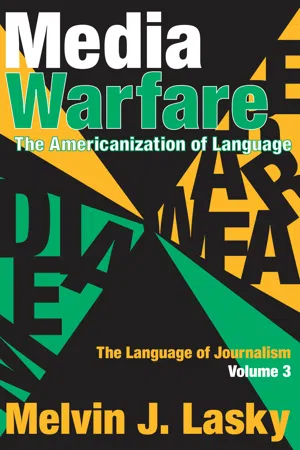
Media Warfare is the concluding volume of Melvin Lasky's monumental The Language of Journalism, a series that has been praised as a ""brilliant"" and ""original"" study in communications and contemporary language. Firmly rooted in the critical tradition of H. L. Mencken, George Orwell, and Karl Kraus, Lasky's incisive analysis of journalistic usage and misusage gauges both the cultural and political health of contemporary society as well the declining standards of contemporary journalism.As in the first two volumes, Lasky's scope is cross-cultural with special emphasis on the sometimes conflicting, sometimes mutually influential styles of American and British journalistic practice. His approach to changes in media content and style is closely keyed to changes in society at large. Media Warfare pays particular attention to the gradual easing and near disappearance of censorship rules in the 1960s and after and the attendant effects on electronic and print media. In lively and irreverent prose, Lasky anatomizes the dilemmas posed by the entrance of formerly ""unmentionable"" subjects into daily journalistic discourse, whether for reasons of profit or accurate reporting. He details the pervasive and often indirect influence of the worlds of fashion and advertising on journalism with their imperatives of sensationalism and novelty and, by contrast, how the freeing of language and subject matter in literature--the novels of Joyce and Lawrence, the poetry of Philip Larkin--have affected permissible expression for good or ill. Lasky also relates this interaction of high and low style to the spread of American urban slang, often with Yiddish roots and sometimes the occasion of anti-Semitic reaction, into the common parlance of British no less than American journalists.Media Warfare concludes with prescriptive thoughts on how journalism might still be revitalized in a ""post-profane"" culture. Witty, timely, and deeply learned, the three volumes of The Language of Journalism are a c
Information
Subtopic
SociolinguisticsPart 1
Intermezzo Robert Burton’s Melancholy Dilemma: Journalism without Newspapers
“You do not need to leave your room. Remain sitting at your table and listen. Do not even listen, simply wait. Do not even wait, be quite still and solitary. The world will freely offer itself to you to be unmasked, it has no choice, it will roll in ecstasy at your feet.”
—Franz Kafka, Reflections on Sin, Pain, Hope and the True Way (1917-1919)
“What did Burton read in his solitary study? As far as we can see, everything, absolutely everything: ancient classics, modern literature, latin and Greek, French and English, philosophy, philology, history, politics, travel, mathematics, astornomy, medicine. He was a complete humanist scholar, but he loved the English poets too, and was up-to-date in all modern subjects. Like his contemporary, Francis Bacon, he took all learning for his province....
“It [The Anatomy of Melancholy, 1621] has left traces in our literature for the next two centuries. We find traces of it in the poetry of Milton and the prose of Sterne. It was the only book which could get Dr. Johnson out of bed two hours early. It inspired Keats. It was enjoyed by Byron....
“Like most interesting men, Burton is not quite consistent. He preaches the happy mean and does not practice it....He is as frank as a pornographer and as mincing as a prude.”
—Hugh Trevor-Roper, Renaissance Essays (1985)
1
The Universal Assignment
We have been pursuing the techniques of censorship by punctuation-they are evidently as old as the hills...especially those odious mountainous obstructions, indeed those s——, f.******? and otherwise unmentionable ranges which block our perception of the road ahead and a clear vision of blue sky. Byronesque asterisks, as we have seen, managed to create enough discreet obfuscation to preocccupy searchers for plain-speaking unambiguous evidence on Lord Byron’s life and loves for centuries. Burtonesque dashes-to which we will be coming in due time-were even older; and their decipherment is rather more complicated by the suspicion that the ingenious seventeenth-century English essayist was being playful and provocative, and justifiably felt that he had expressed his robust and subversive opinions on important topics of the day with sufficiently outrageous directness. Why, then, the blankety-blank dashes?
Here is Robert Burton, going on in his radical way about his civilization and its discontents, in the second volume of his Anatomy of Melancholy (1621).
He poses the question: Who, in point of embarrassing or harassing historical fact, were the great men of power and distinction who constituted the indomitable ruling class of his Elizabethan and Renaissance age? No small dangers lay in this question, especially if it were to be answered candidly and with no sparing of words. After all, acute struggle-between social classes, political clans and their power-hungry kinsmen; among troubled or otherwise discontented souls-has often been held to be historically determined, to be our destiny: “We are sent as so many soldiers into this world, to strive with it, the flesh, the devil; our life is a warfare, and who knows it not?” But Burton also knew that truth had more than one side-an open-mindedness very rare in such parlous times. His beloved Homer was blind, “yet who made more accurate, lively, or better descriptions, with both his eyes?” Perception was all, and the insight obtained therefrom would penetrate whatever blocked the path to truth:
Homer was blind, yet who (saith he) made more accurate, lively, or better descriptions, with both his eyes? Democritus was blind, yet, as Laertius writes of him, he saw more than all Greece besides; as Plato concludes....When our bodily eyes are at worst, generally the eyes of our soul see best. Some philosophers and divines have evirated [emasculated] themselves, and put out their eyes voluntarily, the better to contemplate. Angelus Politianus had a tetter in his nose continually running, fulsome in company, yet no man so eloquent and pleasing in his works. Aesop was crooked, Socrates purblind, long-legged, hairy, Democritus withered, Seneca lean and harsh, ugly to behold; yet show me so many flourishing wits, such divine spirits: Horace a little blear-eyed contemptible fellow, yet who so sententious and wise? Marsilius Ficinus, Faber Stapulensis, a couple of dwarfs, Melancthon a short hard-favoured man, yet of incomparable parts all three. Ignatius Loyola, the founder of the Jesuits, by reason of a hurt he received in his leg at the siege of Pampeluna, the chief town of Navarre in Spain, unfit for wars and less serviceable at court, upon that accident betook himself to his beads, and by those means got more honour than ever he should have done with the use of his limbs and properness of person: a wound hurts not the soul. Galba the emperor was crook-backed, Epictetus lame; that great Alexander a little man of stature, Augustus Caesar of the same pitch; Agesilaus despicabili forma [contemptible in appearance]; Boccharis a most deformed prince as ever Egypt had, yet, as Diodorus Siculus records of him, in wisdom and knowledge far beyond his predecessors. Anno Dom. 1306, Uladislaus Cubitalis, that pigmy King of Poland, reigned and fought more victorious battles than any of his long-shanked predecessors. Virtue refuseth no stature, and commonly your great vast bodies and fine features are sottish, dull, and leaden spirits. What’s in them? What but sheer bulk and stupid insolence?
This was colorful and exuberant; but if Burton would go on (and he would), insolence and worse would be the grievous charges of yet others who felt they were being-as later victims were to cry-slandered, libelled, and calumnied. Burton had no time for those would-be grandees who furtively changed their names, burned down their birthplace (“because nobody should point at it”), bought titles, coats of arms, and by all means “screw themselves into ancient families, falsifying pedigrees, usurping scutcheons, and all because they would not seem to be base.” As Burton says, “Of all vanities and fopperies, to brag of gentility is the greatest.” It was, for him, “a mere flash, a ceremony, a toy, a thing of naught.”
How did such great families of the day begin (i.e., when was the first screw fastened or consummated)? He names the ways: “Oppression, fraud, cozening, usury, knavery, bawdry.” Last but not least: “murder, and tyranny.”
No revolutionist in history, mounting the barricades as the first step to “change the world,” had clenched in his tight little fist so vivid a list of the public enemies which the new society-Burton dreamed of an “excellent commonwealth,” organized “for the common good of all”–would never ever miss:
One hath been a blood-sucker, a parricide, the death of so many a silly soul in some unjust quarrels, seditions, made many an orphan and poor widow, and for that he is made a lord or an earl, and his posterity gentlemen for ever after. Another hath been a bawd, a pander to some great men, a parasite, a slave, prostituted himself, his wife, daughter to some lascivious prince, and for that he is exalted. Tiberius preferred many honours in his time, because they were famous whoremasters and sturdy drinkers; many come into this parchment-row by flattery or cozening; search your old families, and you shall scarce find of a multitude...that have not a wicked beginning....For who did not reach their present position through violence or deceit, as that plebeian in Machiavel in a set oration proved to his fellows, that do not rise by knavery, force, foolery, villainy, or such indirect means. They are commonly able that are wealthy; virtue and riches seldom settle on one man: who then sees not the base beginning of nobility? spoils enrich one, usury another, treason a third, witchcraft a fourth, flattery a fifth, lying, stealing, bearing false witness a sixth, adultery the seventh, etc...
It was, in effect, a cascade of curses, which somehow managed by literary skill alone to evade the twin peaks of the cultural dilemma of his time-the theocratic dangers of blasphemy (on the one side, from above) and the secular vulgarities of profanity (on the other, from below). Journalists on the modern scene are well acquainted with this challenge of a semantic tightrope walk; so many falter, lose balance, trip and fall.
Like the happiest of reporters in any epoch he was exclusively interested in the story. “I am not poore, I am not rich, nihil es nihil deest. I have little, I want nothing....” On occasions he would, with a conspicuous coyness, insist that he was living “a Monastique life,” and in a moment of pique he snapped: “If you like not my writing, go read something else.” More than that: privately, at home-living like “a Collegiat Student”–he had “no Wife nor Children, good or bad, to provide for.” And yet, and yet–“I heare and see what is done abroad, how others run, ride, turmoile, ' macerate [harass, mortify] themselves in Court and Countrey, far from those wrangling Law suits.” End effect: “I laugh at [it] all.”
Not unlike a few other “Great Intelligencers”* of the day, forerunners of that flowering of the Journalistic Imagination in more enlightened times, Robert Burton lived his life on permanent, universal assignment to cover the world. What later newspapermen (and -women) would call “scoops” he thought of as “new newes every day”; and when he summed up his uneventful life and unregistered achievements (no honors, only one book), he linked the kind of “reporting” he did to the kind of intellectual imagination which soars as high as history and as far as philosophy. How many glittering prizes for unprecedented excellence would grateful contemporaries have bestowed upon him-if only he had not remained “penned up” in his study (at Christ Church, Oxford)...living “a silent, sedentary, solitary, private life.” But he owned some 2,000 volumes, and the resources of the Bodleian Library were only a few steps away. A lonely, quiet man-of-letters is often tempted to play the role of the thunderer:
What is gentry, this parchment nobility then, but...a sanctuary of knavery and naughtiness, a cloak for wickedness and execrable vices, of pride, fraud, contempt, boasting, oppression, dissimulation, lust, gluttony, malice, fornication, adultery, ignorance, impiety?...A nobleman therefore in some likelihood is an atheist, an oppressor, an epicure, a gull [simpleton], a dizzard [blockhead], an illiterate idiot, an outsider, a glow-worm, a proud fool, an arrant ass....They were the first in rank, so also in rottenness.
As I have hinted, there was a sort of journalistic dimension to the Burton literary imagination, and specificities had to be enlisted to give factual and colloquial strength to the airy abstractions in which idéologues tend to lose themselves. The author readily succumbed to the temptation to name names, at first only ancestral (and relatively) examples and then current (and usually vindictive) neighbors:
The nobles of Berry are most part lechers, they of Touraine thieves, they of Narbonne covetous, they of Guienne coiners, they of Provence atheists, they of Rheims superstitious, they of Lyons treacherous, of Normandy proud, of Picardy insolent, etc.; we nay generally conclude, the greater men, the more vicious. In fine...they are most part miserable, sottish, and filthy fellows, like the walls of their houses, fair without, foul within. What dost thou vaunt of now? What dost thou gape and wonder at? admire him for his brave apparel, horses, dogs, fine houses, manors, orchards, gardens, walks? Why, a fool may be possessor of this as well as he; and he that accounts him a better man, a nobelman for having of it, he is a fool himself. Now go and brag of thy gentility.
I have slightly compressed the soaring invective, in order to accentuate the cluster bombs of epithet. For I want to broach again the question of whether in the general history of English political prose-or in “the language of journalism,” from detail-padded reportage to inflammatory editorial injunctions-things that needed to be said, in appropriate force and liveliness, could ever be conceived without the shadow of profanity and obscenity, that creative darkness of every great language, lurking on the vulgar periphery of the vernacular.
* I am thinking of such “heroes of history” (in Sidney Hook’s phrase) as Pierre Bayle (1647-1706) and Samuel Hartlib (d. 1662), among others, whom I have sketched in my book on Utopia and Revolution (1976) – see the portraits in chaps. 9-10, “The Great Intelligencers,” pp.. 320-383; and Sidney Hook, The Hero in History (1943).
2
The Journalistic Imagination
My reader is reminded that Burton died in 1640, the opening year of the so-called Puritan Revolution. I suspect that Oliver Cromwell-and even his pamphleteering sidekick John Milton (a.k.a. his Latin secretary)-could not have had any real use for him, despite Burton’s belligerent volubility. His views were sharp and radical, if a wee bit overstated, and his temperament openly enthusiastic. But he was constantly warning his readers that his was “an unconstant, unsettled mind.” Gods as well as demons were always failing him; his critico-melancholic spirit was not entirely reliable. Propagandists for a new and better society’s “Good Cause” need to be of sterner stuff.
Still and all, he was in at the beginning of the future’s modernity; and his work, conventionally termed “a bridge between medieval and modern thought,” is relevant to the dramatic onset of such configurations as ideology (which, unlike some illustrious contemporaries like John Milton, Marchamount Nedham, et al., he abhorred) and utopia (to which he was fitfully attracted). In fact the whole Western emergence of an intellectual class composed of increasingly independent (or perhaps only free-floating) scribblers-men of high spirits who were committed to shape public opinion for the better (or indeed the very best) on behalf of enlightened human ideals-could scarcely transpire without the development of a journalistic temperament. Burton admitted to a vision, “an Utopia of mine own” (vol. I, p. 97); and whatever it was that he himself thought he was up to, he remained committed to his indefatigable pursuit of “the new newes”–from “stealing newes from others”...to curing the human race of its melancholy afflictions...moving closer to some utopian solutions to “those tumults and trobles of the world.” His almost endless amassment of telling facts, allusive quotes, sparkling details served to buttress a grand and historic alternative of beneficent human ideals. Implicit in his critique of the ways of the world was a discernible liberal-humanist ideal of good governance.
Scouring every line of Burton’s thousand pages, one literary critic found “buried” therein a lively Utopianism–“a Utopia which suggests ([H.G.] Wells”–embracing the author’s social and political convictions. It was, in fact, a daunting and beguiling program of innovations and ameliorations. Burton was “revealed” as a humanitarian enemy of war, an advocate of better highways and inland waterways, the reclamation of marshlands, the building of garden villages, and the granting of old-age pensions....To be sure, he was more of a reformer than a revolutionary (that “hard word” was not yet in general usage) but his personal partisan commitment sounded like an absolutist dedication: “I will spend my time and knowledge, which are my greatest fortunes, for the common good of all.”1
The serious mode of responsibility has had for most utopian intellectuals in history very slippery handles. They slide and fall, and when they get picked up again, the grip is very different, if there is a grasp at all. Here is Burton justifying the grand utopian mission and almost reaching the point at which the Principle “Hope,” das Prinzip Hoffnung (in yet another philosopher’s formula), gives way to Praxis Realism or the pragmatism of experience. “...I will yet to satsfie ' please myselfe,” Burton wrote emphatically, “make an Utopia of mine owne, a new Atlantis, a poeticall commonwealth of mine owne, in which I will freely domineere, build Cities, make Lawes, Statutes, as I list my selfe. And why may I not?”
The question was rhetorical; he full well knew why not. Thomas More was beheaded in the Tower; and Michael Servetus was burned at the stake in Calvin’s Geneva. But before he turned the proposition on its head, “topsy turvy” in the “hurly burly” (the phrases of the day), he gave the free poetry a good run...before the humdrum prose took over: “I will...
Table of contents
- Cover Page
- Title Page
- Copyright Page
- Table of Contents
- Part 1: Intermezzo: Robert Burton’s Melancholy Dilemma: Journalism without Newspapers
- Part 3: The Perception of American Words
- Part 4: A Journalist Gets Serious: In P.G. Wodehouse’s “Noo Yawk”
- Part 5: In the Crossfire of the Media Wars
- Part 6: Intimations of a Post-Profane Era
- Notes
- Index
Trusted by 375,005 students
Access to over 1.5 million titles for a fair monthly price.
Study more efficiently using our study tools.
Frequently asked questions
Yes, you can cancel anytime from the Subscription tab in your account settings on the Perlego website. Your subscription will stay active until the end of your current billing period. Learn how to cancel your subscription
No, books cannot be downloaded as external files, such as PDFs, for use outside of Perlego. However, you can download books within the Perlego app for offline reading on mobile or tablet. Learn how to download books offline
Perlego offers two plans: Essential and Complete
- Essential is ideal for learners and professionals who enjoy exploring a wide range of subjects. Access the Essential Library with 800,000+ trusted titles and best-sellers across business, personal growth, and the humanities. Includes unlimited reading time and Standard Read Aloud voice.
- Complete: Perfect for advanced learners and researchers needing full, unrestricted access. Unlock 1.5M+ books across hundreds of subjects, including academic and specialized titles. The Complete Plan also includes advanced features like Premium Read Aloud and Research Assistant.
We are an online textbook subscription service, where you can get access to an entire online library for less than the price of a single book per month. With over 1.5 million books across 990+ topics, we’ve got you covered! Learn about our mission
Look out for the read-aloud symbol on your next book to see if you can listen to it. The read-aloud tool reads text aloud for you, highlighting the text as it is being read. You can pause it, speed it up and slow it down. Learn more about Read Aloud
Yes! You can use the Perlego app on both iOS and Android devices to read anytime, anywhere — even offline. Perfect for commutes or when you’re on the go.
Please note we cannot support devices running on iOS 13 and Android 7 or earlier. Learn more about using the app
Please note we cannot support devices running on iOS 13 and Android 7 or earlier. Learn more about using the app
Yes, you can access Media Warfare by Melvin J. Lasky in PDF and/or ePUB format, as well as other popular books in Languages & Linguistics & Sociolinguistics. We have over 1.5 million books available in our catalogue for you to explore.