eBook - ePub
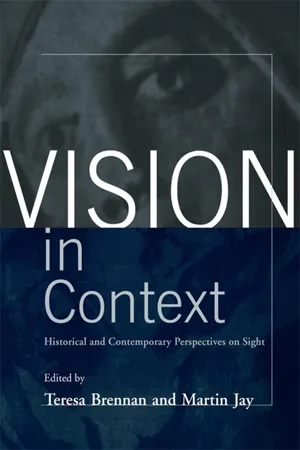
Vision in Context
Historical and Contemporary Perspectives on Sight
- 245 pages
- English
- ePUB (mobile friendly)
- Available on iOS & Android
eBook - ePub
About this book
Vision and the gaze are key issues in the analysis of racism, sexism and ethnocentrism. In recent radical theory, generally, and French theory in particular, vision has been seen as a means of control. But this view is often unnuanced. It bypasses questions such as: Why is it that contemporary theories have been so critical of vision, and generous towards listening (in psychoanalysis) and language (in philosophy)? This collection of original essays brings together historical studies and contemporary theoretical perspectives on vision. The historical papers focus in turn on Ancient Greece, medieval theology, the Renaissance, the Enlightenment and the nineteenth century. These historical studies are themselves thoroughly informed by poststructuralist theory. They provide a rigorous background for several new, exciting articles on vision and its bearings for feminism, race, sexual orientation, film and art. This collection is the first of its kind in juxtaposing historical and contemporary
Information
PART ONE
Historical
Perspectives
2 Refracting Classical Vision: Changing Cultures of Viewing
Simon Goldhill
It all—always—begins with Homer. In the Iliad, Helen, that warred-over object of desire, comes to the walls of besieged Troy and is observed and wondered at by the assembled Trojan elders. King Priam asks her to name particular Greeks whom she sees ranged against the city, and the face that launched a thousand ships identifies the warriors she has deserted. Priam's gaze distinguishes the leading princes of the Greek host: the bodily form of excellence and the social status of prince— mutually implicated categories1—are visible signs, visible attributes, paraded for recognition. This privileged scene of viewing (the teichoscopia) establishes an economics of display that is rehearsed throughout the epic: physical and social worth is constructed in and by the gaze of others. So Achilles at the height of his destructive rampage cries out to his victims, “Look at me! Do you not see how beautiful, noble and great I am?” (I1., 21.108). Even the Odyssey's games of disguising its hero lead to his splendid, epiphanic appearance, flanked by his father and son, at the epic's close. The hero is ineluctably linked to the modality of the visual.
The Homeric poems and their public presentation of the body of the hero retained a unique position throughout Greek culture for more than a thousand years: education, cultural capital, and literary and artistic worth find their source and resources there. What is more, not only does Greek artistic representation return repeatedly to the display of the heroic body for the establishment of its visual regimes, but also the celebrated description of the Shield of Achilles in Iliad 18 heads a tradition of writing about visual art that leads toward the classical turn of Vasari, Lessing, and beyond. It has thus been easy to construct a (white, unbroken) image of the Classical Tradition of writing about viewing and vision. So Stephen Bann, who may stand, together with Norman Bryson and John Hollander2 (whom he quotes), as an icon for the most interesting contemporary exploration and appropriation of ancient writing about viewing (art), states: “Writing about the visual arts in the classical period took place within the terms of the convention usually known as ekphrasis, and though the rules applying to this convention were not absolutely rigid, it is possible to state its main presuppositions with some confidence.”3 It is the aim of this chapter to question each of the central claims of this starting position and to challenge its confidence. First, I will attempt to show that to treat “the classical period” as an unbroken tradition (from Platonic mimesis to Philostratus's Imagines) ignores fundamental paradigm shifts in the culture and philosophy of viewing over what is a more than seven-hundred-year span. In the space available here, I will visit three paradigmatic moments—the classical city of the fifth-fourth century b.c.e.; Hellenistic Alexandria (ca. C3-1 b.c.e.); and the Second Sophistic (ca. C2-4 c.e.).
These three moments are chosen not because of any commitment to Foucauldian “rupture” but in order to maximize difference for the sake of rhetorical clarity. Second, the idea that writing about the visual arts can safely be limited to the trope of ekphrasis significantly distorts what might be called “the discourse of viewing.” Not only is there an extensive tradition of writing on optics,4 but also ancient writing on tourism, theater, desire, epistemology, etc., repeatedly invokes and analyzes accounts of viewing and observation. To extract the description of a painting from its social and intellectual context necessarily misrecognizes it as a historical or cultural artifact. In the first section of this chapter I will focus on the cultural and political context of viewing; in the second, on an intellectual and specifically philosophical frame; in the third, on the novel's narrative engagement with viewing. In the best of all possible worlds these elements would not be so separated (refracted). Since part of my claim, however, is that the range of writing that should be brought to bear on the topic of viewing has been extensively undervalued, each of my limited snapshots will have to be taken as exemplary fragments of a wider possible history. Third, the continuing belief that ekphrasis is most profitably to be analyzed under the rubric of rhetoric, and specifically the rhetorical tradition that opposes narratio and descriptio, seems to have contributed to this restriction of scope in the discussion of viewing.5 I shall argue that writing about viewing is (also) a major contributing factor in the construction of the viewing subject, and it is within such terms that the discourse of viewing (art) should be approached.
These are somewhat grandiose claims, especially when stated so baldly. What is more, this chapter will be able only to sketch in outline what should be a much longer study. I offer these refracted views of ancient viewing, however, as markers of and stimulus to further discussion.
IN THE GAZE OF THE CITIZENS
The view from the walls of Troy and the display of the heroic body as a sign of worth remain an integral and privileged element in the cultural imagination of the classical city. Yet the fifth-century polis fundamentally restructured the space for display and the technologies of representation— as it did the signs and signals of worth. It is the classical city, and Athens in particular, that provided the frame for Plato's theories of mimesis and his analysis of epistemology and vision.
The establishment of democracy depended on a physical and conceptual reorganization of sociopolitical space. Cleisthenes' reforms (which began the development of democracy)6 divided the territory of Attica and the citizen body into a series of demes (a localized social and political unit), and each deme was further assigned to one of ten tribes, which functioned as essential divisions of the citizen body in ceremonial, political, and religious events. Each tribe was made up of demes from the coast, the inland region, and the town itself. Since most political appointments were made by lot from a list drawn up to ensure equal representation from each tribe, there was a compulsory geographical spread that diffused power throughout the territory of the state and spread the opportunities of office to the largest possible range of candidates. Although this sense of a possible tension between coast, country, and town is enacted, on the one hand, in a series of writings that both praise the simple delights of country life and disparage the boorishness of rustics and, on the other, in the rituals and ceremonials that articulate the boundaries between town and country,7 it is in the city itself on which I wish to focus attention. The agora (marketplace) formed the central locus for most cities in Greece (along with the military and religious complex of the acropolis), and I shall be returning to this site shortly. First, however, I want to concentrate on the three major public institutions by which Athenian culture was recognized as supremely Greek, supremely democratic, and supremely Athenian, namely, the assembly, the law-court, and the theater.
Now, classical Greek society was a performance culture that valorized competitive public display. The gymnasium, with its display of bodies in the contests of manhood, and the symposium, with its performance of songs and speeches, became the key signs of Greek culture itself as Hellenism spread through the Mediterranean in the wake of Alexander's conquests. The assembly and the law-court, however, the unique institutions of democracy, constituted a special type of performance culture. For the law-court and assembly were the major political institutions of the state, the city's major sites of conflict and debate, and its citizens' major route to positions of power. Both law-court and Assembly involved large citizen audiences, public performance by speakers, and voting to achieve a decision. Democracy made public debate, collective decision-making, and the shared duties of participatory citizenship central elements in its political practice. To be in an audience was not just a thread in the city's social fabric, it was a fundamental political act. So Athenian political ideology proudly highlighted democracy's commitment to putting things es meson “into the public domain to be contested,” and the historian Thucydides had Cleon, a leading politician, call the Athenians in a telling phrase theatai tôn logôn, “spectators of speeches” (3.38). The pervasive values of performance in Greek culture together with the special context of democracy and its institutions meant that to be in an audience was above all to play the role of democratic citizen. The political space of democracy was established by the participatory, collective audience of citizen spectators. Theoria, the word from which “theory” comes, implies, as has often been noted in contemporary criticism, a form of visual regard; what is less often noted is that theoria is the normal Greek for official participatory attendance as spectator in the political and religious rites of the state.
This sense of participatory collective spectatorship is nowhere more evident than in the theatron, the theater, or “place for viewing.” The dramatic festival of the Great Dionysia, the major theatrical occasion of the year, brought together the largest single collection of citizens in the political calendar. The audience was a visual map of the city. Citizens sat in the wedges of seats according to their tribal divisions, with special seats reserved for the executive council of the city, for priests and for other dignitaries of the state, and for foreigners. So, too, other social groups were specifically distinguished. The audience represented—in all senses—the formal sociopolitical divisions of the state. On stage, before the plays started, extensive rituals were performed that projected and promoted both an ideal of citizen participation in the state and an image of the power of the polis of Athens.8 The civic occasion was used to glorify the polis of Athens—and to construct a highly charged moment for the display of individual status before the citizens' gaze. Plays were funded by individuals (chorêgoi) who gained great political capital by their conspicuous beneficence before such a large audience. The performance of these chorêgoi became a standard subject in the contests of the law-court, where citizens further competed for honor and position. In short, the theater was a space in which all the citizens were actors as the city itself and its leading citizens were put on display. Spectacular viewing.
The institutional spaces of the democratic city thus established the citizens' gaze as the field in which position was contested and made the collective, participatory spectator the role of the citizen. The celebrated imperial decoration of Athens—led by Pericles and his Parthenon—was corollary to this process. On the one hand, the Parthenon itself, as figurehead of the program, funded by and thus sign of Athens' imperial expansion, is decorated over the barbarian wildness of the Centaurs and Amazons but also with an extended, idealized representation of the civic body of Athens performing the ritual processions of the Panathenaia (a festival of the city as a totality [pan-]). As the citizen spectator processed 'round the Parthenon to its entrance, the engagement as spectator in the frieze's procession is an encouragement to associate with this idealized mimesis of democracy.9 Significantly, this was the first time in Greek temple sculpture that the citizen body was so imaged.
The Stoa Poikile, or Painted Stoa, shows a similar exemplary construction of a political space for viewing as a citizen. This colonnade along the agora was elaborately decorated, first with major paintings showing Athenian military triumphs over the Spartans juxtaposed with scenes from the capture of Troy: the affiliation of glorious present to glorious past. Second, there was inscribed a famous epigram on the victory of the Greeks—led by Athenians—over the Persians at Marathon, a victory that was central to Athenian...
Table of contents
- Cover Page
- Half Title page
- Title Page
- Copyright Page
- Acknowledgments
- Contents
- 1 Vision in Context: Reflections and Refractions
- Part One Historical Perspectives
- Part Two Contemporary Perspectives
- Contributors
- Index
Trusted by 375,005 students
Access to over 1.5 million titles for a fair monthly price.
Study more efficiently using our study tools.
Frequently asked questions
Yes, you can cancel anytime from the Subscription tab in your account settings on the Perlego website. Your subscription will stay active until the end of your current billing period. Learn how to cancel your subscription
No, books cannot be downloaded as external files, such as PDFs, for use outside of Perlego. However, you can download books within the Perlego app for offline reading on mobile or tablet. Learn how to download books offline
Perlego offers two plans: Essential and Complete
- Essential is ideal for learners and professionals who enjoy exploring a wide range of subjects. Access the Essential Library with 800,000+ trusted titles and best-sellers across business, personal growth, and the humanities. Includes unlimited reading time and Standard Read Aloud voice.
- Complete: Perfect for advanced learners and researchers needing full, unrestricted access. Unlock 1.5M+ books across hundreds of subjects, including academic and specialized titles. The Complete Plan also includes advanced features like Premium Read Aloud and Research Assistant.
We are an online textbook subscription service, where you can get access to an entire online library for less than the price of a single book per month. With over 1.5 million books across 990+ topics, we’ve got you covered! Learn about our mission
Look out for the read-aloud symbol on your next book to see if you can listen to it. The read-aloud tool reads text aloud for you, highlighting the text as it is being read. You can pause it, speed it up and slow it down. Learn more about Read Aloud
Yes! You can use the Perlego app on both iOS and Android devices to read anytime, anywhere — even offline. Perfect for commutes or when you’re on the go.
Please note we cannot support devices running on iOS 13 and Android 7 or earlier. Learn more about using the app
Please note we cannot support devices running on iOS 13 and Android 7 or earlier. Learn more about using the app
Yes, you can access Vision in Context by Teresa Brennan,Martin Jay in PDF and/or ePUB format, as well as other popular books in Arte & Teoría y crítica del arte. We have over 1.5 million books available in our catalogue for you to explore.