Urban planning is undergoing a period of transformation across Europe, with a major trend towards increased urban competition, national deregulation and greater private sector influence.
Urban Planning in Europe is the first comprehensive analysis of the influence of countries is developed, presenting the similarities and differences of each country's national planning system. The authors use detailed case studies to explore planning policies in a range of European cities, and discuss the social and environmental objectives that influence today's urban planner.
Urban Planning in Europe is an essential guide to contemporary European planning projects and highlighting opportunities for innovation which contain vital lessons for the future of urban decision making.
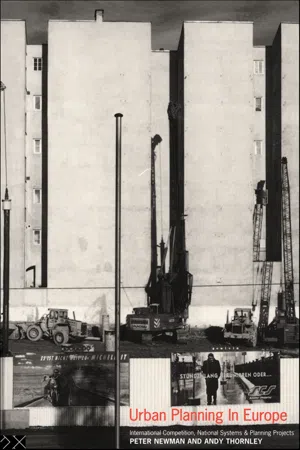
eBook - ePub
Urban Planning in Europe
International Competition, National Systems and Planning Projects
- 304 pages
- English
- ePUB (mobile friendly)
- Available on iOS & Android
eBook - ePub
Urban Planning in Europe
International Competition, National Systems and Planning Projects
About this book
Information
Part I
INTERNATIONAL, NATIONAL AND URBAN INFLUENCES
1
INTRODUCTION
During the 1990s European issues have entered the forefront of debate. The international competitive climate has made it difficult for individual countries to operate in isolation, resulting in ever increasing collaboration through the European Union. Reappraisal of the traditional roles of the nation-state has been required and this has led to tensions and conflicts. This is evident at the political level, for example in the splits within the British Conservative Party, and within the European population at large, as witnessed by the differences of opinion expressed in recent national referendums. However, a more European perspective is inevitable. Many collaborative activities are already in place, discussions on further EU responsibilities are well under way and there is a queue of countries wanting to join. The likely future scenario is for further expansion in both activities and geographical area. Urban planning will clearly be affected by this.
The Single European Act of 1992 removed restrictions and trade barriers in many areas of European activity. Although primarily aimed at increasing economic interaction the more open and communicative climate has also generated greater co-operation between city governments with the establishment of many new networks (Goldsmith, 1993). This process of ‘Europeanisation’ has also had its effect on urban planning. For example at the professional and educational levels we have witnessed the formation of the European Council of Town Planners and the Association of European Planning Schools. There has been a greater interest in the exchange of ideas about urban planning theory and practice. The literature has begun to respond to this. There are now a number of books which outline the planning and property systems in particular European countries (e.g. Needham et al, 1993; Dieterich et al., 1993; Berry and McGreal, 1995) and the EU itself has commissioned a Compendium of European Planning Systems. This body of information is extremely valuable as the awareness and understanding of planning in Europe requires the basic facts about different approaches. However this literature is fundamentally descriptive. Other research is oriented towards the processes of change in European regions and cities (e.g. Dunford and Kafkalas, 1992; Parkinson et al., 1992; Harding et al., 1994) but does not focus on urban planning. The purpose of this book is to fill this gap. It explores in detail the many forces influencing urban planning in cities throughout Europe and provides a framework for understanding the similarities and differences in their responses.
The book focuses particularly on political and economic forces which create common trends in urban planning and explores the scope for national or urban governments to deviate from these trends and adopt their own approach. The dominance of conservative, market oriented, politics is a world-wide trend (e.g. Gourevitch, 1986; Piven, 1991) although the extent of this rightward direction varies. The collapse of communism in eastern Europe gives an added dimension to this trend. The role of planning is to intervene in market processes to achieve certain broader aims. Its position at the interface between market and public interest means that it is particularly influenced by political and ideological positions concerning the appropriate degree of market intervention. One of the common trends throughout Europe over the last decade has been the increased entrepreneurial attitude of governments at national and city level, reinforced by the increase in competition between cities to attract inward investment. A dominant theme is the increase in what is termed ‘public-private partnership’. Does this competitive imper-ative mean that all cities have followed the same path? Other social objectives, local priorities or political agendas can influence the direction of urban planning. Our book explores the existing degree of variation in approaches to urban planning in Europe and the underlying reasons for this.
Urban planning is the focus of our attention and so other dimensions of planning are not covered, for example rural planning or regional planning which may be influenced by different factors. But what is meant by ‘urban planning’? Each country has its own set of ideas about ‘town and country planning’, ‘aménagement du territoire’, or ‘raumordnung’. The European Commission has attempted without success to capture the variety of national legal and cultural meanings in the terms ‘spatial planning’ or ‘territorial planning’. This book provides a framework for examining the forces that affect decisions on physical development in European cities. The aim is to explore these forces from a number of different and overlapping perspectives. There is first the combination, and relative strength, of economic and political pressures. Then there is the interaction of the influences from different levels of government, from European through national and regional to local. The third perspective relates to the relative strength of the different interests involved including the private sector in its different guises, democratic government, appointed agencies and the local community. Urban planning changes in response to this range of forces operating on cities. Our concept of urban planning is therefore both broad and flexible (see also Hall’s argument, 1994). It involves the exploration of the influences on development decisions incorporating both the regulatory planning system as an important dimension and the financial and administrative urban programmes of governments.
There is also much debate over what constitutes an urban area and how this might be defined for comparative purposes. Some (e.g. Cheshire and Hay, 1989) argue that comparisons should be based upon economic relationships and that there is a need to define ‘functional urban regions’ as city boundaries tend to be arbitrary. For many comparative purposes this is clearly a necessary definition. However this book is concerned with the way in which planning decisions are made and the influences on these decisions. In most cases functional urban regions do not have decision-making structures. The book therefore focuses on the political entities in which debates take place and policies are formulated (see for example Fainstein et al., 1992, for a similar approach).
The actions of local political authorities will clearly have an effect on planning at the urban level. It is also necessary to explore the interaction between these authorities and other interest groups. Central to this is the role of business interests and the exact nature of power relations in the catch-all concept of ‘partnership’. The stance adopted by local political parties can be crucial in determining the way in which the balance is struck between different interests. Another variable is the role of central government and the extent of its involvement in planning at the urban level. Urban planning is also set within a legislative framework which provides it with legitimacy and the book explores the degree to which countries vary in their legislative approaches and the implications of this.
Urban planning in a particular city will be responding to both global economic competition and local political forces within a framework of its national legal and institutional circumstances. Given these varying circumstances the book explores whether economic forces are generating similar urban planning responses in cities throughout Europe, and the scope for individual cities to be more innovative and undertake alternative strategies. The increasingly global nature of the economy and the expansion of competition within Europe creates a new context for urban planning. Economic change has variable impacts on places and social groups. Public policy is involved in both enhancing economic forces and averting or ameliorating undesirable social or environmental consequences. The policies emanating from the EU can be seen to reflect this dual role. At the urban level new alliances and forms of government are evolving to generate and implement a range of economic, social and environmental policies. Urban planning forms part of this new policy arena.
In order to explore the full range of interconnected forces outlined above an approach is needed that can deal with the complexity involved while also allowing for comparative analysis. The increase in activity within the EU has provided the need for more information exchange and the justification for descriptive studies of cities and urban planning in different countries (EC, 1994b). However the influences on urban planning are complex and varied, for example an understanding of the detail of local practice may require aninterpretation of local cultural traditions (see Booth, 1993). In order to compare cities there must be an understanding of differing national political, institutional and cultural backgrounds, and studies of the interrelationship between cities and national context are emerging (see Logan and Swanstrom, 1990; Le Gales, 1993). However the national context does not necessarily account for the variation between cities within a country and so the dynamics of change at the urban level must also be examined. In his review of comparative studies in political science Rose (1991) sets out a series of objectives which include being able to identify similarity and difference, the reasons for difference and, in policy related work, to consider the consequences. These objectives shape the approach adopted in this book. Our analysis is informed by a variety of perspectives and draws on a range of generic concepts offered by contemporary social science.
Global forces have a major impact on the operation of local markets and planning responses. Thus there is a need to undertake a wide coverage in order to detect the full range of forces operating and to identify any patterns that might be developing. However, in order to do justice to the complexity of urban planning it is also necessary to examine issues at the detailed level. Any interpretation also needs to be grounded in reality in order to be convincing and to give the detail necessary to avoid superficiality. This need for both breadth and depth creates a methodological challenge. The book is structured to allow an appreciation of the vertical hierarchy of influences on planning—from international to national to urban—and also to draw out horizontal comparisons between countries and between cities and projects.
Part I takes a European-wide approach and explores the wide range of factors influencing urban planning. It covers all the countries of western Europe and outlines the main trends in the former eastern bloc but excludes the territory of the former Soviet Union. The discussion begins with an account of the changes in the international economy and the differential impact this has had on cities. The implications of the European Union, its institutions and policies are then covered. The relative autonomy of the EU, nation-state and city in determining urban policy is raised as a key issue. The collapse of communism in eastern Europe is clearly another major event affecting the geopolitics of Europe. The discussion then continues at the level of nation-state exploring the way in which national legal approaches and institutional arrangements provide the structure within which the planning systems of each country operate. A typology of five different groupings or ‘families’ of countries is constructed: British, Napoleonic, Germanic, Scandinavian and East European. Using this framework the planning systems of all countries are outlined. Within each ‘family’ a similarity in the planning systems can be identified with further convergence a possibility. However the legal and institutional differences between ‘families’ creates considerable variation in the planning systems across ‘families’. It is concluded that a move to a common European planning system is impossible unless these contextualfactors are also changed, which is very unlikely. However there are common trends which are discussed such as the shifts in the importance of plans and increased flexibility. An important distinguishing feature between different planning systems is their degree of decentralisation. A review is then undertaken of the pressure on urban planning at the level of the city. Throughout Europe there has been a move by city governments to take a more entrepreneurial approach and compete to attract inward investment. This has led to the formation of particular coalitions of interest which have dominated urban decision-making and there has been a tendency for urban planning to support these interests. This has commonly been associated with the establishment of special, often undemocratic, agencies within which urban planning operates. However the picture is complex and considerable variety can also be detected. Factors which create this diversity include intergovernmental relationships, party politics, political leadership and community responses. Part I concludes with reviews of the planning processes in Frankfurt, Milan, Barcelona, Prague and Berlin to illustrate the interplay of forces affecting urban planning at the city level.
Part II develops the analysis in greater detail through the investigation of urban planning in three countries, Britain, France and Sweden, which are drawn from different positions in our typology. These are countries which therefore demonstrate different approaches, legal, administrative and political. In each case we analyse recent trends in the operation of their planning systems and the influence of contextual forces. This analysis is then pursued through an even more detailed examination of particular cities and development projects. In Britain there has been a trend towards greater partnership between central government and local authorities and this has affected urban planning with a more collaborative approach to urban regeneration and more importance given to plans. Environmental issues have also become more important. However, the legacy of Thatcherism continues with the private sector still playing an important role in decision-making and central government retaining strong overall control. These trends are illustrated in the case studies. Planning in Birmingham has been affected by the competitive approach taken by the city and there has been a significant involvement from the private sector. However, the local growth coalition eventually had to accept greater central government involvement for financial reasons. The London studies of Canary Wharf, Kings Cross and Greenwich Waterfront show a shift from a closed property-led approach to one with greater involvement of local government and community interests. However, financial dependency again leads to greater influence of central government and, increasingly, the EU. Although a concern for social issues can be detected as a result of the more inclusionary approach this is severely restricted and the fragmentation of planning strengthens central government’s guiding and monitoring role.
The decentralisation reforms of the 1980s created a highly fragmented planning system in France. Central government is attempting to retain influence over sub-national levels by means of new contracts with regions and communes and by encouraging intercommunal co-operation. Meanwhile strong entrepreneurial attitudes have developed in many cities. However, the public sector plays a much greater role in developing pro-growth strategies than in Britain. Two case studies in the Paris region, Seine Rive Gauche and Plaine Saint-Denis, illustrate the significant impact of local market conditions and the variation in the power of communes to intervene in urban development. In Lille the integration of levels of government and local politics through the pivotal role of the mayor contributed significantly to the speedy implementation of the Euralille project.
The two chapters on Sweden show the implications of the collapse of the Swedish welfare state model and the political move to the right. In common with many European countries Sweden has experienced a process of decentralisation of government responsibilities and this has given considerable planning power to the local authority. However, at the same time central government has increased its controls over finance and the private sector has a strong influence over large developments. During the 1980s greater negotiation was detected between local authorities and the private sector and this is illustrated in the first case study of the Globe development in Stockholm. The other case studies cover strategic transport planning in Stockholm and the schemes in Malmö associated with the bridge to Denmark. These both demonstrate the increasing influence of city competition and the corporate nature of decision-making. Growth coalitions strongly influenced events and the normal planning procedures were by-passed.
The main message of the book is that throughout Europe increasing competition and the priority given to economic objectives has led to a fragmentation of the planning process and a greater involvement of the private sector. However, there has been variation in both the degree to which this has occurred and the form it has taken. These variations are due to different national characteristics in culture, intergovernmental relations and politics. Variation can also be detected at the city level caused by particular local political pressures and leadership qualities. The competitive trend and the associated involvement of growth coalitions has generated certain problems. As a result the new agenda will encompass issues of accountability, strategic vision and social and environmental concerns.
2
THE INTERNATIONAL CONTEXT
This chapter examines the changing international context for urban planning. It reviews the literature that points to a ‘globalisation’ of economic relations and the consequences for cities. Both ‘global’ change and developments within Europe have created new relationships between European cities. Related to arguments about international economic forces is the new concern with international governance and the growing influence of European institutions on urban planning. The collapse of communism in eastern Europe has created another major dimension of change within Europe. This has generated a sudden and significant shift in the geopolitics of the continent.
GLOBALISATION
There is a growing literature on the ‘globalisation’ of the world economy and financial system (see Thrift, 1994; Moulaert and Demazière, 1994 for succinct reviews). It is argued that several interconnected changes have occurred in the international economy. Finance has become less dependent on national regulatory systems. Changes in communications and information technologies have meant that financial and other information is available world-wide, day and night, and that the markets which this information feeds have become incessant. The ‘informational society’ forms an essential part of the infrastructure for global capital (Castells, 1993). In addition, large companies have decentralised production and service delivery throughout the globe and it is argued that a new international economic elite has emerged to manage this global business.
Alongside these changes in the international economy new forms of agreement between business and government have developed. It is argued that national economic planning which had been a feature of the early post-war years has been abandoned in favour of deregulation. This is most dramati-cally demonstrated in eastern Europe. Deregulation at the national level has been accompanied by re-regulation of the economy at an international level (by means of, for example, the GATT rounds) and also at the level of regional trading areas (in north America, Europe and the Pacific Rim). In Europe theSingle Market and closer economic integration have served to remove national barriers and bring about a new competition between cities. Cumulatively these changes signal a fundamental difference with the past. It is argued that this global economy now controls events and not macroeconomic policy conducted by nation-states (Stopford and Strange, 1991).
However, there are theoretical and empirical objections to the arguments about ‘globalisation’ (see Thrift, 1994). These focus less on the overall direction of change and more on its extent. How far has the change from the national to the global been completed and is the behaviour of firms truly ‘global’—that is, world-wide—as opposed to merely crossing some international frontiers? It is widely accepted that national economic regulation has weakened and that international markets have become dominant. However, the nation-state may not have disappeared completely as a locus of political organisation and economic regulation although supporters of the globalisation thesis see little future for it.
Just as the nation-state is weakened by global forces and international regulatory bodies so, it is argued, has it come under political challenge from sub-national groupings (see Harding and Le Gales, 1994). Global economic forces impact at local and regional level, replacing old economic activities or creating new ones. Deindustrialisation has had profound effects on northern European cities. In the 1970s the future of many cities seemed in doubt as economic decline and inner city crises combined to point to a bleak future. The recovery of urban and regional economies has however happened in the context of a global economy and not through national economic planning. Some western cities have recovered better than others. However, the service sector industries that replaced manufacturing jobs in the 1970s and 1980s have, also, entered recession and no longer guarantee a secure future. The new international division of labour and shifting locations for production create uncertainty about the economic future of most cities. This new concern with urban economies has been accompanied by a new assertiveness in urban politics. In a situation where global forces dominate, cities have to think about how they position themselves in the market. The leaders of economically successful cities claim to be able to manage their relationships to economic interests without the interference of national government, rather like the city-states of the past. Castells (1993) argues that some European cities, such as Amsterdam, have strong political traditions on w...
Table of contents
- COVER PAGE
- TITLE PAGE
- COPYRIGHT PAGE
- FIGURES
- ACKNOWLEDGEMENTS
- ABBREVIATIONS
- PART I: INTERNATIONAL, NATIONAL AND URBAN INFLUENCES
- PART II: NATIONAL PLANNING APPROACHES AND DEVELOPMENT PROJECTS: BRITAIN, FRANCE AND SWEDEN
- REFERENCES
Trusted by 375,005 students
Access to over 1.5 million titles for a fair monthly price.
Study more efficiently using our study tools.
Frequently asked questions
Yes, you can cancel anytime from the Subscription tab in your account settings on the Perlego website. Your subscription will stay active until the end of your current billing period. Learn how to cancel your subscription
No, books cannot be downloaded as external files, such as PDFs, for use outside of Perlego. However, you can download books within the Perlego app for offline reading on mobile or tablet. Learn how to download books offline
Perlego offers two plans: Essential and Complete
- Essential is ideal for learners and professionals who enjoy exploring a wide range of subjects. Access the Essential Library with 800,000+ trusted titles and best-sellers across business, personal growth, and the humanities. Includes unlimited reading time and Standard Read Aloud voice.
- Complete: Perfect for advanced learners and researchers needing full, unrestricted access. Unlock 1.5M+ books across hundreds of subjects, including academic and specialized titles. The Complete Plan also includes advanced features like Premium Read Aloud and Research Assistant.
We are an online textbook subscription service, where you can get access to an entire online library for less than the price of a single book per month. With over 1.5 million books across 990+ topics, we’ve got you covered! Learn about our mission
Look out for the read-aloud symbol on your next book to see if you can listen to it. The read-aloud tool reads text aloud for you, highlighting the text as it is being read. You can pause it, speed it up and slow it down. Learn more about Read Aloud
Yes! You can use the Perlego app on both iOS and Android devices to read anytime, anywhere — even offline. Perfect for commutes or when you’re on the go.
Please note we cannot support devices running on iOS 13 and Android 7 or earlier. Learn more about using the app
Please note we cannot support devices running on iOS 13 and Android 7 or earlier. Learn more about using the app
Yes, you can access Urban Planning in Europe by Peter Newman,Andy Thornley in PDF and/or ePUB format, as well as other popular books in Architecture & Urban Planning & Landscaping. We have over 1.5 million books available in our catalogue for you to explore.