- 480 pages
- English
- ePUB (mobile friendly)
- Available on iOS & Android
eBook - ePub
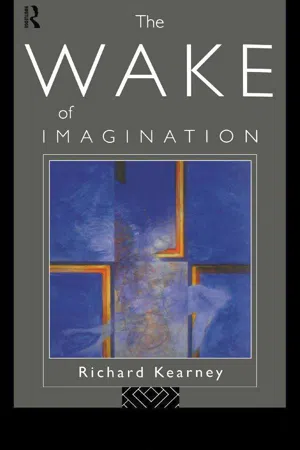
The Wake of Imagination
About this book
With his remarkable range of vision, the author takes us on a voyage of discovery that leads from Eden to Fellini, from paradise to parody - plotting the various models of the imagination as: Hebraic, Greek, medieval, Romantic, existential and post-modern.
Information
PART I
Premodern
Narratives
CHAPTER ONE
The Hebraic
Imagination
He spoke of the beginning, chaos and old night, and their division by God’s word; He recited the vigorous, blithely plural summons of God to Himself, the enterprising proposal: ‘Let us make man’…and indeed did God not go on to say: ‘in our image, after our likeness’? He spoke of the garden eastwards in Eden and of the trees in it, the tree of life and the tree of knowledge; of the temptation and of God’s first attack of jealousy: how he was alarmed lest man, who now indeed knew good and evil, might eat also of the tree of life and be entirely like ‘us’. So He drove out the man and set the cherub with the flaming sword before the gate. And to the man he gave toil and death that he might be an image like to ‘us’, indeed, but not too like, only somewhat liker than the fishes, the birds and the beasts, and still with the privately assigned task of becoming against His jealous opposition ever as much more like as possible…. The very creature which was nearer to the image of the Creator than any other brought evil with him into the world. Thus God created for Himself a mirror which was anything but flattering. Often and often in anger and chagrin He was moved to smash it to bits—though he never quite did, perhaps because He could not bring Himself to replunge into nothingness that which He had summoned forth and actually cared more about the failure of than He did about any success. Perhaps too He would not admit that anything could be a complete failure after He had created it so thoroughgoingly in His own image. Perhaps, finally, a mirror is a means of learning about oneself; Man, then was a result of God’s curiosity about Himself.
(Thomas Mann, Joseph and His Brothers)
The story of imagination is deeply informed by the ancient biblical heritage of Western culture. Together with the Hellenic sources—which make up the other most influential pole of our traditional understanding of this concept—the Hebraic account of the origin and development of imagination merits special attention. To properly grasp the founding narratives of imagination we must begin at the beginning—the Book of Genesis.
In seeking to comprehend what the Hebrew scriptures—both the Torah and Talmud—had to say about imagination, we are, of course, inevitably engaged in a circle of interpretation. This hermeneutic circle stems from the attempt of contemporary consciousness to reappropriate the meanings of ancient texts. How can we be sure we understand what was meant by the original authors and commentators of these writings? But it is not a question of retrieving some ‘original’ intention in its pristine state. Nor is it a matter of simply reducing the ancient meaning to our own contemporary context of interpretation. We are aiming at a mutual convergence of horizons, a meeting of old and new minds where each may grow from contact with the other. What is historically far removed from us may thus be brought near and reinterpreted in the light of contemporary commentaries and perspectives. But this act of reinterpretation remains a two-way process. If what is foreign to our present consciousness becomes familiar, by the same token, what is familiar becomes foreign. Or to put it in another way, in appro-priating other meanings (i.e. the old Hebrew narratives) into our perspective (i.e. the current paradigm of understanding), we also disappropriate ourselves of our own perspective in order to open ourselves to such otherness of meaning. Each is, hopefully, enlarged by the other. In this manner, the hermeneutic circle which our contemporary reading of ancient texts entails, aims at a mutual dialogue in the etymological sense of dia-legein: welcoming the difference in order to learn from it.
1 The Adamic myth: the good and evil Yetser
The story of imagination is as old as the story of creation itself. In Genesis it is suggested that the birth of the human power of imagining coincides with Adam’s transgression of God’s law. The Original Sin of our first parents marks imagination from its inception. The Knowledge of Good and Evil, which the serpent promises will make Adam and Eve ‘like gods’, is henceforth identified with man’s ability to imagine a world of his own making—a world of striving, desire, remorse and death which began with the fall from paradise into history. The Adamic myth of the first book of the Bible tells the tale of a fallen imagination. And, as we shall see, it is above all else an ethical tale.
The main Hebraic term for imagination is yetser. It is of no little consequence that this word derives from the same root yzr as the terms for ‘creation’ (yetsirah), ‘creator’ (yotser) and ‘create’ (yatsar). As the Encyclopaedia Judaica informs us: ‘Yetser as in Ps. 103:14 from yatsar, to form or create as in Gen. 2:8.’1 This allusive interplay between the terms used to describe God’s creation of the world and the First Man’s transgressive capacity (i.e. the Yetser) to imitate this divine act is highly significant. When God ‘created (Yatsar) Adam in his own image (tselem) and likeness (demuth)’ (Gen. 2:8), He risked allowing man to emulate Him, to set himself up as His rival, to supplant Him in the order of creation (see Appendix). The yetser, understood accordingly as man’s creative impulse to imitate God’s own creation, was arguably first realized when Adam and Eve ate of the forbidden fruit of the Tree of Knowledge.2 The wording of the serpent’s temptation is apposite: ‘God knows well that as soon as you eat this fruit your eyes shall be open and you shall be like Gods knowing good and evil’ (Gen. 3:5).
The initial realization of man’s imaginative potential would thus appear to correspond, in the Genesis account, with both an ethical consciousness of good and evil and an historical consciousness of past and future. It is coincident with the ability to project a future order of human creation (i.e. the sin of presumption and pride) and to recall the events of the past (i.e. guilt and remorse). The sin of imagination leads to the fall of Adam and Eve into historical time where the spirit is no longer at one with itself as in the Garden of Eden. Imagination enables man to think in terms of opposites—good and evil, past and future, God and man. Thus bringing about the consciousness of sin and of time, the fallen imagination exposes man to the experience of division, discord and contradiction. Whereas Adam lived in harmony with God in Eden, once exiled east of Eden into history he is subject to unending conflict. Adam’s transgressive act of imagination represents the alienation of God’s original creation from itself—the splitting up of the pre-lapsarian unity of Paradise into the antithetical orders of divine eternity and human mortality.
But why, we may ask, should man, created in the image of God Himself and already enjoying the paradisal privileges of such a God-like creature, have succumbed to the serpent’s temptation to become, as it were, more like God by acquiring the Knowledge of Good and Evil? And why did Yahweh create in the man and woman of his own image the potential to imagine themselves like Him even to the point of assuming themselves to be the creators of their own world? These enigmas have preoccupied commentators of the Hebraic Torah for centuries. In what follows we shall look at some of the more illuminating exegetical readings derived from rabbinical and kabbalistic sources.
In his radical commentary on the narratives of the Old Testament, You Shall be as Gods, the Jewish thinker Eric Fromm defines the term yetser as follows:
The noun yetser means ‘form, ‘frame’, ‘purpose’ and with reference to the mind, ‘imagination’ or ‘device’. The term yetser thus means ‘imaginings’ (good or evil)… The problem of good and evil arises only when there is imagination. Furthermore, man can become more evil and more good because he feeds his imagination with thoughts of evil or good. They grow precisely because of that specifically human quality—imagination.3
The biblical understanding of imagination is thus indelibly marked by the ethical context of its genesis—the rebellion of Adam and Eve. As a power first dramatized in man’s defiance of divine prohibition, the yetser bears the stigma of a stolen possession. (This feature is also evident in the Promethean myth of Greek mythology examined in our next chapter.) Was this stigmatisation the price to be paid for the full exercise of human freedom? Was this the inevitable casualty of man’s ability to knowingly choose between good and evil and thereby inaugurate an historical epoch fashioned in his own image and likeness?
The freedom acquired by imagination was, by all accounts, a mixed blessing. It was both a liberation and a curse. This essential ambiguity of imagination is analysed by the Jewish scholar, Martin Buber, in a work entitled Good and Evil. Stressing the importance of the ethical context in which the biblical concept of imagination emerges, Buber identifies the ‘dream-longing’ which characterizes our First Parents’ act of rebellion as a longing for godliness:
The serpent promises that by partaking of it (the fruit), they would become like God, knowers of good and evil; and God seems to confirm this when he subsequently says that they have thereby become ‘like one of us’, to know good and evil.4
The God-like knowledge appropriated by Adam and Eve in this manner, is the awareness of the ‘opposites implicit in all being within the world’. God Himself could legitimately know this oppositeness of creation; for He was its rightful and original Creator. Such knowledge did not alter or divide His nature as an omnipotent divinity. But for man there is no exemption; such knowledge is unlawful and divisive. Adam is engulfed, accordingly, in the alienating dialectic which ensues:
Good and evil, the yes-position and the no-position enter into the living cognizance; but in man they can never be temporally co-existent…. Through the recognition of oppositeness, the opposites which are always latently present in creation break out into actual reality…. One is ashamed of being what one is because one now recognizes this so-being in its oppositional nature as an intended shall-be.5
Split between his present being and his future possibilities of becoming, the First Man feels torn inside, out of joint with himself.
Shattering the protective dyke of paradise, Adam’s transgression unleashes the flood of contradiction which fills him with ‘shame’. He is ashamed of his nakedness before Eve and before God (Gen. 3.10). He seeks fig leaves with which to gird himself and hide his nakedness; and he thus replaces his natural condition as a created being with his first cultural artefact. This loss of innocence, of contentedness with being what he is, is the cost of the freedom to become more than he is, to make himself other than his given self, to imagine alternative possibilities of existence. But the curse of shame, anguish, labour and death which Adam’s sin entails also contains an ironic blessing. In his presumptuous bid to equal God his father, the human son loses Eden and gains history:
The curse conceals a blessing. From the seat, which had been made ready for him, man is sent out upon a path, his own, the human path. This is the path to the world’s history, only through it does the world have a history—and an historical goal…6
The freedom to choose between good and evil, and to construct one’s story accordingly, is thus intimately related to the yetser as a passion for the possible: the human impulse to transcend what exists in the direction of what might exist. The Talmud—the Jewish tradition of exegetical interpretation of the sacred texts of the Torah or Old Testament—commonly referred to the yetser as the ‘evil impulse’ (yetser hara). Any deviation from the given Creation of God was looked upon as a denial of the good. It was, of course, precisely this ‘impulse as a play with possibility’ which became manifest in Adam’s eating of the forbidden fruit—an act which, as Buber notes, thereby necessitated his expulsion from the ‘divine reality which was allotted to him, from the good actuality of creation…out into the boundless possible which he fills with his imagining, that is evil because it is fictitious’7.
Man’s ability to project imaginatively into the future opens up an infinite horizon of possibilities. He no longer lives in the immediacy of the actual moment. And so no longer present to himself, he is cast out into the chaos of a free-floating existence. (Indeed existence as the existentialist thinkers of our own century understand it—ex-sistere, standing out beyond oneself in a process of endless self-surpassing—may be said to have begun with the birth of imagination. Considered in a biblical context, one could say that if Adam had not transgressed it would not have been possible for existentialist philosophy to define man as a ‘being who is not what he is and is what he is not’—a being haunted by angst and self-division.8) The yetser is evil to the extent that man loses all sense of belonging or direction, living according to his own way rather than according to God’s way— the Hebrew term Torah means quite literally the direction of God. In short, the human imagination becomes subject to evil in that it falls victim to its own idolatrous creations. Freed from the necessity of a divinely ordered reality, the First Man faces the arbitrariness of his own imaginings:
In the swirling space of images through which he strays, each and every thing entices him to be made incarnate by him; he grasps at them like a wanton burglar, not with decision but only in order to overcome the tension of omnipossibility; it all becomes reality, though no longer divine but his own, his capriciously constructed, indestinate reality, his violence, which overcomes him, his handiwork and fate…. Phantasy, the imagery of possibilities imposes its indefiniteness ...
Table of contents
- Cover Page
- Title Page
- Copyright Page
- Acknowledgements
- Introduction: Imagination Now
- Part I: Premodern Narratives
- Part II: Modern Narratives
- Part III: Postmodern Narratives
Trusted by 375,005 students
Access to over 1.5 million titles for a fair monthly price.
Study more efficiently using our study tools.
Frequently asked questions
Yes, you can cancel anytime from the Subscription tab in your account settings on the Perlego website. Your subscription will stay active until the end of your current billing period. Learn how to cancel your subscription
No, books cannot be downloaded as external files, such as PDFs, for use outside of Perlego. However, you can download books within the Perlego app for offline reading on mobile or tablet. Learn how to download books offline
Perlego offers two plans: Essential and Complete
- Essential is ideal for learners and professionals who enjoy exploring a wide range of subjects. Access the Essential Library with 800,000+ trusted titles and best-sellers across business, personal growth, and the humanities. Includes unlimited reading time and Standard Read Aloud voice.
- Complete: Perfect for advanced learners and researchers needing full, unrestricted access. Unlock 1.5M+ books across hundreds of subjects, including academic and specialized titles. The Complete Plan also includes advanced features like Premium Read Aloud and Research Assistant.
We are an online textbook subscription service, where you can get access to an entire online library for less than the price of a single book per month. With over 1.5 million books across 990+ topics, we’ve got you covered! Learn about our mission
Look out for the read-aloud symbol on your next book to see if you can listen to it. The read-aloud tool reads text aloud for you, highlighting the text as it is being read. You can pause it, speed it up and slow it down. Learn more about Read Aloud
Yes! You can use the Perlego app on both iOS and Android devices to read anytime, anywhere — even offline. Perfect for commutes or when you’re on the go.
Please note we cannot support devices running on iOS 13 and Android 7 or earlier. Learn more about using the app
Please note we cannot support devices running on iOS 13 and Android 7 or earlier. Learn more about using the app
Yes, you can access The Wake of Imagination by Richard Kearney in PDF and/or ePUB format, as well as other popular books in Philosophy & Aesthetics in Philosophy. We have over 1.5 million books available in our catalogue for you to explore.