eBook - ePub
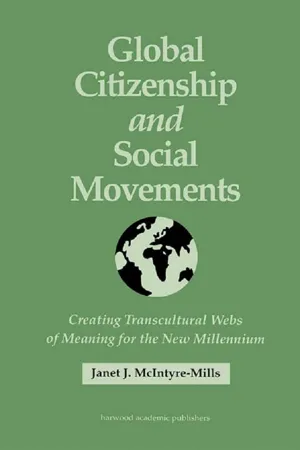
Global Citizenship and Social Movements
Creating Transcultural Webs of Meaning for the New Millennium
- 192 pages
- English
- ePUB (mobile friendly)
- Available on iOS & Android
eBook - ePub
Global Citizenship and Social Movements
Creating Transcultural Webs of Meaning for the New Millennium
About this book
In this book, Janet McIntyre addresses the need for transcultural thinking tools, to not only mend problems in the global environment but also to understand the essential nature of the problems. Thinking tools comprise the analytical concepts which organise, disorganise, pattern and question thoughts about the social and natural world. Specifically, the concepts introduced in this book are 'global citizenship', 'human rights', 'responsibility', 'social movements' and 'transcultural webs of meaning'.
Information
1
Introduction
This essay is based on my varied experiences as a researcher and as a university and community educator, facilitator and planner in a wide range of contexts. The focus of my development work—theoretical, practical and applied—has been to understand the way in which social problems are constructed by different interest groups. So much energy is focused on solving problems without agreement on the nature of the problem. The way reality is constructed is based on our assumptions and values. The first goal of this essay is to convince the reader that inclusive thinking, which traces common webs of meaning across the separate frameworks of cultural and social values, can be taught by means of thinking tools. People can be educated to work with ideas and assumptions rather than within the boundaries of a prescribed orthodoxy. The second goal is to argue that tools for thinking and communicating can help us re-work the categories that limit our thinking by forging transcultural webs of meaning.
Webs are created as a result of a belief that by virtue of our common humanity and common environment, we need to cocreate our futures. Mapping the different perceptions of interest groups and ascertaining the reasons why people think in particular ways are the first steps for working together. By using a range of thinking tools, we can help interest groups think beyond frameworks of meaning and, instead, think in terms of links, overlaps and webs. This could enhance the likelihood that people will choose “pooling, allying and linking” (to use Moss-Kanter's, 1989 term in a broader sense) to solve problems. Such an approach makes more sense in terms of our long-term survival as human beings on this planet. By using group work skills together with problem-solving techniques, common ground can be created, provided the socio-political and economic contexts in which we work are clearly understood and the political will to cooperate exists or is created as a result of a realization that we share one environment and similar needs because, biologically, we are “of one body”. The processes involved encompass more than merely sharing information and building alliances. They also involve helping interest groups to abandon the notion of closed frameworks for understanding.
Recent experience of working in the arid zone of Central Australia, Alice Springs highlights the need to find sustainable development solutions. Alice Springs is a borderlands of cultures. The First Australians are concentrated in this urban centre and the cultural diversity is heightened by large numbers of international and local travellers and immigrants from European and Asian countries. The First Australians, no longer restricted by government wardships or missions, have resumed moving across the land as they did prior to colonisation. This movement between urban areas and ‘country’, along with land title, must also be considered as an indigenous social movement and a challenge to their status as the most marginalised of all Australians (Coulehan, 1998).
The effects of colonisation on Aboriginal people are still visible in terms of all social health indicators, for instance: the highest incarceration rates ‘courtesy’ of a Northern Territory law called mandatory sentencing, unemployment rates, morbidity and mortality rates. Poor diet, extensive use of alcohol and risk-taking behaviour are associated with a sense of having little personal control over their lives. This leads to high injury rates.1 The notion of being a nation within a nation is, however, a powerful reply to this sense of being treated as second-class citizens. Their sense of national identity is built upon a sense of the sustainability of the environment, through living in harmony within a fragile arid zone. The liberative potential of this concept of nationality lies in the potential to contribute to the social movement for an ecologically sustainable future.
The lack of effective communication across cultures underlines the need for transcultural thinking tools that can facilitate mutual understanding and assist in developing a shared political will based on a belief that all cultural maps have creative potential. By learning to consider the way in which cultural maps can overlap, extend and complement one another, problem-solving can be made easier. Ecological and humanistic thinking are required for solving some of the toughest challenges in the next millennium.
The world we live in today has two opposing dynamics: globalisation of the economy and an approach to social change based on a sense of shared interests, which lead to wide-ranging social movements. Biologically, human beings have in common one environment and shared human needs. Political and economic common denominators are increasingly recognised. Simultaneously, a strong tendency exists to splinter off from a shared sense of global interests, to fragment into nation states and for political parties to step back in time to a bounded set of ethnocentric and/or nationalistic policies. These paradoxical characteristics need to be addressed.
Without cooperation and the recognition of common goals we are doomed to conflict and the waste of human and natural resources, therefore competition is harmful and irrational, rather than rational economic behaviour.
It is assumed throughout that:
• responsible global citizenship is a process and goal of development;
• the nature of social development can only be defined in terms of intersubjective dialogue;
• the closest we can get to ‘truth’ is through trying to see the point of view of all the stakeholders within specific socio-cultural, political and economic contexts.
A nihilistic notion of extreme relativism is avoided because if there are no absolutes there can be no recognition of the imperative to recognise our sharedness, which is vital for social justice and survival of systems. Recognition of the balance between diversity and common denominators is the goal of global rights and responsibility. It is based on the normative assumption that by virtue of our common humanity, we do have common denominators: similar biology and one ecosystem to meet our shared needs:
— Private troubles and public issues are central concerns of a social justice that is sensitive to differences in life chances.
— Critical thinking tools can be developed for creative thinking and problem-solving across disciplinary boundaries. The interlinked world of private enterprise and the contracting public welfare sector need to be explored.
— Social change is only possible by expanding the power base of concerned interest groups. Social movements are the political vehicles of concerned interest groups. Only wide-ranging networks set up by a host of social movements concerned about “staying” the so-called hidden hand of the rational market can provide an equal balance. Stretton's (1990) unpublished paper, “Australia on the road to Mexico,” argues that “Most of the serious difficulties in resuming sovereignty over our economy are not technical, but political” (p45). The essence of his argument is that political parties to the Right and Left in Australia have from the time of Paul Keating, allowed the markets to dictate. In his opinion strong opposition is required to restore faith in limited control of markets. The re-introduction of a version of Keynesianism seems to be the thrust of his paper. He advocates a strong trade union movement to challenge current policies. But adopting a much broader social movement approach could increase the likelihood of change.
— We need creative thinking tools for the new millennium to address the fallout caused by rapacious forms of capitalism and socialism. Economic rationalism is a current orthodoxy, which appeared to be self-producing only because the model has been reified into an artificially closed system. Once its flaws became apparent as a result of the collapse of economies, even the most mainstream economists have begun to question the unrestrained rule of markets. The need to intervene and not allow markets to dictate has become a policy agenda once again. What is needed is much greater reconsideration of the nature of economics, the environment and sustainable social justice. This requires setting aside the sort of technocratic thinking that involves concentrating on the visible, the concrete without unpacking the reason why a social issue or disease occurs. The clinical response is a prescription. The economic rationalist response is to continue to apply ‘the market rules’ philosophy. The social work response is to ameliorate with welfare programs and projects without rethinking structure. Technocratic thinking, if used alone, has a “go no further effect” (Zola, 1975). Technocratic thinking is not to be confused with the creative application of technology together with a critical approach to solving problems. Technology, per se, is not the problem. It is only a problem when technology is seen as an end in itself without considering wider issues.
Culture is the set of learned ideas and behaviour that groups of people develop in relation to their environment. Culture is a way of life; it is the way people express themselves in social, political and economic terms in response to their natural environment. Culture includes ideas and values about the social, the built and cultivated, and the natural environments.
Although separate cultures need to be given some unfettered individual space to preserve diversity, the common needs of the environment should be held uppermost. Human beings as global citizens must remember their individual rights and collective responsibilities. This work highlights a belief in the ability of human beings to map their world rationally in reaction to strands of postmodernism, which cynically set aside the notion that any absolutes exist.
The roots of cultural mapping lie in many disciplines. Historians, travel writers, early ethnographers, sociologists and social anthropologists mapped the picture of culture from the point of view of the early settlers. The colonial and masculine viewpoints have been challenged and expanded by feminist “herstories” and indigenous stories, which tell of the same events from different sets of assumptions and values. Mythology, history and “herstory” have equal status in cultural maps. Cultural mapping can represent multiple points of view. As such, it can be a vehicle for achieving mutual understanding and respect for cultural diversity. The goal of cultural mapping is an appreciation that the overlays of many perspectives enrich and expand human understanding. A key function of cultural mapping is to identify information for problem-solving to ensure that human and natural resources are used to the benefit of all citizens. The challenge is to integrate ideas without sacrificing the representation of diversity. This can be achieved by ensuring that each theme is mapped using multiple overlays of paradigms. Cultural maps need to be linked and over-laid so as to benefit from seeing one social issue from many perspectives.
The process for celebrating diversity and preserving creative rights whilst developing collective responsibility is paradigm dialogue (PD). This volume develops a definition of PD and its implications for systemic thinking. Participation as a panel member in a session entitled ‘Paradigm Dialogue’ (PD) at the 14th World Congress of Sociology in Montreal served to underline and develop the specific way in which the concept is used in this argument. In everyday life, PD is about the mechanics and ethics of having a democratic conversation that enables all participants to express their points of view and be listened to with respect. The assumptions are humanistic (Smaling, 1998). PD ensures that researchers using particular research methodologies engage in dialogue with those using different methodologies to prevent misunderstanding a slice of reality (Blaikie, 1998, Romm, 1998). More specifically, PD can be used to bring about democratic changes in a range of applied-action research contexts. The implications for praxis are important (Weil, 1998). The version outlined below includes all these definitions of PD but argues that PD is also about reconsidering; a) the nature of knowledge; b) the process of creating knowing and c) the implications of adopting open and closed stances to paradigms for our human and ecological future. This work attempts to address interlinked socio, cultural and ecological concerns locally and globally. The approach is transdisciplinary and explores concepts not normally considered in juxtaposition. The argument is wide-ranging and spans disciplinary parameters, it emphasises the need for theoretical and methodological literacy in order to address complex social problems.
PD extracts the liberative potential from paradigms rather than pitting one paradigm against another in a competitive way. The argument developed below cannot be dismissed by some as “warm fuzzy thinking”, because our welfare and that of our ecosystem depends on the ability of human rationality to evolve from thinking in categories to thinking systemically. The goal of PD is to use thinking tools to extract the ‘liberative potential’ (Gouldner, 1971, 1980) from a wide range of ideas in order to solve complex social and environmental concerns.
Human beings are not the same as animals. We are not programmed entirely by instinct; we are able to be reflexive about our thinking even though we may be limited by the extent of our knowledge, which is contextual. Aristotelian logic organises and controls by classifying phenomena. Discourses embody binary oppositions: yes/no, black/white, self/other, right/ wrong, civilised/uncivilised, normal/abnormal, pure/impure, safe/dangerous. Foucault (1967) explores the space or divide between self and “other” created by thinking spatially in terms of categories. Knowledge is based on antagonism, competition and “fighting for territory” and defending it through drawing the “line in the sand” and through alienation. Foucault meticulously examines the implications of binary oppositions in human knowledge and human organisation.
The enlightenment version of humanist thinking based on the essential rationality of human beings led to control and power over others and nature. ‘Power over’ requires maintaining the separation between “Self” and “Other”. Human beings were deemed able to “tame”, “civilise” and “colonise” nature and “the other”. Despite this, it is undeniable that Aristotle'sapproach to dialogue did have potential. Unlike Plato, however, instead of engaging in dialogue to find knowledge through unity and seeing the bigger picture, he developed the notion of divisions in order to make sense of the world. Thus it did not follow through the dialectical potential of his version of dialogue that silenced the opposition once it had engaged in a win-lose dialogue. This became the imperative of science.
What needs to be underlined here is that the successful and largely unchallenged establishment of an empirical mode of thought led away from any temptation to indulge in the construction of an intellectual or theoretical totality. If the world is composed of millions of empirical situations, it can be catalogued, but not captured in a single a priori theory or overriding explanation, with the crucial exception of the mind of God. In this perspective, theories are just the accumulative and organisational frameworks of so many facts that make up an ultimately knowable world. It involves an implicit and unacknowledged metaphysics of its own—the stable referent of an irrefutable and independently verifiable world—that was usually displaced into the apparently neutral language of ‘science’ and ‘learning’ (Chambers, 1990).
It is argued that the closest we can get to truth is through dialogue. But, paradoxically, a celebration of diversity cannot silence the one ultimate truth: namely, that human beings are systemically linked to one another and to their ecosystem. This essay explores and celebrates the human paradox—the will to be a creative individual and active agent and the necessity to be part of a collective system.
This acknowledgement of our interlinked reality does not mean that the rich and powerful should have the right to pit nature against the rights of people, particularly those who are less economically dominant in terms of current standards. Ecological thinking is about solving problems through understanding systemically rather than apportioning blame to ‘the other’.
Colinvaux (1978, 1980) argues that species of animals and the species Homo Sapiens compete for scarce resources. Human beings try to maximise their survival by maximising the number of their offspring through developing a cultural niche, which initially was geographically limited. But as creative people developed technology and as trade developed, some were able to claim wider niches. These gave them power over others of the same species. All people share, biologically, a common genotype, with very superficial physical differences, but are able to use culture ingeniously to adapt to different environments. Human beings form one species and have in common one environment. Thus, national identities have been used as a means of differentiating one group from another and as a means of competing for scarce resources.
If we take the ecological thesis seriously, as human beings develop technology and expand their niche to serve the interests of their children at the expense of those of other nations, we could lapse into a type of fatalistic cy...
Table of contents
- Cover
- Half Title
- Full Title
- Copyright
- Contents
- Acknowledgments
- 1 Introduction
- 2 Intellectual Courage and Intellectual Conformity
- 3 Tools for Transcultural Ethical Thinking
- 4 Ecological and Critical Humanism (EcoHumanism): Creating Webs of Meaning Through Paradigm Dialogue
- 5 The Rights and Responsibilities of Global Citizens: Pragmatism, Ethics, and Survival at the Coalface of Bureaucracies
- 6 Class, Culture and Sustainable Global Democracy
- 7 Conclusion. Beyond Nationalism: Striving for Global Democracy Within Conceptual Space, Cyberspace and Geographical Space
- Endnotes
- Bibliography
- Index
Trusted by 375,005 students
Access to over 1.5 million titles for a fair monthly price.
Study more efficiently using our study tools.
Frequently asked questions
Yes, you can cancel anytime from the Subscription tab in your account settings on the Perlego website. Your subscription will stay active until the end of your current billing period. Learn how to cancel your subscription
No, books cannot be downloaded as external files, such as PDFs, for use outside of Perlego. However, you can download books within the Perlego app for offline reading on mobile or tablet. Learn how to download books offline
Perlego offers two plans: Essential and Complete
- Essential is ideal for learners and professionals who enjoy exploring a wide range of subjects. Access the Essential Library with 800,000+ trusted titles and best-sellers across business, personal growth, and the humanities. Includes unlimited reading time and Standard Read Aloud voice.
- Complete: Perfect for advanced learners and researchers needing full, unrestricted access. Unlock 1.5M+ books across hundreds of subjects, including academic and specialized titles. The Complete Plan also includes advanced features like Premium Read Aloud and Research Assistant.
We are an online textbook subscription service, where you can get access to an entire online library for less than the price of a single book per month. With over 1.5 million books across 990+ topics, we’ve got you covered! Learn about our mission
Look out for the read-aloud symbol on your next book to see if you can listen to it. The read-aloud tool reads text aloud for you, highlighting the text as it is being read. You can pause it, speed it up and slow it down. Learn more about Read Aloud
Yes! You can use the Perlego app on both iOS and Android devices to read anytime, anywhere — even offline. Perfect for commutes or when you’re on the go.
Please note we cannot support devices running on iOS 13 and Android 7 or earlier. Learn more about using the app
Please note we cannot support devices running on iOS 13 and Android 7 or earlier. Learn more about using the app
Yes, you can access Global Citizenship and Social Movements by Janet McIntyre in PDF and/or ePUB format, as well as other popular books in Politics & International Relations & Democracy. We have over 1.5 million books available in our catalogue for you to explore.