This book analyses the planning and policy world of major infrastructure as it is moving now in Europe and the UK. Have some countries managed to generate genuine consensus on how the large changes are progressed? What can we learn from the different ways countries manage these challenges, to inform better spatial planning and more intelligent political steering?
Case studies of the key features of policy and planning approaches in France, Germany, the Netherlands, Spain and the UK are at the core of Planning Major Infrastructure. This includes the different regimes introduced in England and Wales, and Scotland, brought in by reforms since 2006. High speed rail, renewable energy deployment, water management, waste treatment – all raise critical planning issues. The case studies connect to the big issues of principle which haunt this field of public policy: how can democratic legitimacy be secured? How can ecological and economic transitions be managed? What is the appropriate role of the national government in each of these areas, as against other levels? What part has the EU played, and should it be involved in the future? These are some of the central themes raised in this innovating exploration of this currently high profile field.
- 304 pages
- English
- ePUB (mobile friendly)
- Available on iOS & Android
eBook - ePub
About this book
Information
PART I
Framing infrastructure and planning
CHAPTER 1
INTRODUCING INFRASTRUCTURE AND “INFRASTRUCTURALISM”
BIG INFRASTRUCTURE
For a very long time, societies have been building large physical structures or objects, which support the way they interact with their surroundings. Enabling travel (ports, roads) and managing water (reservoirs, aqueducts) go back several thousands of years, and are especially associated with powerful states and empires. With the industrial revolution, this process became much more dynamic, creating ever larger systems, moving faster, using enormous quantities of energy. The globalisation of industrialism since the mid-twentieth century means that ever fewer parts of the planet are free of these systems – roads, bridges, power stations, pipelines, airports. They are the objects analysed here. Just type in any of these words to a search engine and you will find dozens of pictures of these objects, worldwide. Many of them will be very recent, and will have gone through lengthy planning processes. Missing will be many elements of infrastructure, proposed but halted by planning processes (amongst other forces).
No attempt is made to match this global reach in this book, with research limited largely to western Europe. This is the result of a personal capacity, as well as prior experience, easy with the planning systems and governing schemas of this part of the world. Many of the basic analytical approaches and principles are doubtless transferable to other world regions, given the nature of globalisation, especially in the force of global finance and globalising companies, but also given the power of neoliberal ideology, insistent in its effects almost everywhere. But there would also be big differences in any attempt to extend analysis elsewhere. In particular, much of what is said about planning approaches will not travel too well to other regions. But politics, economics, geographies and much more also differ radically. So the balancing of commonalities and differences would be quite a complex one.
WHAT DO WE MEAN BY INFRASTRUCTURE?
Infrastructure is one of those words for which, if you ask people for a definition, you will get different answers. Each person will start by saying that they know roughly what they mean by it. But there will be subtle (or not so subtle) differences between each definition. This will apply just as much in everyday talk as in academic disciplines. So we need to start with some idea of these varying understandings. There may be no “correct” answer in the end, but there will be a useful and practical one for the purposes of this book on the planning of major infrastructure.
Sometimes quite wide definitions are adopted, such as that which appears in one of the most entertaining books on infrastructure (perhaps a small field), by Brian Hayes that focuses on the US (Hayes 2005). He includes mining, farming and food industries, although not by and large manufacturing industries more generally, as well as the networked industries.
Planners may see infrastructure as all the physical things needed to support a new development – roads, sewers, water supplies and energy sources, for example. They may then add on social sorts of infrastructure, such as schools or clinics or hospitals. And in recent years, “green infrastructure”, open spaces of various biotic forms, may be put on to the list. The definition used by the UK government for its Community Infrastructure Levy in 2010 had all of this, including “transport schemes, flood defences, schools, hospitals, and other health and social care facilities, parks, green spaces and leisure centres” (DCLG 2010a). Engineers may be more comfortable with just the basic products of their trade – roads, sewers etc. Economists may regard it as everything which supports the economy, which can be as wide as all the built environment and all the training of the labour force, so houses or universities become infrastructure. One understanding of this is shown in Figure 1.1, from RREEF, the infrastructure investment arm of Deutsche Bank. So already we see big divergences, escaping out of the bounds of common sense usage.
Figure 1.1 Classification of infrastructure assets by a leading fund operator, RREEF
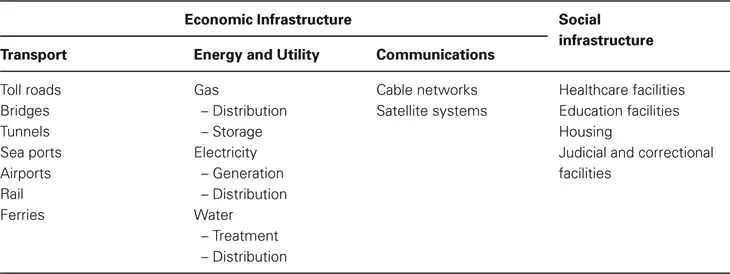
(Source: RREEF 2005 Understanding Infrastructure, from RREEF internet pages 2008).
An older dictionary definition is this: “inner structure, structure of component parts; a system of communications and services as backing for military or other operations” (Chambers Twentieth Century Dictionary, 1972/1977 edition, Edinburgh: Chambers). To an extent this carries us back to the Latin derivation, with “infra” meaning below. Early usages were indeed particularly military. It was only in the later twentieth century that, in English at any rate, the word began to be used more widely to cover the sorts of matters referred to above. The intention was to separate out a part of social equipment from the use of that equipment, just as armies distinguished the physical preparation from the actions of war or potential war. But this has been a creeping growth of usage, one reason for the fuzziness which infuses the concept.
One might have thought that the meaning would be illuminated by contrast with the apparent opposite, superstructure (or suprastructure to be exact). But this has never come to be in common use in the same way. For Marxists it was often one half of the “base–superstructure” duality, with crude versions of this having the economy as the base which in turn “determined” the rest – values, ideologies and so on reflecting economic fundamentals. But this was always uncomfortable for most of the more complicated Marxisms, and never brought in the discussion of infrastructure. English speakers use the word superstructure just to mean the outer part of a building or structure, or metaphorically as some sort of addition or accretion, not really as any sort of opposite to infrastructure.
If derivation or linguistic research does not help us much, we may turn to recent historical impressions. It would appear that the word began to become more common from about the 1960s, in fields like engineering, economics and planning. Until then, and to an extent much more recently, and often still today, it was more normal to be direct and concrete, to refer to transport systems, or just roads and railways, or to sewer systems, or to power stations. There was not much need to have an overarching or more abstract category, even though there was some awareness that such a thing existed. Frey (2005) argues that the rapid economic growth of the post-war years showed up bottlenecks in communication. He says the term was used first of all in the French railway system to refer to the lines, bridges and tunnels (but not trains themselves), and that NATO then adopted it when talking of provisioning depots, radar stations and barracks (but not weapons systems). Already by the 1960s a literature had grown up in West German academic circles (Jochimsen 1966, Jochimsen and Simonis 1970, Frey 1972). However, my impression is that this remained largely within these circles, not spreading much until later, and then hardly using the insights of this literature. We will come back to this, particularly in discussing the approach of economists – probably the discipline which gave the field most attention theoretically, as against the practical concerns of the engineers.
It appears that the word was rising hand-in-hand with another term, “logistics”. In his fascinating history of the container, Levinson (2006 p.266) says that “before the 1980s, logistics was a military term”, but had by 1985 become a routine business function. This he ascribes to the advance of global supply chains and just-in-time practices made possible by containerisation, which he sees as a key material carrier of globalisation. The whole new profession of logistics management, spreading across the manufacturing, transport, wholesaling and retailing sectors, places infrastructure issues in the spotlight, in a way in which they were not before.
The struggle with definition has continued, with Edwards (2003) trying “essentially any important, widely shared, human-constructed resources” (p.187), though falling back by the bottom of the same page to the idea that it may be “best defined negatively, as those systems without which contemporary societies cannot function”.
More on the reasons for infrastructure’s rise will follow in this and the next chapter. From the 1980s, in particular, the now elastic usage developed. Some theorists drew the lines very widely, some very narrowly, depending on their substantive or value concerns. Development economists were aware from an early stage of the varying usage, and it is not surprising that some of the first discussions of the usefulness of infrastructure creation came from World Bank economists, who were therefore obliged to draw lines round the object they were studying. Urban planners were less concerned with the category, working rather with their headings of transport or water supply and so on, but by the 1990s it was beginning to be a target of discussion in English speaking countries.
By the early 2000s, the term was increasingly prevalent, at least in the developed world. It had by no means elbowed aside the more specific terms, either in common discussion or in academic fields. But it was, again especially in English speaking countries, seen as a significant policy zone of states alongside others of older standing – welfare, environment and security, for example. We will see frequent evidence of this as the details of the themes and country studies unfold. For example, in 2010 the Dutch government changed the organisation of its ministries – not, as in many countries, a common event, but something that tends to happen every 20 or 30 years. Two rather venerable ministries ceased to be: that of VROM, including environment, housing and urban affairs and planning, and that of transport and water management. Most of what had comprised the two ministries was combined as a single ministry titled Infrastructure and Environment. Infrastructuralism had become institutionalised in the Netherlands.
All this is important, as it should alert readers to the historical specificity of the whole field. It is useful for us to remember the inherent slipperiness of the concept. This should put up warning signs. Though by necessity it will be essential for me to define what I mean by infrastructure, so that you can understand what I am saying, it is worthwhile remembering that, just like any other concept, this carries with it histories and drives. Infrastructure is not innocent. As long as we know what we are talking about, it is not dangerous or necessarily liable to mislead. But the framing is still critical. This is in line with the movement within the social sciences, in recent decades, which stresses such framing – interpretive social science (Fischer 2003, Hajer and Wagenaar 2003, Jensen and Richardson 2004). This is not to say that this book will be primarily written in those terms. My approach is in fact much “flatter”, once the basic terms are defined. This is as much a matter of personal comfort and basic thought patterns, as thought-out theory. But the interpretive approach is most valuable in reminding us of the constructedness of the field we are looking at here.
THE INFRASTRUCTURE STUDIED HERE
The focus of this book is on “hard” or “networked” infrastructure, and on the major elements of this. Thus hard/networked infrastructure means water, energy, transport and waste treatment systems. This means that “social” infrastructure such as health and education systems is not treated here. It is noteworthy that Infrastructure UK (HM Treasury 2010) adopted this division of “economic” and “social” infrastructure in its National Infrastructure Plan, signalling the critical importance of the first, as against the second, which was being very heavily cut back by the new Conservative–Liberal Democrat government. Such social infrastructure raises different issues, because of the nature of the functions and the way they have been classically dealt with by governments (mainly in the public sector), as well as the public reactions in planning (people rarely campaign against the building of a local school). It is true that the advance of neoliberalism, tending to commodify all social provisioning, may in due course make social infrastructure more similar to the areas examined here. But differences will remain – hospitals and the health sector are largely private in the US, but they are still quite different from the networked infrastructure industries.
Not included are information-technology systems and telecommunications. These are widely regarded as just as critical to economic progress and social existence as the other forms. They are excluded here for two reasons. The primary one is that they raise far less significant planning issues. It is true that mobile-phone masts have been an issue in some places at certain times, in the UK at least. But this has been occasional, and it is clear that the enormous project of rolling out broadband around the advanced world has not been held back, or raised big confrontations, in the way that has happened in other sectors. Equally, the companies involved and the regulatory machinery invented by governments have not been so newsworthy or subject to such big societal debates. In addition, any way of cutting down the range of areas about which I needed to learn was seized, so this sphere, though doubtless of much greater interest from several economic or sociological perspectives, was left aside. Graham and Marvin’s original groundbreaking book, Splintering Urbanism (2001) valuably brought in this sector, making the links to the other networked industries, and related work can be traced by those who are interested in this area.
The other exclusions are the “minor” elements of these infrastructure sectors. Normally the consumer end of these systems is not so problematic, as pipes or wires or small roads enter neighbourhoods. This may not mean that the issues involved are insignificant, especially in financing and maintenance. In the UK there has been a long-running discussion about how some of this local infrastructure should be financed (Ennis 2003, Morphet 2011). Since the 1980s the cuts in public financing have pushed local authorities to extract “planning gain” or “planning obligations” from private developers of housing or other schemes, paying for roads, open space or often larger facilities like schools or health centres. In the 2000s the Barker reports on housing and planning (2004, 2006) suggested reforming this system, either by means of a development tax, a weak version of the sort of systematic approach used in Spain, or by a weaker Community Infrastructure Levy (CIL), a more systematic approach to the existing planning gain system, which was legislated for in the 2008 Planning Act. The post-2010 UK government retained the CIL, but it remains to be seen how well this will work alongside, or instead of, the planning obligations system (DCLG 2010a). Whilst of critical importance in themselves, these issues are not dealt with here. They relate very much more to how development as a whole is regulated and paid for, and to the compensation and betterment issues which have implicitly dogged most planning systems since their foundation, than to the kinds of issues which frame major infrastructure development (or non-development). Naturally the two fields are not wholly separate, affected as they are by some common trends, particularly the retreat of public funding and public ownership. But they can be relatively easily separated out, and that is done here.
WHY HAS MAJOR INFRASTRUCTURE BECOME A BIG ISSUE RECENTLY?
As explained above, infrastructure has been around for a very long time, whatever it has been called. No answer that claimed that there is something dramatically new about the infrastructure now proposed would have much validity. So we have to search for an explanation in other aspects of the contemporary world, as to its current prominence in debate and politics.
Neoliberalism
The word “neoliberalism” is for some a key concept, for others a lazy resort to ideological explanation when more specific factors should be called on. Here it is treated as an essential element of understanding the current world. There is no doubt that it is a fuzzy concept. Recent academic discussion has noted its “variegated” form (Brenner et al 2010). But we need some shorthand for the changes that the world, and above all capitalism, has undergone in recent decades. The generally accepted account is that the post-1945 form of capitalism started to come under pressure in the 1970s, and that the political transformation was led in earnest by leaders like Reagan, Thatcher and Pinochet in the 1980s (Harvey 2005). In due course this has led to a much more market driven world, with almost all countries affected, since the collapse or internal transformation of virtually all Communist regimes since 1990. Bob Jessop (2002, 2008) analyses this as the shift from the Keynesian Welfare National State (KWNS) to the Schumpeterian Workfare Post-national Regime (SWPR). Neil Brenner (2004) uses the phrase Rescaled Competition State Regime (RCSR). Each therefore draws on different features. Jessop contrasts the roles of the two famous economists John Maynard Keynes and Joseph Schumpeter, the way that labour and welfare are treated, and the partial supersession of national state powers. Brenner stresses competitiveness as being at the core of the change, but also emphasises power shifts at the sub-national level (cities and regions) and at the level of bodies such as the European Union and global organisations like the World Trade Organisation.
These acronyms can be used as shorthands to the changes that have occurred. It must be remembered, and the country chapters will make this very clear, that these changes were very variable in space and time and that they remain in process, and not necessarily unilinear. In other words, neoliberalisation is by no means “complete”, whatever that could mean, and it could still be reversed – as it has been in some countries, mainly in secondary ways (such as taking water systems back into public ownership). The global economic crisis which began in 2008 is playing a part in this, above all in the global North, and the outcome remains uncertain as to how this will unfold over the years.
A simple bedrock idea of this book, hardly a novel one, is that this neoliberalising epochal change is at the base of the new ways in which infrastructure has come to be treated, in western Europe and worldwide. It is not the only element, but without this, large parts of what is analysed here would be different. A more detailed account of this shift is reserved for Chapter 2. The essential features in this field are that infrastructure is now regulated, financed, owned and managed in new ways, and this affects its planning: the search is on for new regimes of planning to fit these new realities.
The precise way in which neoliberalisation impinges on infrastructure fields will emerge throughout the book, so the details will not be explored here. The essence lies in the creation of new forces, both economic and political, which create a new urgency and salience to many infrastructure fields. State policies respond to these pressures, though in different ways in each country, and to an extent within countries.
Sustainability and nature
The same period in which neoliberal ideas and practices have developed their sway over the planet has seen the rise of ideas about nature and sustainability that are very different from those before the 1960s or 1970s. There are some links between the two shifts, but only indirect ones – they are largely autonomous, though how environmental or ecological ideas actually get expressed or acted on is greatly affected by the political economy, more or less neoliberalised. Again in shorthand, green thought has moved through changing understandings of nature and development, marked b...
Table of contents
- Cover
- Title
- Copyright
- Contents
- Acknowledgements
- Preface
- PART I. Framing Infrastructure and Planning
- PART II. National Case Studies
- PART III. Conclusions
- References
- List of Interviewees
- Index
Trusted by 375,005 students
Access to over 1.5 million titles for a fair monthly price.
Study more efficiently using our study tools.
Frequently asked questions
Yes, you can cancel anytime from the Subscription tab in your account settings on the Perlego website. Your subscription will stay active until the end of your current billing period. Learn how to cancel your subscription
No, books cannot be downloaded as external files, such as PDFs, for use outside of Perlego. However, you can download books within the Perlego app for offline reading on mobile or tablet. Learn how to download books offline
Perlego offers two plans: Essential and Complete
- Essential is ideal for learners and professionals who enjoy exploring a wide range of subjects. Access the Essential Library with 800,000+ trusted titles and best-sellers across business, personal growth, and the humanities. Includes unlimited reading time and Standard Read Aloud voice.
- Complete: Perfect for advanced learners and researchers needing full, unrestricted access. Unlock 1.5M+ books across hundreds of subjects, including academic and specialized titles. The Complete Plan also includes advanced features like Premium Read Aloud and Research Assistant.
We are an online textbook subscription service, where you can get access to an entire online library for less than the price of a single book per month. With over 1.5 million books across 990+ topics, we’ve got you covered! Learn about our mission
Look out for the read-aloud symbol on your next book to see if you can listen to it. The read-aloud tool reads text aloud for you, highlighting the text as it is being read. You can pause it, speed it up and slow it down. Learn more about Read Aloud
Yes! You can use the Perlego app on both iOS and Android devices to read anytime, anywhere — even offline. Perfect for commutes or when you’re on the go.
Please note we cannot support devices running on iOS 13 and Android 7 or earlier. Learn more about using the app
Please note we cannot support devices running on iOS 13 and Android 7 or earlier. Learn more about using the app
Yes, you can access Planning Major Infrastructure by Tim Marshall in PDF and/or ePUB format, as well as other popular books in Politics & International Relations & Urban Planning & Landscaping. We have over 1.5 million books available in our catalogue for you to explore.