From the foreword: This book is a major contribution to the field of comparative and international education. It has been co-authored by two distinguished figures, who write with authority and clarity, and who present conceptual insights which add creative and intellectual vitality to the field at a time of major change and development.
Changing geopolitical relations, the acceleration of globalisation and major advances in information and communication technology have all transformed and revitalised international and comparative research in education. This multidisciplinary book critically examines the implications of this change for those engaged in such work worldwide. Groundbreaking and insightful, it draws on the latest research and developments in the field to give a comprehensive overview and analysis of the contemporary condition of this valuable form of research.
Drawing upon the authors' extensive international experience, the text:
* Re-assesses the diverse and multidisciplinary origins of this field of study:
* Documents the increased orientation towards research;
* Explores the changing nature of the problems and issues faced by both new and experienced researchers;
* Puts forward a coherent and well-informed case for a thorough reconceptualisation of the field as a whole.
The book argues eloquently for increased cultural and contextual sensitivity in educational research and development in order that the field might make a more effective contribution to educational theory, policy and practice. This multidisciplinary work will be welcomed by a wide range of theorists and researchers in education and the social sciences, as well as teachers, policymakers and anyone concerned with improving dialogue and understanding across cultures and nations.
eBook - ePub
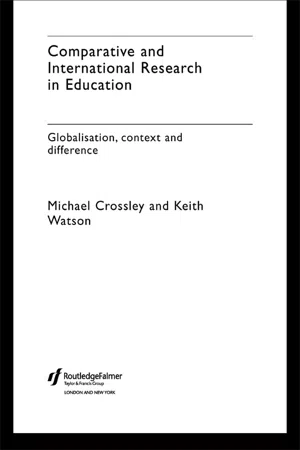
Comparative and International Research In Education
Globalisation, Context and Difference
- 192 pages
- English
- ePUB (mobile friendly)
- Available on iOS & Android
eBook - ePub
Comparative and International Research In Education
Globalisation, Context and Difference
About this book
Information
Chapter 1
Introduction
At the outset of what has been called the ‘Global Century’ there is much evidence of a revitalisation of the field of comparative and international education that few would have envisaged even a decade ago. The impact and implications of intensified globalisation and rapidly changing geopolitical relations underpin much of this revitalisation, as do dramatic advances in information and communications technology, paradigmatic challenges and developments across the social sciences, and the relative ease of international travel that has come to characterise our times.
A research orientation
A research orientation is evident in this revitalisation and in the emergence of related research centres and research training initiatives. These trends are well documented by directories such as those produced by Dyer and King (1993) and Altbach and Tan (1995); and by related reviews of organisational developments, institutional capacity and the growth of national comparative education societies (Bray 1998; Tjeldvoll and Smehaugen 1998; Schweisfurth 1999; Wilson 2003). To this we can add evidence of the buoyant expansion of the World Council of Comparative Education Societies (WCCES), the emergence of new specialist journals, the research impact of international development agency involvement in the South, and the growing influence of large scale, collaborative research initiatives. Indicative of such developments are the various African Education Research Networks (Mwiria and Wamahiu 1995), the vibrant Northern Policy Research and Advisory Network on Education and Training (NORRAG) (King and Buchert 1999), the European Union funded PRESTIGE (Training and Mobility of Research) initiative (Phillips and Economou 1999), and the globally influential International Association for the Evaluation of Educational Achievement (IEA) (Postlethwaite 1999).
International interest in the latter, largescale, comparative studies of educational achievement, and in the methodologies employed in their design, is often motivated by concern for system differentials in performance notably, as revealed in school subject league tables. Intensified global economic and educational competition has thus helped to heighten the prominence of comparative and international research and involved a wider range of stakeholders in both the research process and in the interpretation of findings (Goldstein 1996). So too has the international application of related studies concerning school improvement and school effectiveness; inspired by the apparent ‘lessons to be learned’ from the economic transformations and educational achievements of Pacific Rim states, such as Taiwan and Singapore (Levin and Lockheed 1993; Reynolds and Farrell 1996; Teddlie and Reynolds 2000). Indeed, the high profile and controversial nature of such studies have been instrumental, in themselves, in involving a wider range of formerly mainstream educationalists in comparative and international research. Alexander (1995), for example, has challenged the school effectiveness studies by extending his contextually grounded work on primary education in the United Kingdom to new multi-level studies of culture and pedagogy in England, France, India, Russia and the United States (1999, 2000). From a more macro-oriented stance, well known analysts such as Ball (1998a) have also begun to apply their own distinctive, and theoretically inspired, policy perspectives within a comparative framework, and sociologists, including Green (1997) and Dale (1999, 2000a and b, 2001), are increasingly exploring comparative implications as they engage directly with the processes and mechanisms through which globalisation affects national systems of education. Planners, funders and consumers of education are, moreover, increasingly expressing keen interest in international and comparative studies as they seek ways of dealing with the implications of competitive league tables, market forces, multiple innovations, and demands for ever more cost effective ways of increasing access and improving the quality of educational provision. This resurgence is visible, at all levels, within and beyond the framework of formal national systems of education and it encompasses, for example, non-formal provision, adult and continuing education, distance and lifelong learning, community projects and a diversity of private sector initiatives.
More broadly speaking, it is pertinent in the post-September 2001 era to emphasise renewed worldwide preoccupation with the need to improve cross-cultural dialogue and understanding. Such goals, as we shall argue later, have long underpinned the rationale for much work in the field of comparative and international education. They were especially prominent in studies carried out following the two world wars, but the centrality of the humanitarian dimension of the field has remained visible in its consistent engagement with concerns that include, for example, development studies, health related initiatives and the implications of HIV/AIDS, work with refugees and migrants, liberation theory and peace education. Adding renewed stimulus, world leaders today can be observed, with some urgency, to be calling for international development issues to be more clearly seen as priorities for all in society to engage with as we try better to understand the causes of international conflict and work towards a ‘safer world’. This was, for example, a core theme in a speech delivered by the Secretary of State for International Development in the United Kingdom, in March 2002 (Short 2002). In this global context, implications for the rethinking of development strategies, and for comparative and international research in the fields of education, development and beyond, cannot be underestimated. Other pertinent issues could be mentioned, but these examples are clearly indicative of the contemporary widening of interest in the potential and processes of comparative and international research in education worldwide.
The present volume is designed both to contribute to, and further stimulate, this resurgence of interest and activity, at what is clearly a strategically important time for research and scholarship that transcends national and cultural boundaries. In doing this, however, it is argued that comparative and international research in education must also be fundamentally reconceptualised in ways that better articulate and demonstrate its continuing relevance for the future (Crossley 1999; Watson 1999b). The field’s diverse history and traditions, for example, deserve both celebration and challenge while its multidisciplinary origins and nature position it well for further advancement in a world in which the socio-cultural analysis of global trends and developments requires concerted attention.
The case for such reconceptualisation is developed within a conceptual framework that recognises that the processes of globalisation are advancing simultaneously with a variety of poststructuralist challenges to the Enlightenment project, positivistic science, modernisation theory and rationalism itself (Howard and Lewis 1998; Peters 2001). Tensions between the ideas and developments that underpin globalisation on the one hand, and theoretical perspectives that prioritise difference on the other, it is argued, generate what may be the most fundamental of all intellectual challenges of the present day. The implications of this for comparative and international education are profound because concern with global trends, the dilemmas of international transfer, and the concepts of cultural and contextual difference lie at the very heart of both the traditions and the aspirations of the field. Indeed, capturing the contemporary discourse well, Arnove and Torres (1999) portray the re-emergent intellectual agenda for comparative education as one that, most pertinently, focuses upon the ‘dialectic of the global and the local’.
Our own perspectives on these core issues have developed from extensive professional and academic experience in different capacities and contexts across the globe. This cumulative experience consists of periods of longterm work and residence in Australia, Papua New Guinea, Kenya, Bangladesh, Poland, Iran, Thailand and the United Kingdom. It includes intensive periods as researchers, consultants and teachers in countries such as Belize, St Lucia, Botswana, Tanzania, Canada, the USA, India and China; and senior professional and administrative responsibilities within, or for, a wide range of universities, international agencies, professional associations and non-governmental organisations. We also bring together a range of different intellectual traditions, substantive interests and areas of professional expertise. These include specialist interests in research and evaluation capacity for development, globalisation and education, education in small states, language policies in ethnically and linguistically plural societies, educational policy, planning and administration and most pertinently here theoretical and methodological developments in the field of comparative and international education.
The present volume thus draws upon a combination of theoretical analysis, critical reflection upon practical and professional experience, and extensive engagement in empirical research in a wide variety of professional and cultural contexts worldwide. This combination of theory, methodology, policy and practice also underpins much of the reconceptualistion thesis advanced throughout the present work. We therefore argue that, to a great extent, a more effective bridging of the worlds of theory and practice lies at the heart of contemporary efforts to improve both the quality of educational development and the quality and impact of educational research itself. These arguments are developed more fully in subsequent chapters in ways that build cumulatively upon the previous work of both writers (see, for example, Watson 1980, 1982; Crossley 1984, 1990; Crossley and Broadfoot 1992; Crossley and Vulliamy 1997a; Watson 1998; Crossley 1999; Watson 2001a; Crossley and Jarvis 2000a, 2001).
Conceptual framework
In the light of the above, and given the extent of contemporary challenges to the nature and impact of both social and educational research, this book is designed to develop a meta-level analysis directly related to the socio-economic transformations, intellectual shifts and educational priorities that characterise the outset of the twenty-first century. This is intended as a stimulus and benchmark for others to build upon in shaping what is emerging as a new period of development for the field of comparative and international education as a whole. In saying this, we acknowledge the teleological dangers and limitations of attempts to demarcate phases of development in any arena. The reconceptualisation proposed here therefore argues for a more cumulative building upon the valuable traditions of the field, while articulating a challenging and future-oriented critique that is informed by contemporary social and intellectual developments.
The book is structured around three theoretically and methodologically oriented conceptual themes. First, we present an historically informed review of the nature and evolution of the combined field of comparative and international education, from its nineteenth-century foundations to the present day. In doing so we explore the differing origins and foundations of diverse comparative and international traditions; identify the changing motivations and purposes that have generated various periods of growth; chart major paradigmatic shifts of emphasis; and examine the nature of the challenges that currently command critical attention. This historical perspective is largely focused upon Chapter 2, although it plays an important part in shaping our overall and contemporary critique.
Second, a critical analysis is undertaken of the implications of the literature relating to globalisation, post-modernism and post-colonialism for the future development of comparative and international research in education. This is initially articulated in Chapter 4, but the emergent themes are applied in the broader analysis through to the conclusions.
Third, throughout the book an assessment is made of the significance of the current, and internationally prominent critique of educational and social research, with particular regard to its relevance for (i) the improvement of educational policy and practice and (ii) the theoretical and methodological advancement of future comparative and international research and development initiatives.
In developing the overall framework for the book, from Chapter 3 onwards we examine the changing nature of problems encountered within the field. Ideas derived from the various theoretical and methodological analyses are also applied to an identification and examination of the substantive issues and priorities that have dominated the research agenda during the past decade, and to those that we believe will continue to command attention well into the twenty-first century. This incorporates a critical review of recent developments and problems encountered within the field and further consideration of the professional and intellectual implications of the globalisation and other theoretically-inspired debates. Particular attention is given to the impact of globalisation and changing geopolitical relations upon the nature and role of influential bilateral and multilateral development assistance agencies. We examine how such bodies have influenced the research process, their part in the shaping of educational policy worldwide, and how they have impacted upon varied educational contexts and systems in practice.
In doing this, we address specific geopolitical changes that have taken place in major regions of the globe such as East Asia, Southern Africa and Eastern Europe. The book thus examines the impact of rapid socio-political change upon dramatic educational transformations worldwide, and demonstrates how new research priorities, challenges and opportunities have opened up as a result. This is linked to a discussion of pertinent and contemporary research studies and, in Chapter 6, to a more focused examination of the implications of changing priorities and agendas in the arena of international development co-operation. As indicated above, this is informed by the analytical framework generated by the globalisation, post-modern and postcolonial debates and by our evolving critique of the uncritical international transfer of education policy and practice. Indeed, at the heart of the rationale for the book lies our concern with the dilemmas generated by the increasingly rapid, and uncritical, transfer of educational theory, policy and practice from one context to another. Moreover, we argue that the complexities of this issue have become increasingly problematic as multilateral and bilateral development agencies have sought to collaborate in the formulation of internationally agreed educational policy agendas. While many benefits can, indeed, be derived from such co-ordinated efforts, these have often been achieved at the expense of important contextual considerations. Dadey and Harber (1991) and Harber and Dadey (1993) have, for example, shown how many of the findings of Western school effectiveness research do not apply well in African contexts. The same can also be seen to apply to much of the Western literature on curriculum change, decentralisation, teacher professionalism and school autonomy (Crossley 1984; Thaman 1993; Harber and Davies 1997; Reimers and McGinn 1997; Buchert 1998). In the course of later chapters we examine a number of these substantive topics in greater depth. Here, however, we first draw attention to the more fundamental need for all those engaged in comparative and international initiatives to accord such issues and contemporary challenges the disciplined and critical attention they deserve worldwide. This clearly underpins our own proposals for the reconceptualisation of comparative and international research as outlined further in the section below, and as articulated more fully in Chapters 7 and 8.
Context matters
Perhaps it should not come as a surprise that, when faced with the turbulence of successive waves of economic and social change, policy-makers, practitioners and consumers of education, alike, look to the successful experiences of others for guidance and advice. We have already noted, for example, how policy-makers in the United Kingdom have purposefully examined the experience of Pacific Rim nations, in the light of their reported ‘superior performance’ in international surveys of educational achievement (Reynolds and Farrell 1996). Much can certainly be learned from comparisons with the work of others and from the international experience, but many distinguished comparativists have long pointed out that major problems lie in any simplistic transfer of educational policy and practice from one socio-cultural context to another. To cite Sir Michael Sadler’s (1900:49) seminal lecture, appositely delivered at the turn of the last century:
We cannot wander at pleasure among the educational systems of the world, like a child strolling through a garden, and picking off a flower from one bush and some leaves from another, and then expect that if we stick what we have gathered into the soil at home, we shall have a living plant …
Many are familiar with Sadler’s socio-cultural and interpretative perspective, but it justly deserves re-consideration here as we increasingly recognise the importance of cultural influences on learning, and assess the future potential of the field as a whole. Indeed, it is especially pertinent in a global era where economic imperatives, neoliberalism, and positivistic assumptions currently dominate much social policy and where the diverse challenges of, for example, post-modern and post-colonial perspectives help to highlight the extent of contested terrain, and the (multi)cultural forces and factors that underpin human progress (Mazrui 1990; Morrow and Torres 1995; Cowen 1996a; UNESCO 1998a; Welch 1999; Peters 2001). As argued elsewhere, (Crossley 1999; Crossley with Jarvis 2001a and b), context matters and comparative and international research in education is especially well placed to demonstrate this. On the other hand, while the field of comparative and international education has many professional and intellectual traditions that deserve both recognition and celebration, it must also face concerted internal and external challenges if it is to prove to be of continuing worth and influence for the future. Chief of the field’s traditional strengths are its multidisciplinary character and ‘time honoured commitment to policy-oriented research relevant to the world around it’ (E.J. King 1997:90). These and other strengths upon which we can build are considered in subsequent chapters here, however, it is first pertinent to pursue the contemporary critique a little further to show how this underpins the rationale for the proposed reconceptualisation process and for the thesis of the book itself.
A rationale for reconceptualisation
New developments and challenges to the established traditions of comparative and international research in education are becoming visible on many fronts but, to date, their cumulative impact and potential has not been coherently articulated in a way that directly examines the implications and complexities of globalisation. The time, however, is ripe for a comprehensive re-assessment of the field as a whole. This is demonstrated well by the many strategically significant arguments for change that can be marshalled to build on those already outlined above.
First, the timing is most propitious, following both the 100th anniversary of Sadler’s (1900) lecture, and the start of a new century. For many analysts of trends the end of a century, and especially of a millennium, provides a useful opportunity to take stock, although we emphasise here that the year 2000, in itself, is a Eurocentric perc...
Table of contents
- Cover Page
- Title Page
- Copyright Page
- Foreword
- Preface
- Acknowledgements
- Abbreviations
- Chapter 1 Introduction
- Chapter 2 Multidisciplinarity and diversity in comparative and international education
- Chapter 3 Difficulties in conducting comparative and international research in education
- Chapter 4 Globalisation, context and difference
- Chapter 5 Changing research agendas
- Chapter 6 Educational research, global agendas and international development co-operation
- Chapter 7 Reconceptualising comparative and international research in education
- Chapter 8 Context and culture in educational research and development
- References
Trusted by 375,005 students
Access to over 1.5 million titles for a fair monthly price.
Study more efficiently using our study tools.
Frequently asked questions
Yes, you can cancel anytime from the Subscription tab in your account settings on the Perlego website. Your subscription will stay active until the end of your current billing period. Learn how to cancel your subscription
No, books cannot be downloaded as external files, such as PDFs, for use outside of Perlego. However, you can download books within the Perlego app for offline reading on mobile or tablet. Learn how to download books offline
Perlego offers two plans: Essential and Complete
- Essential is ideal for learners and professionals who enjoy exploring a wide range of subjects. Access the Essential Library with 800,000+ trusted titles and best-sellers across business, personal growth, and the humanities. Includes unlimited reading time and Standard Read Aloud voice.
- Complete: Perfect for advanced learners and researchers needing full, unrestricted access. Unlock 1.5M+ books across hundreds of subjects, including academic and specialized titles. The Complete Plan also includes advanced features like Premium Read Aloud and Research Assistant.
We are an online textbook subscription service, where you can get access to an entire online library for less than the price of a single book per month. With over 1.5 million books across 990+ topics, we’ve got you covered! Learn about our mission
Look out for the read-aloud symbol on your next book to see if you can listen to it. The read-aloud tool reads text aloud for you, highlighting the text as it is being read. You can pause it, speed it up and slow it down. Learn more about Read Aloud
Yes! You can use the Perlego app on both iOS and Android devices to read anytime, anywhere — even offline. Perfect for commutes or when you’re on the go.
Please note we cannot support devices running on iOS 13 and Android 7 or earlier. Learn more about using the app
Please note we cannot support devices running on iOS 13 and Android 7 or earlier. Learn more about using the app
Yes, you can access Comparative and International Research In Education by Michael Crossley,Keith Watson in PDF and/or ePUB format, as well as other popular books in Education & Education General. We have over 1.5 million books available in our catalogue for you to explore.