This is a collection within the anthropology of violence and witness studies, a discipline inaugurated in the 1980s. It accomplishes a tight focus while tackling seemingly disparate topics: from Rigoberat Menchu to O.J. Simpson, and from feminist poetry to Hiroshima Mon Amour. With approaches ranging from anthropological and historical to literary and philosophical, this collection is engaging in both subject matter and writing style.
eBook - ePub
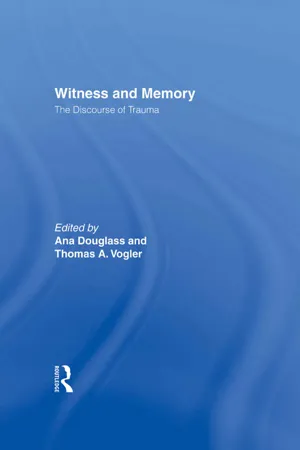
Witness and Memory
The Discourse of Trauma
- 288 pages
- English
- ePUB (mobile friendly)
- Available on iOS & Android
eBook - ePub
Witness and Memory
The Discourse of Trauma
About this book
Information
CHAPTER 1
The Menchú Effect: Strategic Lies and Approximate Truths in Texts of Witness
The consumption of testimonial literatures on American campuses, and the almost reverential treatment these texts have received, have recently come under intense scrutiny with the publication of an anthropological study of the single most celebrated text of witness of the last two decades, Me llamo Rigoberta Menchú y asi me nació la conciencia.1 Menchú’s account of her life as a political activist and spiritual leader altered the trajectory of history in Guatemala and beyond. On one level Menchú’s autobiographical narrative exists as a textual record of the horrors enacted against the indigenous population of Guatemala by its right-wing leadership and stands defiantly, both on a political as well as a generic level, as an artifact based exclusively on personal experience. In her testimonial, Menchú presents a personal account of the political and economic repression she, her family, and her village suffered while living and working within a fundamentally feudal land system in Guatemala during the 1970s. Menchú describes how her parents, brothers, friends, and neighbors were subjected to horrific acts of torture and humiliation, in many instances culminating in death, as a direct result of their efforts to undermine the social and economic structures supporting the system of land distribution in rural Guatemala. Within American universities, Menchú’s testimonial came to function as the definitive example of the value of testimonial literature, both as literary productions and as vehicles for informing an otherwise uninformed readership about human rights atrocities occurring around the world. A recent critique and, in places, direct refutation of Menchu’s text, David Stall’s Rigoberto. Menchú and the Story of All Poor Guatemalans raises fundamental questions, however, about the “truthfulness” of significant passages and events in Menchú’s Nobel Peace Prize generating narrative.2 Stoll’s claims that Menchú’s text contained numerous inaccuracies, if not conscious lies and acts of manipulation, unleashed a flurry of discussion in the popular press.3 His research, whether we are in complete agreement with it or not, forces a rereading not only of Menchú’s testimony—a product of the rhetorical stance of the witness—but also of the rhetorical constructs that underlie the primarily Western readers’ assumptions about the witness—the notion that the witness is necessarily innocent, truthful, and above conscious manipulation in the telling of his or her story.
Considered as a genre, testimonials are more vulnerable than other personal narratives to the many social, political, and historical pressures from which they are generated. Typically, these texts purport to be the utterances—represented with a minimum of external intervention—of the indigenous voice, a voice otherwise rarely recorded, and otherwise never heard. These narratives represent for many readers an almost transparent account of the life and communities of indigenous people, generally from Third World contexts, whose lives and cultural fabrics are coming unraveled under the pressures of encroaching Western values and persistent political, economic, and social oppression from within. A common subtext of texts of witness is the theme of cultural loss as they chronicle the acculturating impact of various economic, political, and religious forces affecting the indigenous communities’ previously “uncomplicated” lives. Read within this context, testimonial literatures stand as a kind of “pure” utterance and “authentic” transmission of experience in spite of theoretical trends of the last few decades that question the notion of “truth” within the unstable vehicle of language. These texts avoid the interpretive pressures of poststructuralism, not because they are somehow outside of contemporary models for understanding language and its relationship to concepts of “truth,” but because of a perceived political necessity of their very existence. “Testimonio,” John Beverley argues, “can never … create the illusion of that textual ‘in-itselfness’ that has been the basis of literary formalism, nor can it be adequately analyzed in these terms.” Read in this light, texts of witness occur as “an extraliterary or even antiliterary form of discourse” (Beverley 1996a: 37). Any attempt to consider Menchú’s persona as a rhetorical construct can be construed as a denial of the fact that human rights abuses occur in Guatemala. Such an act would be an abuse of practice in the name of theory, a cynical subordination of historical fact and political realities to the solipsistic pursuit of theory. To do so would be tantamount to dismissing Menchú’s authority to serve as a witness to an undeniably “real” series of human rights abuses.
Thus, critics have tended to employ “a hermeneutics of solidarity” to generate “sympathetic” readings of texts of witness that account only for the political context out of which the text is produced.4 In an effort to create this sense of solidarity with the politics of the witness, critics pay little, if any, attention to the rhetorical processes and aesthetic considerations influencing the production of texts of witness and often completely ignore the political climate affecting the readership’s consumption of these texts. Such critics have evacuated the interpretive process in favor of a facile affirmation of the absolute “truth value” of the witness’s account, ignoring many of the rules of textual analysis they would not hesitate to consider when reading a novel on the subject of human rights abuses from anywhere in the world.5 Equally telling, the politics of consumption—the social, political, and economic conditions shaping the perceptions of the Western reader—have received very little consideration. The resulting criticism is more interested in building a sense of solidarity with the witness than in looking critically at the politics of production and consumption of the text itself.
In light of recent revelations that Menchú’s text includes distortions and moments of false or inaccurate information, it seems that the time has come to revisit the forces that brought her testimonial to such prominence in the Western world and to reconsider notions of authorship and readership in her text and the relationship between the two. For my purposes, the politics that produce texts of witness and the politics that inform the way the readership consume texts of witness are inextricably intertwined. A second equally significant consideration, caught between the forces of production and consumption and implicated in both, is the issue of the primacy of the text itself, the need to hold in place the artifact with its rhetorical constructs and strategies, its capacity to stand in error and to stand in some proximity to truth. The issue of Menchú’s “truthfulness” interests me less than the difficulties her “lies” present to the hermeneutics of solidarity informing the critical line on her text. I would prefer to ask the questions: what do Menchú’s “lies” tell us about the nature of the readership of texts of witness, and how do “lies” function within the textual doubling “effect” that I see as a defining characteristic of the genre? Somewhere in between the politics of production and the politics of consumption of these texts, the witness establishes the witnessing “effect,” a concept that should be understood both in terms of the noun—an “effect”—and in terms of its rarer usage as a verb—“to effect” change. Testimonials as artifacts include both meanings of the term. Whether or not readers can agree upon the “truth value” of their content, texts of witness create in their very existence a supposition of “truth value,” an “effect” or, as Alberto Moreiras argues, an “aura” of truth that gestures at “absolute truth.” Herein lies the power and value of texts of witness, the doubling effect that I am calling the “Menchú effect.”
I. The Politics of Western Consumption: The “Rebirth of the Sacred” the Culture Wars, and the Defining of a New Genre6
In critical considerations of the politics informing the production and consumption of texts of witness, the other genres used for representing the events and transmitting the “truths” of a politically volatile situation are often forgotten—the less glamorous texts of governmental documents, the popular press, and human rights reports. Texts of witness take on a somewhat sacred role in discussions of international politics and human rights abuses. During the 1970s and 1980s, horrific human rights abuses occurred in countries throughout the world, but it was only with the widespread dissemination of texts of witness that Western readers began to consider the implications of the ongoing atrocities in a country like Guatemala. For a number of reasons, academics and their students preferred the single voice of the “eyewitness” over the governmental study, the human rights document, or the Western journalist’s account. This preference for first person accounts fed directly into the essentialist belief system inherent in the emerging identity politics of the 1980s. In accordance with this brand of identity politics, the privileged status of the testimony ultimately stems from a belief within the readership, either implicit or explicit, that the eyewitness account gleans a kind of authenticity from the speaker’s proximity to his or her culture and its traditions. The witness’s credibility resides at least in part in a shared identity with those who are being victimized and, in some cases, even with those who are perpetuating the victimization of the witness and the community. From this privileged position of shared core identity, the witness speaks with a kind of authority that begins from the premise that the accuracy of the account resides first and foremost in the unimpeachable authority of shared identity—an authenticity of speech that can only come from a deeper shared identification with the victims. It is in the linguistic encounter with the “authentic other” that the reader can come to understand events and issues of another culture that would otherwise escape comprehensibility.
Western critics have recently tried to account for the 1980s’ fascinated consumption of Third World literature, especially the vaguely defined genre of testimonial literature.7 Precipitating what might loosely be referred to as the “culture debates” of the 1980s, texts such as Miguel Barnet’s record of the life of Esteban Montejo, The Autobiography of a Runaway Slave, and I, Rigoberta Menchú: An Indian Woman in Guatemala, were embraced by the academic left as exemplary of a new “poetics of solidarity,” focal points of “resistance literature” which not only served as a powerful resource for addressing issues of class, race, and cultural difference in the classroom but also as an equally provocative tool for applying pressure to the hegemony of the literary canon and the hierarchy of genre implied within it (Gugelberger 1996b: 1). With the widespread inclusion of Third World testimonials in core curricula across the United States, a debate ensued in which the academic left saw in the testimonial literature of Third World peoples a source of potentially liberating leftist discourse and a means of creating greater understanding of and solidarity with these emerging liberation movements. The sides of the “culture debates” loosely fell along “those who saw in testimonio a salvation, almost the proof that the subaltern can speak, and those who saw in the first wave of reception a flawed affirmation giving way to an implicit restitution of precisely that discipline that the originators of the discourse considered as being challenged by the testimonio” (Gugelberger 1996b: 6, emphasis added). In practice, this debate achieved a potentially undesirable and unexpected end for Western scholars, with the coopting at the level of ideas and language of the Third World by the First World, in a “Latinamericanism” similar to the “Orientalism” identified by Edward Said.8
In the 1980s, Western audiences were presented with a proliferation of first person accounts of the economic and social abuses perpetrated against various marginal communities throughout much of the Third World. At the same time, universities within the United States were engaged in an active attempt to “diversify” the curriculum.9 The traditional Western culture course “appeared to many not only an anachronism but the exemplar of everything that needed to change in the new university” (Pratt 2001: 32). At many universities student- and faculty-led grassroots movements emerged, attempting to force curricular changes that would incorporate such texts into their Western traditions-based curricula. In his much discussed work, Illiberal Education, Dinesh D’Souza chronicles one of the most widely discussed and openly contested examples of this movement to incorporate testimonial texts into core curricula—the transformation by Stanford University faculty of their Western traditions core course to a “Culture, Ideas, and Values” course, a shift that marked a curricular move away from a traditional “great books” approach to one that reflected multicultural concerns. I, Rigoberta Menchú serves for D’Souza as “the text which best reveals the premises underlying the new Stanford curriculum” (71). Indeed, Pratt sees D’Souza’s text as “the book that definitively established I, Rigoberta Menchú as a political target” (2001: 35). Describing Menchú as “a consummate victim ,” a woman who “suffer [s] from multiple vectors of simultaneous oppression,” D’Souza challenges the decision to use her testimony to replace the “great works” of the Western traditional canon. “Rigoberta’s victim status,” he suggests, “may be unfortunate for her personal happiness, but is indispensable for her academic reputation” (72). D’Souza’s critique of Stanford’s move to replace Dante with Menchú lies with his discomfort with what he calls the “paradoxical provincialism” of the “multicultural project,” the paradoxical impulse, he argues, for women and students of color to want to study themselves rather than study such non-Western cultural phenomena as the influence of Japanese markets upon the world’s economies or the increasingly powerful presence of Islamic fundamentalism in Third World politics.
D’Souza’s critique of Menchú herself and his understanding of her text reveals his own conservative political agenda, which sees her and her text as pawns of leftist campus politics. In a particularly misleading statement, D’Souza argues that students see Menchú as “a modern Saint Sebastian, pierced by the arrows of North American white male cruelty… her life becom[ing] an explicit indictment of the historical role of the West and Western institutions” (72). He asks the complicated question: “Whom does she represent?” and offers the simple answer that she “embodies a projection of Marxist and feminist views onto South American Indian culture.”10 D’Souza’s criticism of Menchú as a political activist, however, ventures beyond simply disagreeing with what he perceives to be her Marxist and feminist beliefs. He even goes so far as to discount Menchú’s suffering as that of a person who “simply happened to be in the right place at the right time,” as if to find oneself in the midst of a genocidal moment in history could in any way be read in terms of being “in the right place” (72).
While it is relatively easy to dismiss D’Souza’s critique of Menchú herself and of the value of texts of witness in general, his critique of the academic left is a bit more difficult to discount given the widespread usurpation by First World academics of the text to serve their Marxist and feminist agendas. Again, the distinction is one between the text itself and the politics of consumption informing the reception of the text. D’Souza argues that Menchú’s testimony gets used by Marxist and feminist academics as “independent Third World corroboration of Western progressive ideologies,” her words serving as a mere “mouthpiece for a sophisticated left-wing critique of Western society,” a critique that is “all the more devastating because it issues not from a French scholar-activist but from a seemingly authentic Third World source” (72). It is here that D’Souza actually touches upon a legitimate critique. He sees in the 1980s move to affirm texts of witness evidence that the academy was simply creating another professional pathway for itself, another vehicle for replicating itself through the act of celebrating texts that it decided are worthy of celebration. D’Souza’s charge that the emergence of texts of witness during the 1980s is tied to a shift in the trends of scholarship in the humanities and social sciences and a need for those disciplines to reinvent themselves finds support when we consider the flurry of scholarship dedicated to defining the history and boundaries of the genre of testimonio within Latin American literature. Consideration of texts of witness “c[ame] to be an important academic activity in the context of Latin American literature … cultural studies departments,” anthropology, and other literary traditions at precisely the same time when “high literature [was experiencing] a loss of cultural capital” (Moreiras 196, 198). This trend goes to the heart of the politics of consumption of texts of witness. At the same time that D’Souza and other conservative cultural critics were launching public attacks on what they considered to be the academic left’s misplaced fascination and overvaluation of texts of witness, “the emergence of the ‘Third World’ genre of the testimonio on the (largely academic) markets of the First World” initiated a flurry of scholarship that quickly became a career path in the humanities (Gugelberger 1996b: 6). The first step in this movement to legitimize the scholarly pursuit of texts of witness was to define the boundaries of the genre and to chronicle its origins.
John Beverley gives the most often cited definition of the primary characteristics of the genre of testimonio.11 Building upon Raymond Williams’ argument, in “The Writer: Commitment and Alignment,” that the emergence of new genres can be understood in terms of the emergence of new historical consciousness, and the assumption that “the forms of working-class consciousness are bound to be different from the literary forms of another class,” Beverley suggests that the genre of testimonio performs a similar ideological task for representing the colonial and postcolonial consciousness of the modern era (Williams 1980: 25). Such an era, defined in part as it is by “the potential for transition from one mode of production to another” should expect “to experience the emergence of new forms of cultural and literary expression that embody, in more or less thematically explicit and formally articulated ways the social forces contending for power in the world today” (Beverley 1996a: 24). By “testimonio,” Beverley means, “a novel or novella-length narrative in book or pamphlet (that is, printed as opposed to acoustic) form, told in the first person by a narrator who is also the real protagonist or witness of the events he or she recounts, and whose unit of narration is usually a ‘life’ or a significant life experience” (1996a: 24). While he acknowledges the role of earlier “testimonio-lïke texts [that] have existed at the margin of literature,” he maintains that the full-blown emergence of the genre occurs in the aftermath of “two related developments: the 1970 decision of Cuba’s Casa de las Americas to begin awarding a prize in this category in its annual literary contest, and the reception in the late 1960s of Truman Capote’s In Cold Blood and Mi...
Table of contents
- Cover Page
- Title Page
- Copyright Page
- Dedication
- Contents
- Preface
- Acknowledgments
- Introduction
- 1. The Menchú Effect: Strategic Lies and Approximate Truths in Texts of Witness
- 2. Excessive Witnessing: The Ethical as Temptation
- 3. Witness in the Wilderness: The Tropical Tryst of Claude Lévi-Strauss and Theodore Roosevelt
- 4. An All White Jury: Judging Citizenship in the Simpson Criminal Trial
- 5. Poetry, Witness, Feminism
- 6. Poetic Witness: Writing the Real
- 7. The Burning Babe: Children, Film Narrative, and the Figures of Historical Witness
- 8. The Limits of Vision: Hiroshima Mon Amour and the Subversion of Representation
- 9. Ex/propriating Survivor Experience, or Auschwitz “after” Lyotard 249
- 10. Between History and Memory: The Voice of the Eyewitness
- Notes on Contributors
- Notes
- Works Cited
- Index
Trusted by 375,005 students
Access to over 1.5 million titles for a fair monthly price.
Study more efficiently using our study tools.
Frequently asked questions
Yes, you can cancel anytime from the Subscription tab in your account settings on the Perlego website. Your subscription will stay active until the end of your current billing period. Learn how to cancel your subscription
No, books cannot be downloaded as external files, such as PDFs, for use outside of Perlego. However, you can download books within the Perlego app for offline reading on mobile or tablet. Learn how to download books offline
Perlego offers two plans: Essential and Complete
- Essential is ideal for learners and professionals who enjoy exploring a wide range of subjects. Access the Essential Library with 800,000+ trusted titles and best-sellers across business, personal growth, and the humanities. Includes unlimited reading time and Standard Read Aloud voice.
- Complete: Perfect for advanced learners and researchers needing full, unrestricted access. Unlock 1.5M+ books across hundreds of subjects, including academic and specialized titles. The Complete Plan also includes advanced features like Premium Read Aloud and Research Assistant.
We are an online textbook subscription service, where you can get access to an entire online library for less than the price of a single book per month. With over 1.5 million books across 990+ topics, we’ve got you covered! Learn about our mission
Look out for the read-aloud symbol on your next book to see if you can listen to it. The read-aloud tool reads text aloud for you, highlighting the text as it is being read. You can pause it, speed it up and slow it down. Learn more about Read Aloud
Yes! You can use the Perlego app on both iOS and Android devices to read anytime, anywhere — even offline. Perfect for commutes or when you’re on the go.
Please note we cannot support devices running on iOS 13 and Android 7 or earlier. Learn more about using the app
Please note we cannot support devices running on iOS 13 and Android 7 or earlier. Learn more about using the app
Yes, you can access Witness and Memory by Ana Douglass, Thomas A. Vogler, Ana Douglass,Thomas A. Vogler in PDF and/or ePUB format, as well as other popular books in Social Sciences & Historical Literary Criticism. We have over 1.5 million books available in our catalogue for you to explore.