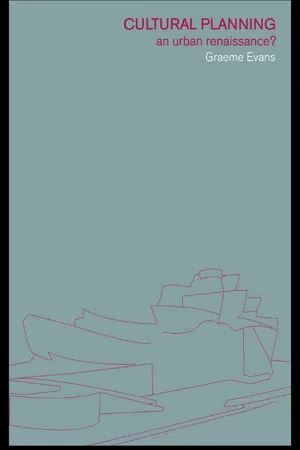
Using an historic and contemporary analysis, Cultural Planning examines how and why the cultures have been planned and the extent to which cultural amenities have been considered in town planning. From its ancient roots in the cities of classical Athenian, Roman and Byzantium empires, to the European Renaissance, public culture shows both an historic continuity and contemporary response to economic and social change. Whilst the arts are considered an extension of welfare provision and human rights, the creative industries and cultural tourism are also vital for economic growth and employment in the post-industrial age. However, the new 'Grand Projects', which look to the arts as an element of urban regeneration, tend to be at the cost of both local cultural amenities and a culturally diverse society.
Cultural Planning is the first book on the planning of the arts and culture and the interaction between the state arts policy, the cultural economy and town and city planning. It uses case studies and examples from Europe, North America and Asia.
The book calls for the adoption of consultative planning policy, distributive models and a more integrated approach to both culture and urban design, to prevent the reinforcement of existing geographical and cultural divides.
- 352 pages
- English
- ePUB (mobile friendly)
- Available on iOS & Android
eBook - ePub
About this book
Information
1 Introduction
Those who toiled knew nothing of the dreams of those who planned.
(Metropolis, Fritz Lang)
The places where collective and public cultural activity occurs have an important and lasting influence—aesthetic, social, economic and symbolic—on the form and function of towns and cities. At their most integrated, the arts have played a central role in the life of different societies and in models of urban design, from various classical, renaissance, industrial and post-industrial eras the world over. Where this coincided with affluence, technological and social change, the cultural economy of cities has also supported arts and crafts production, innovation and a thriving cultural industry, which has in turn created powerful comparative advantage and helped create and reinforce a sense of identity.
Land-use and culture are fundamental natural and human phenomena, but the combined notion and practice of culture and planning conjure up a tension between not only tradition, resistance and change; heritage and contemporary cultural expression, but also the ideals of cultural rights, equity and amenity. Where public culture and ‘civilisation’ are celebrated and where state, ethnic or municipal pride require signification, public monuments, squares, cultural buildings and events have been used and promoted, whether motivated by ceremonial, propagandist or place-making objectives. These manifestations also symbolise, often over a long period, a place, a town, city, even a whole society or nation-state. How and why culture is planned is therefore a reflection of the place of the arts and culture in society, of the approaches to the design and planning for human settlements in the town planning tradition and therefore in the development of urban society:
Place and culture are persistently intertwined with one another, for any given place…is always a locus of dense human interrelationships (out of which culture in part grows), and culture is a phenomenon that tends to have intensely local characteristics thereby helping to differentiate places from one another.
(Scott 2000:30)
Whilst the ‘cities of culture’ have in the past been associated with the centres of empires, city-states, trading and industrial towns and cities, the urban renaissance which incorporates culture as a consumption, production and image strategy is evident now in towns and city-regions in developed, lesser developed, emerging and reconstructing states; in historic towns and new towns; and in cities seeking to sustain their future in the so-called post-industrial age (or more accurately the new industrial era). The symbolic and political economies of culture have arguably never been so interlinked. This is perhaps not surprising in the context of globalisation, where late capitalism sees symbolic goods as niche markets and the arts and culture are big business—for local, domestic markets and for international and tourism trade. Planning for culture in this sense adopts industrial and economic resource planning and distribution, whilst the physical aspects of public culture—facilities, amenities, the public realm: a cultural infrastructure—directly contribute to urban design and the relationships between landuse, access and transport, i.e. the town planning process. Although the cultural flagships and the designated and self-styled cultural cities and industries receive most attention from both historical and contemporary perspectives, the creation, planning and support of cultural amenities for primarily local communities, and for artists themselves (e.g. education, training, small-scale production, studios), has a much wider application and tradition. This is most apparent in the twentieth century where notions of cultural equity ‘rights’ and growing urbanisation and cosmopolitanism looked to aspects of the arts and culture as social welfare provision. This was also evident not only in the most prescriptive socialist society models (People’s Palaces), but also in the past where popular entertainment and common (and uncommon) culture took place in gatherings and meeting places, festivals and fairs, and pleasure gardens, as well as in buildings for arts and entertainment. It is these local art centres, maisons de la culture, casas de cultura, whether shared village halls, community centres, workers and association clubs, or municipal and commercial cultural facilities from the museum, theatre, civic and dance hall to the cinema and local festival, that planning for culture also encompasses. A critique of cultural planning as this book seeks to present therefore needs to consider both high-art as well as local and popular culture, in different places and in different times. An international perspective also provides a comparative basis by which culture in society and the design of urban settlements has impacted and been treated in different countries and under different regimes. How far replication, models and convergence is evident in the current and earlier examples of cosmopolitan and globalised states and empires, and how far social and planning policy has influenced this, are therefore recurrent questions considered throughout this book.
It could of course be argued that a book on planning for the arts at a time of increasing globalisation of cultural consumption and production, and the converse but not unrelated rise of individualism and new millennialism, is anachronistic. The technology-driven expansion of home-based entertainment and leisure activity; moves towards the twenty-four-hour city and night-time economy; the associated social atomisation of work, home and play; and fragmentation of traditionally collective forms of cultural participation might therefore render an investigation of planning for the arts somewhat redundant, or at least of historic rather than contemporary concern. Despite, and perhaps because of, the globalisation of media and cultural products, images and social expression, the late twentieth century has paradoxically seen a renaissance in the development of new and improved venues for cultural activity—from arts and media centres, theatres, museums and galleries, and centres for edutainment; public gatherings, raves and festivals, Pavarotti in the Park; to public art works, urban design and public realm schemes—as well as the promotion of cultural industries zones and workspaces to attract and support the new media and cultural economy in towns and cities world wide. This is seen in cities seeking to transform their image and appeal and thereby qualify as cultural capitals for the first time, such as ‘Guggenheim Bilbao’, to established industrial cities also undergoing re-imaging through upgraded and new cultural facilities, from Glasgow, Barcelona and Frankfurt to Baltimore, Montreal and New Jersey to name a few, with massive fin de siècle cultural and museum quarter developments in Berlin and Vienna and in Beijing and Singapore. As Zukin maintains: ‘Rightly or wrongly, cultural strategies have become keys to cities’ survival…how these cultural strategies are defined and how social critics, observers, and participants see them, requires explicit discussion’ (1995:271). This is not only a Western phenomenon-although its foundations may have ancient roots from the cities of the classical Athenian, Roman and Byzantine empires, to the European Renaissance—since it has been replicated and adapted in developing and emerging nation-states, from Croatia to Southern Africa. As one indication of this, the World Bank, whose mission is to provide loans to developing countries and in areas of post-conflict/reconstruction, recently initiated a Culture and Sustainable Development programme with a focus not only on conservation and heritage (e.g. sites and patrimony), but also on ‘Culture and Cities’ (1998). The cultural dimension to development—a form and function of land-use and economic planning—is therefore seen as an important component of economic and social policy, rather than an aspect of society which is peripheral or at least subsidiary to the political economy and public sphere (McGuigan 1996).
Indeed, the development and funding of cultural Grands Projets by national, regional and city governments, as this book will present, both emulates and parallels the urban renaissance witnessed in Europe between the fifteenth and seventeenth centuries, and subsequent public works and rational recreation policies advocated by the Georgians and later the Victorians in Britain and elsewhere. Rationales for state involvement and promotion of cultural facilities show both an historic continuity and contemporary response to economic and social change. This is not least reflected in the breaking down of traditional planning assumptions and imperatives that have in the past separated the functions of employment, leisure and housing in the dualistic industrial city, with a clear spatial divide between these social spheres (Weber 1964, Doxiadis 1968). As Charles Jencks comments on the failure of modern town planning: ‘masterplans were drawn up with the city parts neatly split up into functional categories marked working living, recreation, circulation’, but as he goes on: ‘inevitably these mechanistic models did not work; their separation of functions was too coarse and their geometry too crude to aid the fine-grained growth and decline of urban tissue. The pulsations of a living city could not be captured by the machine model’ (1996:26). Physical proximity does not however overcome social and cultural exclusion, while at the same time ambiguous transitional zones blur the edges and offer more porous boundaries that allow people to move and restructure the urban area in accordance with socio-economic change, as the postindustrialnotion of the urban village and ‘a complex pattern of interlinked districts takes shape’ (Seregeldin 1999:52). Cultural planning, as well as an aspect albeit an exceptional one, of amenity planning, has therefore played a role and one that is increasingly being adopted in the post-industrial era in meeting economic and physical regeneration as well as ‘place-making’ objectives (Ashworth and Voogd 1990, Ward 1998), and as an approach to urban design and the more integrated planning of towns and cities.
Planners, ‘urban strategists’ (Landry 2000) and writers on cities, urbanism and globalisation have of course contributed to an air of determinism and fragmentation, not quite in the manner of John Ruskin and the later Arts & Crafts movements and their planning inheritors, the Garden City and Utopian movements, but with a feeling of the failure of urbanisation and the deleterious effects of post-Fordist economic change. This is seen in the de-urbanisation and suburban sprawl evoked by Noel Garreau’s Edge City (also Evans 1998d); Dejan Sudjic’s 100 Mile City (1993) and the technopolis, core and periphery divides analysed in Castells’ Information Age (1989, 1996), as well as by masterplanners such as Peter Hall (1988) and others. At the same time, urban sociologists and analysts in the USA, such as Anthony King, Saskia Sassen and Sharon Zukin have linked the symbolic economy: ‘the trade in signs, images and symbols…’ (King 1990), with the post-industrial city, in terms of land-use, landscape and development, and in terms of the cultural economy itself (Scott 2000). What distinguishes the late capitalism phase and post-industrial eras from the earlier colonial and commodity trade-based globalisation periods is the extent to which society has become cosmopolitan, not that cultural consumption has just become homogenised and cultural facilities serially replicated. Some argue that the earlier period of intense globalisation that occurred in the late nineteenth/early twentieth century brought about national alliances and power structures and a consequent nationalism of ‘wilful nostalgia’, requiring homogenised and integrated so-called common cultures and the elimination of ethnic and regional identities (Robertson 1990, also Adorno and Horkheimer 1943, Adorno 1991). The heyday of the Hollywood film and movie-going was witnessed between the 1930s and 1950s, despite the resurgence of cinema attendance today, accelerated by the development of the multiplex (if not of film production and choice), whilst the culture industry which Adorno and Horkheimer (1943) railed against in Nazi Germany has exhibited important gains in cultural democracy and cultural development—the ability of people to mediate, adapt and make their own cultural forms and to access associated technology (e.g. audiovisual, desk-top publishing, photography, digital arts and multimedia) is one measure of this; the process of cultural hybridity and fusion is another. As Stuart Hall (1990) and others (Cooke 1990, King 1991) maintain, this is increasingly the norm and assumptions beneath cultural planning necessarily need to take this new reality into account. Culture, to borrow Homi Bubha’s phrase (1994), has many locations: ‘a dialogue in which there are many parts…we are forced to speak of the cultures of cities rather than of either a unified culture of the whole city or a diversity of exotic sub-cultures’ (Zukin 1995:290). As Willis therefore optimistically put it: ‘We need to think of ourselves as only at the beginning of civilisation’s historical clock. The best of what is thought, spoken, written, composed and made, must be yet to come, and come it must from our living culture and not from a backwards looking, self-propagating “art”’ (1991:8–9).
Book focus and scope
The primary focus of this book is the role and relationship between cultural policy and provision and town and city planning, taking key exemplars and approaches, and presenting planning regimes and case-studies from various countries and cities—from the classical, pre-industrial periods, to the industrial and post-industrial eras. On the one hand cultural planning is considered in terms of the amenity aspects of arts and cultural facilities, or culture as an aspect of ‘social welfare’ and spatial approaches to such provision; and on the other, cultural planning is placed within the wider context of urban planning, regeneration and local-global relationships. The adoption of arts and urban regeneration policies and urban economic strategies from the late 1970s in Europe, the Americas and spreading to Asia presents a particular version of the urban renaissance with a hardening core-periphery and social divide in cultural activity and amenity, and an archetypal manifestation of the twin movements of globalisation and cosmopolitanism. Issues and practice of urban cultural rights, identity and the city as a shifting site for cultural production and consumption emerge from this late twentieth-century attempt to reclaim and redefine the city.
The related but distinct sub-discipline of cultural geography has also developed an approach and body of knowledge on the spatial and symbolic variations among cultural groups and the semiotics of landscape, taking Tuan’s definition of culture as ‘the local, customary way of doing things; geographers write about ways of life’ (1976:276). It is fair to say, however, that geographers and their urban cousins, town and city planners, have not tended to consider the arts, creative activity or cultural development—one example of this is the lack of a definition of ‘amenity’ in town planning legislation and practice, other than through a negative, anti-urban sentiment, and the absence of planning standards for arts facilities in contrast to the more benign areas of parks, play and recreation, and conservation and heritage, alongside housing, industry and other local amenities. Until recent times, planning has, not surprisingly therefore, avoided a deeper appreciation of the needs of arts practice and participation, or resisted engagement with ‘culture’ altogether, unlike other areas of social policy and urban development. This book therefore attempts to introduce and analyse some of the ways in which culture and planning have and may be integrated against these anti-planning (‘Non-Plan’) tendencies.
Arts/planning defined
In a book on planning for the arts and the position of arts and cultural facilities in amenity planning, the ubiquitous term ‘planning’ itself requires further delineation. Some core definitions of planning in these related but discrete contexts may therefore be useful at this stage. Like the term ‘culture’, the generic ‘planning’ is widely used and associated with a range of functions and disciplines, from human geography—the disciplinary root of modern town planning; urban design, as in the planning of settlements, e.g. masterplan; planned economy and modern political economics— ‘Marshall plan’, five-year plan; related social policy and public administration to business management (corporate and strategic planning) and organisation theory. Planning is the application of scientific method—dictionaries define town planning successively or cumulatively as a science and an art—however crude, to policy-making and is closely associated with ‘public policy and choice’ theory (Dunleavy 1991). Planning is also defined as ‘a process for determining appropriate future action through a sequence of choices’ (Davidoff and Reiner 1973:11) and therefore in the case of amenity planning—as Tietz argues in his seminal work on facility location: ‘public determined facilities [have a] role…in shaping the physical form of cities and quality of life within them’ (1968:35). The definitions below, whilst discrete, are also used in combination with each other and in practice can overlap: ‘In all probability, the difficulty of achieving a closer definition of this concept is attributable to its polymorphous character: yet all would agree that in the final analysis, its purpose is to organise the city for the greater happiness of its inhabitants’ (Cohen and Fortier 1988:12). All definitions of planning therefore infer some consideration of the future and the achievement of given goals or end states, whether physical and environmental, social or economic: arguably all manifestations and impacts of culture. The terms ‘strategy’ and ‘strategic plan’ are also now widely applied, a reflection perhaps of the business and scientific management approaches exported from the USA from the 1960s and drawing on technological and military terminology—e.g. cultural strategies (Zukin 1995) and urban strategists (formerly ‘planners’; Landry 2000). A specific adaptation in town planning, including the cultural sphere, is the concept of infrastructure—first coined by the French railways and then in military installation and public utility provision. These terms found favour and usage from the 1980s in arts administration and government policy and practice (e.g. Arts Council 1984, 1993a), as a natural terminology for both the new managerialism and rationalised public services (Pick 1988, 1991, Evans 2000b, Adorno 1991), and in local, regional and city arts plans and strategies—all confirming a planning approach to resource allocation and decision-making for the future.
- Town Planning—in Britain, Town & Country Planning legislated comprehensively in town and country planning Acts in Britain from 1947 and in the USA City Planning and at the micro-level, zoning. It incorporates amenity planning—recreation, conservation, as well as economic development. Primarily a function of population, land-use and the control of development (zoning, land-use classes) and latterly heritage/are...
Table of contents
- Cover Page
- Title Page
- Copyright Page
- Plates
- Figures
- Tables
- Preface
- Acknowledgements
- 1 Introduction
- 2 The historical evolution of city arts and cultural planning
- 3 Urban culture and the early industrial city
- 4 Amenity planning and the arts centre
- 5 Planning for the arts
- 6 The cultural economy
- 7 European common culture and planning for regional development
- 8 Cities of culture and urban regeneration
- 9 Planning for the arts
- Appendix I
- Appendix II
- Bibliography
Trusted by 375,005 students
Access to over 1.5 million titles for a fair monthly price.
Study more efficiently using our study tools.
Frequently asked questions
Yes, you can cancel anytime from the Subscription tab in your account settings on the Perlego website. Your subscription will stay active until the end of your current billing period. Learn how to cancel your subscription
No, books cannot be downloaded as external files, such as PDFs, for use outside of Perlego. However, you can download books within the Perlego app for offline reading on mobile or tablet. Learn how to download books offline
Perlego offers two plans: Essential and Complete
- Essential is ideal for learners and professionals who enjoy exploring a wide range of subjects. Access the Essential Library with 800,000+ trusted titles and best-sellers across business, personal growth, and the humanities. Includes unlimited reading time and Standard Read Aloud voice.
- Complete: Perfect for advanced learners and researchers needing full, unrestricted access. Unlock 1.5M+ books across hundreds of subjects, including academic and specialized titles. The Complete Plan also includes advanced features like Premium Read Aloud and Research Assistant.
We are an online textbook subscription service, where you can get access to an entire online library for less than the price of a single book per month. With over 1.5 million books across 990+ topics, we’ve got you covered! Learn about our mission
Look out for the read-aloud symbol on your next book to see if you can listen to it. The read-aloud tool reads text aloud for you, highlighting the text as it is being read. You can pause it, speed it up and slow it down. Learn more about Read Aloud
Yes! You can use the Perlego app on both iOS and Android devices to read anytime, anywhere — even offline. Perfect for commutes or when you’re on the go.
Please note we cannot support devices running on iOS 13 and Android 7 or earlier. Learn more about using the app
Please note we cannot support devices running on iOS 13 and Android 7 or earlier. Learn more about using the app
Yes, you can access Cultural Planning by Graeme Evans in PDF and/or ePUB format, as well as other popular books in Architecture & Urban Planning & Landscaping. We have over 1.5 million books available in our catalogue for you to explore.