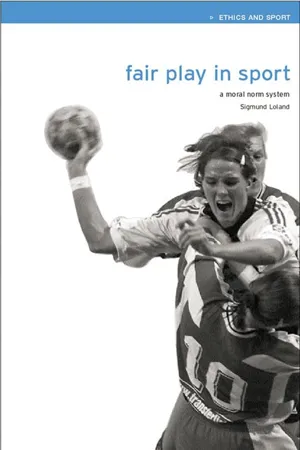
Fair Play in Sport presents a critical re-working of the classic ideal of fair play and explores its practical consequences for competitive sport. By linking general moral principles and practical cases, the book develops a contemporary theory of fair play.
The book examines many of the key issues in the ethics of sport, including:
* fairness and justice in sport
* moral and immoral interpretation of 'athletic performance'
* what makes a 'good competition'
* the key values of competitive sport.
The notion of fair play is integral to sport as we know and experience it, and is commonly seen as a necessary ethos if competitive sport is to survive and flourish. Fair Play in Sport provides an invaluable guide to the subject for all those with an interest in ethics and the philosophy of sport.
- 192 pages
- English
- ePUB (mobile friendly)
- Available on iOS & Android
eBook - ePub
About this book
Information
Chapter 1
Sport competitions
Rules, goals and social logic
Rules, goals and social logic
To be able to suggest a normative understanding of sport competitions as potentially meaningful and valuable human practices, we need a clearer grasp of what kind of practices we are talking about, and what traditionally have been their moral ideals. A focused normative analysis requires some conceptual groundwork.
SPORT AND SPORT COMPETITIONS
What do we mean when we talk of ‘sport’ and of ‘sport competitions’? McPherson et al.'s (1989:15) idea of sport as ‘a structured, goal-oriented, competitive, contest-based, ludic physical activity’ is quite representative of definitional efforts and captures common understanding and use of the term.1 This definition includes a variety of activities. We talk of ‘children’s and youth sport’, of ‘recreational sport’ such as leisure ball games in the local park, of ‘amateur sport’ such as college athletics, and of ‘professional sport’ and ‘commercial entertainment sport’ such as English Premier League football and the basketball played in the American National Basketball Association (NBA).
Moreover, activities we refer to as ‘sport’ develop, change, and sometimes vanish in relation to the social and cultural contexts of which they are parts. As Morgan (1994:213) says, sport is ‘…a social rather than a natural kind’. The term ‘commercial entertainment sport’ would scarcely have had any meaning to the founding members of the International Olympic Committee (IOC) in 1894. The rise of women's sport in the latter half of the twentieth century was probably unthinkable to most sport leaders between the two world wars. Snowboarding and beach volleyball are new sporting activities that have developed over the last couple of decades.
Therefore, in such a socio-cultural setting, quests for ‘objective’, ahistorical definitions make little sense. My pursuit of clarification here is more modest. I propose an interpretation of fair play in what are traditionally seen as the core of sport practice, the competitions. In what follows, the term ‘sport’ refers to sport competitions unless otherwise indicated. Moreover, I shall discuss sport competitions as they are understood and practised today. To begin, here is a brief overview of what I consider to be their key characteristics.
Sport as a rule-governed practice
Sport competitions are rule-governed practices. The predominant view of the function of rules is that they structure and in fact define a practice, or at least that they define the framework within which the practice takes place. Searle (1969:33) takes up the well-known Kantian distinction between constitutive and regulative rules and talks of ‘constitutive rules’ that ‘…constitute (and also regulate) an activity the existence of which is logically dependent on the rules’:
The rules of football or chess, for example, do not merely regulate playing football or chess, but as it were they create the very possibility of playing such games. The activities of playing football or chess are constituted by acting in accordance with (at least a large subset of) the appropriate rules.(Searle 1969:33–34)
Regulative rules, on the other hand, regulate pre-existing activities that exist logically independently of the rules. Examples of regulative rules might be norms for proper conduct in social interaction, such as norms for how to engage in conversation, how to eat, or how to dress.
Constitutive rules stipulate a goal and the means, through prescriptions and proscriptions, by which this goal can be attained. In sport, the stipulated goal is usually given in terms of definitions of specific states of affairs to be attained, such as getting a particular kind of ball over a line drawn between two poles on a grass field, hitting another kind of ball over a net with a racket and making it bounce within certain lines drawn on a smooth surface, or jumping from a platform ten metres high into a pool while performing certain movements.2 In addition, constitutive rules have as an integral part of them a description of the means by which these specific states of affairs can be reached, and how to rank competitors within this framework according to how they perform. Constitutive rules define what it means to win a sport competition. In football, winning means scoring goals by getting the ball over what is called the goal line more often than the opposing team without using the arm below the shoulder and without being in so-called off-side positions. Tennis players try to score more points, games and sets as defined by the rules of tennis than their competitors, and thus win the match. Divers jump from a ten-metre high platform while performing somersaults and twists in the best way possible according to certain well-defined criteria, so as to be awarded more points than their competitors. We can now see that constitutive definitions of winning demarcate one sport from another. In what follows, we shall talk of definitions of winning as sport-specific goals.
The constitutive rules of a sport define how to win but not how to compete successfully. Suits (1973) introduces a third category of rules, rules of skill. These are technical and tactical rules about how to perform well. In tennis we are told to keep our eye on the ball, and freestyle swimmers emphasize the importance of a ‘high elbow’. But rules of skills are not constitutive rules. Sport can be realized in practice without actually adhering to them. A particular game of football can be a poor game but it is still football. We shall examine rules of skill in more detail in the discussion of athletic performance in Chapter 3. At this stage, the important point is that the constitutive rules of a sport by defining its sport-specific goal, provide a conceptual framework within which the sport can take place. In short, we can say that the constitutive rules stipulate what counts as play in a particular sport (Reddiford 1985).
Regulative rules, on the other hand, place constraints, restraints, and conditions upon activities that are logically independent of the process of competing. Usually, regulative rules are of secondary importance in the realization of a sport. Many of them serve to facilitate the realization in practice of the constitutive rules. Rules that define the appearance, size, and weight of the golf ball, or identify the profile of a ski jumping hill, are of this kind. A golf ball that is too heavy or too light would change the technical demands of golf and probably lead to changes in playing styles and equipment. If the profile of a ski jumping hill is different from what is stated in the rules, jumping could easily become more difficult and possibly more dangerous. In addition, Meier (1985) talks of ‘auxiliary rules’ that deal with matters that are outside the competitive situation, such as rules for eligibility (linked to age, sex, or performance), safety rules, or more or less arbitrary regulations linked to social, political, or commercial interests external to sport. Sometimes auxiliary rules override constitutive rules. Apel (1988:230) uses an example from boxing to describe how a general moral principle for safety and non-harm from ordinary life [Lebenswelt] may be supervenient to the rules of the game-world [Spielwelt]: the attending medical doctor may consider a boxer's injuries so serious that the fight is called off.
The distinction between constitutive and regulative rules serves for analytic purposes but it is not absolute. Regulative rules can be seen as extensions of the constitutive ones—they depend upon constitutive rules. Regulative rules necessarily presuppose a practice to regulate. Moreover, the various kinds of rule overlap. Do the rules that define the size of basketball courts or stipulate a maximum number of five players on the court at any one time, belong to the constitutive or the regulative rules of basketball? Is a two-against-two pick-up game in the local park still basketball?
In the present context, a clear answer here is not really important. My aim is to establish moral norms for competitions in which persons mutually agree upon, and compete according to, what are considered the constitutive rules. The norms at which I arrive should be relevant to both highly formalized elite basketball games and for the pick-up game in the local park. What is of interest now is that sport competitions are made possible by what are deemed as their constitutive rules, and that regulative rules are, among other things, designed to facilitate the realization in practice of the constitutive rules.
The social logic of sport
According to, Suits (1973), Meier (1988), and Morgan (1987, 1994:211ff.) among others, the understanding of goals and means in sport sketched above implies there is a particular social logic in these practices. ‘Winning’ in a sport is logically dependent upon using only the means defined in its constitutive rules. Morgan (1987) talks of the inseparability of goals and means. We cannot win unless we compete in accord with the constitutive rules. Moreover, according to Suits (1973), when we reflect on the nature of such rules we see that they seem always to prescribe the use of less efficient means towards the state of affairs that counts as winning rather than more efficient means. Instead of walking up to the net and smashing the ball straight down and out of reach of the opponent, a tennis player is given only two serving attempts from the base line. Instead of grabbing the ball and running with it, players in European handball are restricted to carrying the ball a maximum of three steps then bouncing or passing it. Instead of going straight down the slope, slalom racers are required to cross with both skis the imaginary line between the two poles of every gate of the slalom course. More precisely, a sport can be understood as a kind of game with a particular social logic that entails inseparability of means and goals and a voluntary attempt to overcome what Morgan (1994) calls ‘gratuitous difficulties’. This logic, the argument goes, serves to demarcate sport and games from non-games.
A more detailed example can illustrate how the logic works. Traffic control is a rule-governed practice. The goal of traffic control can be said to be the efficient transport of people and things from A to B with least risk of injuries and material damage. In short, the goal of traffic control is efficient and safe transportation. Typical traffic rules point to what are considered the most efficient means to reach this goal. Realizing this goal does not require that the rules are always adhered to. Though some people run red lights in the middle of the night in towns devoid of people, or a bicyclist may ride on the wrong side of the road where there are no cars around, they still manage to move from A to B in a safe manner. The rules of traffic control are regulative rules and have only instrumental value in reaching a goal that is independent of the rules.
Imagine I compete with a friend to discover who is the faster cyclist by having a race from the restaurant in which we have had lunch back to the university, without breaking traffic rules. We agree that taking short cuts on the wrong side of the road and racing through an intersection on a red light, even if there are no cars around are not allowed. Now the social logic of the practice changes. Or rather, we now engage in a different practice. We are no longer engaged primarily in efficient and safe transportation but rather in an attempt to see who, according to a shared set of rules, is the fastest and smartest cyclist. The normal traffic rules take on the characteristics of constitutive rules upon which we have specifically agreed for our purposes. We cannot reach the goal of our practice without keeping to them. Our cycling amounts to something like a competitive game in which motor skills are of significance to the outcome—what we can call a sport competition.
The idea of sport's particular social logic must not be taken as an empirical claim about the actual understanding of sport among parties concerned. Some subscribe to the logic of the game and compete for fun or as a challenge. Others are engaged for instrumental reasons such as profit and prestige. The assumption is that, however various the goals of the participants may be, sport has built into its structure of rules the possibility for a non-instrumental, ‘gratuitous’ logic of overcoming ‘unnecessary’ obstacles to reach specific goals. A further assumption is that it is precisely by grasping this possibility that sport becomes joyful, challenging, interesting, and exciting—which, in Morgan's (1994:211) words, is ‘…after all, the main point of sporting endeavors’.
The assumption that sport has a particular social logic seems to have strong standing both among philosophers who deal with these topics and the general public. However, it is not unproblematic. I shall weigh alternative interpretations of sport against one another below (Chapter 4). For now I shall proceed by looking more closely at some critical comments on the understanding of rules suggested above.
The formalist position
In D'Agostino's (1981) view, the idea that a set of constitutive rules defines a sport and that the means described in the rules and the goal of winning are inseparable, represents a formalist understanding of social practices. A game or a sport can be defined only by reference to its constitutive rules, and sport competitions, the formalist would claim, are realized only if the constitutive rules are adhered to completely in all aspects.
D’Agostino is critical of this position. An immediate objection is that it seems counter-intuitive and against common-sense understanding. If we take the position seriously, a formalist would have to say that we do no longer play a game G ‘if a rule of G is violated during an alleged instance of G’ (D’Agostino 1981:9). But, as D’Agostino demonstrates with an example from basketball, rule violations seem to be an unavoidable part of most sport competitions. An actual instance of the game of basketball without intentional body contact (which in fact is proscribed by the rules) would seem meaningless to most players. A similar example can be taken from European handball. The way the game is currently played includes regular rough body checking of attackers by defenders that leads to so-called nine-metre throws. Although a nine-metre throw is in principle a penalty, it is considered an acceptable part of current handball technique and tactics. Handball as it is played today is inconceivable without it.
According to D'Agostino, the formalist's mistake is to overlook the important real life-distinction between acceptable and non-acceptable rule violations. Moreover, the formalist perspective makes it impossible to distinguish between competitions of various degrees of fairness, and unfair competitions (Loland 1998). Indeed, in real life we talk of a fair result of a game of basketball or handball even if rule violations occurred, as long as they do not seem to have been decisive for the outcome.
The core problem for the formalist is that rules are always of a certain generality, and their implementation must therefore be based upon interpretations. As Wittgenstein (1953:§201–202) points out, a rule cannot determine its own application. Formalists end up here in a constant quest for new rules for the interpretation of older ones, a process becomes an infinite regress. Rule interpretation is a logical necessity. But, no system of rules can define completely the full variety of possible actions within the practice it constitutes. No competition, or no piece action in a particular competition, is ever identical with other competitions and actions. Empirical surveys, among others by Heinilä3 and Nilsson (1993), show that the interpretation of the rules of football varies with level of performance, age and the socio-cultural context in which the game is played. For instance professionals, to a greater degree than young and amateur players, accept rule violations that serve efficiency and team interests. Indeed, Nilsson (1993) found significantly different understandings of rules among football clubs in the same geographical area and at the same level of performance, findings he explains by reference to local culture and club traditions.
Few if any people interested in sport, hold to the hard-core formalist position. The position is just unreasonable. Still, a statement and critique of formalism is helpful as a step towards a clearer understanding of sport competitions as a social practice. The inadequacies of the formalist position indicate that sport is best understood with reference to the social and cultural context in which it takes place.
The ethos of sport
A contextualist approach is based on the insight that no rule or rule system speaks for itself, and that human interaction in rule-governed practices must build on shared norms for interpretation of such rules among the parties concerned. According to Newcombe et al. (1966:221ff.), norms are shared if they satisfy two requirements.
First, there must be a certain amount of common knowledge among the parties concerned about how the basic rules are to be understood. To play tennis, both players must agree upon interpretations of what it means to serve, to score a point, and to win games, sets, and finally the match. To play football, all players must agree upon what it means to score goals and that it is forbidden to handle the ball. Such knowledge provides a necessary condition for sport competitions to be realized at all.
Second, competitors must mutually recognize their common knowledge of basic rules and act upon it. This calls for communication between them. Each competitor has to demonstrate in words and actions observable to others his or her acceptance of certain norms for rule interpretations. Then all competitors can recognize that each competitor has...
Table of contents
- Cover
- Half Title
- Full Title
- Copyright
- Dedication
- Contents
- Series editor's preface
- Preface
- Introduction: the fair play argument
- 1 Sport competitions: rules, goals, and social logic
- 2 A moral point of view
- 3 Right sport competitions: fairness
- 4 Good sport competitions: play
- 5 Fair play in sport competitions: a moral norm system
- Notes
- Bibliography
- Index
Trusted by 375,005 students
Access to over 1.5 million titles for a fair monthly price.
Study more efficiently using our study tools.
Frequently asked questions
Yes, you can cancel anytime from the Subscription tab in your account settings on the Perlego website. Your subscription will stay active until the end of your current billing period. Learn how to cancel your subscription
No, books cannot be downloaded as external files, such as PDFs, for use outside of Perlego. However, you can download books within the Perlego app for offline reading on mobile or tablet. Learn how to download books offline
Perlego offers two plans: Essential and Complete
- Essential is ideal for learners and professionals who enjoy exploring a wide range of subjects. Access the Essential Library with 800,000+ trusted titles and best-sellers across business, personal growth, and the humanities. Includes unlimited reading time and Standard Read Aloud voice.
- Complete: Perfect for advanced learners and researchers needing full, unrestricted access. Unlock 1.5M+ books across hundreds of subjects, including academic and specialized titles. The Complete Plan also includes advanced features like Premium Read Aloud and Research Assistant.
We are an online textbook subscription service, where you can get access to an entire online library for less than the price of a single book per month. With over 1.5 million books across 990+ topics, we’ve got you covered! Learn about our mission
Look out for the read-aloud symbol on your next book to see if you can listen to it. The read-aloud tool reads text aloud for you, highlighting the text as it is being read. You can pause it, speed it up and slow it down. Learn more about Read Aloud
Yes! You can use the Perlego app on both iOS and Android devices to read anytime, anywhere — even offline. Perfect for commutes or when you’re on the go.
Please note we cannot support devices running on iOS 13 and Android 7 or earlier. Learn more about using the app
Please note we cannot support devices running on iOS 13 and Android 7 or earlier. Learn more about using the app
Yes, you can access Fair Play in Sport by Sigmund Loland in PDF and/or ePUB format, as well as other popular books in Philosophy & Ethics & Moral Philosophy. We have over 1.5 million books available in our catalogue for you to explore.