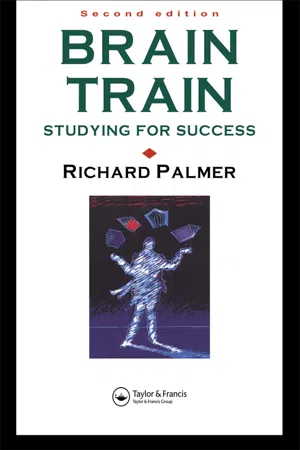
- 352 pages
- English
- ePUB (mobile friendly)
- Available on iOS & Android
eBook - ePub
About this book
A new edition of a highly successful study skills books. The style and approach is particularly suited to current student needs as the author stresses the importance of adopting a positive response to study. The lively and enthusiastic tone, and the practical advice on everything from planning revision to designing CVs gives this book enormous appeal to all, from A-level to mature students.
Trusted by 375,005 students
Access to over 1 million titles for a fair monthly price.
Study more efficiently using our study tools.
Information
Topic
EducationSubtopic
Education GeneralPART ONE
APPROACHES AND ATTITUDES—HOW TO GET THE BEST OUT OF YOUR MIND
TESTING…TESTING
1
I like work; it fascinates me. I can sit down and look at it for hours.
Jerome K.Jerome
What would you say the following had in common?
- Getting up in the morning
- Writing an essay
- Cleaning the car
- Reading War and Peace
- Re-decorating a room
- Mowing the lawn
- Having to practise the piano
- Sending off thank-you letters
- Preparing a meal
- Chatting up someone you fancy
You might answer that, with the possible exception of (10), they are all unpleasant or a drag but will have to be tackled sooner or later. Another possible answer, though, is that they are all difficult to start doing, but that once you have started, they’re not so bad—even pleasant. Initially, however, there must be a degree of motivation present for you to be willing to start the task.
Since this is a book about study, and since study, like all things, requires such initial motivation, it is appropriate to suggest that this might be paraphrased as your ‘interest’ or ‘enjoyment’. Indeed, the emphasis throughout the book is on enjoyment. Few people succeed at anything while finding it dull; and most really successful people— whatever their job—derive an enormous amount of good old-fashioned fun from what they do. So just about the worst thing you can do when starting a new course is to dwell miserably on what hard work it’s going to be. If you expect a course to be difficult, obscure or boring, the chances are it will be. From the start, therefore, cultivate a sense of enjoyment; believe in the pleasures and satisfactions that await you.
It is of course idle to pretend that any course of study does not involve work—hard work. But the key to that phrase lies in the adjective ‘hard’. If you think it means ‘laborious’, or its cousin ‘tedious’, you’re going to lose a lot of will power immediately. If, however, you can latch on to the alternative meaning, of ‘muscular’ or ‘concentrated’, you will be setting up a tough and clear-sighted attitude which will sponsor enjoyment. All success requires care and industry: if you’ve picked up this book hoping for some smart alec way to by-pass necessary toil, you might as well put it down again right away. On the other hand, effort is not ultimately enough on its own: pleasure and enjoyment are vital ingredients too.*
I am assuming from the start that you are past the age of intellectual consent. For my purpose that is the same as the law prescribes in more physical matters: sixteen. Up to that age, in the United Kingdom at least, school is compulsory, and you may not have any choice about how you study and what. After sixteen, it is up to you. You can stay on to do A-Levels, go beyond those to a degree or diploma course, or take up a course after years away from study. Since it is just stupid to go on doing something you really dislike, I further assume that you are more or less pleased to be doing the course you’ve chosen. If you’re not, this book can I hope still help you. But some kind of motivation is necessary, even if it’s only the pleasure of looking forward to when you stop!
To help you work out your own attitude in more detail, here are four caricatures of ‘student types’. They are meant to amuse; but I can assure you that any teacher (and most students) will have encountered them all at some time.
THE WOULD-BE STUDENT
Would-Be Students like the idea of studying rather than the fact. Like the person who fantasizes about being a concert pianist, but never practises, WBSes enjoy the prospect of success, plan the way they will use it, but find it extraordinarily irksome to get down to any work. They expect the teacher to do most of the work for them. Of course, they would be hurt, even angry, if it were put to them in this way. But it sums up their fundamental reliance on being served a regular diet of pre-digested information and opinion.
In schools this process is called ‘spoon-feeding’ and is regarded as a necessary evil. Authentic WBSes go further: they expect the teacher to pre-chew the stuff for them. Or, put another way: the WBS is a sponge. S/ he finds remarkable any suggestion that it is necessary to think rather than merely absorb.
WBSes are also hostile to exams, condemning them as unfair and evil. They constantly search for tricks with which to outsmart the system. By the time the exam is imminent, they have bought their own bodyweight in those dismal ‘Study Aids’ which now infest the market.* Saddest of all, the WBS expends formidable energy finding excuses not to work. These are often brilliantly ingenious: one marvels at them, but also wonders what might have been achieved if their inventor had devoted the energy to doing the work.
THE EARNEST STUDENT
The Earnest Student is all mouth and notebooks. ESes cannot for the life of them find anything in the classroom or at their desk remotely amusing: ESes want to work, not take part in some comedy show, and anything as trivial as a joke wastes their time. ES doesn’t approve of a light-hearted approach from the teacher; to ES, Teacher is God Almighty—until His fallibility is exposed. He then becomes a liability, if not a menace.
ESes are fascist, in the strict sense of that word: they expect Authority to be right, and right in a watertight fashion. ESes don’t like discussion or argument: these are either time-wasting or a fatal sign of ignorance and uncertainty. ES demands that everything be Relevant: all things not of direct and immediate benefit to one’s current studies are mere chaff. In addition, ES is also a towering snob, especially if engaged on an Arts course. Shakespeare is a Good Thing; stylish light fiction won’t do at all. Beethoven Rules OK; the Rolling Stones are repellently noisy ageing yobs, and as for Jazz…BBC-TV is properly serious; ITV and Sky are cheap and nasty. And if a passage has ‘George Eliot’ printed beneath it, it will be very fine; should the name ‘Dick Francis’ appear instead, it will be escapist rubbish. Naturally, no scrutiny of the text itself will be required.


ESes may be able, or they may not. They may be vocal and aggressive, or they may sit in Olympian silence. Whatever their personality and talent, however, ESes are absolutely clear about one thing, thank you very much: Study Is a Serious Business. There is no time for humour, digression, scepticism, tolerance of the non-serious, tolerance of most kinds, in fact. ESes expect to end up knowing all the answers: they are not remotely interested in the questions.
THE LUCKY STUDENT
At school, Lucky Students are often known as ‘swots’. They find it hard to understand why they attract envy and ridicule. They simply like working. LSes read voraciously and enjoy lessons, even when they are apparently boring. Eventually the hostility ceases, even if the jealousy remains, for LSes are cheerful and at one with themselves and their work, so that they disarm criticism.
LSes do not always triumph. It is unlikely that such natural workers will do badly very often, but they have their difficulties and failures like everyone else. Nor are LSes necessarily ‘gifted’ or bright: they will however become brighter through their commitment to work, for quantity changes quality. Their ‘luck’ is the luck of anyone fortunate enough to find an activity they love.
And if you are an LS, you don’t need this book or any other kind of artificial aid: you’ve got quite enough advantages already!
THE ADMIRABLE STUDENT
Admirable Students are not paragons. They get fed up and bored with study sometimes, and have periods of total lethargy. But this is entirely normal, and they know that and refuse to worry about it. Essentially, however, AS wants to learn, and is prepared to work at doing so. In no way should s/he be confused with the Earnest Student, who no matter how diligent expects merely to be taught. ASes are unsolemn and open: they study because they like their subject.
ASes accept that what they are asked to read and listen to is worth taking seriously, but they are not unquestioningly reverent. If something jars on them, they will say so. ASes prefer to be delighted and impressed, but their minds are not closed to the much under-rated pleasures of destructive criticism. ASes are humorous, and find laughter and even the occasional silliness an important ingredient of their enjoyment of study.
Most important of all, ASes are humble. (This is not to be confused with modest.) They are neither afraid to be wrong nor determined to be serious all the time: they know that the brain must have its periods of rest and moments of sheer laziness. ASes do not worship their study at a shrine, but live with it as an intimate pleasure. At best, they retain that quality of wonder that characterizes the child: they love their subject, and particularly relish the sense of their own progress and understanding. ASes at their most impressive closely resemble Benjamin Franklin’s ideal of ‘the wise innocent’.
Well, which type are you? In fact, most students contrive to be all four types at different times: I know that I have. The obvious point to make is that the Would-Be Student and the Earnest Student are invariably unsuccessful students, while the Lucky and Admirable Students usually prevail with some distinction. And the single biggest difference between the two pairs is the ingredient I have termed ‘fun’. WBSes, underneath whatever surface liveliness they may show, find work boring and unsatisfying, while ESes are so solemnly determined to improve themselves that they forfeit all possibility of actual pleasure from the beginning. LSes and ASes, on the other hand, enjoy what they do. Underpinning all their industry, concentration, frustrations and disappointments, they believe that study, like life itself, is in the last analysis a pleasure.
The four ‘portraits’ above were written in 1983. I believe they stand up well, otherwise I’d have altered or omitted them. However, this chapter would not now be complete without a look at three further types of student. These are not so much caricatures as thumbnail sketches designed to be illuminating and helpful; I would stress again the central importance of pleasure, and of the principle outlined in my Preface to the Second edition—you are in charge.

THE RETURNING STUDENT
Nowadays more and more people return to study after an absence of many years—out of necessity, vocational impetus, or sheer desire and interest. The original godsend for such students was the Open University, whose foundation Harold Wilson considered the greatest achievement of his 1964–70 Labour Government. Over a quarter of a century on, the OU’s pioneering example has been followed by the majority of tertiary institutions; there is a thriving nationwide ‘University of the Third Age’ for retired people; more and more graduates are returning to study part-time for further degrees; and so on. This proliferation seems to me cause for unambiguous celebration; nevertheless, although such familiarity does not breed contempt, it may encourage the idea that a return to study is an easier and more comfortable matter than it used to be. Not so:
The Returning Student may be a far commoner ‘type’ than was the case a generation ago, but that does not mean the step is any less momentous or nerve-wracking.
The Returning Student: a momentous step
If my experience as a teacher for the OU and elsewhere is anything to go by, the RS is almost invariably humble—sometimes excessively so. To begin any new course has its daunting side, whoever one is; to do so after many years away from such a world seems forbidding indeed. Returning Students feel ‘rusty’, naturally enough; that can all too easily lead them to feel that they are out of touch, technically deficient, ignorant, or all three. Presumably those are not their sole or even chief feelings, or they’d have abandoned the whole thing already. But it’s a most unusual RS who does not harbour at least a residual sense of such doubts and fears.
If you are a Returning Student, you almost certainly possess three major strengths, which you should bear centrally in mind:
- You’re doing your course because—above all else—you want to. There is no substitute for such ‘hunger’, and just like literal hunger, satisfying it brings immediate satisfaction and pleasure.
- However diffident you feel returning to the world of books and essays, you know a great deal— through having left home and learning to cope with independence, the work you do and the jobs you’ve had, your experience as a parent and/or partner, and simply by virtue of having lived longer...
Table of contents
- COVER PAGE
- TITLE PAGE
- COPYRIGHT PAGE
- OTHER TITLES FROM E & FN SPON
- DEDICATION
- PREFACE TO REVISED EDITION
- ACKNOWLEDGEMENTS
- PART ONE: APPROACHES AND ATTITUDES—HOW TO GET THE BEST OUT OF YOUR MIND
- PART TWO: SKILLS AND TECHNIQUES
- PART THREE: EXAMINATIONS
- PART FOUR: STUDY SKILLS AND EMPLOYMENT
- APPENDIX A: SOME NOTES ON STYLE
- APPENDIX B: READING NOVELS AND CREATIVE LITERATURE
- APPENDIX C: SOME SIMPLE RELAXATION AND FITNESS EXERCISES
- APPENDIX D: ANSWERS TO PRECIS EXERCISES
- BIBLIOGRAPHY
- AUTHORS, SOURCES AND NAMED REFERENCES
Frequently asked questions
Yes, you can cancel anytime from the Subscription tab in your account settings on the Perlego website. Your subscription will stay active until the end of your current billing period. Learn how to cancel your subscription
No, books cannot be downloaded as external files, such as PDFs, for use outside of Perlego. However, you can download books within the Perlego app for offline reading on mobile or tablet. Learn how to download books offline
Perlego offers two plans: Essential and Complete
- Essential is ideal for learners and professionals who enjoy exploring a wide range of subjects. Access the Essential Library with 800,000+ trusted titles and best-sellers across business, personal growth, and the humanities. Includes unlimited reading time and Standard Read Aloud voice.
- Complete: Perfect for advanced learners and researchers needing full, unrestricted access. Unlock 1.4M+ books across hundreds of subjects, including academic and specialized titles. The Complete Plan also includes advanced features like Premium Read Aloud and Research Assistant.
We are an online textbook subscription service, where you can get access to an entire online library for less than the price of a single book per month. With over 1 million books across 990+ topics, we’ve got you covered! Learn about our mission
Look out for the read-aloud symbol on your next book to see if you can listen to it. The read-aloud tool reads text aloud for you, highlighting the text as it is being read. You can pause it, speed it up and slow it down. Learn more about Read Aloud
Yes! You can use the Perlego app on both iOS and Android devices to read anytime, anywhere — even offline. Perfect for commutes or when you’re on the go.
Please note we cannot support devices running on iOS 13 and Android 7 or earlier. Learn more about using the app
Please note we cannot support devices running on iOS 13 and Android 7 or earlier. Learn more about using the app
Yes, you can access Brain Train by Dr Richard Palmer,Richard Palmer in PDF and/or ePUB format, as well as other popular books in Education & Education General. We have over one million books available in our catalogue for you to explore.